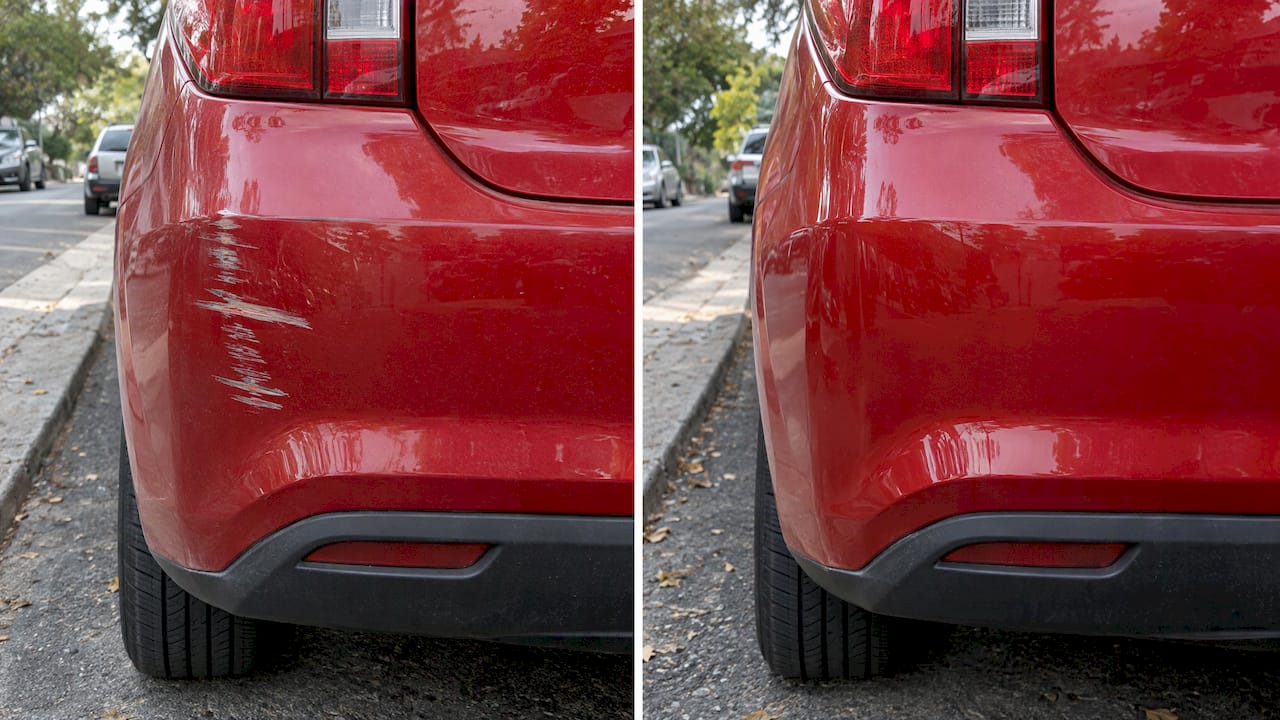
A scratched bumper needs one of three fixes, and the depth of the scratch decides which. A light mark in the clear coat can be polished. A scratch that reaches color, primer or bare plastic needs sanding, color-matched paint and clear coat. A crack or tear needs a structural repair first. If your bumper falls in the second or third group, our mobile team can repair it at your home or office, so you don’t have to leave the car at a shop for days.
TL;DR
- Run a fingernail across the scratch. If it doesn’t catch, it is likely a surface mark. If it catches, polishing alone will not remove it.
- Seeing white, primer or bare plastic in the scratch means paint is gone and the area has to be refinished, not buffed.
- Home remedies like WD-40 only hide shallow scratches for a short time.
- Bumpers flex, so the repair has to flex with them. A rigid filler that looks fine on day one can pop off later.
- We repair plastic bumpers onsite in Contra Costa County and nearby areas. Get a free quote and we’ll tell you what your bumper needs.
Table of Contents
- Step one: find out how deep the scratch is
- When a light scratch is worth polishing
- What a deep bumper scratch really needs
- Repair or replace?
- What bumper scratch repair costs
- Our view on bumper scratches
- Get your bumper looked at where you park it
- FAQ
- Sources
Step one: find out how deep the scratch is
Most bumper covers are flexible plastic with a layered paint finish: primer, a color coat and a clear coat on top. Every scratch stops somewhere in those layers, and where it stops tells you what repair it needs.
The fingernail test. Wash and dry the area. Drag a fingernail across the scratch, perpendicular to it. If you can’t feel it, the damage is probably in the clear coat only. If your nail catches, the scratch has gone deeper.
The color test. Look at what shows inside the scratch:
| What you see | What it usually means | What it needs |
|---|---|---|
| Faint white or hazy line, body color still visible | Clear coat damage only | Polishing, if your nail doesn’t catch |
| Lighter or different color line | Through the clear coat into the color coat | Sanding, touch-up and clear coat |
| Gray, black or primer-colored line | Through the paint to primer | Refinishing the area |
| Bare plastic, gouge or rough edge | Through all paint layers, possibly into the plastic | Plastic repair, then refinishing |
| Crack, split or torn edge | Structural damage | Repair of the plastic itself, then paint |
Scuffs from parking lot bumps are often paint transfer from another car or a wall. Those can look worse than they are, and a good wash and polish sometimes clears them. Real scratches, where the surface is cut, do not wash off.
When a light scratch is worth polishing
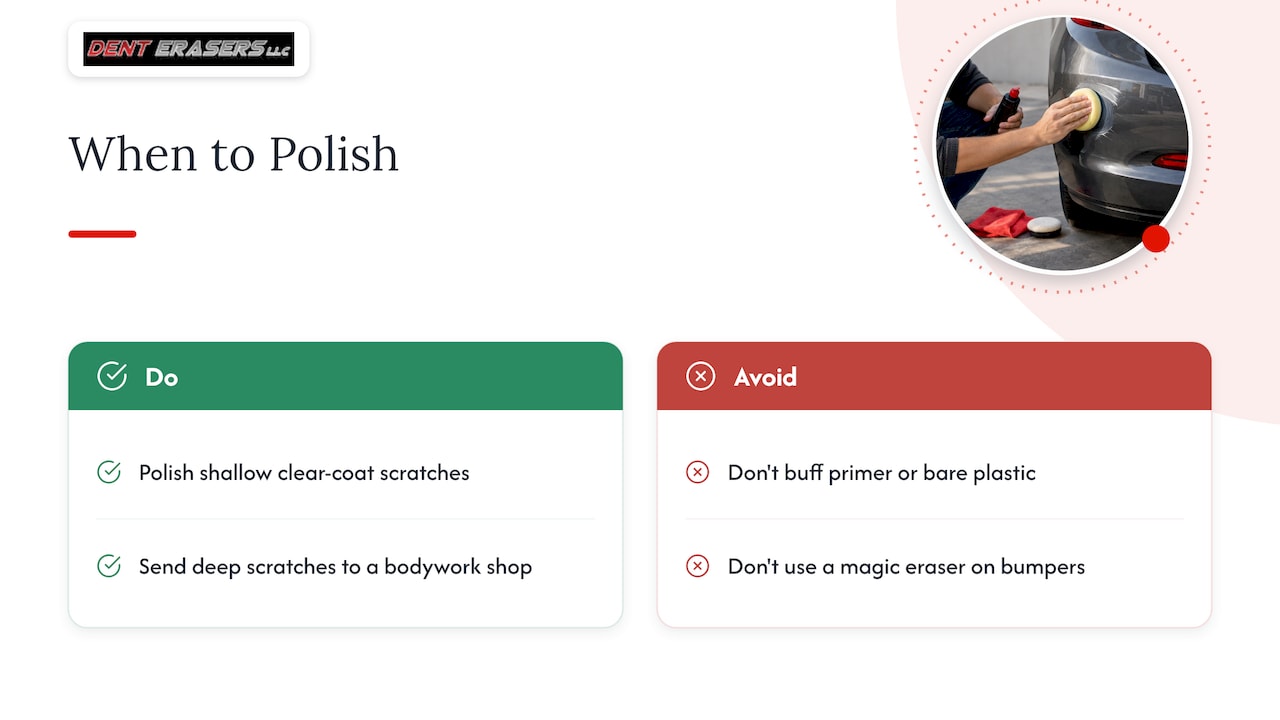
If the fingernail test passes, the damage is shallow. Polishing levels the clear coat around the mark so the scratch blends in. It cannot put missing paint back. So once the scratch shows primer, bare plastic or a different color layer, more buffing only removes more of your finish without fixing anything.
For very light swirl marks and haze from washing, a guide on how to remove swirl marks from your car’s paint explains the surface-level correction. It is also worth knowing that automatic car washes and paint scratches are linked, since fine marks often come from brushes and dirty cloths rather than from impacts.
What about the products people reach for first? Testing by consumer magazine Which? in 2026 found that WD-40 only temporarily hides shallow scratches: it took four applications to make a difference, and the effect washed away at the first car wash. The same testing found that scratch removers only work on shallow clear coat scratches, and that deep scratches should go to a bodywork shop. A magic eraser is a mild abrasive, so on a bumper it can dull the finish and still leave the scratch.
What a deep bumper scratch really needs
Once paint is gone, the repair is a sequence. Each step depends on the one before it, and the finish is only as good as the weakest step:
- Clean and prep. The area is washed and degreased so nothing is sealed under the new paint.
- Level the damage. The scratch or gouge is sanded and, if needed, filled with a material made for flexible plastic.
- Prime. Bare plastic needs a primer that bonds to plastic, or paint will peel at the edges.
- Color. Paint matched to your vehicle’s color code is applied in thin coats and blended into the surrounding paint.
- Clear coat. The final layer restores gloss and protects the color.
- Cure and finish. The paint is left to cure before it is handled, then polished to match the panels around it.
Where do repairs go wrong? Usually in three places. Rigid body filler is used on a flexing bumper and cracks or lifts after a few months. The color is off, which shows most on metallic and pearl paints, and the patch looks like a patch. Or the edges are not blended, so you see a rectangle where the repair ends. Plastic bumper covers are designed to flex on minor impact, which is why the repair materials have to flex too.
Bumper cover damage also comes in two types. Scratches, bubbling and minor surface cracking are one-sided repairs, handled from the front. Cracks and tears that go through the plastic are two-sided repairs that need a different procedure, according to 3M’s collision repair resources. That is why a scratch that looks small but has a split at the bottom edge is worth having looked at before it spreads.
Repair or replace?
Most scratched bumpers do not need replacing. A scratch, scuff or shallow gouge is a refinishing job on the cover you already have. Replacement comes up when the cover is badly cracked, torn, or has broken mounting tabs.
If your vehicle has parking sensors, cameras or radar behind the bumper, mention that when you ask for a quote. Damage near those parts needs a closer look than a surface scratch, and a repair that keeps your original cover in place avoids disturbing them where possible. Our auto body and collision repair team can assess that with you.
What bumper scratch repair costs
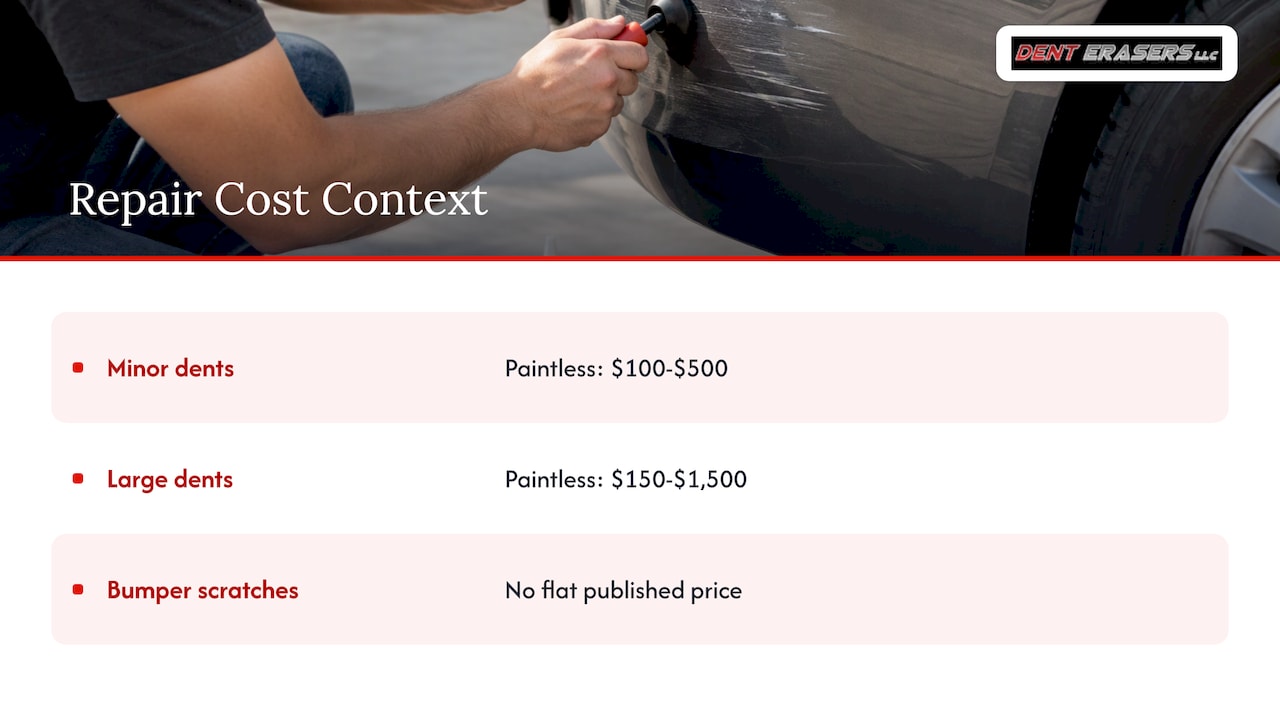
Price depends on the depth of the damage, the size of the area, your paint color and whether the plastic itself is damaged. A small scuff and a long gouge across a corner are very different jobs, and a three-stage pearl finish takes more work than a solid white. Our plastic bumper repair has no flat published price for that reason: we quote the job after seeing the damage.
For context, our published ranges for paintless repair of regular dents are $100 to $500 for minor dents and $150 to $1,500 for large dents. Those are for dents, not scratches, but they show how repair cost scales with the size and difficulty of the damage. If you want a breakdown of what moves a bumper quote, our bumper scuff repair cost guide goes through the factors.
Sending photos of the scratch from two angles, plus your car’s year, make and color, is the quickest way to get an accurate number.
Our view on bumper scratches
Most people who call us about a bumper scratch have already tried something: a polish, a touch-up pen, a home remedy. Often it made the scratch less visible for a week and then it came back, because the damage was deeper than the product could reach.
Our advice is to start with the depth. If the scratch is only in the clear coat, a careful polish is the answer. If it is through the paint, repair it properly once. That means the right plastic-safe materials, a color match to your vehicle, and blending so the repair disappears into the panel.
With 27+ years of experience, we have seen how a bumper repair holds up over time, and the difference is nearly always in the prep. We do the work onsite, so a busy workday, a lease return date or an insurance estimate does not have to turn into days without your car. And because we also work on luxury, classic and specialty vehicles, we treat a daily driver’s bumper with the same care for factory finish.
Brian Blanc
Get your bumper looked at where you park it
We are a mobile repair company serving Contra Costa County and nearby areas. We repair scratched and scuffed plastic bumpers at your location, along with dents, collision damage and specialty work. Our mobile dent repair service means we come to your home, office or lot.
If you are returning a leased car, our lease return repair service covers scratches and dents that could show up on an inspection. If an accident caused the damage, we also offer insurance claim dent repair assistance. Fleet managers can see our fleet repair page.
Ready for a price? Request your free quote and send us photos of the scratch.
FAQ
Can you fix a scraped bumper?
Yes. A scraped plastic bumper can usually be repaired without replacing the cover. Shallow scrapes can be polished, and deeper ones are sanded, primed, painted and clear coated. Cracks and tears need the plastic repaired first.
Does WD-40 or a magic eraser remove bumper scratches?
Not in any lasting way. In 2026 testing, WD-40 only hid shallow scratches temporarily and washed away with the first wash. A magic eraser is abrasive and can dull the finish. If the scratch is deeper than the clear coat, it needs a proper refinish.
How do I know if a scratch can be polished out?
Use the fingernail test. If your nail does not catch and you see only a light mark, it is probably in the clear coat and may polish out. If your nail catches, or you see primer, a different color or bare plastic, polishing will not be enough.
Will repairing a scratch match my paint?
A good repair uses paint matched to your vehicle’s color code and blended into the surrounding area. Metallic and pearl colors are the hardest to match, which is why the blending step matters. Send us photos with your quote request and we will go over it with you.
Sources
- Which?: Does WD-40 remove car scratches, and nine other things we learned testing car scratch removers
- 3M: Collision bumper repair and plastic tab resources
- How to remove swirl marks from your car’s paint
- Do automatic car washes scratch your paint?