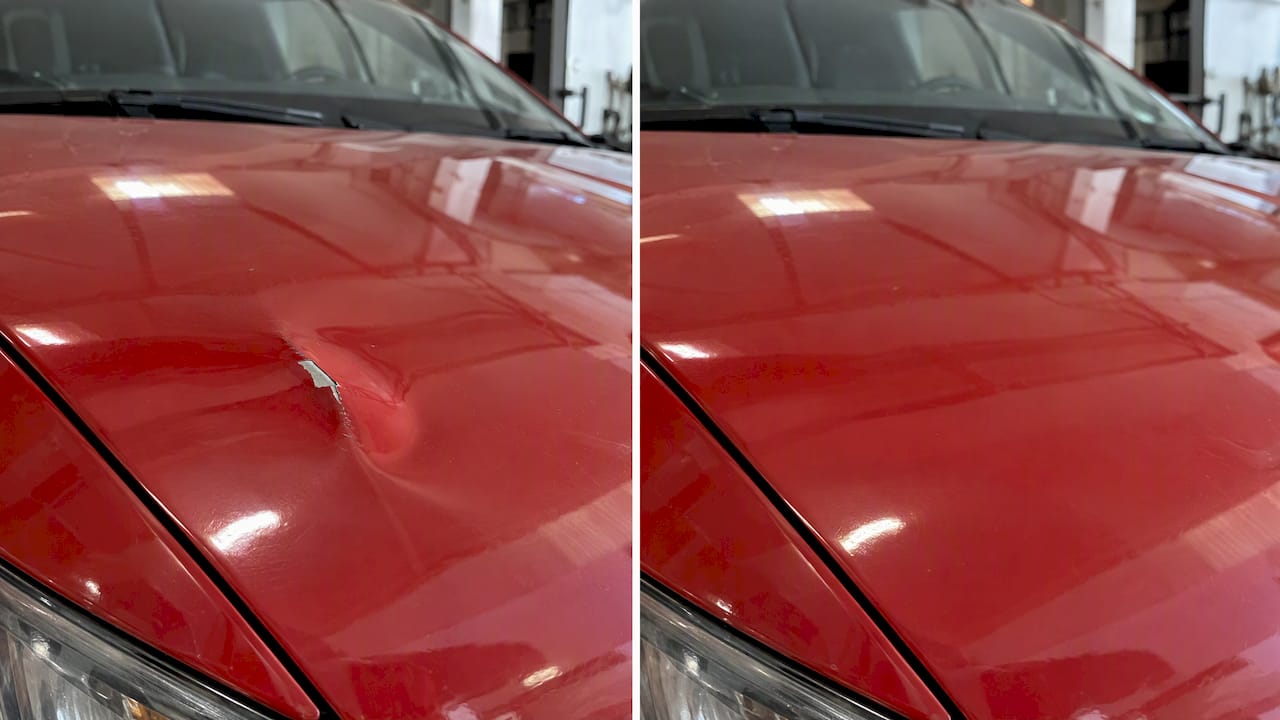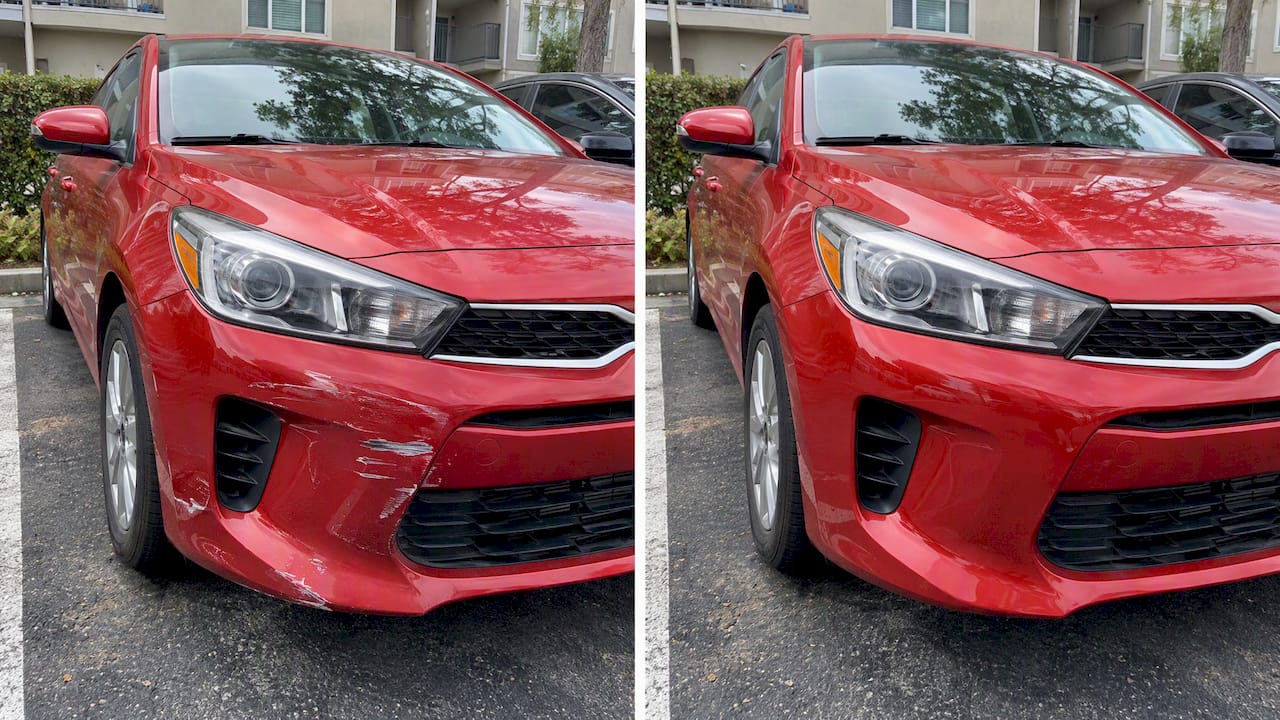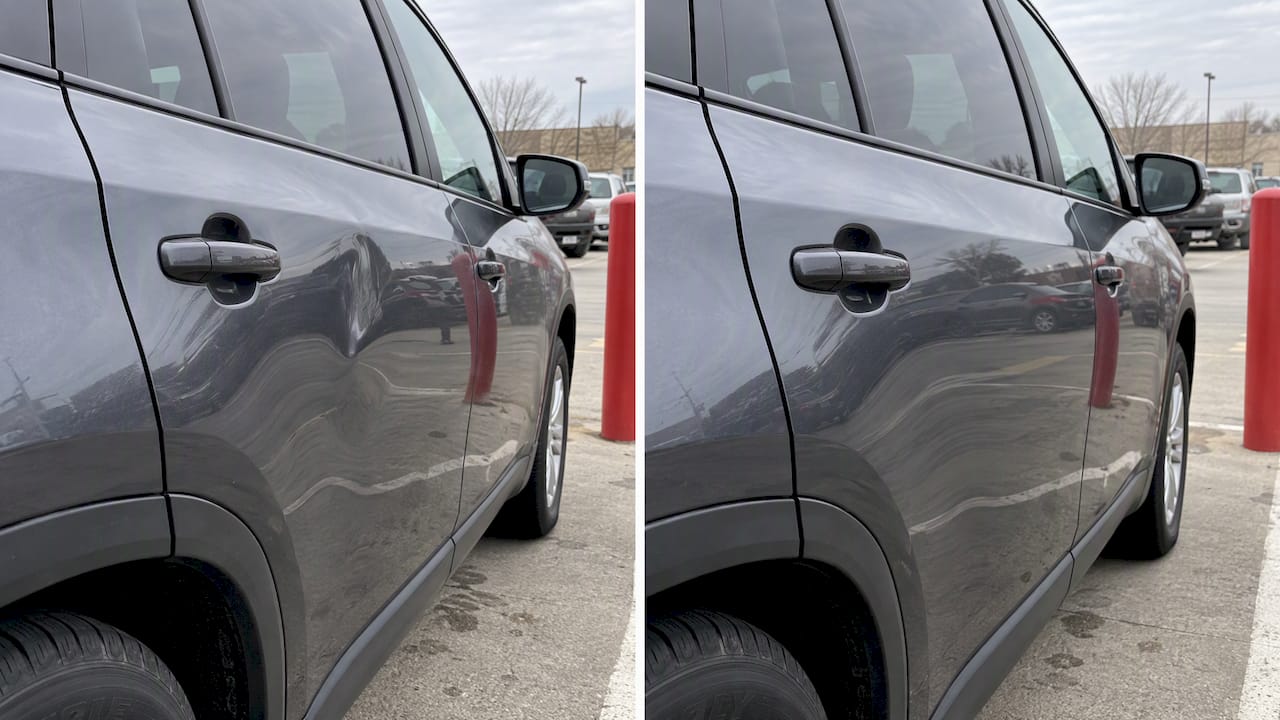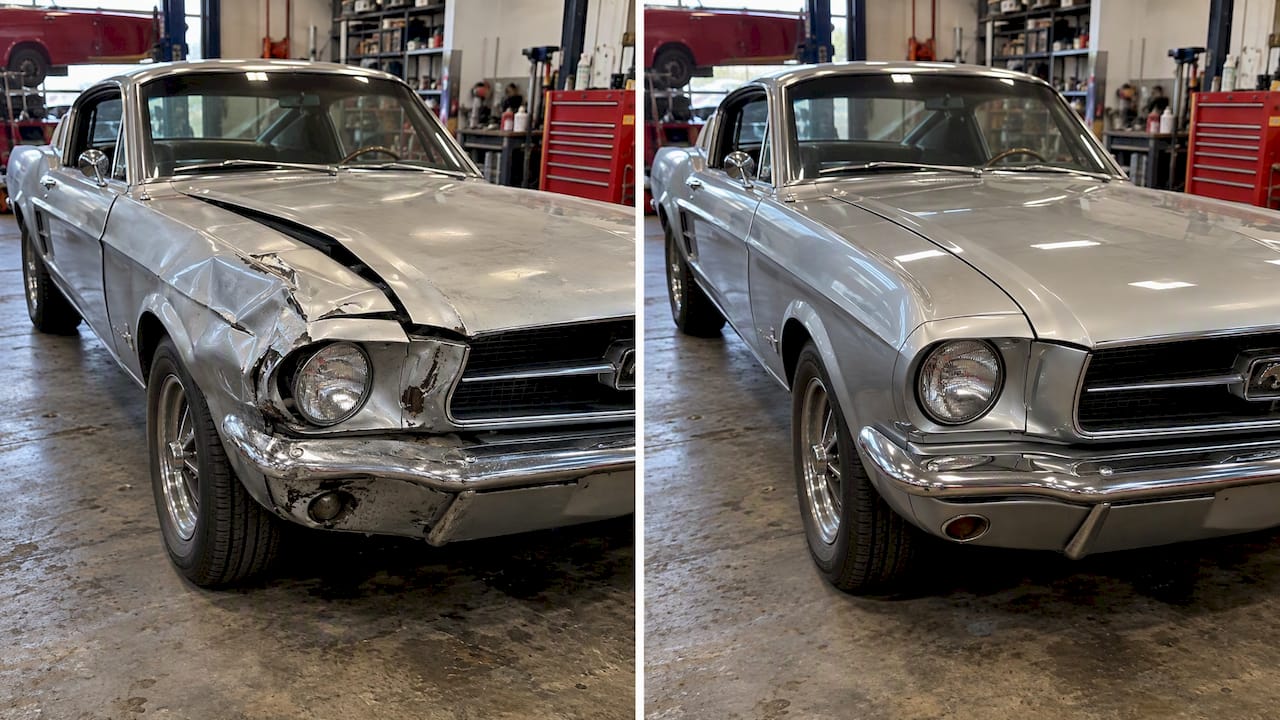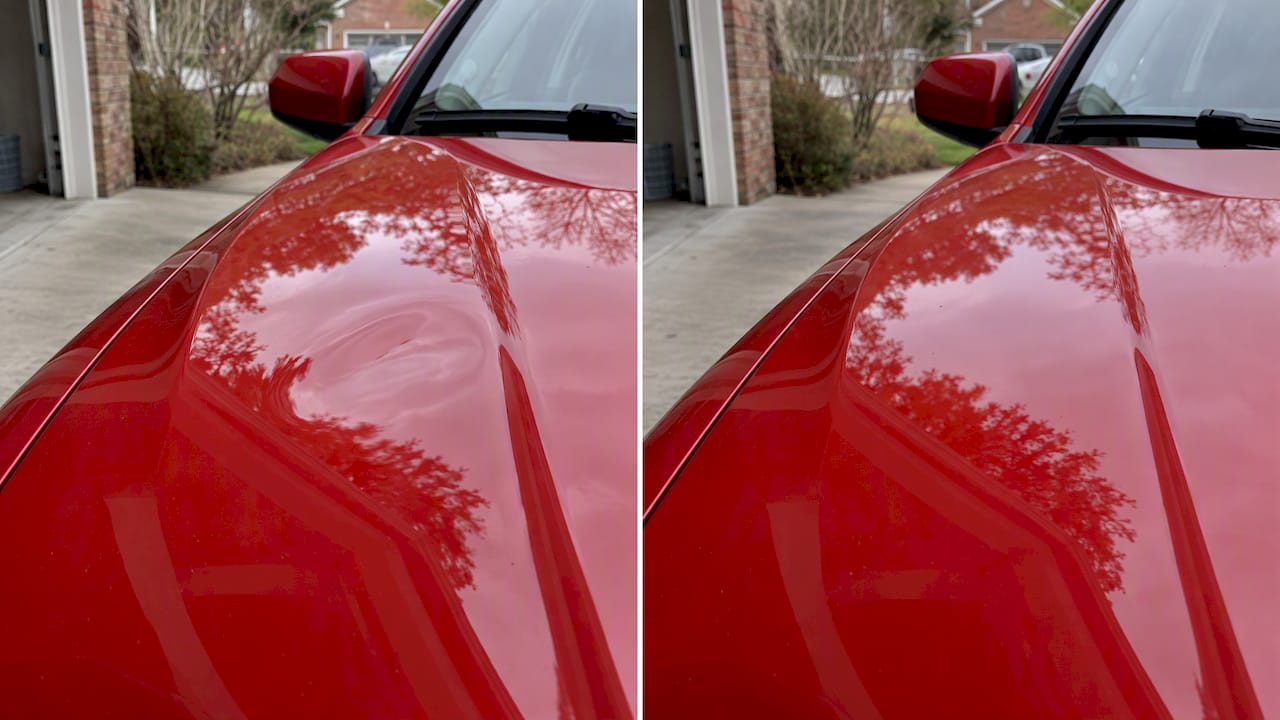
The safest way to remove a dent without harming your clear coat is paintless dent repair (PDR), as long as the paint is unbroken and a technician can reach the back of the panel. PDR reshapes the metal from behind and never sands, fills or sprays, so your factory finish stays untouched. If the paint is already cracked, the dent is sharp and deep, or it sits on a panel edge, a conventional repair is the honest answer. This guide shows you how to tell which case you have.
TL;DR
- PDR works the metal from behind, so the factory clear coat is never sanded, filled or repainted.
- Dents with unbroken paint and reasonable backside access are the best candidates, including shallow dents the size of a dinner plate.
- Cracked paint, panel-edge dents and sharp, stretched dents usually need conventional body repair.
- Prying, heating or pulling a dent yourself is the fastest way to turn a repairable dent into a paint problem.
- We come to your home or office, inspect the paint first and tell you straight whether PDR will work.
Table of Contents
- What “clearcoat safe” actually means
- How PDR removes a dent without touching the finish
- Which dents are safe to repair
- When PDR is the wrong tool
- Check your paint before you decide
- Why DIY puts your clear coat at risk
- What clearcoat-safe repair costs
- Protecting the finish after the repair
- Our perspective on clearcoat-safe repair
- Get a clearcoat-safe repair at your location
- FAQ
- Sources
What “clearcoat safe” actually means
Modern car paint is layered: primer, color, then a clear coat that gives gloss and UV protection. A repair is clearcoat safe when that top layer is never cut, thinned, cracked or replaced.
Conventional dent repair usually involves sanding, body filler, primer, color and new clear coat. Each step removes or replaces something the factory applied. A good refinish can look excellent, but it is no longer the original finish. PDR skips all of it.
The National Association of Paintless Dent Repair Technicians explains that today’s factory paints are flexible and are not damaged by PDR, and that the method leaves the original paint undisturbed. That is the whole idea: move the metal back, and the paint comes along with it.
How PDR removes a dent without touching the finish
A technician gains access behind the panel, often through a door, trunk, taillight opening or a small gap in the interior trim. Using specialized rods and tools, they apply slow, controlled pressure to the back of the dent. Light reflected on a PDR lamp or board shows how the surface is moving, so the technician can raise the low spot in many small pushes instead of one big one.
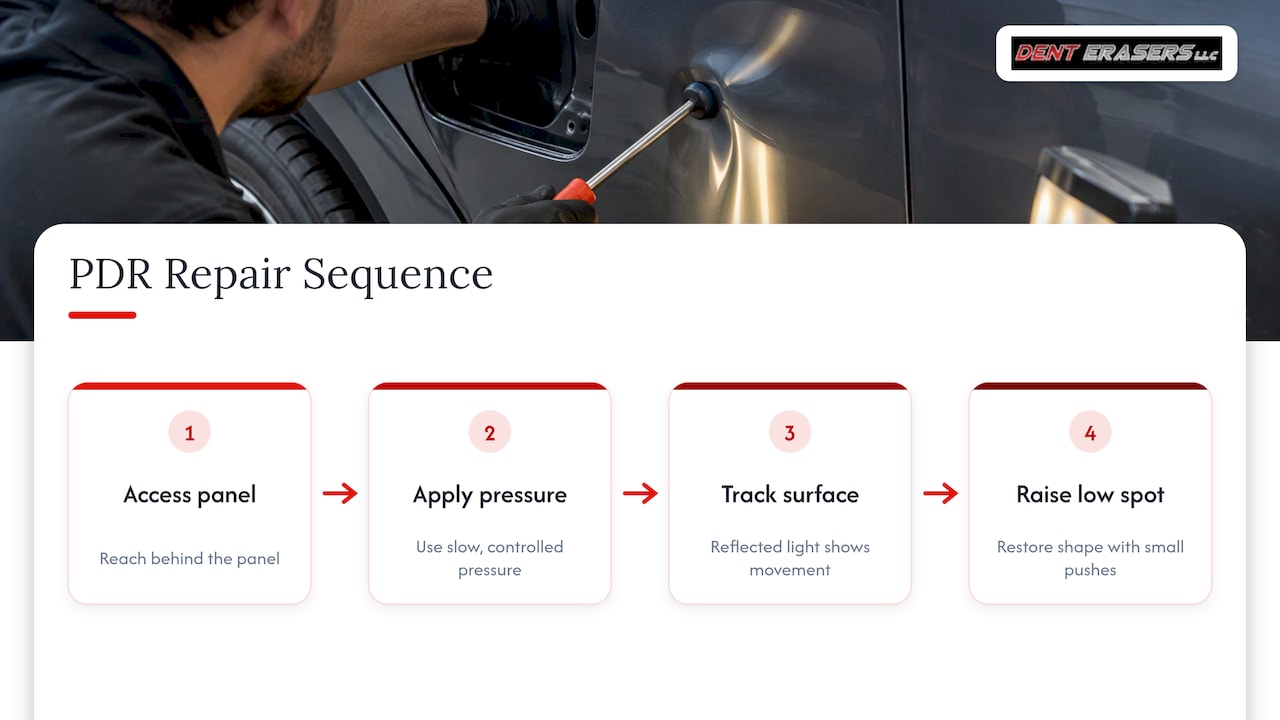
The key word is tension. Metal that has been pushed in holds stress around the dent. Releasing it gradually lets the panel return to its factory shape. Our own walkthrough of the tension-first approach to dent repair without repainting goes deeper, and the technician’s PDR process shows what a typical visit looks like.
Tool quality matters too. General Motors’ service bulletin on PDR recommends high-quality tempered-steel tools with smooth, polished, rounded tips so the back of the panel is not marked. The same GM bulletin says trained technicians have the equipment and know-how for this work.
Which dents are safe to repair
GM’s bulletin recommends PDR for minor dents, soft dents in body lines, and dents with no broken paint that allow reasonable access to the back of the damaged area (GM TSB 99-08-51-001F). In practice, these are the dents we see most often:
- Door dings from parking lots
- Shopping cart and basketball dents
- Hail dimples
- Creases from a bump that left the paint intact
- Shallow, wide dents on doors, hoods, fenders and roofs
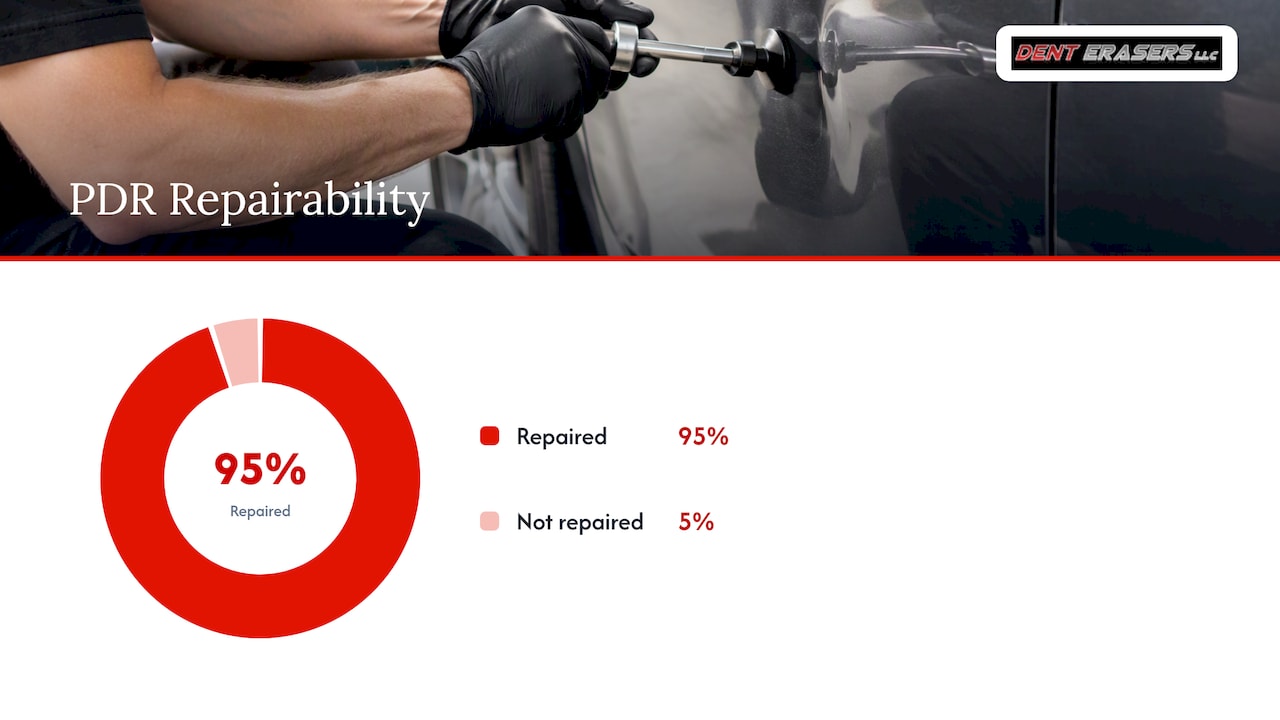
Size alone does not decide it. According to NAPDRT, a shallow dent the size of a dinner plate can be repaired, while a small but deep, highly stretched dent often cannot. The same page says about 95% of minor dents can be repaired with PDR and about 5% cannot because of depth or location (NAPDRT).
Depth and stretch matter more than diameter. Think of pressing your thumb into a sheet of foil versus a pencil tip: the pencil tip stretches the material past the point where it can return.
When PDR is the wrong tool
A clearcoat-safe repair also means being honest when a dent is not a PDR job. GM’s bulletin lists these as inappropriate for PDR:
- Cracked paint
- Damage that requires drilling or removing structural parts
- Sharp dents in contoured areas
- Dents on a panel edge
- Zero-clearance areas where a glue-stick repair was unsuccessful
The same bulletin notes that conventional paint repair may be required for dents over 3 inches and up to 6 inches (GM TSB 99-08-51-001F). That guidance is written for GM vehicles, but it reflects the physical limits any technician works within.
If you have cracked paint, trying PDR can make the cracks spread or flake. That is why some repair providers decline those jobs outright. When the finish is already broken, the right fix is body repair and refinishing. Our auto body and collision repair service covers that side, and our plastic bumper repair handles bumpers, where the material behaves differently from a steel door.

Check your paint before you decide
You can do a quick inspection in five minutes.
- Wash and dry the area so dirt does not hide hairline cracks.
- Look at the dent from several angles in bright, indirect light.
- Check the center and edges of the dent for lines, flaking or a spiderweb pattern.
- Run a fingertip lightly over the surface. A catch or a rough edge points to broken paint.
- Use a magnifier if you have one. GM suggests a 4x magnifying glass for inspecting paint for cracks (GM TSB).
Smooth, glossy and unbroken paint is a good sign. Cracks, chips down to primer or bare metal, or an older repaint with thick, brittle paint call for a professional opinion before anything gets pushed.
Why DIY puts your clear coat at risk
Suction cups, boiling water, hair dryers and glue pullers all show up in online tutorials. Some work on very light dents. The risk is that you cannot see what is happening behind the panel, and you cannot control the force.
Over-pulling creates a high spot that is harder to fix than the original dent. Too much heat softens clear coat. Glue can lift paint, especially on a panel that has been repainted or has weak adhesion. Once the finish is compromised, a repair that could have been paintless turns into a repaint.
If the dent is on a hood line, a roof, or a newer or high-value vehicle, skip the experiment. Our guide on questions to ask before PDR is a good checklist for evaluating any technician.
What clearcoat-safe repair costs
Our published price ranges are:
| Service | Price range |
|---|---|
| Minor dent repair | $100-$500 |
| Paintless dent repair | $150-$500 |
| Large dent repair | $150-$1,500 |
For context, Lemonade reports that small and medium dent repairs commonly run $50 to $400 nationally, and that large or severe damage can reach $1,000 to $3,000 or more, with PDR usually landing around $75 to $300 (Lemonade, updated September 30, 2025). Size, depth, paint condition, location on the panel and vehicle type all move the price.
A dent that needs filler and paint costs more because it adds materials, labor and drying time. For a closer look, see our breakdown of small dent repair cost and our guide to the cost of fixing a dent and paint.
Protecting the finish after the repair
A repaired panel still has its factory clear coat, so normal care applies: wash gently, avoid abrasive polishing right on the repair, and keep the surface protected from sun and bird droppings. If you plan to add a protective layer, this guide to ceramic coating over PPF explains wait times and film compatibility, which helps you sequence the work correctly.
Our perspective on clearcoat-safe repair
We have more than 27 years of experience, and the first thing we do on every job is look at the paint, not the dent. The question we ask is simple: will this finish survive being moved? If the answer is yes, PDR is faster, usually costs less, and keeps the car original, which matters most on luxury, classic and lease-return vehicles.
If the answer is no, we say so. We would rather tell you a panel needs refinishing than push a dent and crack the clear coat. That honesty is why customers return, and why a first-time fix matters to us.
We also come to you. Mobile service means no drop-off, no rental car and no lost day. For fleets, leases and insurance claims, we can work around your schedule.
— Brian Blanc
Get a clearcoat-safe repair at your location
We repair dents at your home or office across Contra Costa County and nearby areas. Send photos and we will tell you whether PDR will protect your paint. Start with a free dent quote, or learn more about our mobile dent repair service.
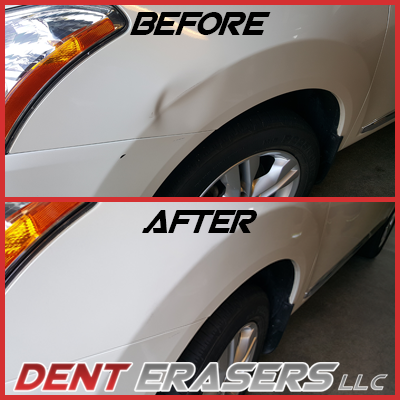
We also handle luxury, classic and motorcycle dents, lease returns, fleets and insurance claim paperwork.
FAQ
Does paintless dent repair damage the clear coat?
Not when the paint is intact and the technician is trained. NAPDRT says modern factory paint is flexible enough to handle PDR. Damage is a risk mainly on paint that is already cracked, brittle or repainted poorly.
Can a dent with a crack in the paint be fixed without repainting?
Generally no. GM lists cracked paint as inappropriate for PDR, so that dent needs conventional repair and refinishing. A technician should inspect it first to confirm.
How big a dent can PDR fix?
Shallow dents as large as a dinner plate can be repairable. Depth and location matter more than width: a small, sharp, stretched dent may not come out cleanly, and dents on a panel edge are usually excluded.
Is PDR cheaper than a body shop repair?
Usually, because it skips filler, primer, paint and drying time. The final price depends on dent size, depth, location and vehicle. Our published ranges run from $100 to $1,500 depending on the service.
Sources
- About Paintless Dent Repair, NAPDRT
- GM Technical Service Bulletin 99-08-51-001F, NHTSA
- How Much Does it Cost to Repair a Car Dent?, Lemonade
- Ceramic Coating Over PPF, Diamondbrite