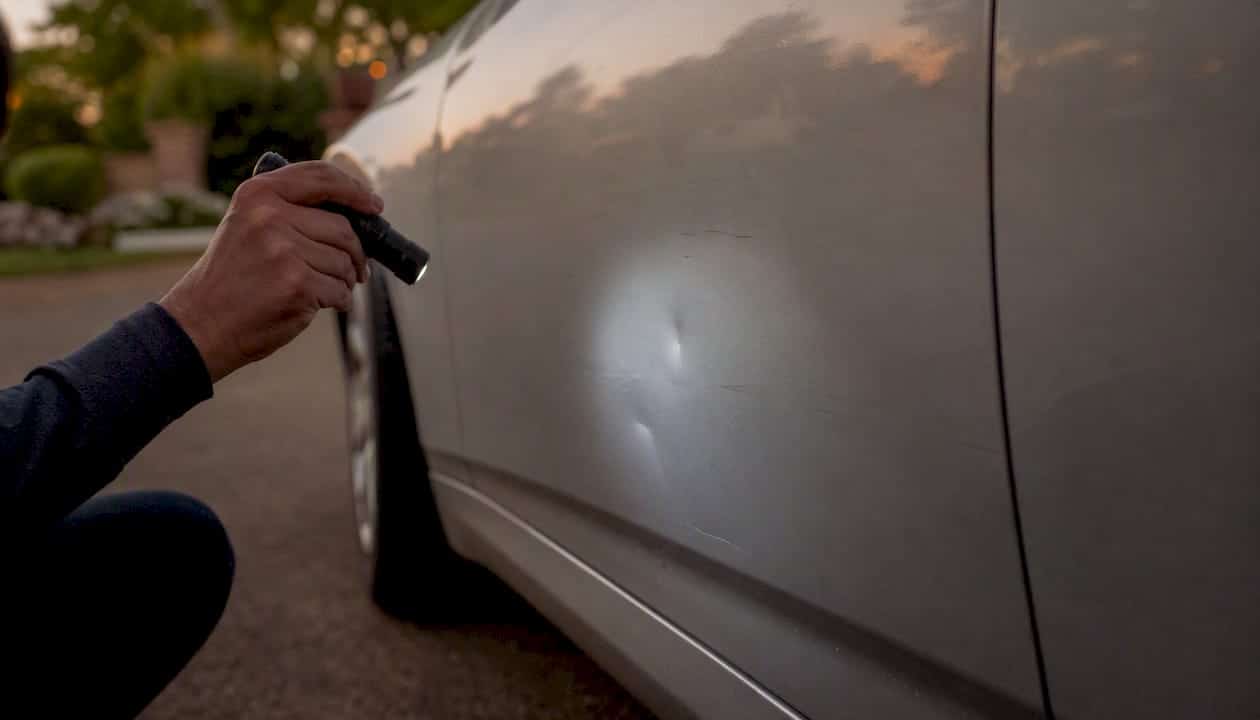
Lease excess wear standards are the condition benchmarks your leasing company uses to decide whether damage on your returned vehicle exceeds normal use — and who pays for the difference. If your car comes back with dents, scratches, tire wear, or interior damage beyond those thresholds, you pay per-item charges that can easily run into hundreds of dollars. The single most important thing you can do right now: schedule a courtesy pre-inspection with your dealer about 60 days before your lease ends, then compare your vehicle against your OEM’s published wear-and-use guide.
Before that appointment, do a quick triage walk-around and flag these common charge triggers:
- Dents and scratches larger than a credit card, or more than a few per panel
- Cracked or chipped glass with damage that has spread or spidered
- Tires with tread below the minimum threshold or mismatched brands
- Interior stains, burns, or tears that won’t clean up with standard detailing
- Missing keys, key fobs, owner manuals, or OEM accessories
Pro Tip: Take timestamped photos of every panel, the interior, all four tires, and the glass before you schedule the pre-inspection. That photo record becomes your first line of defense if a charge appears on your final invoice.
Table of Contents
- What lease excess wear standards actually mean — and why they exist
- Category-by-category thresholds: what OEMs actually measure
- When to schedule your courtesy pre-inspection
- How to avoid excess wear charges — and when to repair
- When paintless dent repair is the right call for lease returns
- Key Takeaways
- The repair decisions most lessees get wrong
- Fast, mobile lease-return repairs in Contra Costa County
- Useful sources to check for your specific lease
- FAQ
What lease excess wear standards actually mean — and why they exist
Excess wear and use, the industry’s formal term, refers to any vehicle condition at lease-end that reduces the car’s resale value beyond what normal, everyday driving would cause. The Federal Reserve’s consumer leasing guidance frames it plainly: lessors may charge for damage that exceeds their standards, but those standards must be reasonable, and state law may limit what they can collect.
The reason these standards exist is straightforward. When you signed your lease, the leasing company projected a residual value — what the car would be worth at return. Excessive damage erodes that value, and the lessor recovers the shortfall through wear-and-use charges. Your lease agreement is the binding document, but every major OEM finance arm also publishes a separate wear-and-use guide that spells out specific thresholds, measurement methods, and per-item examples.
State consumer protections can affect how charges are applied and disputed. Some states require written itemized invoices; others give lessees a specific window to contest charges. Sales tax is typically added to the repair cost estimate on your final invoice, so a $250 dent charge may land closer to $275 depending on your state’s rate.
Maintenance records matter more than most lessees realize. If a leasing company can show that a mechanical issue stems from a missed service interval, that becomes a chargeable item under most Ford Credit and similar OEM policies. Keep your oil change receipts and any dealer service records in a folder you bring to turn-in.
Category-by-category thresholds: what OEMs actually measure
Every major leasing company publishes its own wear-and-use chart, but the measurement logic is consistent across brands. Here is what each category looks like in practice, with real OEM examples.
Exterior paint and body
GM Financial’s wear-and-use guide accepts fewer than four dings per panel when each is under 2 inches, and allows one dent up to 4 inches or one scratch under 6 inches per panel. Go beyond those counts or sizes and the panel is chargeable. Nissan’s Wear and Use Guide draws the line at any panel with four or more dents, any single dent over 2 inches, or any scratch longer than 3 inches on a painted surface. Ten or more paint chips on a single panel also triggers a charge under Nissan’s guidelines.
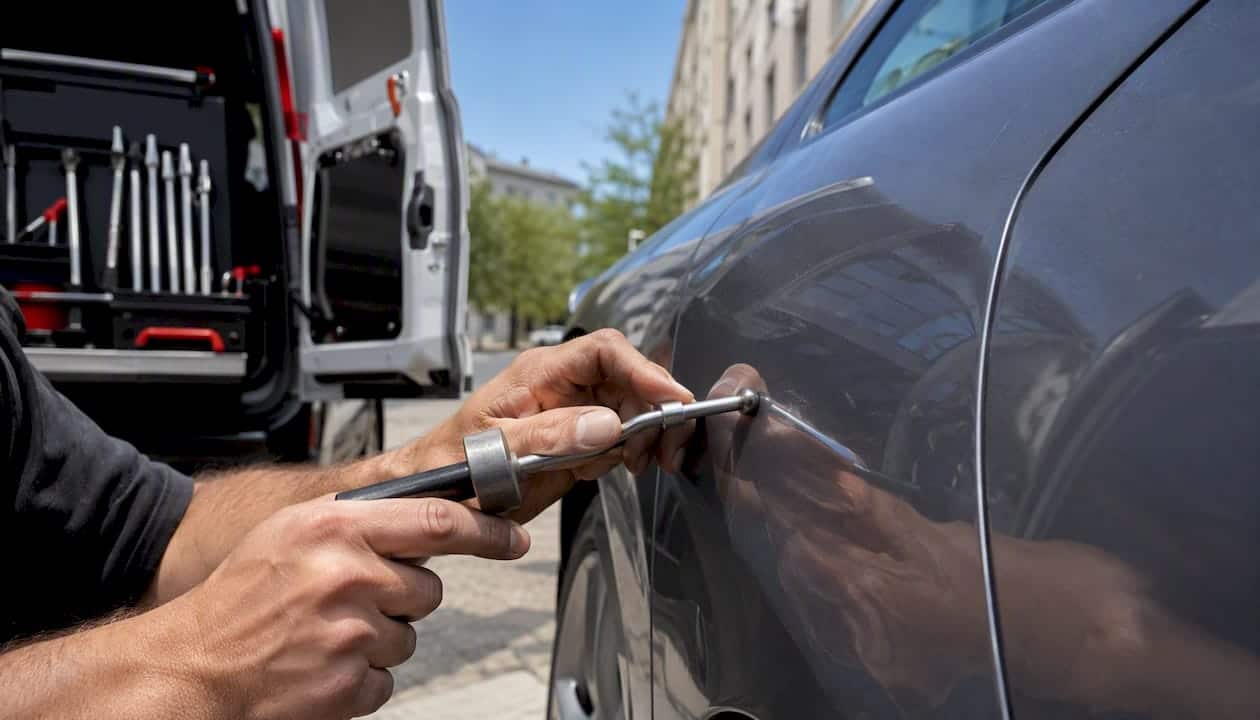
Toyota’s lease-end guide recommends using a standard credit card as a quick field gauge: if a scratch or dent is larger than the card, it’s likely chargeable. That credit-card test, referenced in the Toyota Lease-End EWU PDF, is one of the most practical self-inspection tools available.
Glass and lights
A chip smaller than a bull’s-eye or star crack that hasn’t spread is generally acceptable. Once damage exceeds roughly 1/2 inch in diameter, begins to spider, or sits in the driver’s line of sight, most OEMs treat it as chargeable. Non-factory window tint that wasn’t present at lease start is also a common trigger.
Tires and wheels
Nissan charges for tread depth below 1/8 inch at the lowest point. GM Financial uses similar depth thresholds. Mismatched tire brands or sizes, bulges, sidewall damage, and exposed cords are universally chargeable. Wheel gouges deeper than a surface scuff — typically anything that catches a fingernail — will show up on most inspection reports.
Interior
| Item | Typically Acceptable | Typically Chargeable |
|---|---|---|
| Stains | Light soiling, removable with cleaning | Permanent stains that don’t clean out |
| Burns | None | Any burn hole larger than 1/8 inch |
| Tears/cuts | Minor surface wear | Tears or cuts larger than 1/2 inch |
| Odors | Normal use | Smoke damage, pet odors requiring treatment |
Stellantis Financial Services’ EWU Guidelines price burn holes over 1/8 inch at $100 each (up to three), and permanent stains at $100 each (up to three). Interior damage adds up fast when multiple items are involved.
Equipment and accessories
Missing smart keys are among the most expensive line items. Stellantis lists a missing smart key at $500. Missing owner manuals, second key fobs, cargo covers, and OEM floor mats all generate charges. Aftermarket accessories installed during the lease — a trailer hitch, a roof rack, a non-OEM audio system — must be removed and the vehicle restored to original condition before return.
Mechanical
Maintenance-related failures are chargeable under most agreements. Ford Credit’s wear-and-use policy specifically flags broken or missing parts, poor-quality prior repairs, and mechanical or electrical malfunctions tied to missed service intervals. A repair done with non-OEM parts or substandard bodywork can actually increase your charges rather than reduce them.
OEM thresholds vary. Always treat your lease agreement and your lessor’s published wear-and-use guide as the authoritative source for your specific vehicle.
When to schedule your courtesy pre-inspection
Schedule your courtesy pre-inspection about 30–60 days before your lease-end date. Both Toyota Financial Services and Lexus Financial Services recommend this window explicitly. That timing gives you enough runway to address chargeable items before the final turn-in inspection.
The pre-inspection is conducted by a third-party inspector arranged through your dealer or leasing company. You receive a written condition report that outlines potential charges for any items found. This report is not a final bill — it’s a preview that lets you make informed decisions.
Bring to your pre-inspection:
- All keys and key fobs
- Owner’s manual and any supplemental guides
- Original OEM equipment (floor mats, cargo covers, charging cables for EVs)
- Maintenance records and service receipts
- Odometer statement if required by your lease
- Your own timestamped photos from your walk-around
The condition report gives you three clear decision points: repair the flagged items before turn-in, accept the charges on the final invoice, or explore a lease buyout if the vehicle’s market value makes that worthwhile. Reviewing the report carefully before committing to any of those paths is the move most lessees skip.
How to avoid excess wear charges — and when to repair
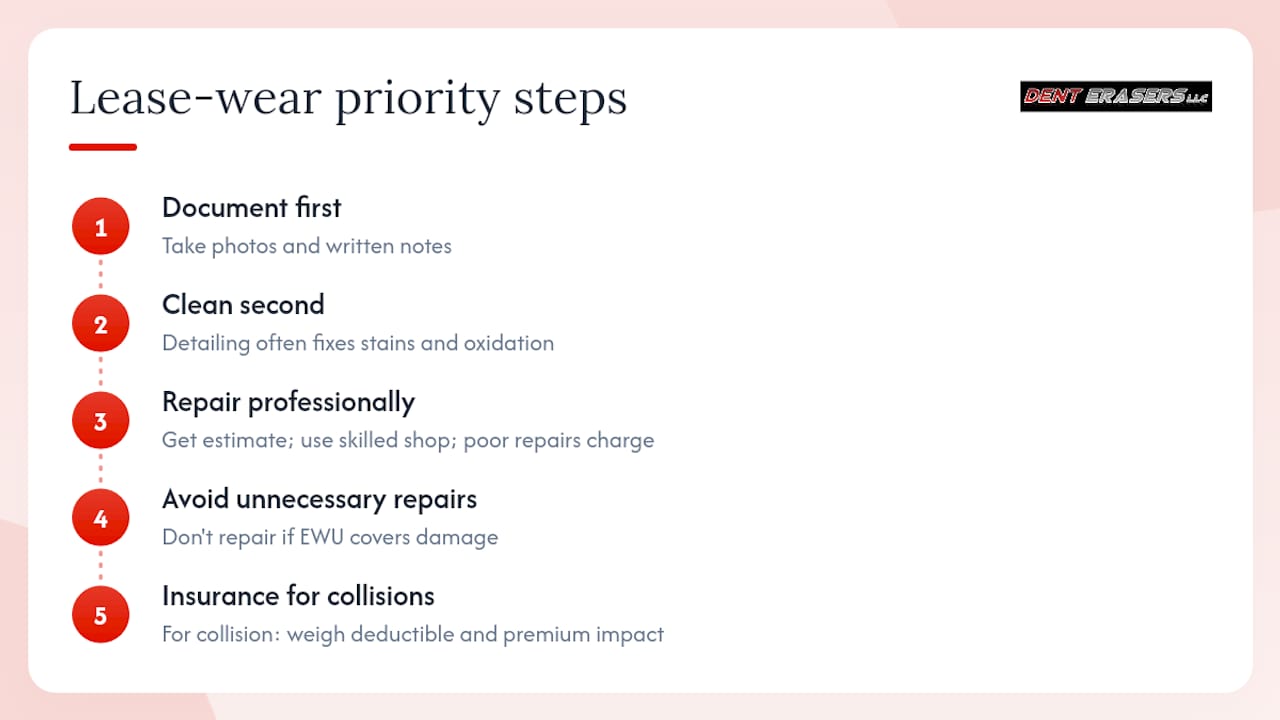
The priority order for addressing lease wear and tear is: document first, clean second, repair professionally third, and use insurance only when the damage qualifies as a collision claim.
Start with a thorough interior detail. Many stains that look permanent respond to professional cleaning, and a clean interior often passes inspection without any charges. Exterior detailing can remove light surface scratches and oxidation that might otherwise flag on an inspection report.
For dents and scratches that exceed OEM thresholds, the cost-benefit math usually favors professional repair over paying the leasing company’s per-item rate. A paintless dent repair on a small door ding typically costs less than the $250 or more a leasing company charges per item. The key word is professional: a poor-quality repair can trigger a higher charge than the original damage. Ford Credit’s policy explicitly lists poor-quality repairs as a chargeable condition.
When not to repair: if damage is borderline and your EWU protection covers it, paying for a repair you didn’t need is wasted money. Check your protection document first.
For collision damage, your auto insurance may cover the repair cost minus your deductible. Weigh the deductible against the estimated lease charge and the impact on your premium before filing a claim. You can also review who pays for repairs on a leased car for a fuller breakdown of insurance versus out-of-pocket decisions.
Pro Tip: Get a written estimate from any repair shop before authorizing work, and take a post-repair photo. Both documents belong in your turn-in folder — they show the leasing company the damage was professionally addressed.
When paintless dent repair is the right call for lease returns
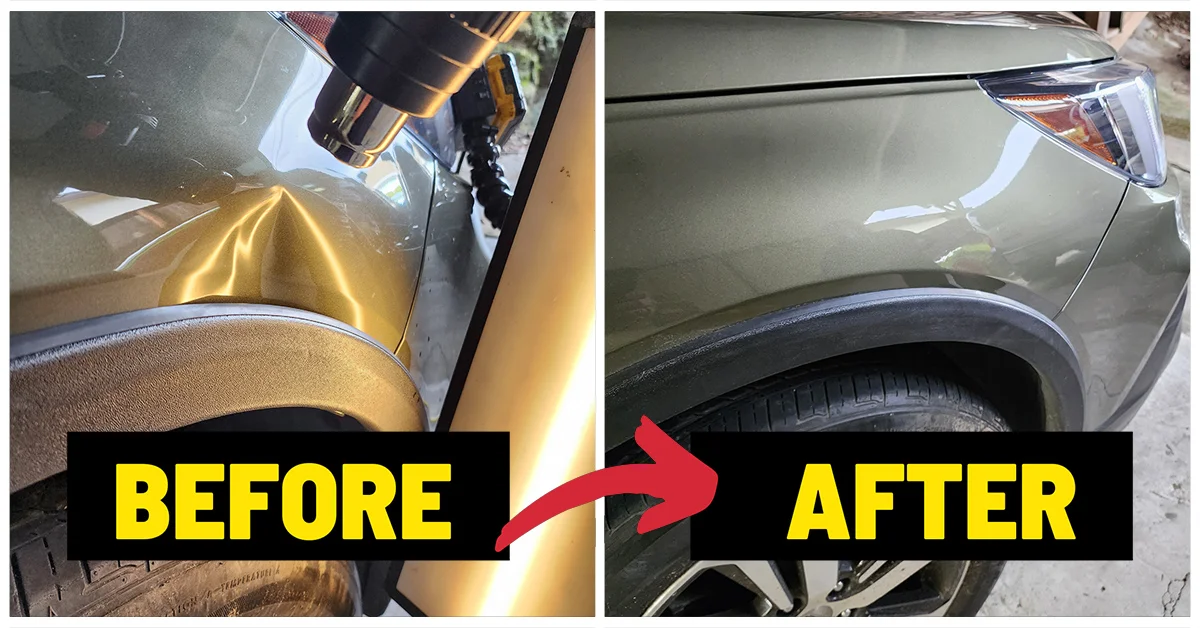
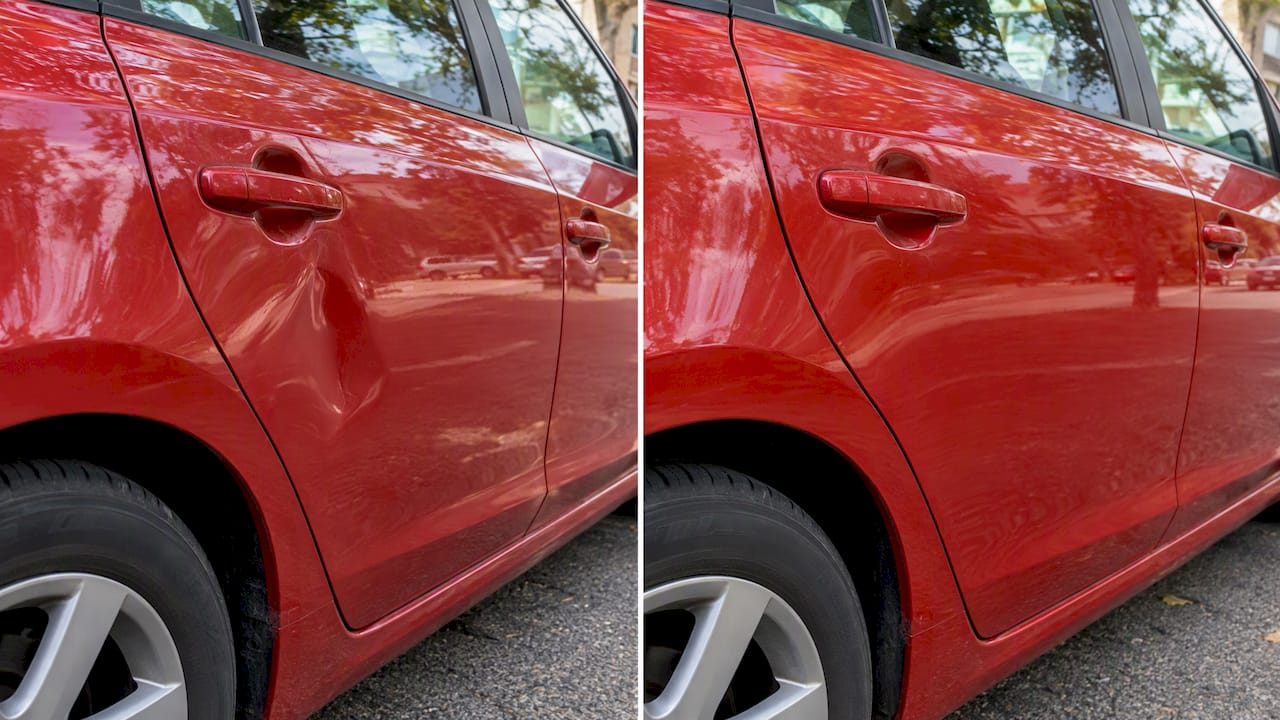
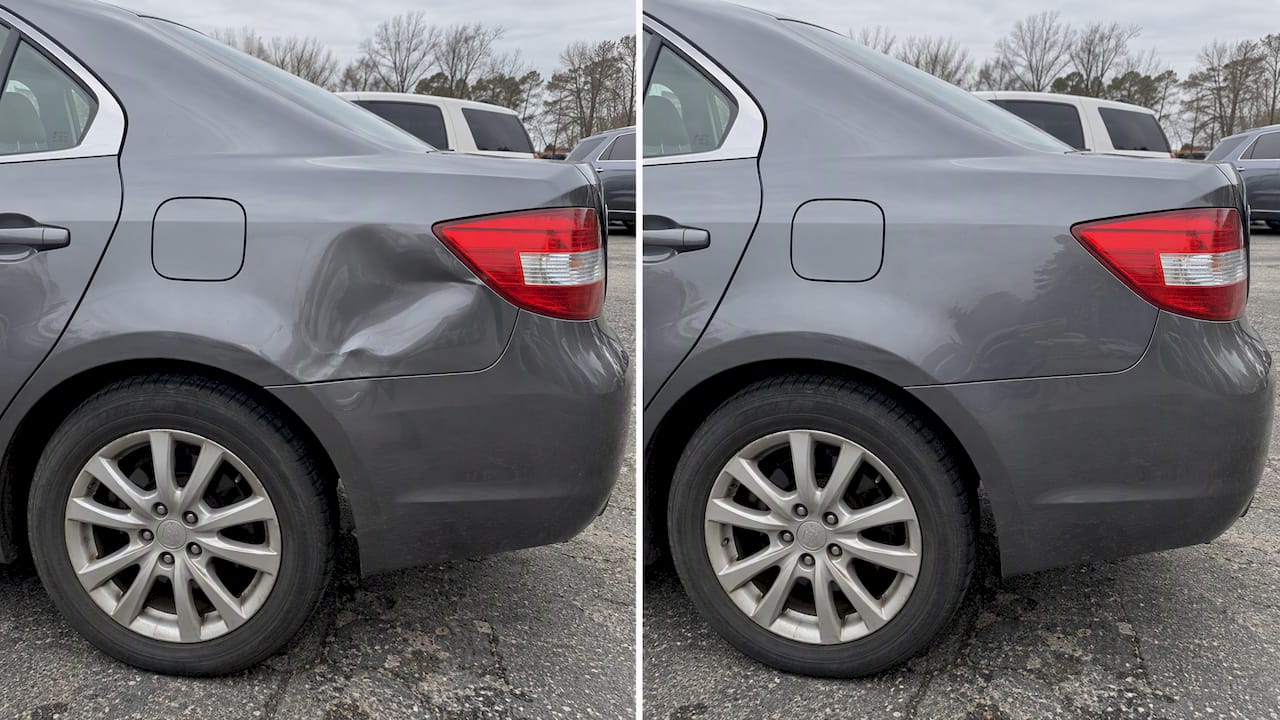
Paintless dent repair (PDR) is the first-line professional option for dents where the paint is intact and the metal hasn’t been creased or stretched. A skilled technician uses specialized tools to massage the metal back to its original contour from behind the panel, preserving the factory finish entirely. No filler, no repainting, no risk of a color mismatch that a leasing company inspector will flag.
Benefits for lease returns:
- Lower cost than conventional bodywork in most cases
- Faster turnaround, often same-day for smaller dents
- Factory paint stays intact, which matters to OEM inspectors
- No risk of paint-match issues that could trigger additional charges
PDR has real limits. It doesn’t work on creases with sharp edges, panels that have already been repainted, or collision damage where the metal has been stretched or torn. For those situations, conventional body repair is the appropriate path. Understanding minor collision damage and when it crosses into territory PDR can’t address helps you choose the right repair method before you spend money.
When hiring a PDR technician for a lease return, ask for:
- Before-and-after photos of the specific repair
- An itemized written estimate tied to the OEM’s threshold measurements
- A written guarantee on the repair
- Confirmation that the technician has experience with lease-return standards
That paperwork is your protection if the final inspector disputes whether a repair was completed properly.
Key Takeaways
Lease excess wear standards are OEM-specific, measurable thresholds — and addressing chargeable items before turn-in almost always costs less than paying the leasing company’s per-item rates.
| Point | Details |
|---|---|
| Schedule early | Book your courtesy pre-inspection 30–60 days before lease-end to leave time for repairs. |
| Use OEM thresholds | Nissan charges for dents over 2" or 4+ per panel; GM Financial accepts up to 4 dings under 2" per panel. |
| Document everything | Timestamped photos before and after any repair are your strongest tool in a charge dispute. |
| PDR saves money | Paintless dent repair preserves factory paint and typically costs less than a leasing company’s per-item dent charge. |
| Denterasersllc | Mobile PDR and bumper repair in Contra Costa County — a fast, lease-compliant repair option before your turn-in date. |
The repair decisions most lessees get wrong
Most people approaching lease-end focus on mileage overage and forget that condition charges often cost more. A lessee who’s 500 miles over their allowance might owe a predictable, modest overage fee — but three chargeable dents, a cracked windshield, and a missing key fob can easily double that number.
The other mistake I see regularly: lessees who attempt DIY repairs or use discount body shops to save money, then end up with a poor-quality repair that the inspector flags as a chargeable condition on top of the original damage. The Federal Reserve’s guidance is clear that lessors’ standards must be reasonable, but “reasonable” still includes the right to charge for substandard repairs. A repair that uses mismatched paint, leaves a visible texture difference, or shows filler cracking is worse than no repair at all in most inspectors’ eyes.
The smartest approach is to get a professional estimate first, compare it to the leasing company’s likely charge, and make the repair decision based on that math — not on the assumption that any repair is better than none. For paint-intact dents, PDR almost always wins that comparison. For anything involving repainted panels or structural damage, conventional bodywork is the right call, and you should document it thoroughly regardless.
Fast, mobile lease-return repairs in Contra Costa County
When your pre-inspection report comes back with a list of dents and dings, the clock starts ticking. Denterasersllc offers mobile paintless dent repair and plastic bumper repair that comes to your location in Contra Costa County and surrounding areas, so you’re not burning time dropping off a car at a shop and waiting days for it to come back.
Every lease-return job includes an onsite estimate, before-and-after photos, and a written guarantee on the repair — exactly the documentation your turn-in folder needs. The work preserves your factory finish, which matters to OEM inspectors who know what a repainted panel looks like. For lease-return dent repair, reach out to Denterasersllc to book your mobile appointment before your turn-in date.
Useful sources to check for your specific lease
Each of these sources covers a different OEM’s standards. Pull the one that matches your lease and read it alongside your lease agreement.
- Vehicle Leasing: Up‑Front, Ongoing, and End‑of‑Lease Costs: More Information about Excessive Wear-and-Tear Charges — Federal Reserve
- Wear and Use Guidelines | GM Financial
- NISSAN GUIDE TO CHARGEABLE WEAR AND USE — Nissan USA
- Wear & Use | Toyota Financial Services
- Wear & Use | Lexus Financial Services
- Wear and Use | Ford Credit
- SFS EXCESS WEAR & USE (EWU) GUIDELINES — Stellantis Financial Services
- Toyota Lease-End EWU PDF — Toyota Financial Services
- Excess Wear & Use Guide — Tesla Support
Your lease agreement is always the final authority. When an OEM guide and your contract conflict, the contract governs.
FAQ
What counts as normal wear and tear on a leased car?
Normal wear and tear includes minor surface scuffs, light interior soiling that cleans up, and small chips consistent with everyday driving. Damage that exceeds OEM size or count thresholds — such as dents over 2 inches or permanent stains — falls into excess wear territory.
How much do excess wear charges typically cost?
Charges vary by OEM and item. Stellantis Financial Services publishes examples such as $250 per qualifying dent and $500 for a missing smart key. Multiple chargeable items on one vehicle can push a final invoice well above $1,000.
Can I dispute an excess wear charge on my lease?
Yes. Request an itemized written invoice and compare each charge against your OEM’s published wear-and-use guide and the Federal Reserve’s reasonableness standard. Your state attorney general’s consumer protection office may also provide guidance specific to your state.
Does EWU protection eliminate all excess wear charges?
Not always. EWU protection products from OEM finance arms like Toyota Financial and Lexus Financial carry per-event and aggregate caps. Review your protection document to understand exactly what is covered and what the limits are before deciding whether to repair anything.
Is paintless dent repair accepted by leasing companies at turn-in?
A professional PDR repair that restores the panel to within OEM thresholds is generally accepted. The key is quality: a repair that leaves visible texture differences or doesn’t fully correct the dent may still be flagged. Always get before-and-after photos and a written guarantee from your technician.