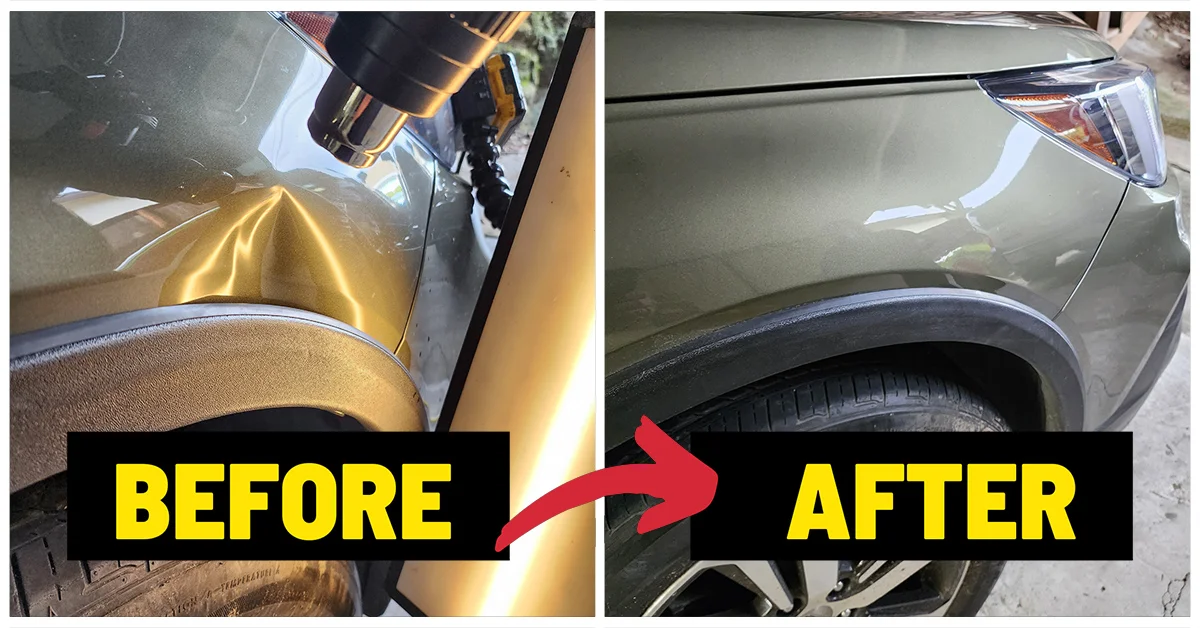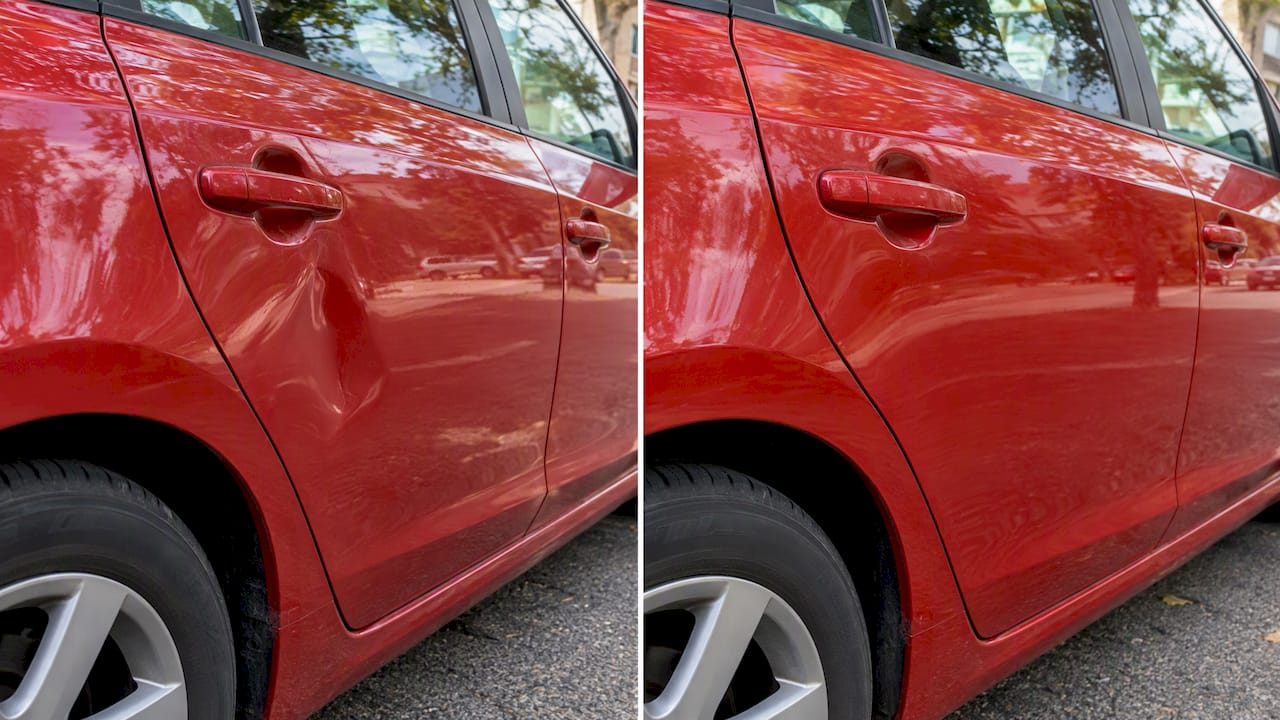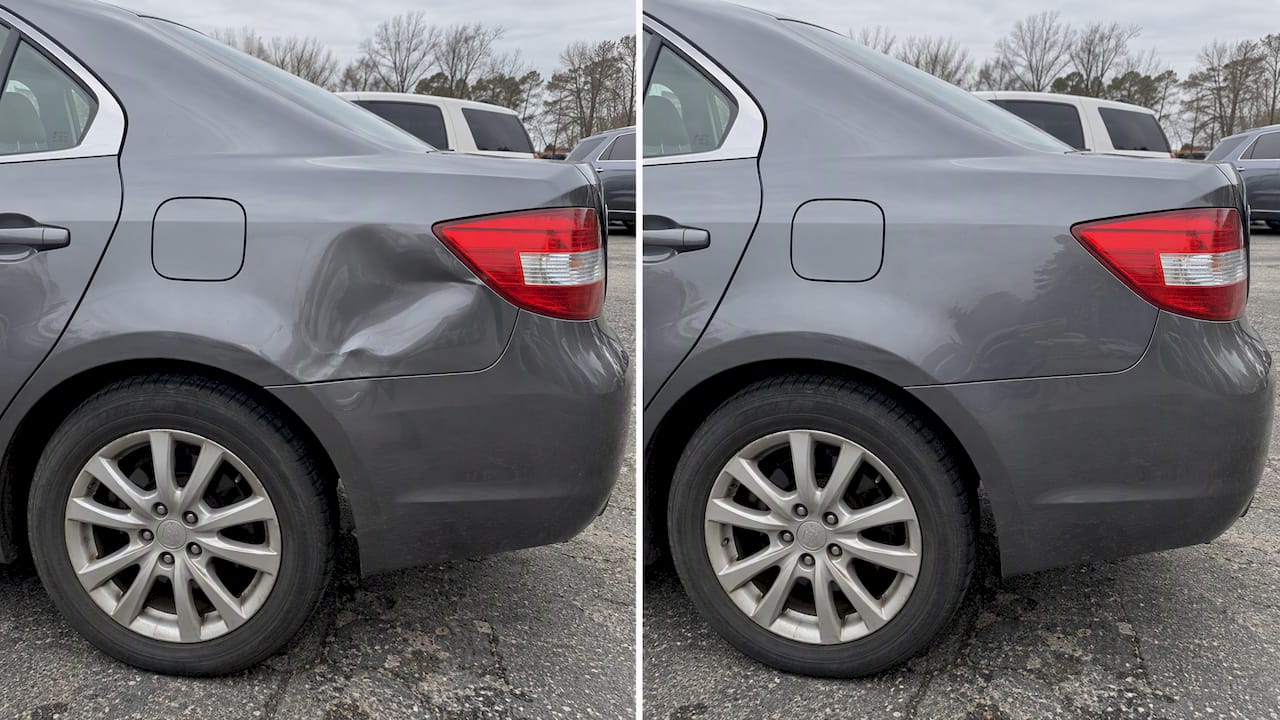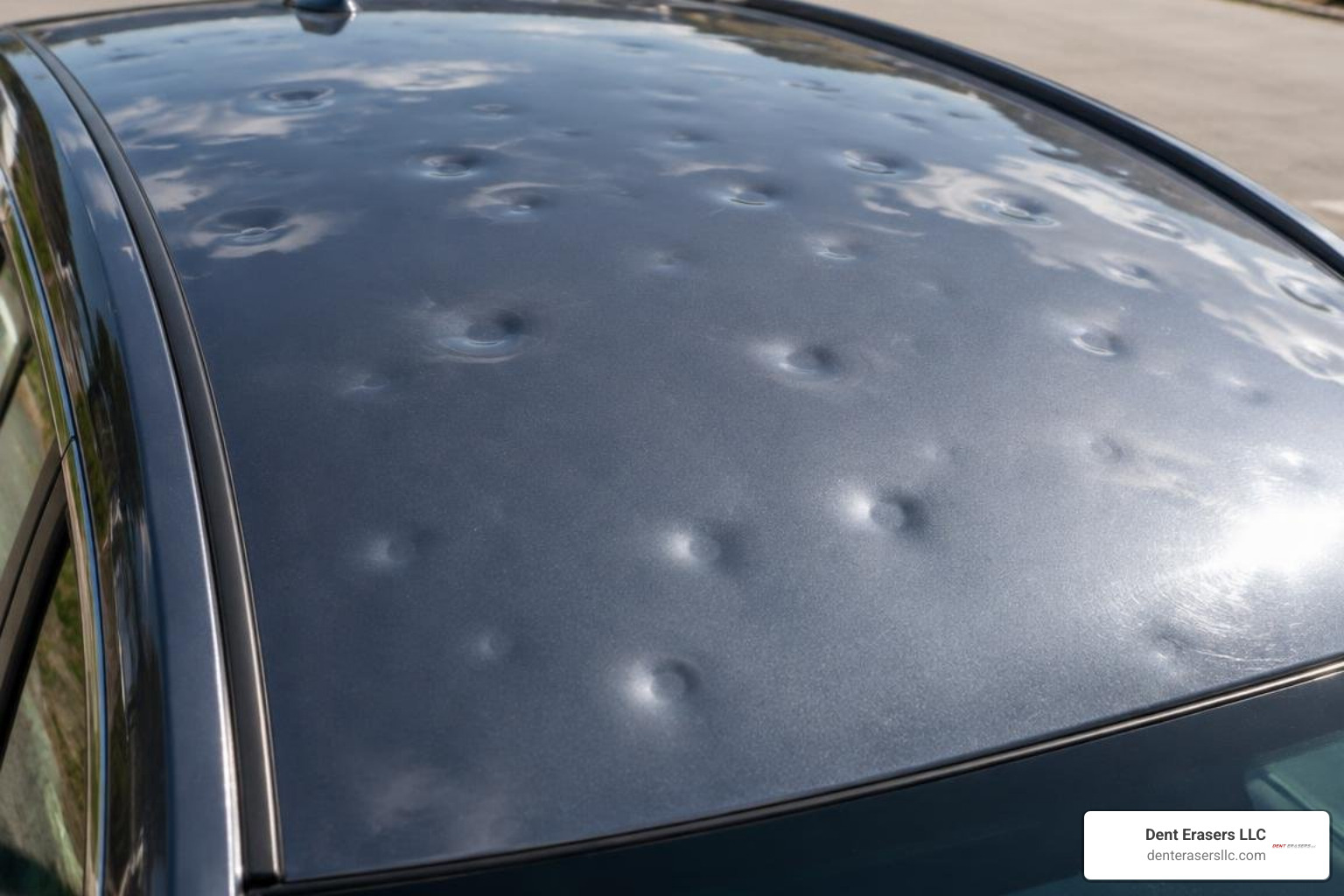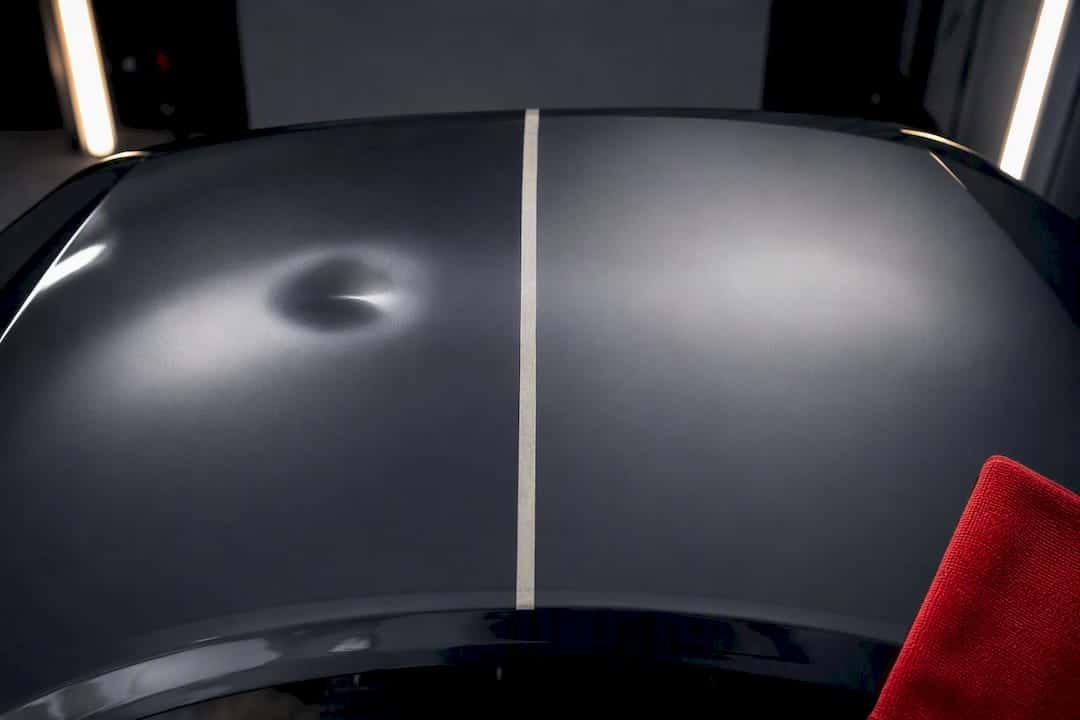
No, dry ice does not reliably remove a dent. It cools a panel but cannot restore metal that has already stretched past its elastic limit, and that stretch is what causes a dent in the first place. Very shallow hail pings on thin, flat panels sometimes look better after a cold treatment, but that’s the exception, not the rule. Handle dry ice carelessly and you risk frostbite on bare skin or cracked clear coat on your paint.
TL;DR:
- Dry ice cooling cannot reverse metal stretching or displacement caused by a dent, especially on sharp creases or stretched panels.
- Successful dry ice results are limited to small, shallow, and flat surface dents with uniform tension, and depend heavily on timing and ambient conditions.
- Repeated cold cycles risk cracking paint, creating micro-checks, or increasing metal fatigue, leading to more costly repairs rather than fixing the dent.
- Professional paintless dent repair uses targeted mechanical pressure from behind the panel, which preserves the factory finish and is more reliable than thermal methods.
- Handling dry ice improperly can cause frostbite, paint cracks, or further damage, and DIY attempts are generally less effective and more risky than professional repair.
Table of Contents
- The Dry Ice Dent Repair Myth: The Science of Why It Rarely Works
- When Dry Ice Sometimes Seems to Work on Small Dents
- The Risks: Paint Cracking, Metal Fatigue, and Bigger Repair Bills
- How Professionals Actually Fix Dents Without Wrecking the Paint
- Trying Dry Ice Anyway? Safety Rules You Shouldn’t Skip
- What It Costs, and When It’s Time to Call a Pro
- The Denterasers LLC Perspective on Dry Ice Shortcuts
- Primary Sources and Further Reading
- Sources
- FAQ
The Dry Ice Dent Repair Myth: The Science of Why It Rarely Works
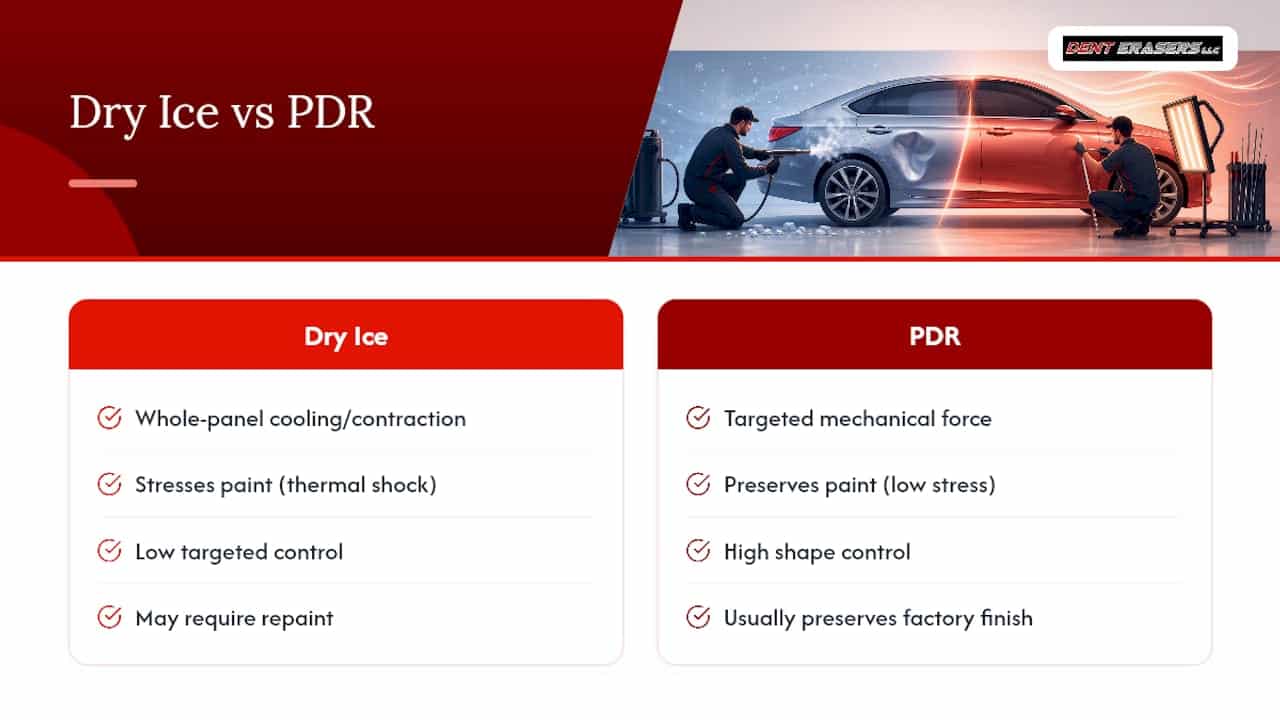
A dent isn’t a temperature problem. It’s a mechanical one. When metal gets struck hard enough to displace, the surrounding material stretches and holds that new shape under tension, almost like a taut sheet that’s been pushed and refuses to spring back on its own. Dry ice sits at about negative 109 degrees Fahrenheit, cold enough to make a panel contract slightly, but contraction happens across the whole surface, not just at the dent. There’s no way to aim that shrinkage at the exact spot where the metal stretched.
Technicians who work on dents every day put it plainly: dents involve metal stretch and displacement, not a temperature issue. Cooling the steel doesn’t undo the physical deformation any more than putting an ice pack on a bent coat hanger would straighten it back out.
Here’s why the myth persists despite that:
- Thin panels flex more. Hoods, roofs, and some hail-prone body panels are thin enough that temperature swings create a visible, if temporary, change in surface tension.
- Pre-existing stress matters. A panel already under slight tension from a shallow impact reacts more to cooling than a panel with a deep, sharply creased dent.
- Timing looks convincing on camera. A quick pop or shift right after the cold hits the metal reads as “fixed,” even when the underlying displacement is still there.
- Confirmation bias does the rest. People remember the one dent that looked better and forget the five that didn’t move at all.
Pro Tip: If you’re staring at a dent trying to decide whether it’s a “dry ice candidate,” check whether you can see a sharp crease line. Creases mean the metal has folded, not just stretched, and no amount of cold will undo a fold.
When Dry Ice Sometimes Seems to Work on Small Dents
The narrow cases where dry ice produces a visible change all share the same profile, and it’s worth knowing what that profile looks like before you spend an afternoon on a dent that was never going to respond.
- Small, shallow hail pings. Round, shallow dings on flat hood or roof panels are the most common success stories, largely because the metal displacement is minor and the surrounding tension is uniform in every direction.
- Thin, flat panel sections. Curved fenders, wheel arches, and reinforced door panels resist thermal tricks far more than a flat hood ever will.
- Precise timing and temperature differential. DIY guides that document favorable results stress that success depends on panel thickness, existing tension, and a fairly exact temperature swing, not just “cold enough for long enough.” One hail-damage repair guide frames it as a narrow-window technique, not a general fix.
- Uniform ambient conditions. A cold garage on a mild day gives more consistent results than a driveway in July, where the panel is already warm and expanding.
Creases, edges near trim, and anything with stretched or folded metal almost never respond, because the damage there isn’t just displacement, it’s a permanent change in the metal’s shape. And even a favorable-looking result is cosmetic, not structural. The panel may look flatter for a while, but the metal fibers underneath haven’t been massaged back into their original arrangement the way they would in a proper repair. That’s a meaningful difference if you’re trying to preserve resale value or pass a pre-sale inspection down the road.
The Risks: Paint Cracking, Metal Fatigue, and Bigger Repair Bills
Rapid cooling doesn’t just fail to fix most dents. It can actively damage the car around the dent. Clear coat and paint are flexible within a normal temperature range, but shock them with something as cold as dry ice and that flexibility disappears fast. The result is often called “checking,” a network of tiny cracks that show up as a hazy or dulled patch, sometimes days after the treatment rather than immediately. Rapid thermal shock can crack or delaminate clear coat, and once that happens, a simple dent problem becomes a paint problem, which is a different and more expensive repair entirely.
Repeated cold cycles compound the risk. DIY guides that cover this technique in detail actually recommend limiting how many times you apply dry ice to the same spot, because each cycle adds internal stress to metal that’s already been stressed once by the original impact. Think of it like bending a paperclip back and forth. It doesn’t break the first time, but every additional bend brings it closer to failure.
Here’s what that escalation can look like in practice:
- A dent that doesn’t budge, so you’re back to square one, only now with cold-stressed paint.
- A hairline crack in the clear coat that widens over the following weeks as the car cycles through weather.
- A “popped” dent that looks fine on the surface but still has slightly displaced metal underneath, which can print through the paint later as a faint shadow.
- A repair bill that jumps from a paintless fix to a full sand, prime, and repaint on that panel.
Pro Tip: If you notice a dull or hazy patch on the paint anytime in the days after a dry ice attempt, don’t wait to see if it gets worse. Micro-checking in clear coat rarely heals itself, and catching it early keeps the fix limited to that panel instead of spreading.
How Professionals Actually Fix Dents Without Wrecking the Paint
Paintless dent repair, or PDR, is the industry’s answer to exactly the problem dry ice tries and usually fails to solve. A trained technician accesses the back of the panel, often through a door panel, trunk liner, or wheel well, and uses specialized rods and picks to apply incremental pressure directly against the stretched metal. That’s the piece dry ice can’t replicate: real, targeted mechanical force applied from behind the panel, guided by feel and by light reflection on the surface, until the metal is coaxed back toward its original contour.
Some dents, especially ones with limited backside access, call for the glue-pull method instead. A technician bonds a small tab to the face of the dent and uses a slide hammer or pulling bridge to draw the metal outward, working in small stages rather than one aggressive yank. Learn more about how this compares to older bodywork approaches in our guide to paintless dent repair basics.
Most professional body shops and PDR technicians simply don’t reach for dry ice, and the reasoning is straightforward: controlled mechanical techniques restore panel shape without stressing the paint the way thermal shock does. Because PDR works with the metal’s own memory rather than fighting it with temperature extremes, it preserves the factory finish in the overwhelming majority of cases. Compare that to the alternative, which sometimes means paint that has to be sanded and resprayed anyway, and PDR usually wins on both cost and outcome. A repaint only becomes necessary when the paint or metal is already compromised, whether from a deep crease, prior body filler, or, ironically, an aggressive DIY attempt gone wrong.
Trying Dry Ice Anyway? Safety Rules You Shouldn’t Skip
If you’re set on trying it despite the odds, treat it as a safety exercise first and a repair attempt second.
- Wear heavy insulated gloves at all times. Dry ice sits far below freezing, and bare skin contact can cause frostbite in seconds, not minutes.
- Wrap the dry ice, never place it directly on bare skin or unprotected eyes. Wear eye protection too; sublimating dry ice releases carbon dioxide gas, and you don’t want a chunk shattering near your face.
- Keep application times short. A brief, controlled exposure limits paint stress; extended sessions raise your odds of clear-coat damage without improving your results.
- Skip creases, trim edges, weatherstripping, and seals entirely. Cold applied near rubber seals or plastic trim can make those materials brittle and prone to cracking.
- Stop the moment you hear a crack or see any change in the clear coat’s sheen. That sound or hazing means damage is already happening, and continuing only makes it worse.
DIY hail-repair guides that walk through this method consistently advise capping the number of cold cycles per dent rather than repeating the treatment until something happens. If you’re using dry ice for anything around the car, standard cold-handling precautions apply well beyond dent repair, since accidental skin contact is one of the most common injuries reported with this material.
What It Costs, and When It’s Time to Call a Pro
Paintless dent repair typically runs cheaper than a repaint, largely because it skips sanding, priming, blending, and clear coat application entirely. Repaint work, by contrast, climbs fast once you factor in labor, materials, and the blending needed to match surrounding panels. Costs vary by region, panel size, and damage severity, so treat any number as a ballpark rather than a quote.
Use this quick checklist to decide your next move:
- Dent is small, shallow, and on a flat panel with no crease — a candidate for PDR, often at the lower end of the cost range.
- You see a crease, a sharp fold, or damage near an edge — PDR may still work, but it’s a job for a trained technician, not a DIY attempt.
- Paint is already cracked, chipped, or peeling at the dent — you’re likely looking at a repaint alongside any structural fix.
- You’re unsure how to classify what you’re looking at — our breakdown of dent versus ding differences can help you describe it accurately when you call for an estimate.
Mobile PDR offers the convenience of having a technician come to you, assess the panel in person, and often complete the repair during the same visit, saving you time and effort. Before that visit, snap a few clear photos of the dent in daylight, note when the damage happened, and avoid further DIY attempts. That documentation helps if you’re filing an insurance claim and keeps the panel in its most repairable state.
The Denterasers LLC Perspective on Dry Ice Shortcuts
I’ve heard the dry ice pitch from customers more times than I can count, usually right before they show me a hood with a dull, hazy patch where the paint used to be glossy. The pattern is consistent: someone tries the cold trick on a dent that looked simple, the metal doesn’t move because it was never a temperature problem, and now there’s a clear-coat issue layered on top of the original damage. What started as a free fix becomes a paint job.
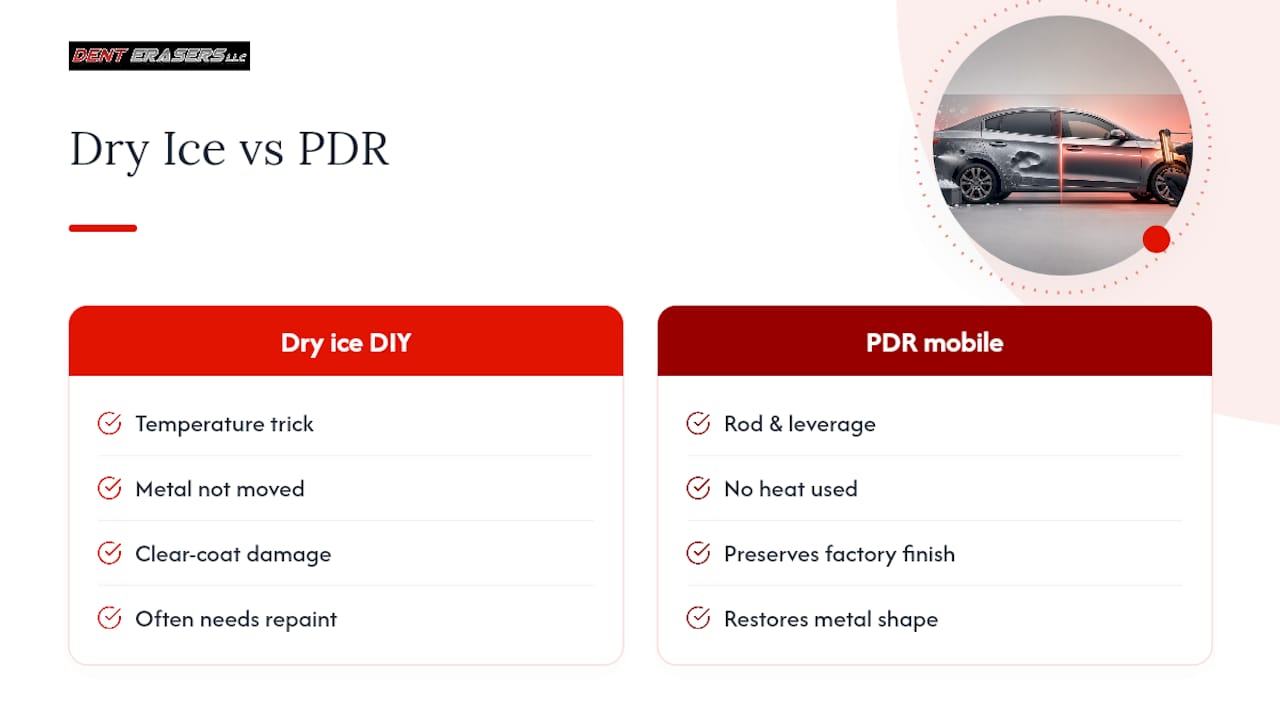
That’s exactly why our mobile paintless dent repair approach exists. We come to your driveway or office lot, examine the panel by hand and eye, and use the same rod-and-leverage techniques that restore metal shape without ever touching a heat gun, a hair dryer, or a canister of dry ice. It preserves your factory finish because it works with the metal, not against it with a temperature swing.
If you’ve got a dent you’re tempted to treat yourself, or one you already tried the cold trick on, get it looked at before the damage compounds. Book an inspection with a technician to find out whether it’s a quick paintless fix or something that needs more attention. It’s usually faster, and cheaper, than the DIY route you were considering.
— Brian Blanc
Primary Sources and Further Reading
These sources back the technical claims throughout this piece:
- Subzero Dry Ice’s hail-repair guide details the narrow conditions where cold treatment shows results.
- Caversham Coachworks explains clear-coat cracking risk from thermal shock.
- Caliber Collision’s PDR guide outlines why professionals avoid dry ice.
- Rapidrepair offers cycle-limit safety guidance for DIY attempts.
Sources
- How to Use Dry Ice to Repair Car Dents – Hail Damage Repair
- Dry Ice vs Paintless Dent Repair | Caversham Coachworks
FAQ
Does dry ice really work on dents?
Rarely. It cools the panel, but it doesn’t restore metal that’s been stretched beyond its elastic limit, so most dents look exactly the same afterward.
What are the downsides of dry ice cleaning?
The biggest risks are clear-coat cracking from thermal shock, added metal fatigue from repeated cold cycles, and frostbite if you handle it without heavy insulated gloves.
What dents cannot be removed with dry ice?
Creased dents, damage near trim or seals, and anything on curved or reinforced panels almost never respond, since dry ice can’t target displaced metal the way mechanical pressure can.
What are three things you should never do with dry ice on a dent?
Never touch it with bare skin, never apply it directly to already-cracked paint, and never keep repeating cold cycles on the same spot once you’ve tried it once or twice without results.