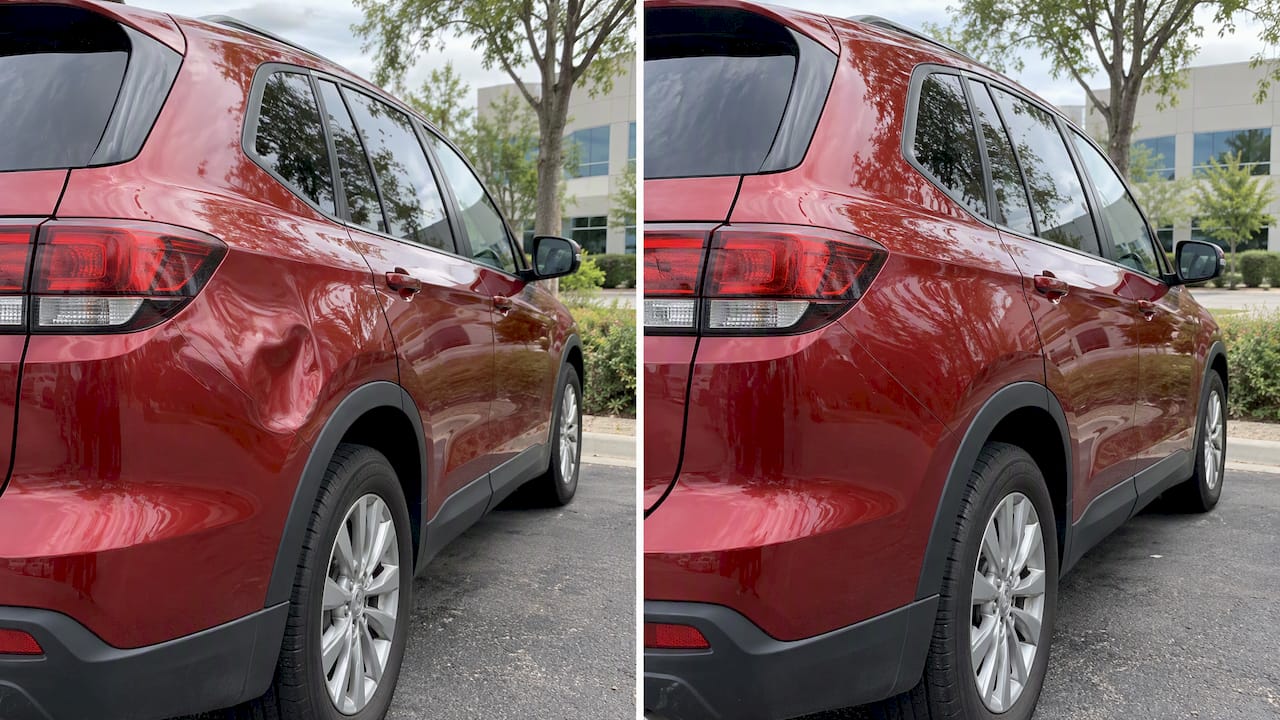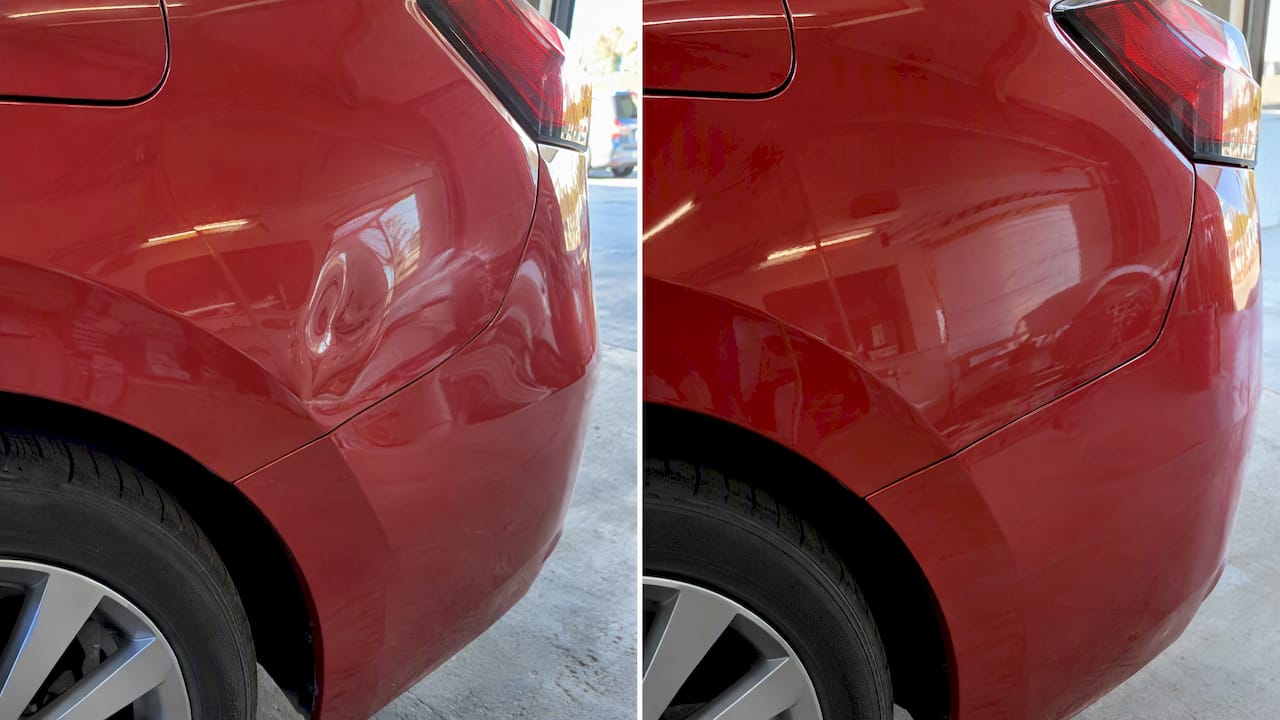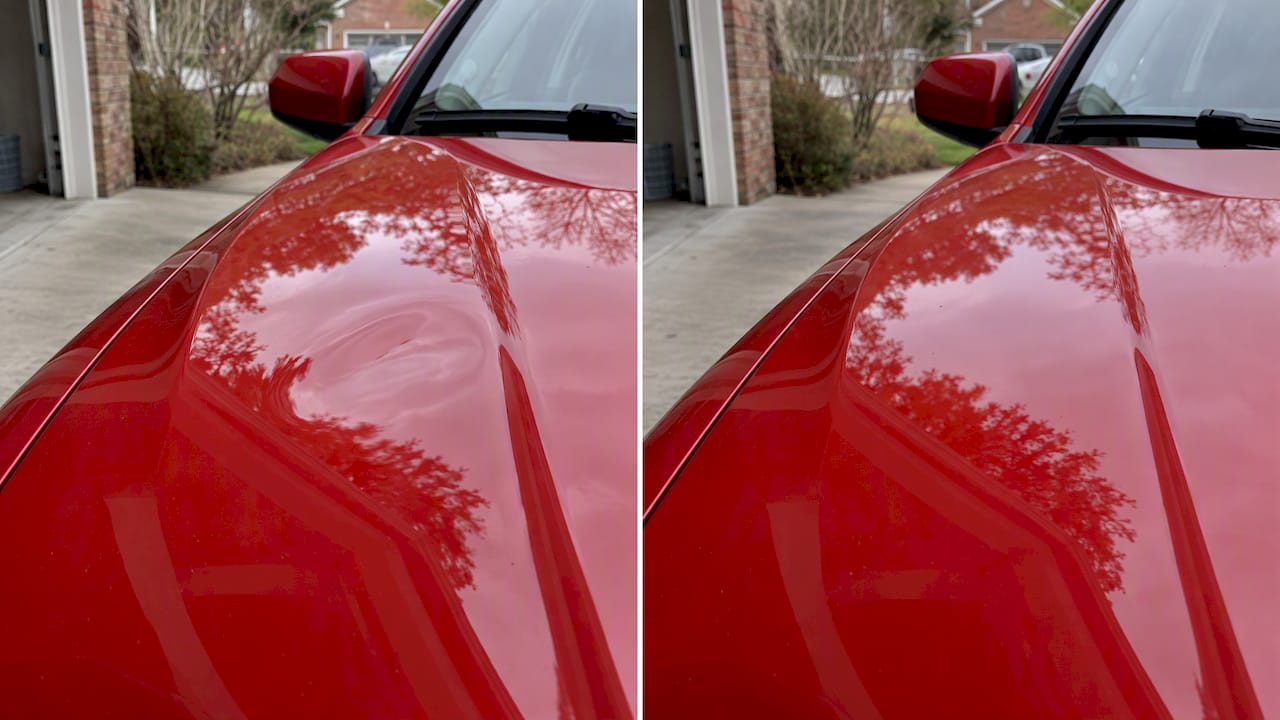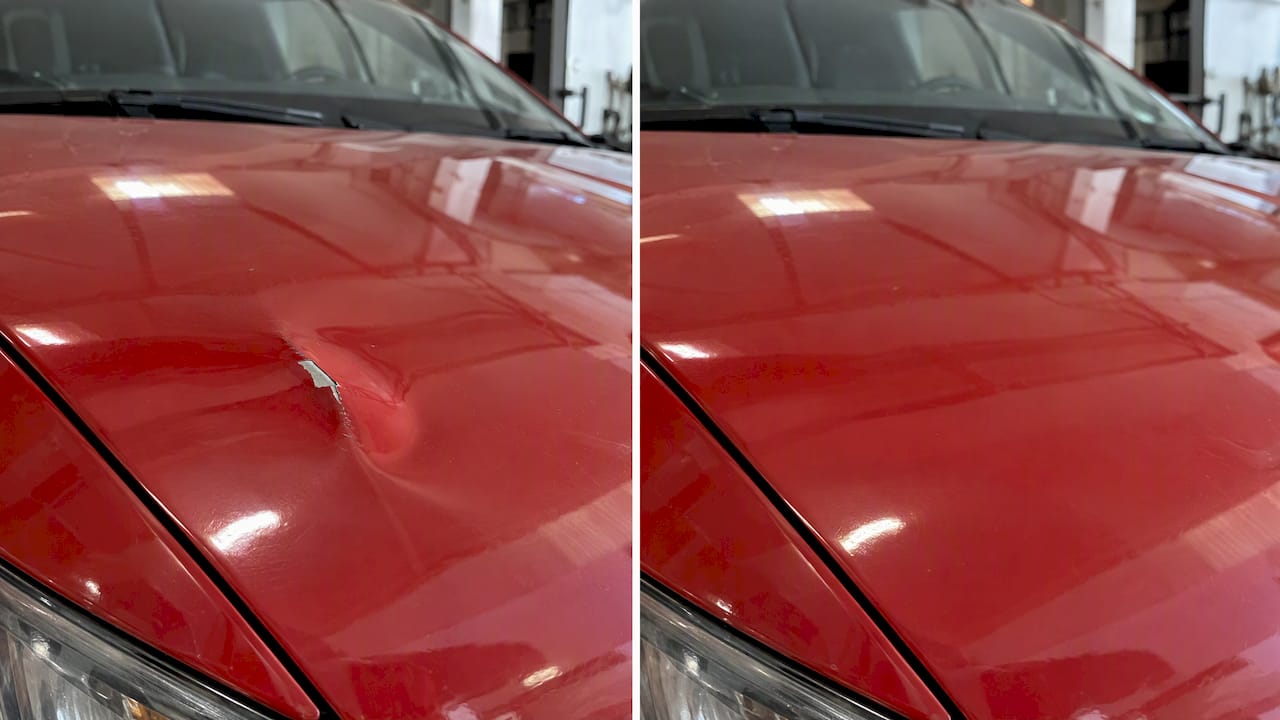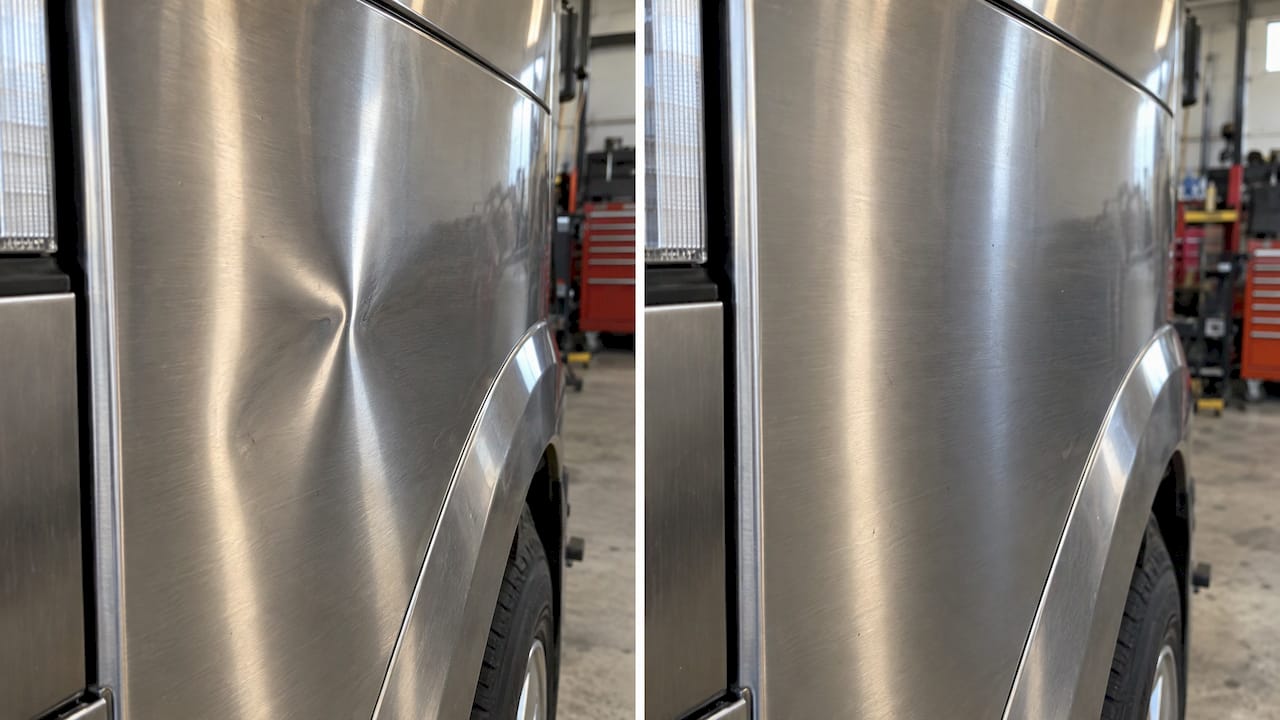
Yes, paintless dent repair (PDR) can work on stainless-steel vehicle panels, but only for the right dent and only with the right method. Tesla’s own Cybertruck repair manual allows PDR for cosmetic panel damage as long as no holes are drilled for tool access. Shallow, smooth dents with reachable backsides are good candidates. Sharp creases, panel edges and damaged finish usually are not.
TL;DR
- PDR is accepted for cosmetic stainless-steel panel damage on at least one major vehicle, and the maker’s repair procedure always has the final word.
- Shallow, rounded dents with some access behind the panel are the best fit. Sharp dents, edge dents and cracked finish are not.
- Stainless steel has no clear coat to hide mistakes. Sanding or aggressive pulling can leave a visible mark.
- Suction-cup pullers are a gamble on a stainless panel. A professional assessment costs far less than a ruined panel.
- Our published PDR pricing runs from $100 to $1,500 depending on dent size, and we come to you.
Table of Contents
- Why stainless steel is a different job
- Which dents suit PDR on stainless steel
- How a technician removes a stainless-steel dent
- The main risk: too much force
- Can you fix it at home with a suction cup?
- Perspective
- What PDR costs with us
- Get your dent assessed on site
- FAQ
- Sources
Why stainless steel is a different job
Most PDR guides assume painted steel or aluminum. Stainless-steel panels change the picture in two ways.
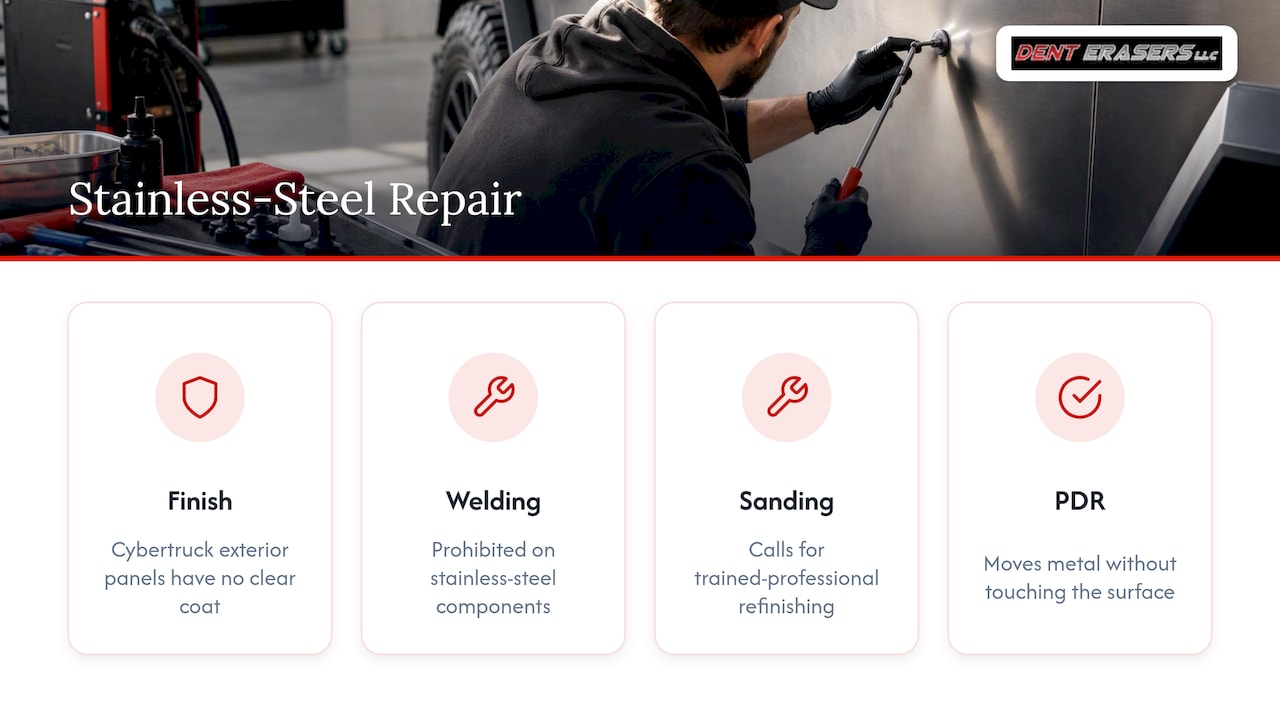
First, the finish is the metal. Tesla says Cybertruck exterior panels have no clear coat, so a scratch is a scratch in the stainless steel itself, not just in a coating. A painted panel hides small tool marks under refinishing. A bare panel does not.
Second, the repair options shrink. Tesla treats the stainless-steel body separately from its other materials and prohibits welding repairs on those components. Sanding is not a casual fix either: Tesla says it can change how the repaired area looks and calls for trained-professional refinishing.
That makes a clean, non-invasive method like PDR more valuable, not less. If the metal can be moved back without touching the surface, there is nothing to refinish.
The same maker also states that its stainless exterior is more resistant to dents and dings than most vehicle exteriors. Fewer dents is good news. The ones that do happen still deserve careful handling.
Which dents suit PDR on stainless steel
General Motors’ July 2023 U.S. service bulletin is a useful yardstick for steel outer panels. It describes PDR as a process for shallow dents that avoids filling, painting or replacing the panel. It also says PDR fits dents with intact paint, including large or small soft dents in body lines and contoured areas, when there is reasonable access from behind. That bulletin covers GM painted steel, not stainless, but the physics of a soft, rounded dent are the same.
In practice, these are the good candidates:
- Door dings and parking-lot impacts with rounded edges
- Shallow dents on flat or gently curved panels
- Soft dents with no sharp crease at the center
- Dents where a technician can reach the back of the panel without drilling
These are the poor candidates. GM’s bulletin lists them as inappropriate for PDR:
- Cracked paint or finish
- Repairs that need drilled access holes
- Dents that require removing structural parts
- Sharp dents in contoured areas
- Dents on a panel edge
- Dents where a zero-clearance glue pull fails
Size matters too. GM notes that dents over 3 inches and up to 6 inches across may still need conventional repair. That is the rule for its vehicles, so treat it as a guide rather than a hard limit for every panel.
How a technician removes a stainless-steel dent
There are two principal approaches. A technician either pushes the dent out from behind with rods or body picks, or pulls it from the outside with glue tabs. Light tapping then knocks down any high spots, as the general PDR overview explains.
Professional standards stress judgment before tools. The UK Institute of the Motor Industry standard requires the technician to assess whether the repair can reach an acceptable standard without compromising the vehicle, and to choose tools suited to that panel area. It also says drilling for access is not acceptable.
Glue-tab pulling
When the back of a panel is blocked, glue pulling is the usual answer. One industrial dent-lifter manual describes the method as usable on stainless steel, aluminum and sheet steel from 0.5 to 2 mm thick, with low heat and no repainting when the surface and technique allow. The sequence it describes:
- Clean the dent.
- Glue an adapter at the deepest point.
- Let it cool.
- Pull with a sliding hammer.
- Heat and remove the adhesive residue.
The same document says that skipping a repaint depends on the quality of the existing finish and on how the product is used. On a bare stainless panel, that means technique and cleanup matter a great deal.
Heat and induction
Some shops use induction tools. The manufacturer describes the idea as heating ferrous metal so expansion pushes a dent outward, then cooling lets the metal contract and level. It is meant for soft dents, door dings and hail dents. Whether it suits a given stainless alloy and finish is a call for the technician, since heat can discolor a bare surface.
The main risk: too much force
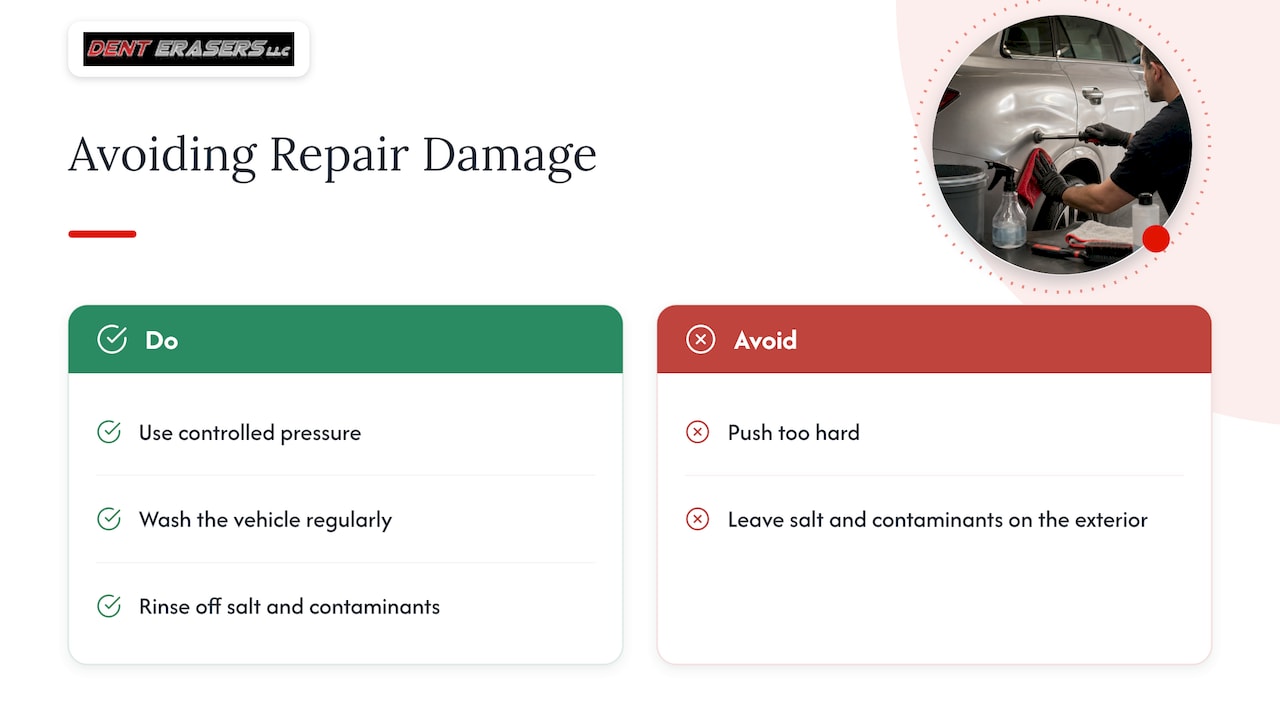
PDR works because the metal moves within its elastic range. Training material from a PDR tool maker explains that controlled pressure lets the technician see the tool’s effect without permanently deforming the panel. Push too hard and you create a high spot, damage the finish, and can stretch the panel enough to crack paint.
On stainless steel there is no paint to crack, but the lesson holds. An over-pushed high spot is visible in the reflection, and it is hard to undo. Tesla also requires that when a stainless scratch is refinished, the entire flat plane be refinished, and the same plane across other panels on that side, so the look stays consistent. A small mistake can grow into a large repair.
One more care point after any repair: Tesla warns that acidic or corrosive substances, road salt and industrial fallout can corrode the stainless exterior. Wash the vehicle regularly and rinse off salt and contaminants.
Can you fix it at home with a suction cup?
Suction-cup pullers are sold widely for car dents, and they can sometimes lift a large, shallow, flexible dent. On a stainless panel, though, a failed attempt can add a pulled-out high spot to the original dent, and neither a bare finish nor a refinish forgives that. We have not found a manufacturer procedure that endorses suction pullers for stainless vehicle panels, so check your owner’s documentation first.
If the dent is small, shallow and rounded, a quick photo to a professional will tell you whether it is worth leaving alone, pulling or repairing properly. Our checklist for paintless dent removal shows what to look at before you decide.
Perspective
After 27+ years in dent repair, our view is simple: the panel tells you what it will allow. Our job is to read it before a tool touches it.
A stainless panel leaves no room to hide. There is no clear coat to blend a mistake into, so patience, light and a steady hand count for more than speed. That is why we assess every dent first and say plainly whether PDR fits.
When it does, the payoff is real: no filler, no repaint, and the original finish stays intact. We bring the work to your driveway or workplace, so you do not lose a day to a shop visit.
Brian Blanc
What PDR costs with us
Prices on our site are published as ranges because every dent is different. Paintless dent repair runs $150 to $500, minor dent repair $100 to $500, and large dent repair $150 to $1,500. Depth, size, location on the panel and access all move the final number. Your quote tells you the exact price before work begins.
Get your dent assessed on site
We serve Contra Costa County and surrounding areas with mobile dent repair at your home or office. If you drive a luxury, classic or specialty vehicle, or you are handling a lease return, fleet or insurance claim, our specialty services cover those cases too.
Send us photos and we will tell you whether PDR is realistic. Get your free dent quote in a few minutes.
Want to understand the method first? Read why paintless repair beats traditional methods.
FAQ
Can PDR be done on a stainless-steel vehicle?
Yes, in the right cases. Tesla’s Cybertruck repair manual accepts PDR for cosmetic panel damage when no holes are drilled for access. The vehicle maker’s own procedure decides what is allowed for your model.
Will PDR leave marks on bare stainless steel?
Done well, it should not. The risk comes from too much pressure, which creates high spots, or from heat and adhesive residue left behind. That is why the technician’s skill and an assessment first matter so much.
When does a stainless panel need conventional repair instead?
Cracked finish, sharp dents in contoured areas, panel-edge dents and repairs that would need drilled access holes are usually outside PDR. Very large dents may also need conventional work. A technician can confirm after seeing the damage.
Is a dent in stainless steel covered by insurance?
That depends on your policy and deductible. We offer insurance claim assistance, so ask when you request your quote and we will explain the process.
Sources
- Body Structure Materials and Allowed Operations, Tesla Cybertruck Body Repair
- Exterior Cleaning, Tesla Cybertruck owner guidance
- Exterior Stainless Steel Panel Refinishing, Tesla Cybertruck Service Manual
- General Motors service bulletin 99-08-51-001F, July 2023
- IMI standard: Remove Dents and Creases from Motor Vehicle Body Panels
- Dent Lifter Set documentation
- Inductor Max PDR Kit product page
- Technical training support for PDR
- Paintless dent repair overview