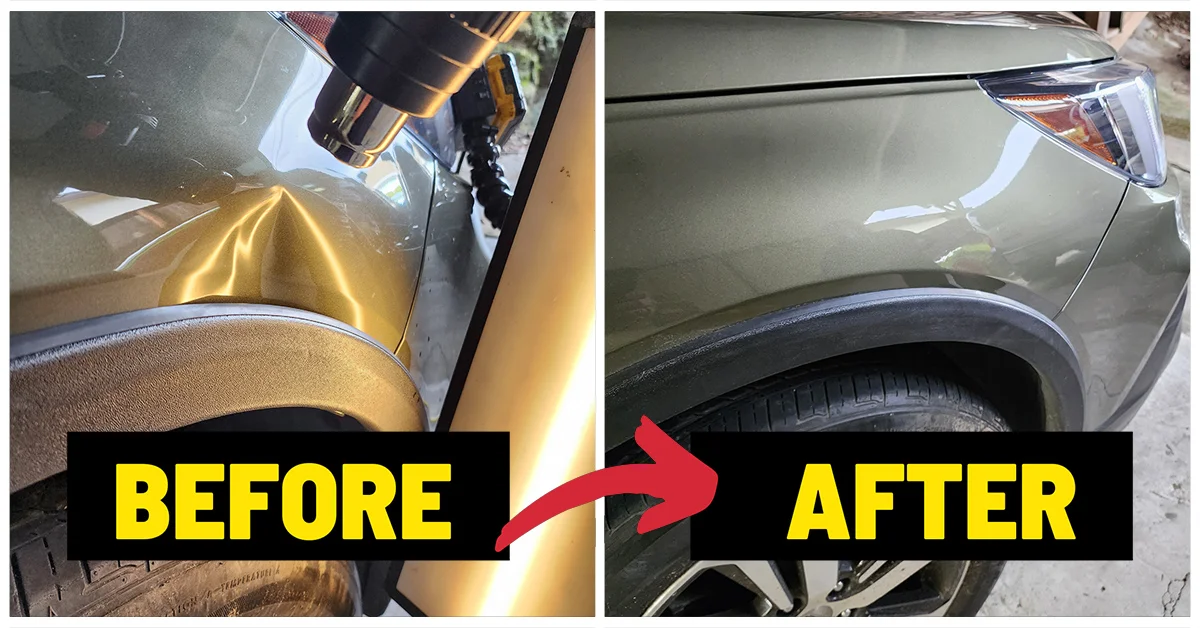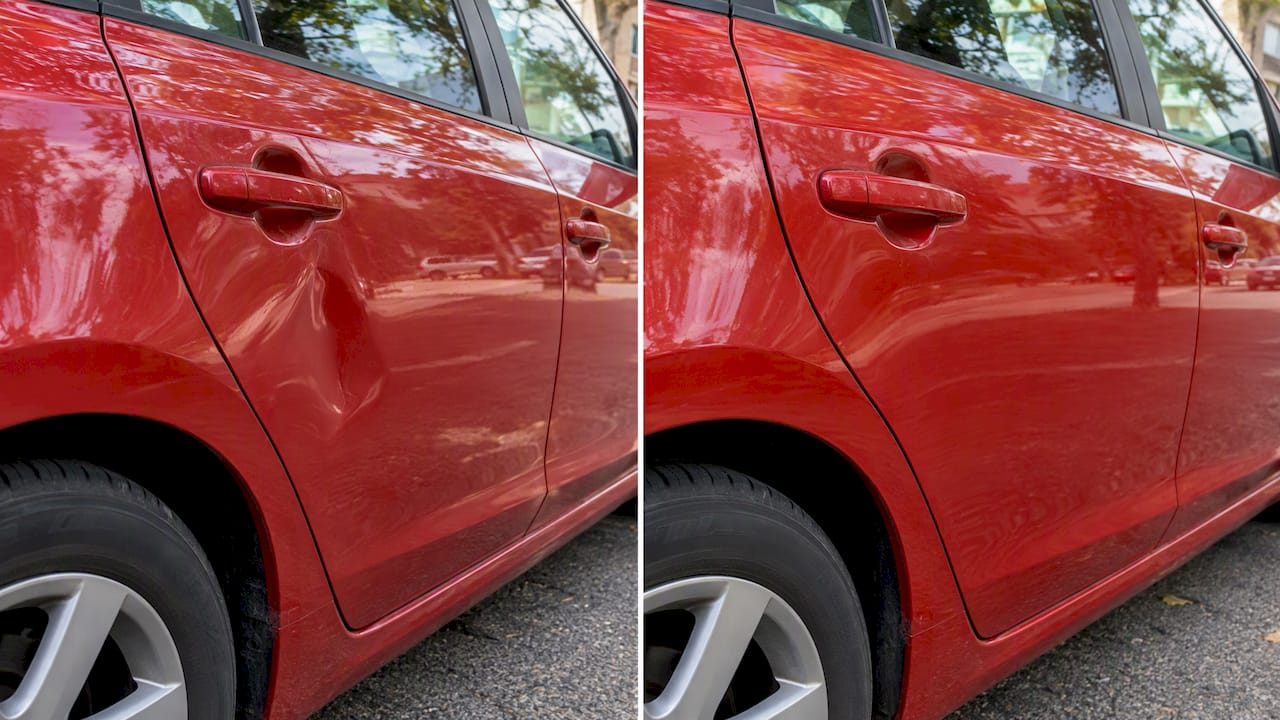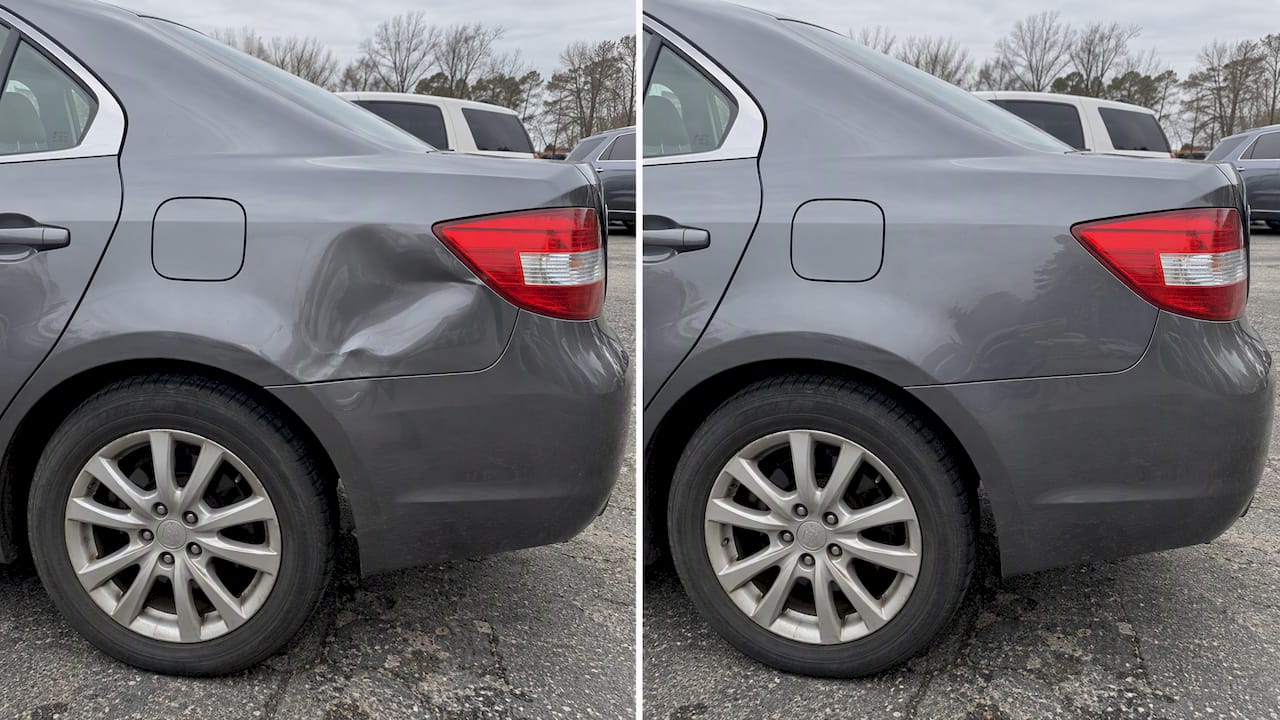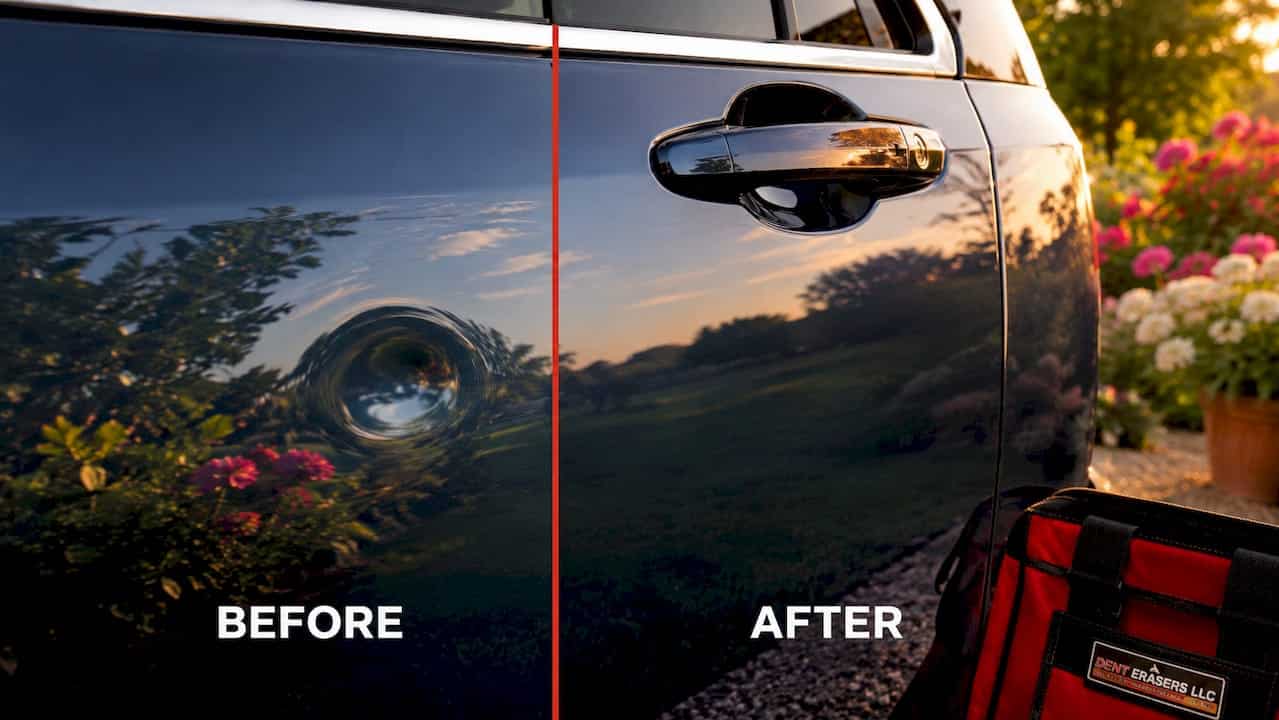
Paintless dent repair (PDR) is the most effective method to repair dents near door handles when the factory paint remains intact and the metal has not been sharply creased. PDR requires no sanding, filling, or repainting, which means your vehicle keeps its original finish and its resale value stays protected. Denterasersllc specializes in exactly this type of repair, using professional tools and techniques to massage metal back to its original shape without leaving a trace. Acting early matters too. A dent left untreated exposes bare metal to moisture, and rust follows quickly.
Why are dents near door handles so hard to repair?
Dents near door handles sit in one of the most mechanically complex areas of a car door. The handle hardware, reinforcement bars, and interior trim all crowd the space behind the outer panel. That limited access makes it difficult to position a rod behind the dent and apply steady, controlled pressure.
The physical characteristics of the dent matter just as much as its location. Sharp, deep dents near body lines require more skill and time to fix than larger, softer dents. A shallow, round ding responds well to PDR. A sharp crease near a body line is a different problem entirely and carries a higher risk of paint cracking or metal stretching if handled incorrectly.
Access is the other major challenge. Dents near door handles often require removal of interior trim or weatherstripping before a technician can even reach the back of the panel. Sometimes reinforcement bars block rod access completely, making the glue-pull method the only viable option.
Key factors that make this area difficult:
- Tight clearance behind the panel limits rod angles and movement
- Reinforcement bars block direct access to the dent from behind
- Metal tension near the handle recess makes the metal more work-hardened
- Body line proximity increases the risk of a sharp crease that resists reshaping
- Paint stress is higher near edges and hardware cutouts
Pro Tip: Before any repair attempt, inspect the paint under direct sunlight or a focused flashlight. If you see white stress marks or cracking in the paint, PDR is no longer an option. That dent needs a body shop.
How to fix door dents using paintless dent repair: step by step
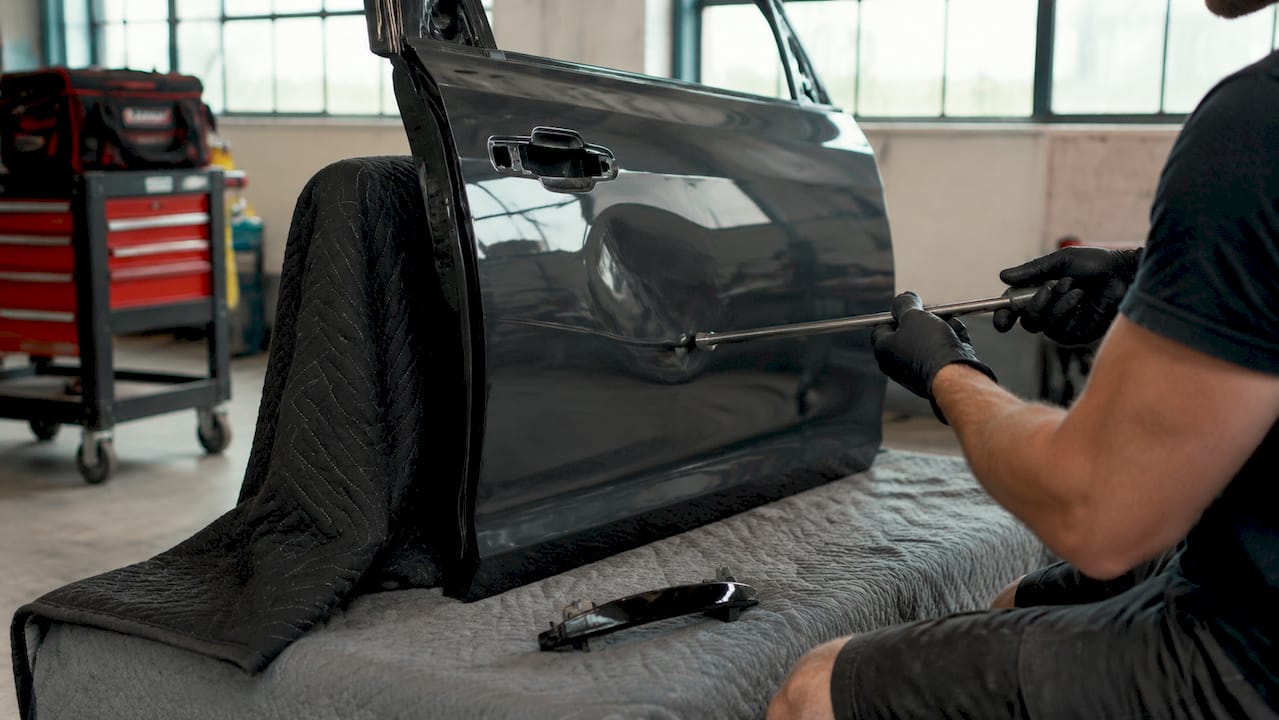
PDR is a precise metalworking art, not simply popping a dent out with suction. Technicians use tempered steel rods and glue-pulling techniques to reshape metal from behind or in front without touching the paint. Here is how a professional approaches a door handle dent repair.
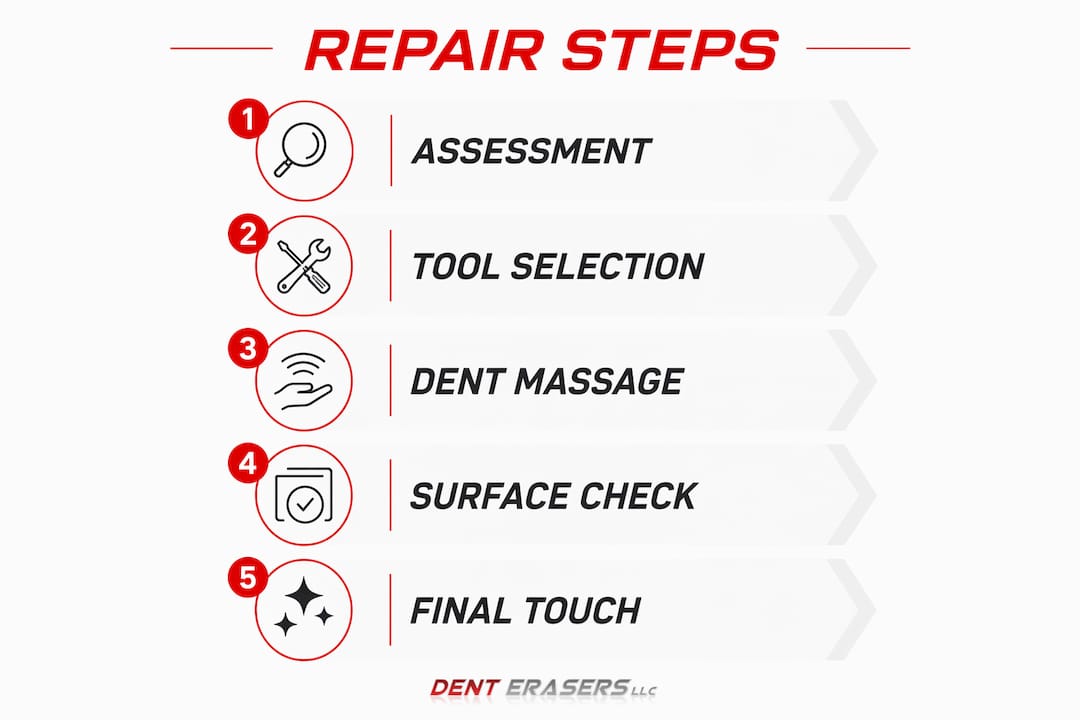
- Assess the dent. Check paint condition first. Look for cracks, chips, or stress marks. Confirm the dent has no sharp creases. Measure the approximate size and depth.
- Set up specialist lighting. LED light boards reveal subtle distortions invisible to the naked eye. Position the board so the reflection lines show exactly where the metal is low or high.
- Remove interior trim. Carefully pull the door panel, handle trim, and any weatherstripping blocking access. Professional technicians plan their access route before touching the metal.
- Choose your method. If rod access is clear, use a steel rod to apply gentle upward pressure from behind. If reinforcement bars block the path, switch to the glue-pull method.
- Apply the glue-pull method if needed. Hot-melt glue and plastic tabs draw the dent outward. After pulling, use a knockdown tool to carefully tap down any high spots.
- Massage the metal back. Work from the outer edges of the dent toward the center. Apply light, rhythmic pressure. Never force the metal. Let it move gradually.
- Inspect under lighting. Check the reflection lines again. Any remaining low spots or waves show up clearly. Repeat pressure steps until the panel is flat.
| Repair stage | Tool used | Purpose |
|---|---|---|
| Assessment | LED light board | Reveal dent depth and paint condition |
| Access | Panel removal tools | Clear path to back of panel |
| Push method | Tempered steel rod | Lift metal from behind |
| Pull method | Glue tabs and puller | Draw metal out when rod access is blocked |
| Final check | LED light board | Confirm panel is flat with no high spots |
Most PDR repairs complete in 60–90 minutes, preserving the factory finish and protecting resale value. That speed is one of the biggest practical advantages over traditional body shop work.
Pro Tip: Never rush the metal. Applying too much pressure at once creates a high spot that is harder to fix than the original dent. Slow, steady pressure is the professional standard.
When is DIY dent repair safe near door handles?
DIY repair is only appropriate for very specific conditions. A small, shallow, round ding with fully intact paint and no sharp edges is the only scenario where a home repair attempt is reasonable. Any other situation carries a real risk of making the damage worse.
DIY dent repair near door handles carries a high risk of creating high spots or stretching the metal further. Both outcomes lead to more expensive repairs. A stretched panel cannot be fully corrected with PDR and may require filler or repainting.
Conditions where DIY is not appropriate:
- Paint is cracked, chipped, or shows white stress marks
- The dent has a sharp crease or sits on a body line
- The dent is larger than a golf ball
- The dent is directly over a reinforcement bar
A plunger or basic suction tool can work on a perfectly round, shallow ding on a flat panel section. Near door handles, the panel curves and the metal is stiffer. That combination makes suction tools unreliable and increases the chance of pulling the metal unevenly.
If you try a DIY kit and the dent does not move cleanly on the first attempt, stop. Repeated pulling stretches the metal and turns a $150 repair into a $500 one. Knowing when to call a professional is the most cost-effective decision you can make.
How to find a reliable mobile dent repair service for door handle dents
A mobile dent repair service comes to your location, which means no drop-offs, no waiting rooms, and no rental cars. For minor door handle dents, that convenience is a genuine time-saver.
Professional mobile PDR for minor door dings costs $195–$350 on average and often completes the same day. Standard turnaround is 30 minutes to a few hours on-site. That pricing reflects the skill involved, not just the time.
Follow these steps to get an accurate estimate and find a qualified provider:
- Take high-resolution photos in natural light from multiple angles. Include a close-up and a wider shot showing the dent’s location relative to the door handle.
- Text or email the photos with your car’s year, make, model, and color. Sending clear photos lets professionals assess the dent remotely before scheduling.
- Ask about their PDR certification and how long they have worked on door handle dents specifically. This area requires more experience than a flat hood dent.
- Confirm the repair method they plan to use. A qualified technician will explain whether they will use rod access, glue pull, or a combination.
- Check reviews and before-and-after photos. Visual proof of past work is the most reliable quality indicator.
For guidance on what separates a skilled provider from an average one, the PDR service checklist from Denterasersllc covers the key questions to ask before you commit.
Key Takeaways
Paintless dent repair is the single best method for fixing door handle dents when paint is intact, and acting quickly prevents rust and keeps repair costs low.
| Point | Details |
|---|---|
| PDR preserves factory paint | No sanding or repainting means your vehicle retains its original finish and resale value. |
| Location adds complexity | Reinforcement bars and tight clearance near handles often require trim removal and specialized access. |
| DIY has strict limits | Only attempt DIY on small, shallow, round dings with fully intact paint. Stop if the dent does not move cleanly. |
| Mobile PDR is fast and affordable | Most door handle dent repairs complete in 60–90 minutes at $195–$350 for minor dings. |
| Photos speed up estimates | High-res photos with car details let technicians assess the repair remotely and schedule accurately. |
What I have learned from years of repairing door handle dents
The dents I see most often near door handles come from parking lots. Someone swings their door open too fast, catches the edge of your panel, and walks away. The damage looks minor. That is exactly why so many car owners wait too long to fix it.
Here is what I have seen play out repeatedly: a small ding sits untreated for six months. Moisture gets under the paint edge. Rust starts forming from the inside out. What would have been a straightforward PDR job becomes a body shop repair with filler and paint. The cost jumps from a few hundred dollars to well over a thousand.
The other mistake I see is the DIY attempt on the wrong dent. A car owner buys a glue-pull kit, pulls too hard, and creates a high spot. Now the panel has a crown where the dent used to be. Fixing a high spot is harder than fixing the original dent because the metal has been stretched. I always tell people: if you are not sure, send me a photo first. It costs nothing to ask.
The technology in PDR has improved significantly over the years. LED light boards in particular changed the game. They show distortions that are completely invisible under shop lighting. That precision is why a skilled technician can restore a panel to factory condition without touching the paint. It is genuinely satisfying work, and the results speak for themselves.
— Brian Blanc
Denterasersllc can handle your door handle dent repair
Denterasersllc brings professional paintless dent repair directly to you across Contra Costa County and surrounding areas. Whether your dent is a small parking lot ding or a more complex crease near the handle recess, the team has the tools and experience to restore your panel without touching the factory paint.

Browse the fender repair gallery to see the quality of work Denterasersllc delivers on real vehicles. For car owners who want to choose the right PDR provider and avoid costly mistakes, that resource walks you through exactly what to look for. Contact Denterasersllc for a free estimate. Send your photos, your car details, and your location, and get a same-day response.
FAQ
What is paintless dent repair and how does it work?
Paintless dent repair is a technique that uses steel rods and glue-pull tools to massage metal back to its original shape without sanding or repainting. It works only when the factory paint is fully intact and the dent has no sharp creases.
How much does it cost to repair a dent near a door handle?
Professional mobile PDR for minor door dings costs $195–$350 on average, with most repairs completing in 30 minutes to a few hours on-site. Sharp creases or dents requiring trim removal may cost more due to added complexity.
Can I use a DIY kit to fix a dent near my door handle?
DIY kits are only safe for small, shallow, round dings with fully intact paint. Near door handles, the curved panel and stiffer metal make DIY tools unreliable, and a failed attempt can stretch the metal and increase repair costs significantly.
How do I get an estimate for a door handle dent repair?
Text or email high-resolution photos of the dent along with your car’s year, make, model, and color to a local PDR provider. Most technicians can assess the repair remotely and give you an accurate quote before scheduling.
Does fixing a dent near the door handle affect my car’s resale value?
A properly completed PDR repair preserves your factory paint and leaves no Carfax record, which protects resale value. Leaving the dent untreated risks rust and paint damage that reduces value far more than the cost of repair.