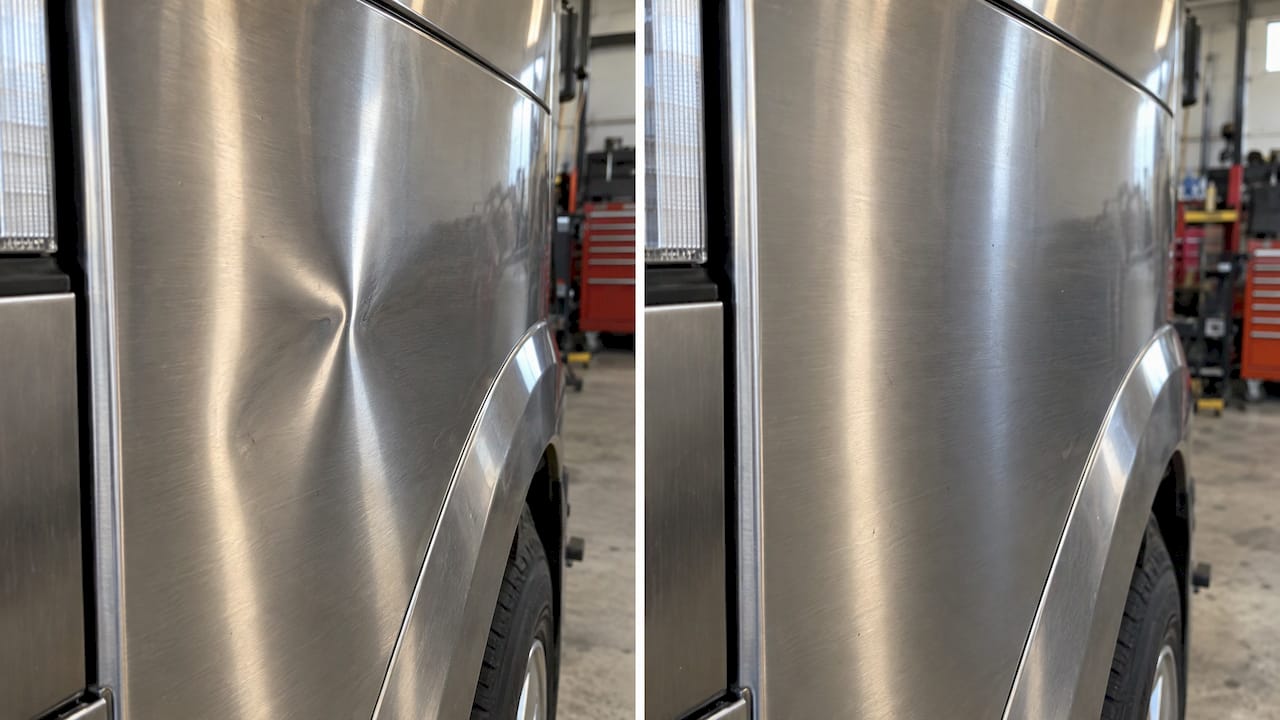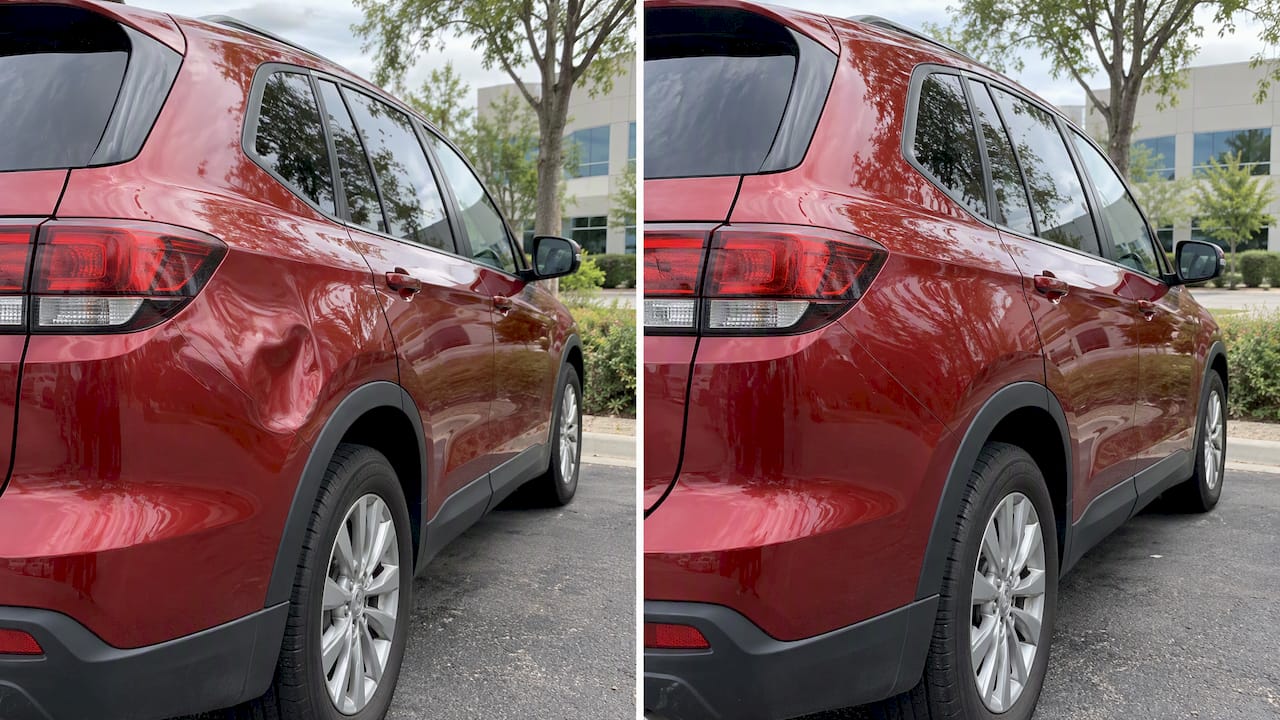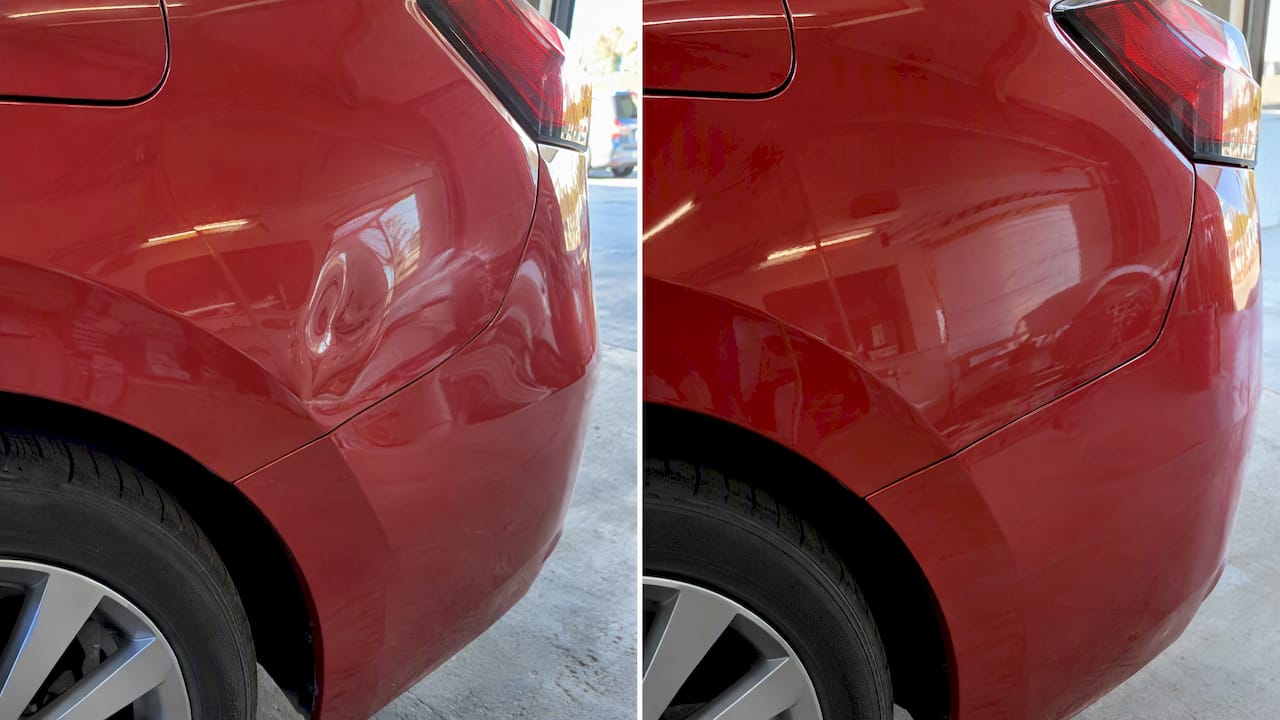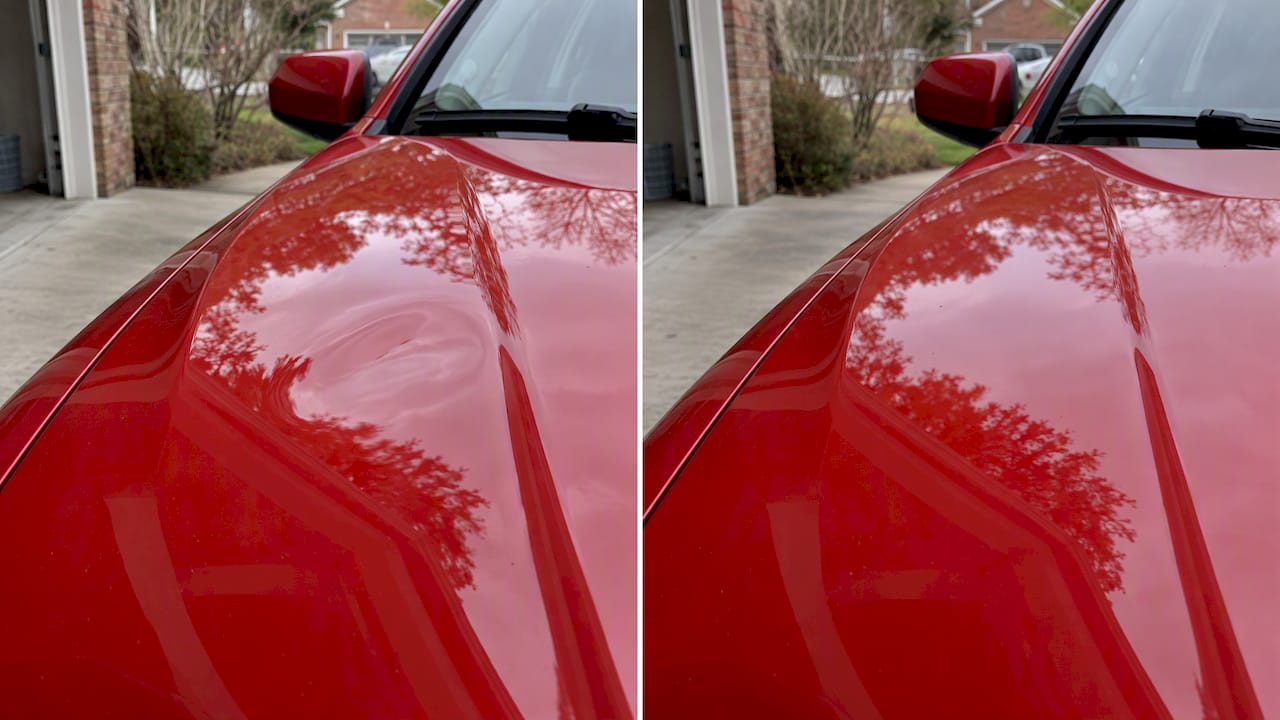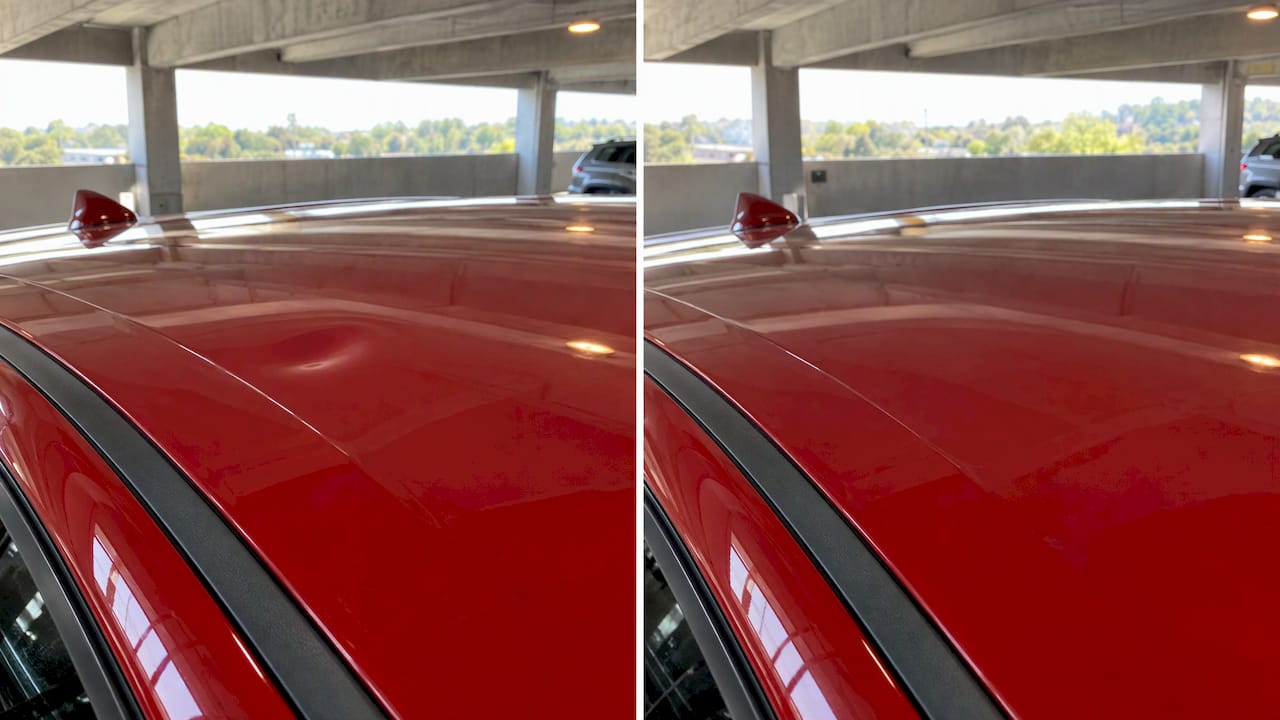
Yes. Paintless dent repair (PDR) is safe for your car’s paint and body panels when the paint is unbroken and a technician can reach the back of the dent. The metal is gently massaged back into shape, so nothing is sanded, filled or repainted. The real risks come from the wrong dent, the wrong technician or a DIY kit, and this guide shows you how to avoid all three.
TL;DR
- PDR is safe for factory paint: the repair works from behind the panel and does not remove your paint, according to the National Association of Paintless Dent Repair Technicians (NAPDRT).
- General Motors tested PDR procedures and found no negative impact on the repaired parts.
- It works best on dents with intact paint and reasonable access. Cracked paint, sharp creases and stretched metal usually need conventional repair.
- Most of the risk comes from DIY pullers and inexperienced technicians, not from the method itself.
- A skilled mobile technician can check your dent on site and tell you honestly whether PDR fits.
Table of Contents
- Why PDR is safe for your paint
- What automakers say
- Which dents PDR can and can’t fix
- Does PDR affect your car’s value?
- The real risks: DIY kits and the wrong technician
- Caring for the paint after a repair
- Get your dent checked on site
- FAQ
- Sources
Why PDR is safe for your paint
Traditional bodywork fixes a dent by sanding, filling, priming and repainting. Each step replaces some of what the factory put on your car. PDR skips all of it.
A technician uses specialty tools and controlled pressure to work the metal back to its original shape from behind the panel. NAPDRT explains that PDR removes minor dents without removing the vehicle’s paint, and that modern factory paints are flexible enough that the process will not damage them.
That matters for three practical reasons:
- No new paint to match. There is no blended color and no visible edge where a repaint begins.
- No filler to fail. Nothing is added to the panel that could shrink, crack or peel later.
- Your original finish stays original. That is a plus for resale, lease returns and collectors.
If you want the longer version of these advantages, see our guide to the top benefits of paintless dent repair over traditional methods.

What automakers say
It is not only repair associations that back the method. In a July 2023 technical service bulletin filed with NHTSA, General Motors reports that it evaluated PDR procedures and found no negative impact on the repaired parts. The same bulletin calls PDR an appropriate process for most panels with reasonable access to the backside of the damage, which removes the need to fill, paint or replace the panel.
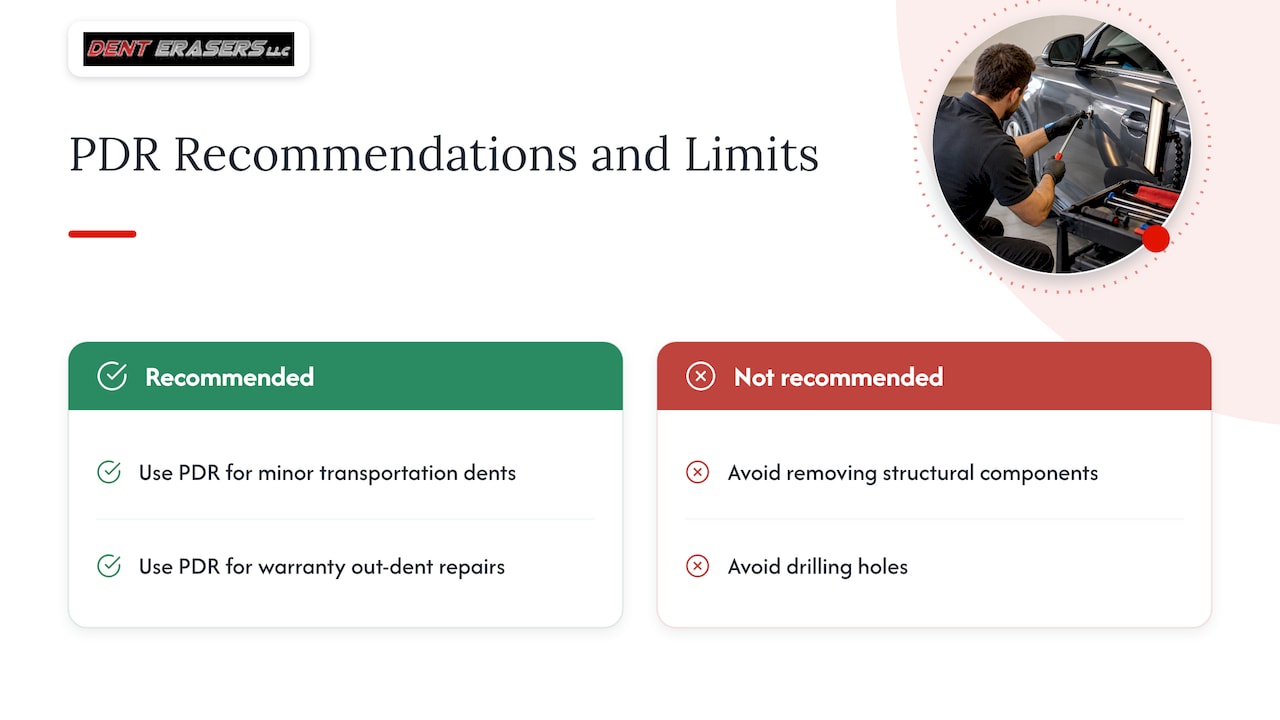
The bulletin is also clear about limits. It recommends PDR for minor transportation dents and warranty out-dent repairs. It does not recommend removing structural components or drilling holes, which may void the corrosion warranty. In other words, the method is safe when it is used on the right kind of damage.
Which dents PDR can and can’t fix
Safe use starts with the right dent. According to NAPDRT, PDR can repair about 95% of minor dents. The other 5% or so cannot be fixed because of their depth or location.
| Situation | Good PDR candidate? |
|---|---|
| Door ding, parking lot dent, shopping cart dent | Yes, if paint is intact |
| Hail dents and soft-object dents | Often yes, depending on size and access |
| Shallow to medium dent with reasonable backside access | Yes |
| Cracked, chipped or peeling paint | No, paint repair is needed |
| Sharp crease or very deep dent | Sometimes harder; may need conventional repair |
| Metal that is badly stretched | Usually no |
| Panel edge or tight area where tools can’t reach | Often no |
The GM bulletin adds that dents over 3 inches may need conventional repair, and that cracked paint, sharp dents and dents needing holes or structural removal are inappropriate for PDR. Treat that 3-inch figure as a rule of thumb for that automaker’s guidance, not a hard line for every panel. A technician looks at metal condition, location and access, not just width.
Can PDR make paint crack?
PDR does not crack sound factory paint. Cracks that show up are usually already there, or the paint was weakened by a prior repair, an aftermarket repaint or age. NAPDRT notes that cracked paint can signal that a dent is too deep for PDR. If your dent has fine cracking around it, read how to prevent paint cracking around dents before you book.
Does PDR affect your car’s value?
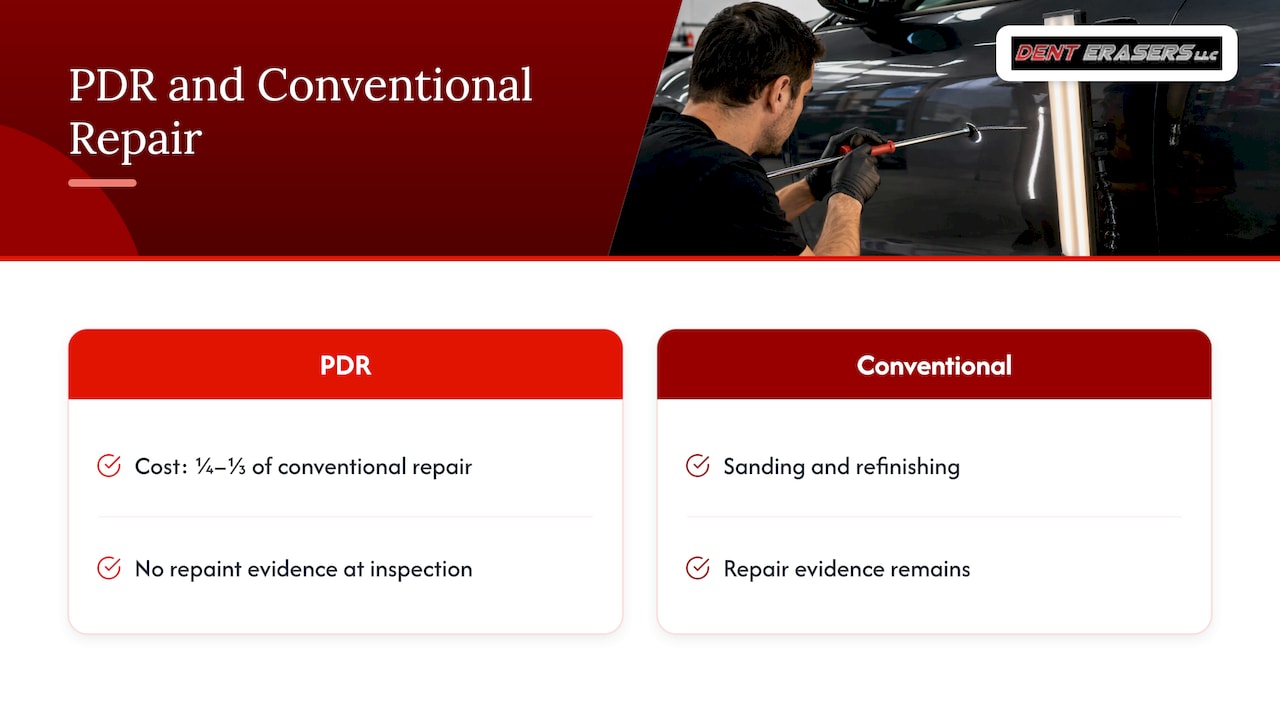
Done well, it protects it. Because the factory finish stays in place, there is no repaint to appear on a vehicle history inspection or a lease-return check. A repair that needs sanding and refinishing is the one that leaves evidence behind.
PDR also tends to cost less. NAPDRT says PDR typically costs between one-quarter and one-third as much as conventional dent repair. For our own price ranges, our paintless dent repair pricing guide breaks down what drives the cost.
The real risks: DIY kits and the wrong technician
The method is safe. The shortcuts around it are where paint gets hurt.
- DIY suction cups, glue pullers and hammer kits. Without training, it is easy to over-pull the metal, leave a high spot or lift paint with glue. A dent you could have fixed for a modest fee can become one that needs paint.
- Heat and tools used without experience. Paint and metal need controlled, patient work.
- Taking on a dent that PDR can’t fix. A technician who pushes ahead on cracked paint or a stretched crease can make the damage worse. An honest one tells you to go the body shop route.
Before you hire anyone, run through our paintless dent removal checklist. Ask how long they have been doing PDR, whether they inspect before quoting, and what they will do if the dent turns out not to be repairable.
Caring for the paint after a repair
After PDR your paint is the same finish you started with, so normal care applies. If you have a ceramic-coated or matte finish, use the right products for it. For road tar and similar contamination, this guide shows how to remove tar from car paint safely without harming a protective finish.
Our perspective
After more than 27 years of working on dents, we have seen the same pattern: the repairs that go wrong rarely go wrong because of PDR itself. They go wrong because the dent was never inspected properly, or because someone tried to pull it with a kit from the internet.
That is why we start with the paint and the metal. If the paint is intact and we can get behind the panel, PDR keeps your factory finish exactly where it belongs. If it is not a PDR dent, we say so, and our auto body and collision team can take care of it.
We do it at your home or workplace, so you don’t lose a day waiting at a shop. That includes luxury and classic cars, motorcycles, fleets and lease returns, where keeping the original finish matters most.
Brian Blanc
Get your dent checked on site
If you are in Contra Costa County or nearby, we come to you. Our published ranges are $100 to $500 for minor dent repair and $150 to $1,500 for large dent repair, and the final price depends on the dent’s size, depth and location. Our mobile dent repair service brings the work to your driveway or parking lot.
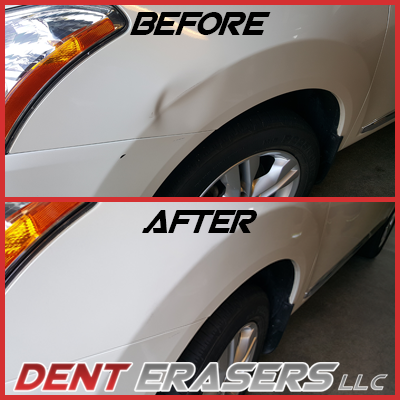
Send us photos and get a free dent quote, and we will tell you whether PDR is the right fix.
FAQ
Is PDR safe for new cars and leased cars?
Yes, when the paint is intact and the dent is accessible. General Motors’ own bulletin recommends PDR for minor transportation dents and warranty out-dent repairs. Because it keeps the original finish, it is a common choice before a lease return. Our lease return dent repair page explains how we handle it.
Can PDR remove creases?
Sometimes. Shallow, rounded creases are often repairable, while sharp creases and stretched metal are harder and may not be fixable. NAPDRT says that deeper dents are harder to repair and that metal that is too stretched may not be repairable. A technician needs to see the crease in person or in clear photos.
Does insurance pay for PDR?
Often it can, but it depends on your policy. One example: Zurich’s PDR plan excludes dents larger than 4 inches and sharp creases, and its hail coverage is very limited. Check your own policy and your deductible first. We offer insurance claim assistance, so ask us when you request a quote.
Does PDR really work?
Yes, for the right dents. NAPDRT says it can repair about 95% of minor dents. Results depend on the technician’s skill, the dent’s depth and whether the paint is intact.
Should you fix a dent in your car?
Usually yes, and sooner is better, especially if the paint is still intact. A dent left alone can end up with paint damage around it, and then PDR is off the table. Our guide to paint and dent repair costs shows what waiting can cost.
Sources
- About Paintless Dent Repair, NAPDRT
- GM technical service bulletin 99-08-51-001F, NHTSA (July 2023)
- Paintless Dent Repair, Zurich (2025)
- Remove Tar from Your Car Safely, Diamondbrite