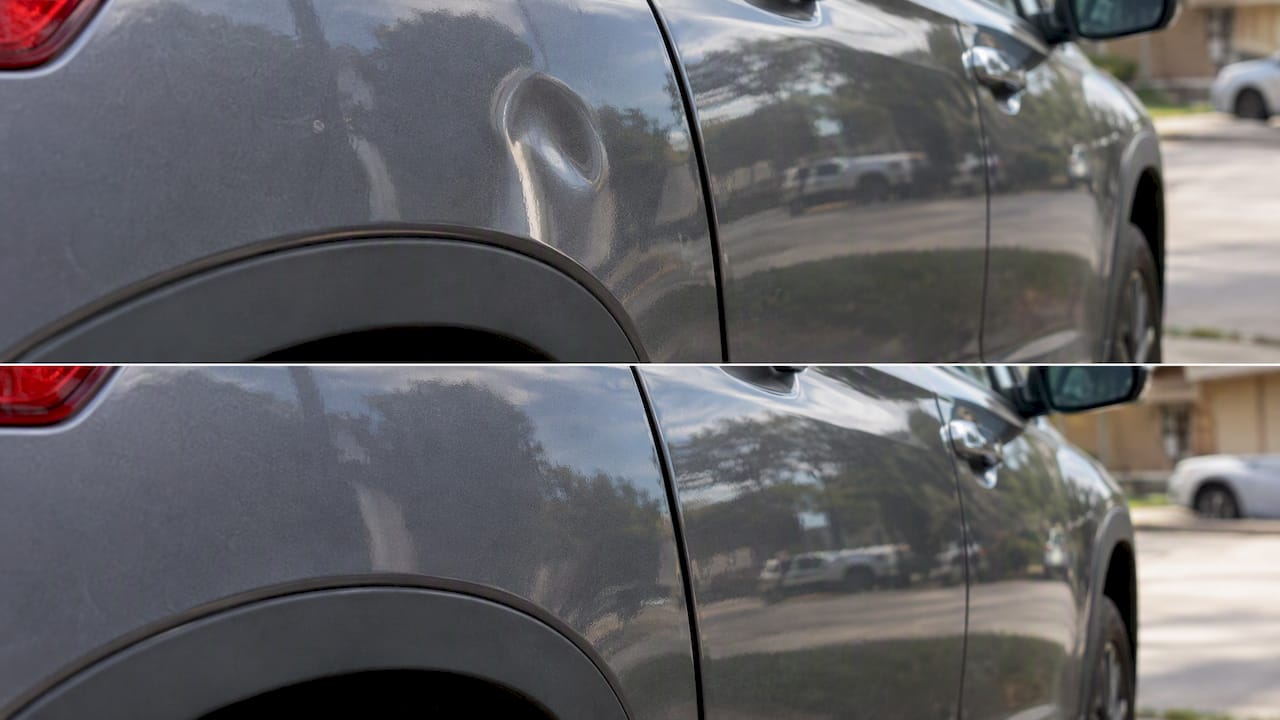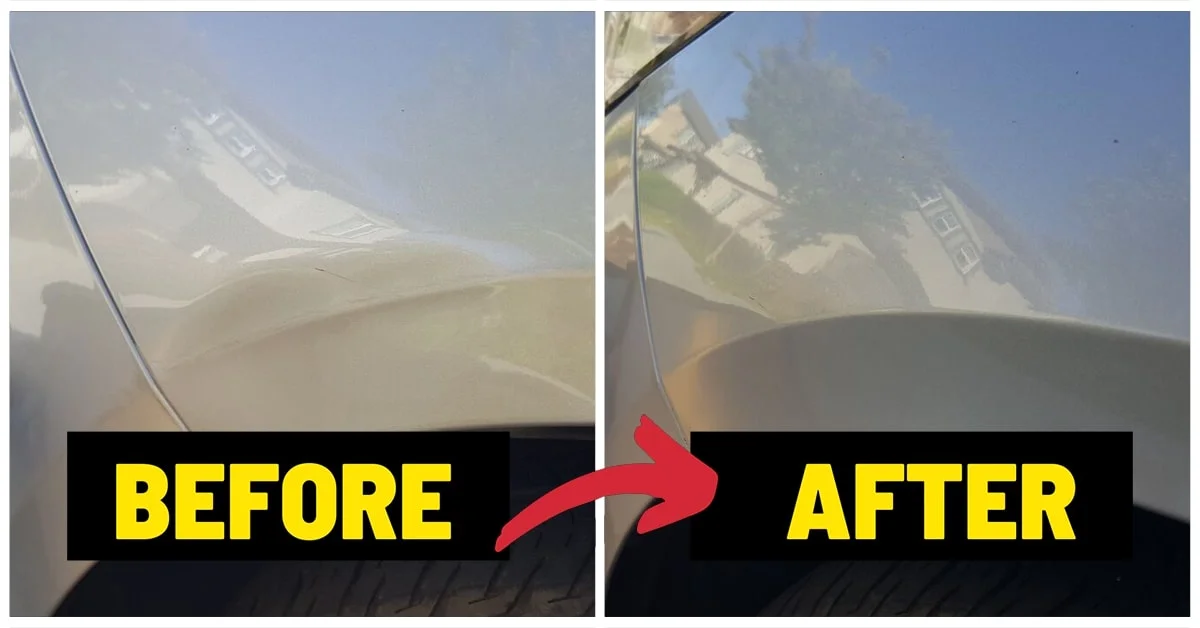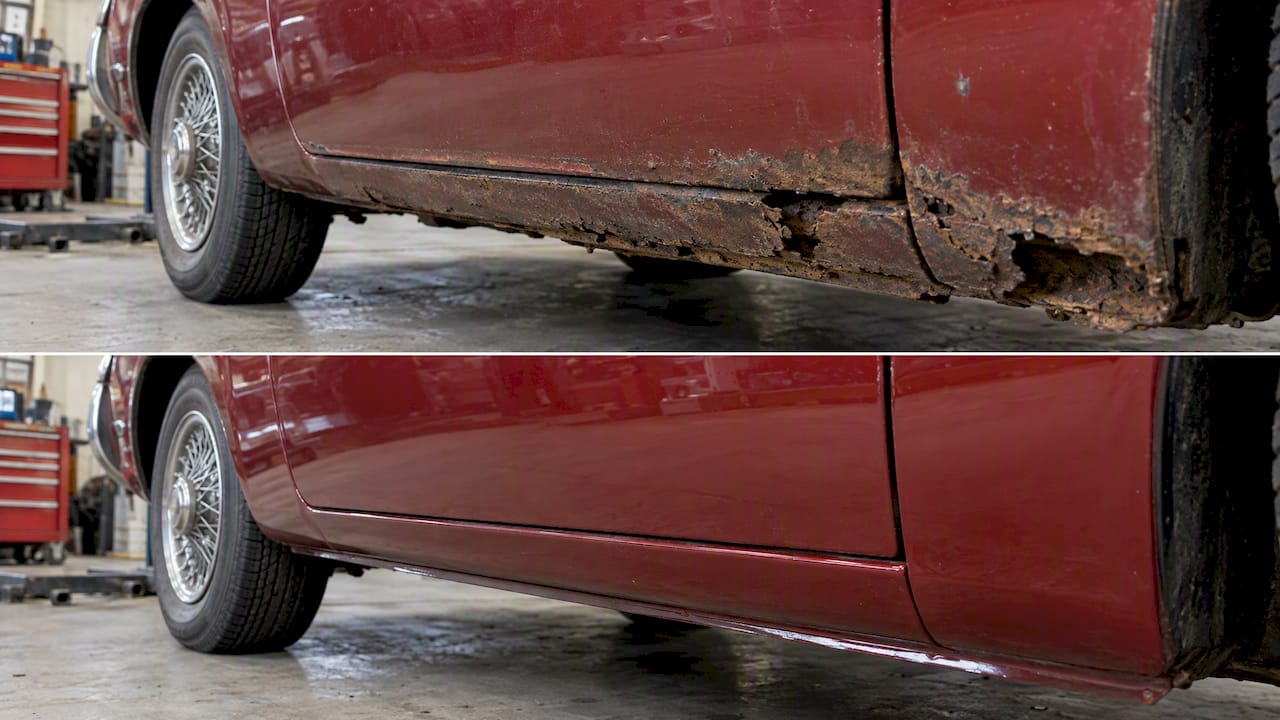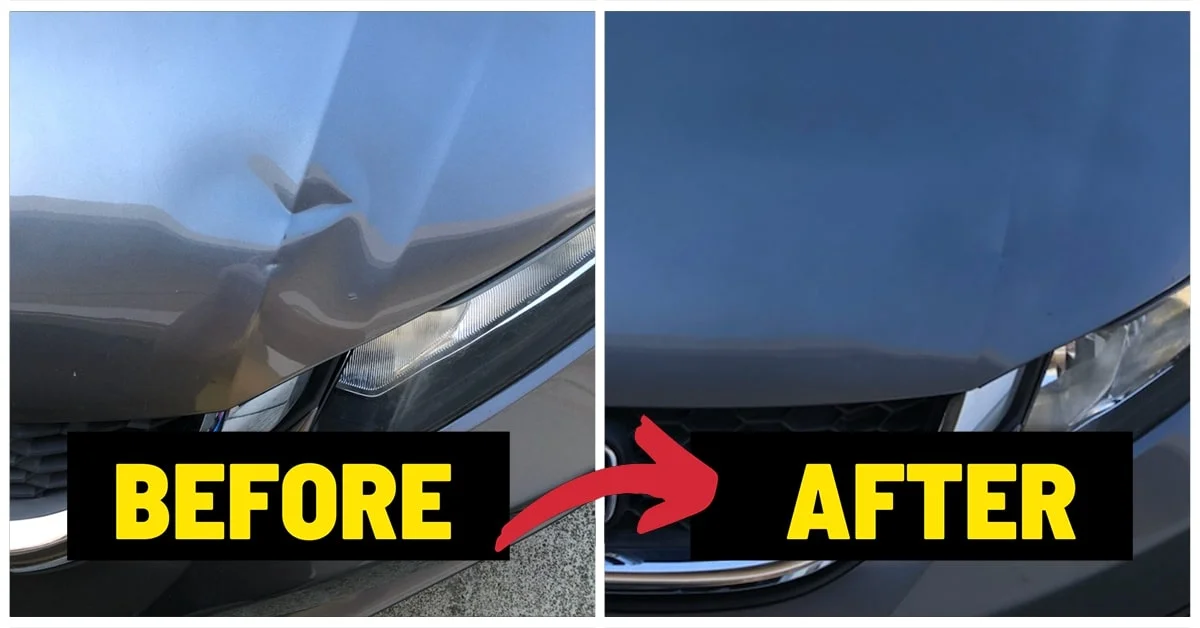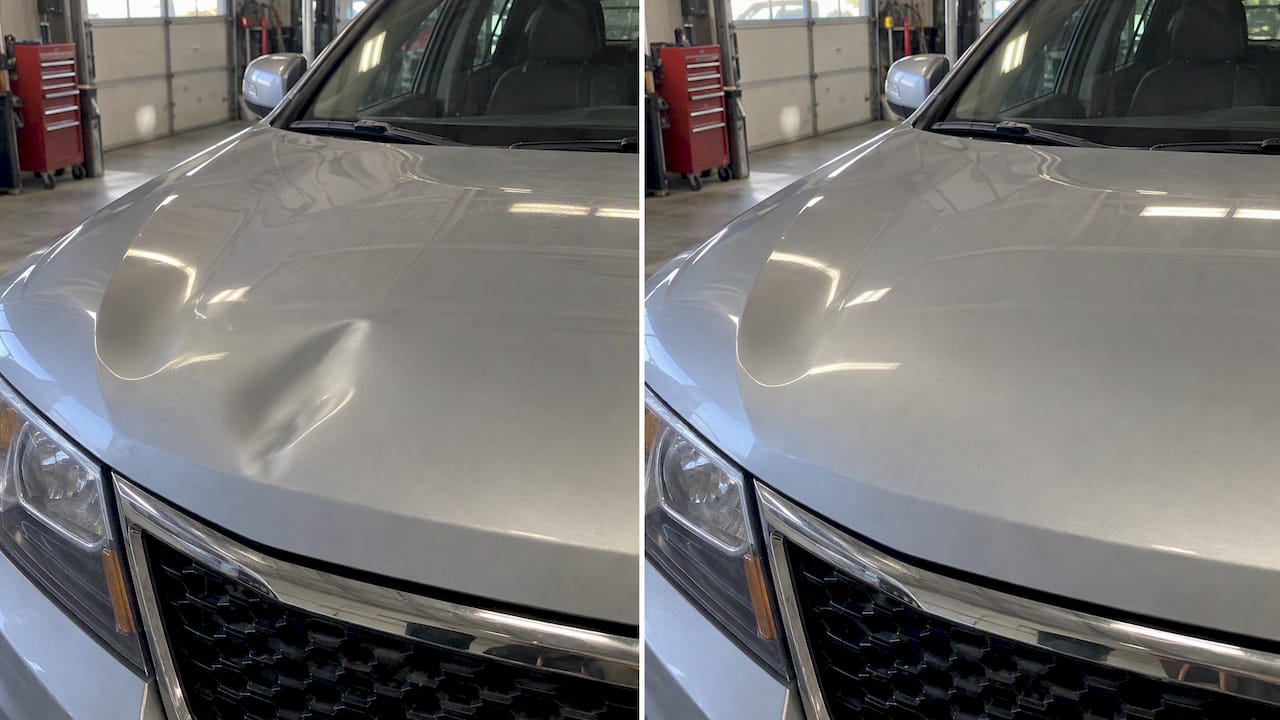
For a typical aluminum-panel dent, plan on roughly $150 to $500 for paintless repair, with aluminum jobs often running higher than the same dent on steel because the metal is harder to work. Training standards from I-CAR explain why. Exact numbers need a photo, so send us pictures at Denterasers LLC and we’ll give you a written estimate.
TL;DR:
- Minor dings fall within the $100 to $500 range, while large creases can reach $1,500, especially when they cross aluminum body lines.
- Paintless repair is the lower cost option when factory paint remains intact; cracked or chipped paint may require filler, refinishing, color matching, or replacement.
- Aluminum hardens as technicians reshape it, so repeated passes and body line damage take more labor; controlled shrinking uses roughly 250°F to 450°F.
- Ask for an itemized estimate that identifies labor, parts, and planned procedure, and confirm the technician has aluminum repair training and controls heat.
- Compare an estimate with your deductible before filing: a $400 repair with a $500 deductible produces no payout, while hail damage may exceed it.
Table of Contents
- What does aluminum panel dent repair cost in the U.S.?
- Why does aluminum repair usually cost more than steel?
- What factors shape an individual dent repair quote?
- Should you file an insurance claim for an aluminum panel dent?
- How do you evaluate and compare written estimates?
- How long does an aluminum dent repair take?
- How can you manage cost without cutting quality?
- How do you care for an aluminum panel after a dent repair?
- Do aluminum dent repair prices vary by region?
- A mobile paintless dent repair provider’s view on aluminum
- How can Denterasers LLC fix your aluminum dent at your location?
- FAQ
- Sources
What does aluminum panel dent repair cost in the U.S.?
Price depends on size, depth, location and whether the paint is still intact. Our published ranges for paintless work give you a starting map, and any real quote depends on the dent.
- Small door ding or quarter-size dent: our Minor Dent Repair runs about $100 to $500 for a single dent, and the simplest dings sit at the low end. AAA Mid States notes that minor PDR work often starts below $100 per dent, though that guidance dates to 2018 and covers dents in general, not aluminum specifically.
- Medium dent: this is the core of our $150 to $500 paintless range. A flat, accessible spot is cheaper than a dent near an edge, where the metal is stiffer and harder to reach.
- Large crease or body line dent: our Large Dent Repair service is priced at $150 to $1,500, and a crease on an aluminum body line sits toward the top of that band.
- Multi-panel hail or complex damage: this is quoted panel by panel after inspection, and totals climb quickly when many panels are involved. We cover the options in our guide to hail dents on aluminum panels.
Paintless repair is usually the cheapest route when paint is intact. AAA Mid States reports that PDR can cost about 65% less than traditional body-shop repair. That figure comes from a general 2018 article, so treat it as a direction, not a promise for your car.
When paint or panel replacement pushes the price up
If the paint is cracked, chipped or stretched, paintless methods may not be enough. The panel then needs filler, refinishing and color matching, and sometimes replacement. Our guide to dent and paint costs walks through that budget. A dent that would cost a few hundred dollars with intact paint can multiply once paintwork enters the quote.
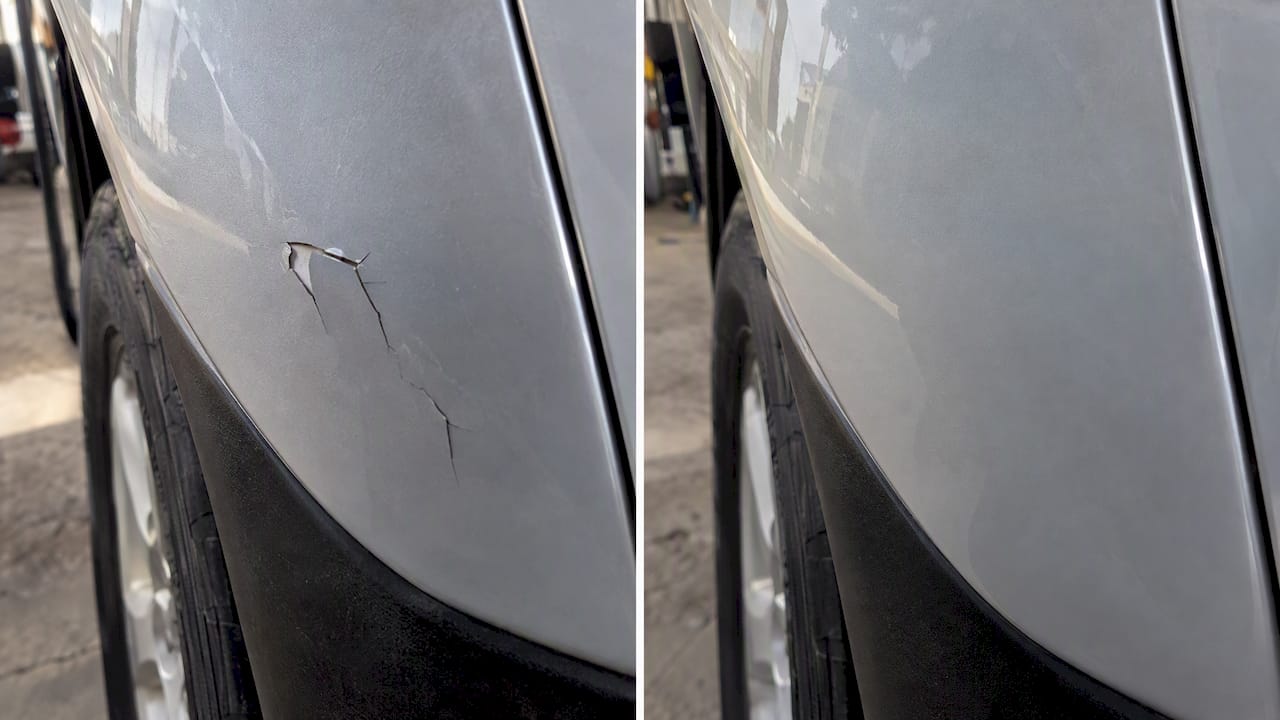
Three quick scenarios
Say you have a quarter-size ding on a flat door skin with perfect paint. That is a minor job and should land in the lower part of our $100 to $500 range.
Say a shopping cart left a palm-size dent near the edge of a hood. Access is tighter and the metal is stiffer, so expect a quote in the middle to upper part of the $150 to $500 band.
Say a sharp crease runs across a body line on a door. That is the territory of large dent repair, and a technician has to judge on photos whether the metal can be moved without heat work or replacement. For a rough sense of how other dent jobs price out, our dent repair cost estimator is a useful primer.
Why does aluminum repair usually cost more than steel?
The short answer is that aluminum fights back. Steel has memory and forgives a heavy hand. Aluminum doesn’t, and the shop needs more skill, more equipment and more time to get the same result.
Work hardening makes every pass harder
Aluminum strengthens as it’s worked. According to I-CAR repair guidance on cosmetic aluminum repairs, aluminum work hardens as it is straightened, so the metal becomes harder to move and complex damage on body lines or crowns gets more difficult, and sometimes infeasible without advanced techniques. In plain terms, every extra push on the same spot makes the next one tougher. More labor time goes into the same dent.
Repairing aluminum differs from steel because of work hardening: as aluminum is straightened it strengthens and becomes harder to move.
Heat has to be controlled tightly
When a dent needs shrinking, heat control becomes critical. I-CAR’s aluminum heat shrinking guidance gives safe shrinking temperatures of roughly 250°F to 450°F depending on the operation. Going above about 400°F risks adhesive breakdown, and approaching 750°F can anneal the metal and permanently soften it. Ask the shop how it controls heat during aluminum repairs, and have a qualified technician handle the work.
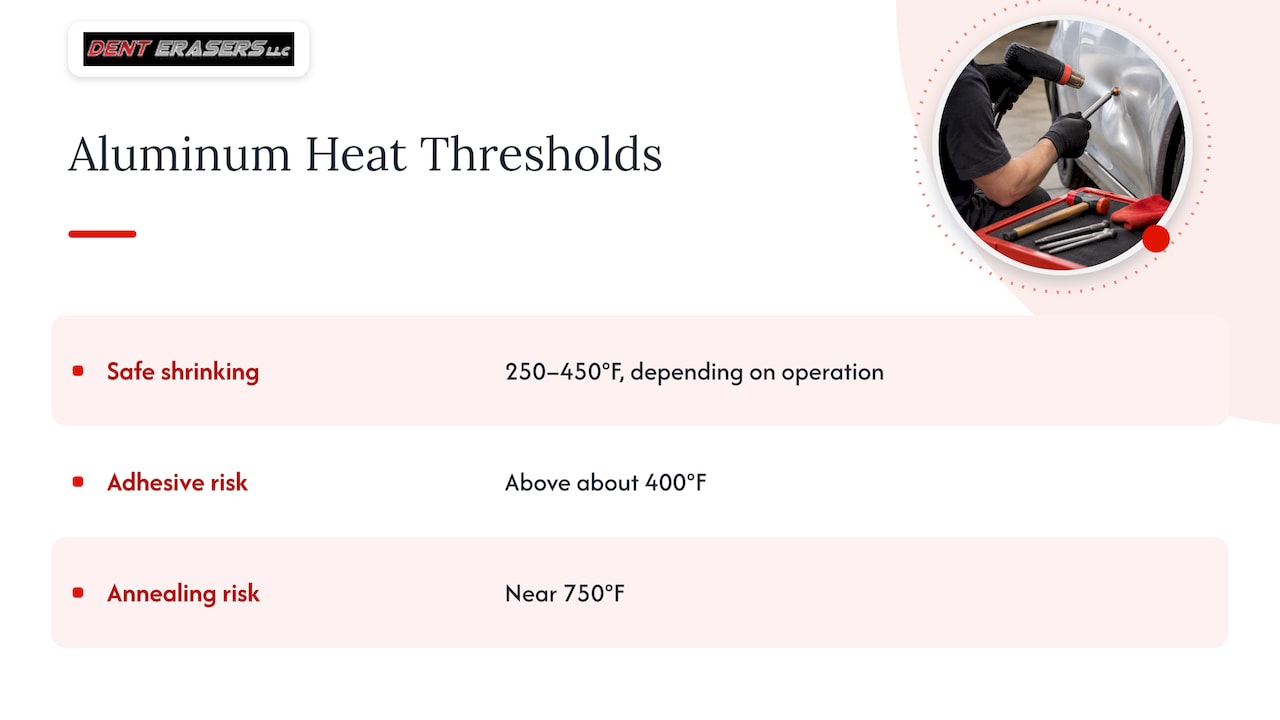
Pro Tip: Ask how the shop controls heat during aluminum shrinking and what training its technicians have.
Training and equipment raise overhead
Aluminum repair also costs more to be able to do at all. Professional hands-on aluminum courses such as I-CAR’s dent removal workshop start around $1,495 per technician. On the equipment side, I-CAR’s aluminum repair article notes that dedicated riveters and welders can cost $20,000 to $30,000, and shops need clean-room or cross-contamination controls so steel dust does not cause galvanic corrosion. A shop owners’ roundup on aluminum upgrades adds that rivet guns can average $10,000 apiece, so certified shops weigh the economics before adding lines.
What that means for your quote
Those costs show up in two places: more labor units on the job, and a higher per-job share of overhead. You are paying for a technician who has trained on aluminum and a shop that has invested in the right tools. That is a fair premium for a repair that comes out right the first time, and it is the main reason the same dent can cost more on an aluminum hood or door than on a steel one.
What factors shape an individual dent repair quote?
No two dents are the same, so no two quotes are either. Know these six factors and you can compare estimates fairly.
- Dent size and depth. A shallow dent the size of a coin is a very different job from a deep, wide one. Depth matters as much as diameter, because deep dents stretch the metal.
- Location on the panel. A flat area is easier than a body line or crease, where the metal is reinforced and unforgiving. Access also counts: if a technician can’t get tools behind the panel because of bracing or inner structure, labor rises.
- Number of dents and panels. Hail often means dozens of dents across several panels. Bundled work usually costs less per dent than separate visits, but the total grows with the panel count.
- Paint condition. Intact paint favors paintless repair. Cracked or chipped paint pushes the job toward filler and refinishing.
- Vehicle make and model. Some vehicles use aluminum extensively, and some only for a hood or a few panels. A technician needs to identify what the panel is made of before pricing, and the I-CAR training protocol lists identifying aluminum use on vehicles as its own knowledge area.
- Required procedure. Straight paintless pulling, shrinking with heat, partial repair and full replacement each carry different labor and parts costs. Estimating guides in collision repair, such as the I-CAR estimating resource, rely on labor units, part prices and judgment times for panel repairs, so your quote should show those pieces clearly.
Should you file an insurance claim for an aluminum panel dent?
Often the deductible decides it. If the total repair cost is lower than your deductible, you pay out of pocket either way, as AAA’s guide to hail and car damage explains. Its advice is to get an informal estimate first, then decide whether a claim makes sense.
- Compare before you call. Get a photo-based estimate and set it beside your deductible. Say a repair quote comes to $400 and your deductible is $500: filing gains you nothing.
- Think about the bigger jobs. Multi-panel hail damage or repairs that need paint and replacement can pass a deductible quickly, and a claim may be worth it. AAA’s hail damage article notes that insurers may cover repainting if paint is damaged.
- Use the tools insurers offer. AAA’s direct repair program describes quick-photo-estimate tools that can produce an estimate or payout in 24 to 48 hours for some repairs.
- Check your policy on claims history. Ask your insurer how a claim could affect your premium before you file, especially for a small dent.
We’re happy to give you a number to compare against your deductible.
How do you evaluate and compare written estimates?
A good estimate is easy to read. You should be able to tell what you are paying for and why.
- Itemized lines. AAA’s direct repair program describes itemized estimates. Ask for a breakdown of the work, labor and parts, and check your options with your insurer. If a quote is a single lump number, ask for a breakdown.
- Aluminum training. Ask who will work on the panel and what aluminum-specific training they have. The I-CAR training protocol lists identifying aluminum, repair considerations and aluminum skill development as core areas, so a technician should be able to speak to them.
- Heat management. A credible estimate accounts for controlled heating, ideally induction, and for the chance that a partial replacement may be needed.
- Warranty and guarantee. Look for a stated warranty or satisfaction guarantee. AAA’s direct repair program mentions a lifetime workmanship warranty at approved shops, which gives you a benchmark.
- Mobile service. If the repair is paintless, ask whether the technician comes to you, since that can save a tow or a drop-off day.
- Reference pricing. AAA’s repair estimate tool breaks out parts, labor and member discounts at AAA-approved facilities, which helps you sanity-check a number.
Pro Tip: Send the same photos to two providers. If the estimates differ a lot, ask each one to explain which procedure they plan to use.
How long does an aluminum dent repair take?
The time needed for a paintless repair depends on the dent and access to the panel. Ask the technician for an estimate after they assess the damage.
Complex aluminum work, including multi-panel hail damage or repairs that need heat shrinking or partial replacement, can take longer. Ask the shop for a time estimate after inspection. Time matters for cost because labor is billed against the hours the job demands.
Some delays have nothing to do with labor. Inspection and insurance approval can add time, parts may need to be ordered, and any painted work needs refinishing and curing time before the car is ready.
How can you manage cost without cutting quality?
You can lower your out-of-pocket cost without trading away the quality of the repair.
- Get a photo estimate first. Do this before filing insurance so you know where the repair sits against your deductible.
- Bundle small dents. Fixing several dings in one appointment spreads the call-out overhead across the work.
- Choose PDR when paint is intact. Skipping repainting is the biggest single saving, since refinishing drives a large share of body-shop bills.
- Use mobile service. It avoids towing and shop drop fees, and you stay on your own schedule.
How do you care for an aluminum panel after a dent repair?
A good repair deserves a little care afterward. Wait for any refinished area to cure as directed, and hold off on waxing or machine polishing until the technician says the paint is ready. Wash by hand with a mild soap and soft mitt for the first weeks, and avoid pressure washers aimed at the repaired spot.
Keep steel contamination in mind. Aluminum can corrode where steel dust or particles are left against it, which is why professional shops control cross-contamination. Don’t let a roadside helper grind or sand steel near an aluminum panel, and rinse off any metal filings quickly.
Finally, park away from carts, doors and hail where you can. Aluminum dents more easily than many owners expect, and a few inches of distance in a parking lot is the cheapest maintenance there is. If you spot a ripple or a lifting edge on the repair later, contact the shop sooner, not later.
Do aluminum dent repair prices vary by region?
They do. Labor rates, shop overhead and local demand all move prices, so a quote in a high-cost metro area will often run above one in a smaller market. Public figures broken out by state for aluminum dent repair are hard to find, so we won’t put numbers on regional gaps. The pattern is simple: where shop rents and wages are higher, repair costs follow.
Weather also shapes local pricing. After a major hail event, demand for qualified technicians spikes and schedules fill up, which can push prices and wait times up in affected areas. Mobile service helps here, because a technician who travels to you removes the shop-rent part of the equation. For the best move, gather two or three photo-based estimates and compare them line by line.
A mobile paintless dent repair provider’s view on aluminum
Here is where I land after years of fixing dents on the driveway and the office lot: most aluminum dents cost less to fix than owners fear, as long as you get the right technician involved early. Waiting is what costs you. A small ding left alone sometimes gets a crease from the next bump, and a crease on a body line is a very different bill.
I’d also push back on the idea that aluminum is something to avoid. It is a different discipline, not an impossible one. The metal rewards patience, controlled heat and a technician who knows when to stop pushing before the panel work hardens. That’s the part no price list shows you.
Our goal is always to keep your factory paint, because original paint is the finish you can never fully buy back. If you are weighing a quote, send us photos and we’ll tell you honestly what the job needs, including when paintless is the right call.
— Brian Blanc
How can Denterasers LLC fix your aluminum dent at your location?
We bring mobile paintless dent repair to your home or workplace, so you don’t lose a day to a shop drop-off. We handle aluminum panels with controlled methods designed to keep your factory finish, and we provide an estimate before work begins. Here is what we can do for you:
- Minor Dent Repair for door dings and small dents, priced at $100 to $500.
- Large Dent Repair for creases and bigger damage, priced at $150 to $1,500.
- Mobile Dent Repair at your location, plus auto body and collision repair when paintless is not enough.
- Specialty work for luxury and classic vehicles.
Ready for a real number? Request a photo quote and we’ll tell you what your aluminum panel needs and what it will cost.
FAQ
Can dents in aluminum be repaired?
Yes, most aluminum dents can be repaired when the metal has not been stretched too far. Paintless methods work well on shallow dents with intact paint, while sharp creases on body lines may need heat shrinking or panel work, as I-CAR repair guidance on aluminum panels explains.
How much does it cost to fix a dented side panel?
It depends on size, depth and location, so a photo is the only way to get an exact number. Our paintless repairs run about $150 to $500 for typical dents, and our large dent repair goes up to $1,500 for bigger damage.
Will insurance pay for paintless dent repair?
Often yes, if your policy covers the damage and the repair cost exceeds your deductible. AAA’s hail and car damage guidance advises getting an informal estimate first to see whether filing makes sense.
What dents cannot be removed with paintless repair?
Paintless repair is not a fit when paint is cracked or chipped, or when the metal is stretched or creased beyond what can be moved. Aluminum adds another limit, since it work hardens as it is pushed, which makes complex body-line damage harder and sometimes infeasible without advanced techniques.
Sources
- Ding Dong the Dent is Dead | AAA Mid States
- Hail and Car Damage: What Auto Insurance Covers
- Cosmetic Repairs To Aluminum Exterior Panels