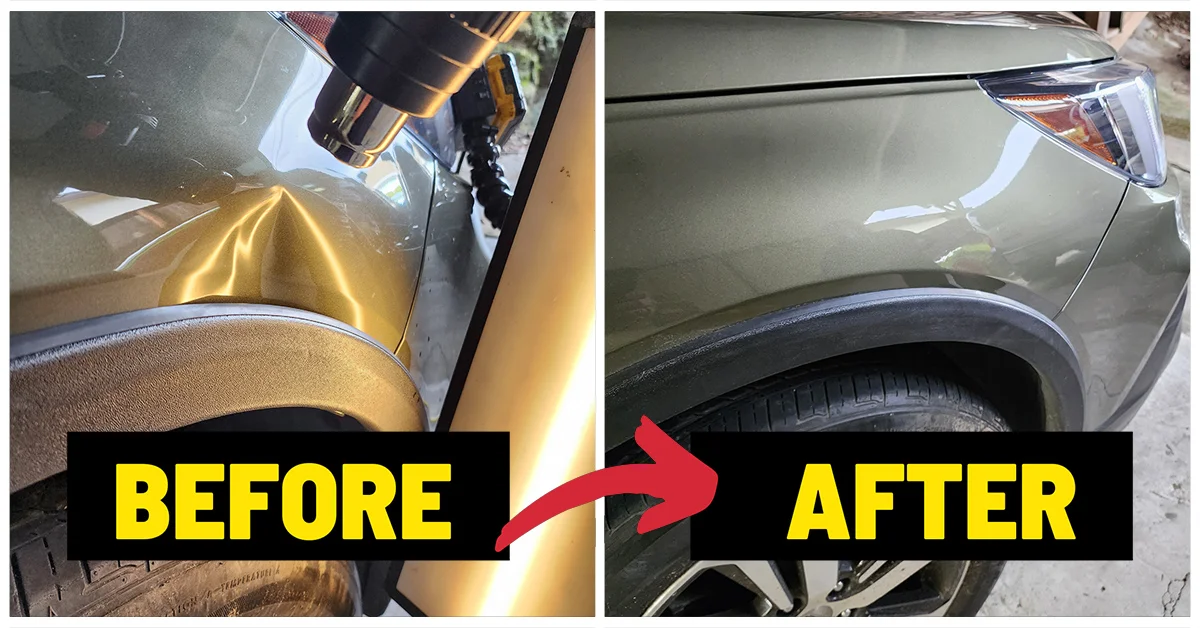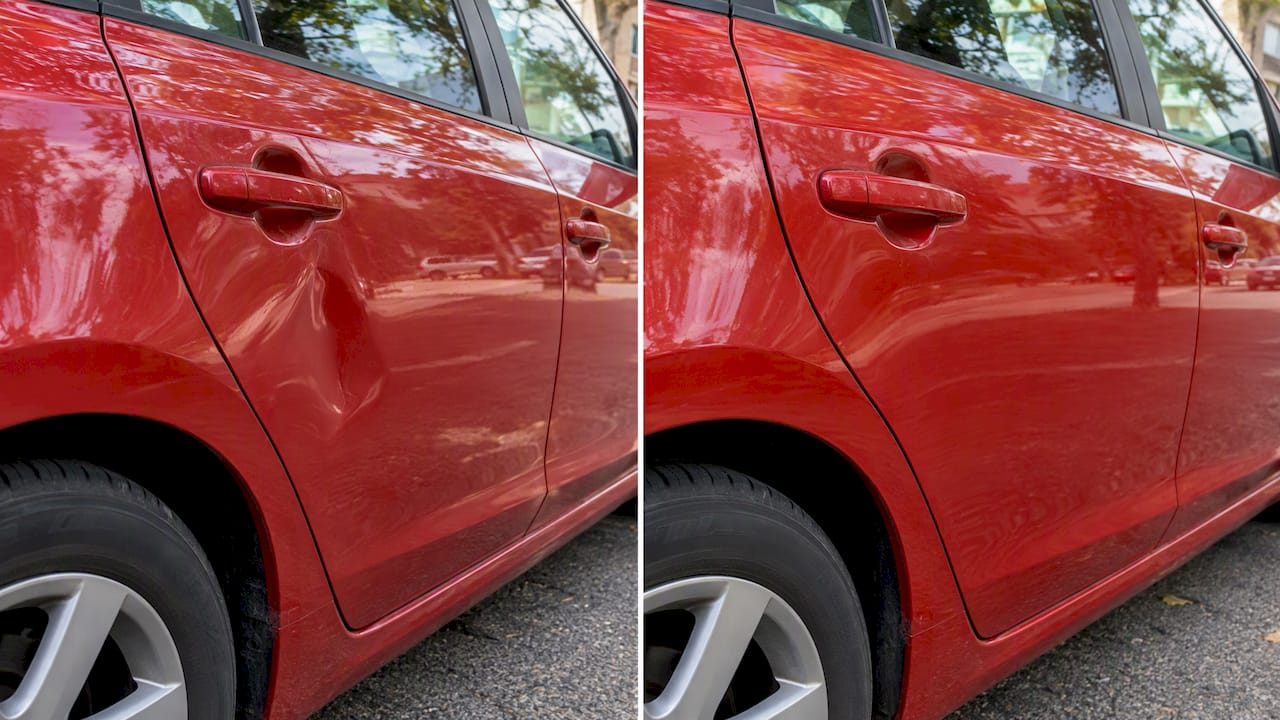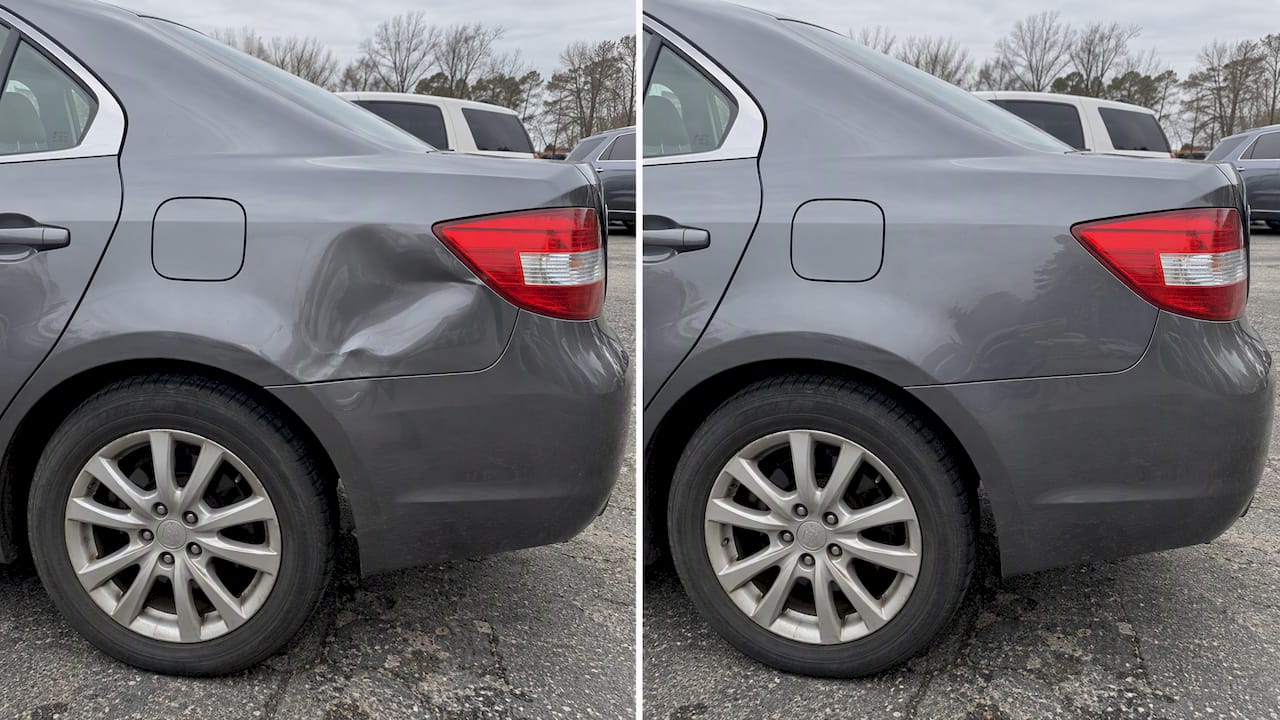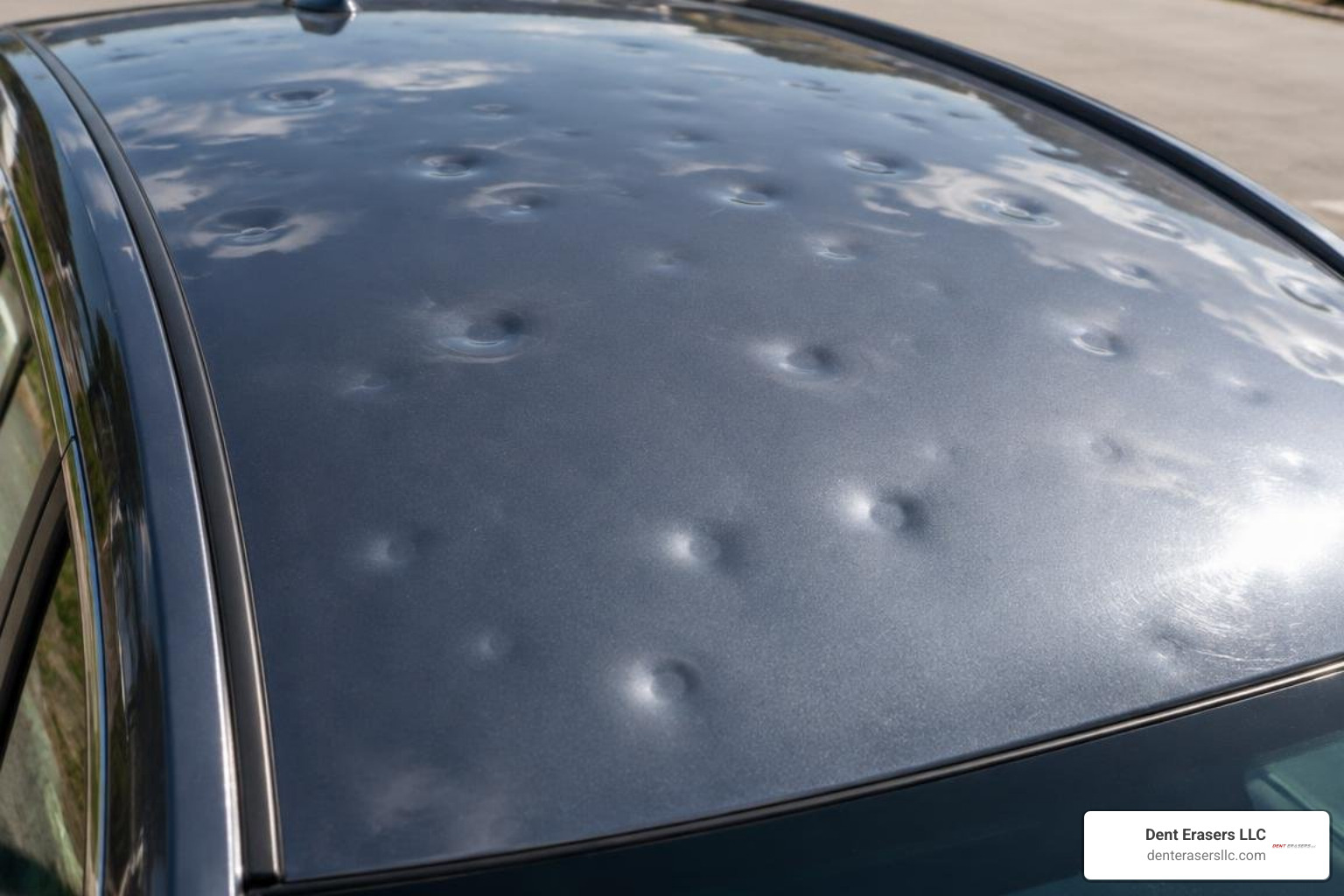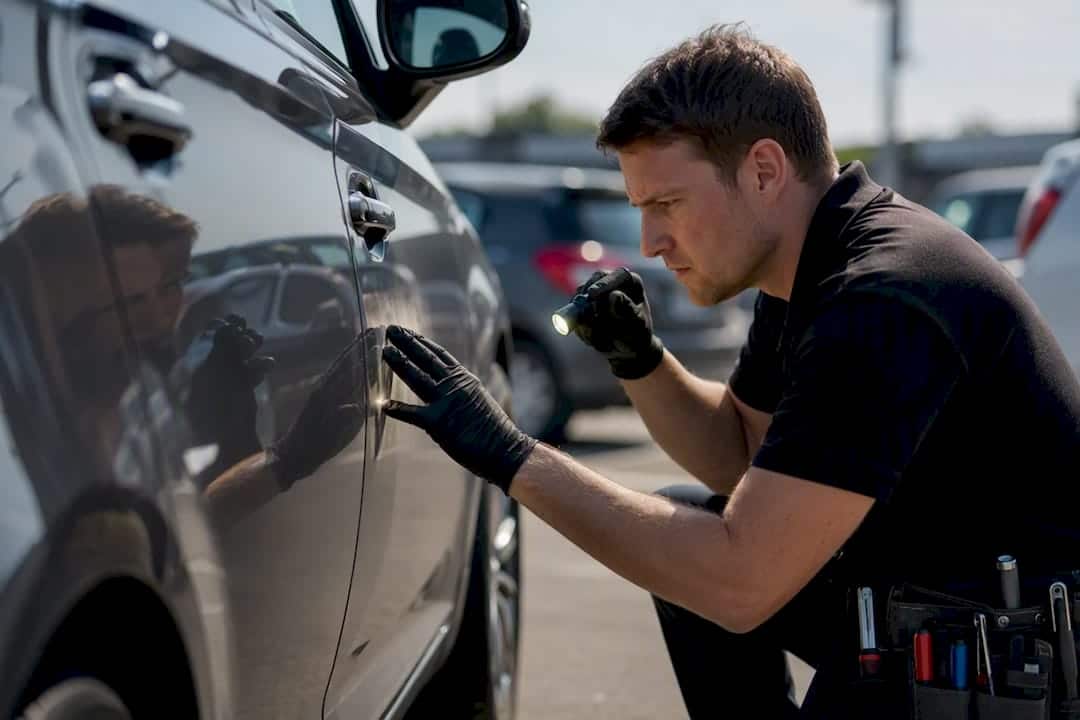
Sometimes. Advanced paintless dent repair can restore many body line dents, but only when the paint, metal, and access all cooperate. The biggest deal breakers are cracked coating, severe metal stretch, and damage tucked inside about an inch of a hem flange. If your dent sits near a line and you’re not sure which category it falls into, get a professional inspection before you assume it needs a repaint.
TL;DR:
- PDR can safely repair body line dents only if the paint is intact, the metal is not severely stretched, and access is straightforward.
- Sharp creases with locked folds or damage near hem flanges often require more staged repairs or traditional methods due to material limitations.
- Repair duration varies from one to two hours for simple cases to six hours or more for complex or hard-to-access dents, impacting costs accordingly.
- An experienced technician should evaluate the five key factors—paint condition, metal behavior, material, location, and access—before proceeding.
- Mobile inspections ensure accurate assessment and transparent quoting without the need for vehicle drop-off or repairs before understanding your dent’s true repairability.
Table of Contents
- What Makes a Body Line Dent Different From a Flat-Panel Dent
- The Five-Factor Checklist That Determines PDR Suitability
- Why Body Line Dents Are Technically Harder to Fix
- Can PDR Fix Sharp Creases? Steel vs. Aluminum Matters
- How a Technician Repairs a Body-Line Dent, Step by Step
- The Specialist Tools Behind Precision Line Repair
- No-Go Signals: When PDR Should Not Be Attempted
- What Body-Line PDR Actually Costs and How Long It Takes
- How to Choose a Qualified PDR Technician for Line Work
- Denterasers LLC’s Approach to Body Line Repairs
- An Honest Word on Managing Expectations
- Get a Mobile Inspection Before You Commit to Anything
- Sources
- FAQ
What Makes a Body Line Dent Different From a Flat-Panel Dent
A body line, sometimes called a character line, is a raised or creased edge rolled into a panel during stamping. It does two jobs: it gives the car visual definition, and it stiffens the sheet metal so the door or fender doesn’t flex like a drum skin. That stiffness is exactly what makes a dent on a body line behave so differently from one on a flat hood or roof.
On a flat panel, a dent is usually one smooth low point. Push it out evenly, and the surface returns close to its original shape. A body line dent almost never behaves that way. The impact displaces the ridge itself, sometimes folding it into a crease, and it often leaves secondary “crowns” or highs nearby where the metal buckled instead of simply sinking.
Reading the damage takes more than a glance. Technicians rely on a line board, a flat panel with alternating light and dark stripes, held or reflected against the body line to reveal exactly where the ridge deviates.
- Set the vehicle under even, diffused light or use a PDR light board to expose subtle waves.
- Sight down the line from the front and rear of the panel, not just from directly above.
- Note where the reflection breaks, bends, or doubles. That’s usually where the real work starts.
The Five-Factor Checklist That Determines PDR Suitability
Technicians rely on a five-factor decision framework to figure out whether a body line dent is a straightforward job, a conditional one, or a repaint. Walking through these five factors before any tool touches the panel is what separates a shop that gets consistent results from one that’s just guessing.
- Paint and coating condition. Run a fingernail and a bright light across the ridge, looking for micro-cracking, chips, or dulling in the clear coat. Intact paint is necessary, though it’s not the whole story.
- Metal stretch and geometry. Feel for a sharp, locked center versus a smooth, springy low point. Stretched metal resists returning to its original contour no matter how it’s massaged.
- Panel material and construction. Steel and aluminum respond to force differently, and high-strength steel reinforcements behave differently than mild steel skins.
- Location relative to edges and reinforcement. Damage near a hem flange, a bonded seam, or an inaccessible brace changes the entire plan.
- Safe access for a controlled pull. Without a clean rod route or a safe glue-pull surface, even a textbook dent becomes a bad candidate.
A “suitable” repair checks all five boxes cleanly. A “conditional” repair might have good paint and accessible metal but requires staged work near a reinforcement, meaning the technician proceeds carefully and reassesses at each step. Anything that fails two or more factors should be escalated.
Pro Tip: Bring your own flashlight to the inspection and ask the technician to walk you through each of the five factors on your specific panel. A tech who can explain their reasoning, factor by factor, is one you can trust with a harder repair.
Why Body Line Dents Are Technically Harder to Fix
The stiffness that gives a body line its crisp look works against the repair process. Automakers add ribs and creases specifically to resist flexing, which means the same force that pops out a smooth dent on a door skin barely moves a dent anchored to a line. Technicians often need two or three times the controlled leverage, applied more precisely, to get the same amount of movement.
Crowns compound the problem. When metal buckles along a stiff ridge, it frequently pushes up a high spot right next to the low point. Push the low back into place, and the high can remain, or even become more visible once the low is gone. That’s why body line repairs require staged correction rather than a single pull. A technician moves the low partway, checks the crown, adjusts, and repeats, sometimes across a dozen small steps.
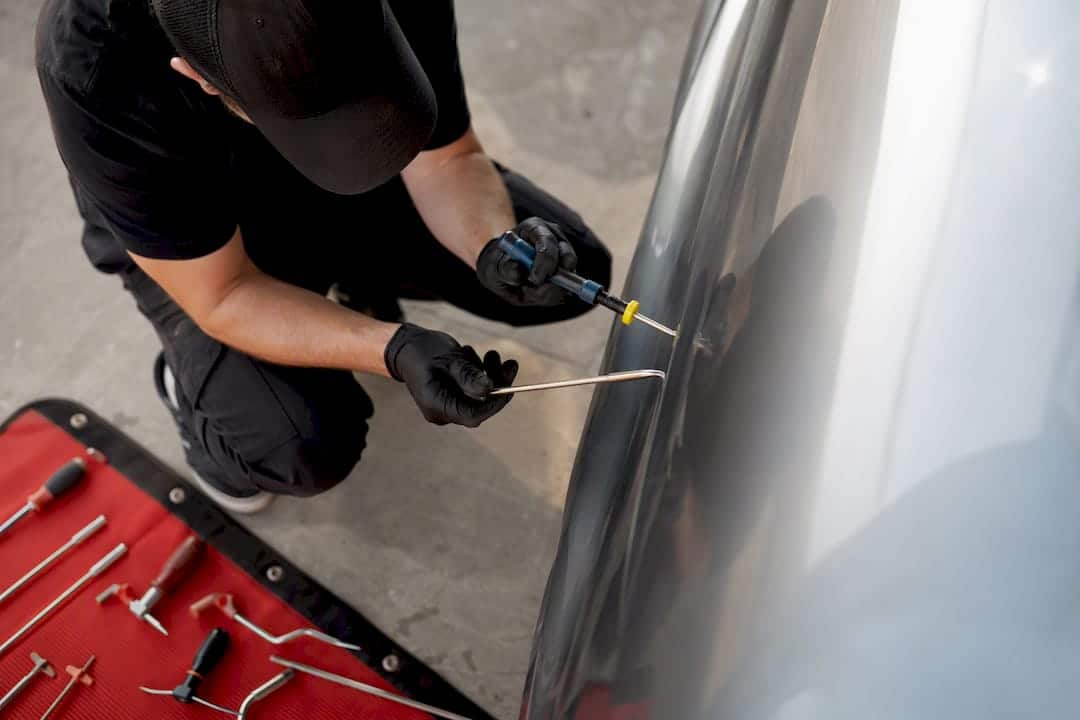
Paint adds its own risk. Clear coat and base coat are thinnest right at the peak of a body line, where the panel was stretched hardest during stamping. That’s the exact spot repair force concentrates. Push too aggressively and you get micro-cracking invisible to the eye in normal light but obvious under raking light or after a few months of UV exposure. This is why a cautious technician moves slower on a line than on a flat panel, even when the dent looks similar in size.
Can PDR Fix Sharp Creases? Steel vs. Aluminum Matters
Sharp creases sit at the edge of what PDR can do. A crease that’s still rounded at its base, where you can slide a fingernail across without catching an edge, often responds well to staged pulling and rod work. A crease with a locked, angular fold, where the metal has essentially memorized a new shape, usually resists full correction no matter how skilled the technician is.
Panel material changes the calculation significantly:
- Steel work hardens under repeated bending, but it also tolerates staged reshaping better. A technician can often push, check, and push again across several sessions without cracking the surface.
- Aluminum has lower ductility than steel and cracks or thins with far less warning. Aluminum panels frequently need panel-specific tools, slower movement, and a technician who has specifically trained on aluminum work.
- Mixed-material vehicles, common in modern trucks and luxury sedans, may need different approaches on the same car depending on which panel is aluminum and which is steel.
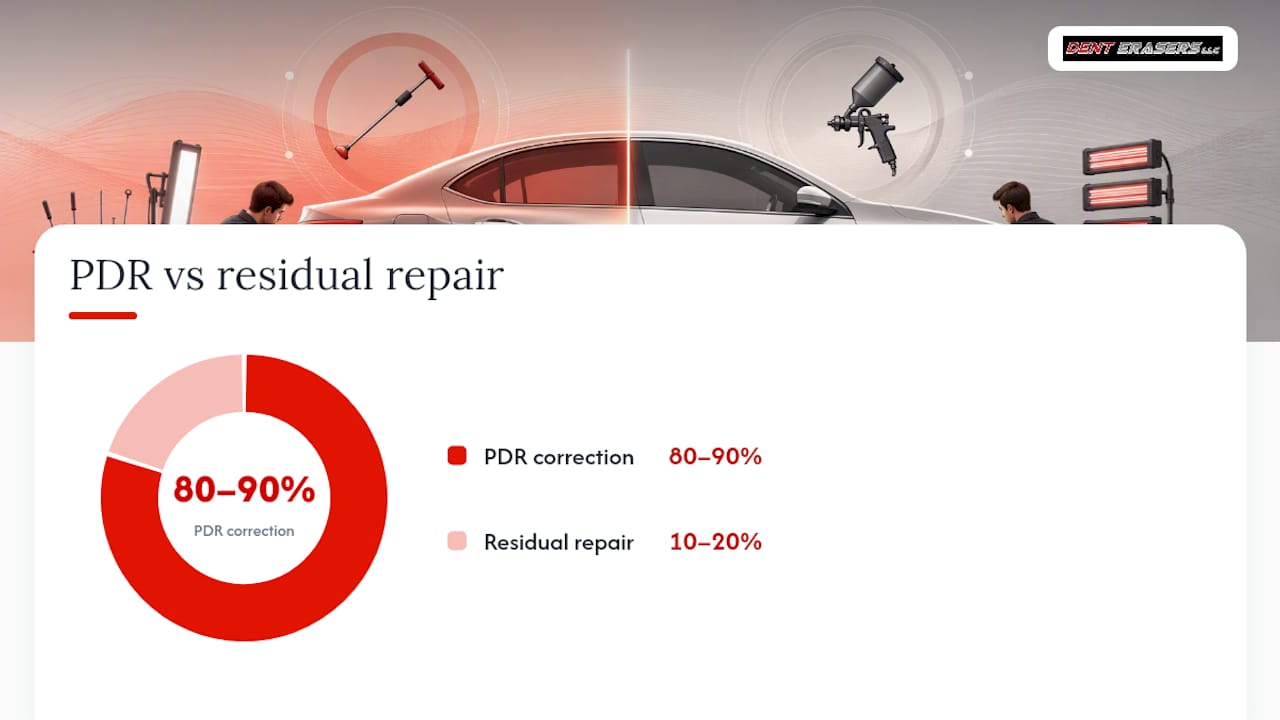
When a crease is too sharp for full correction, a hybrid approach is often the honest answer: PDR pulls the bulk of the deformation out, reducing the dent by 80 to 90 percent, and a small touch-up or blend covers the residual imperfection. That’s a better outcome for your wallet and your factory finish than a full repaint, even if it isn’t a perfect “like it never happened” result.
How a Technician Repairs a Body-Line Dent, Step by Step
A body line job isn’t one pull. It’s a sequence of small, checked moves, and understanding the sequence helps you evaluate whether a technician is doing it right.
- Document and map the damage. The technician photographs the panel, marks the low point, the surrounding crowns, and notes the paint and coating condition before touching anything.
- Plan the access route. Rear access through a door panel or wheel well is preferred whenever possible. If the reinforcement blocks a rod route, the technician decides between exterior glue pulling or escalation, never drilling a new access hole to force it.
- Define acceptance checks. Before starting, the tech sets checkpoints, what the panel should look like after each stage, and under what conditions they’ll stop.
- Move the low point first. Careful, controlled pressure brings the deepest part of the dent up in small increments, never in one aggressive push.
- Reduce the crowns. Once the low is mostly corrected, the technician works the surrounding highs, checking reflection and feel after every pass.
- Blend the line. Fine tapping and knockdown work restores the crisp visual break along the body line itself.
- Final acceptance inspection. The panel is checked under raking light, by hand, and against the original photos before the job is called complete.
If at any stage the coating shows stress, the metal won’t move as expected, or the access requires cutting into a bonded area, the technician stops and escalates rather than pushing forward and risking the finish.
The Specialist Tools Behind Precision Line Repair
Body line work leans on a different toolkit than a simple door ding, and the tools matter almost as much as the technician’s hands.
- Profiled PDR rods, curved and tipped specifically to reach behind a line and apply pressure without gouging the backside of the panel.
- Glue pulling kits, using tabs and pull tabs bonded to the exterior paint, essential when rear access is blocked by a brace, wiring harness, or insulation.
- Line boards and reflection boards, the striped panels mentioned earlier, used constantly throughout the repair, not just at the initial inspection.
- PDR lights, adjustable LED arrays that reveal subtle waves invisible under standard shop lighting.
- Knockdown tools and fine taps, used at the very end to smooth micro-highs left after the bulk of the correction.
Pro Tip: Ask whether the shop uses glue pulling on your specific repair. It’s a legitimate and often necessary technique, but it should always be followed by proper adhesive removal and a paint-safe cleanup, never left as a shortcut that skips the finishing steps.
No-Go Signals: When PDR Should Not Be Attempted
Not every body line dent should go to a PDR technician first, and a good one will tell you that upfront rather than after charging you for an attempt.
- Cracked, chipped, or missing paint, or micro-cracking visible only under raking light.
- Severe metal stretch, a torn surface, oil-canning, or a sharp, locked center that won’t flex under hand pressure.
- Damage within roughly 1 inch (25 mm) of a hem flange or sitting over reinforcement the technician can’t safely reach.
- Access that would require drilling, cutting, or disturbing bonded joints, airbag sensors, or existing corrosion protection.
That 25 mm hem-flange rule isn’t arbitrary caution. It reflects how little material margin exists at a panel’s folded edge before forced movement risks breaking the bond or fracturing high-strength steel underneath. When you hear a technician say “that’s too close to the hem,” they’re describing a real mechanical limit, not hedging.
What Body-Line PDR Actually Costs and How Long It Takes
Time is the real cost driver in body line repair, more than the size of the dent itself. A minor body line dent with intact paint and clean access might take a technician one to two hours from setup to final inspection. A complex repair, sharp crease, tight access, or multiple staged corrections, can run six hours or more, sometimes spread across more than one visit if the panel needs to settle between stages.
Several factors push a quote up or down:
- Severity determines how many staged corrections are needed and how carefully the crowns must be managed.
- Access matters enormously; rear-rod access is faster and cheaper than glue-pull work requiring tab removal and cleanup.
- Material affects speed, since aluminum panels demand slower, more deliberate technique than steel.
- Panel count adds up quickly if a single impact affected two adjoining panels along the same line.
Ask any technician for an itemized estimate that breaks down the hours, the planned technique for your specific dent, and the acceptance criteria they’ll use to call the job finished. A vague flat quote with no explanation is a sign to ask more questions.
How to Choose a Qualified PDR Technician for Line Work
Body line repair separates skilled technicians from average ones faster than any other type of dent. Before you book, ask direct questions and expect direct answers.
Ask specifically about experience with body lines, not just dents in general, and request a before-and-after gallery of similar repairs on similar panels. A technician confident in their work will show you the inspection process itself, not just promise a result before ever looking at the car. Ask what their acceptance checks are and get them in writing, along with any warranty terms.
Watch for red flags: a blanket “we can fix anything” guarantee before inspection, reluctance to physically examine the panel first, or no examples of comparable body line work in their portfolio. A legitimate technician wants to see the damage in person before committing to a repair method, and they’ll document their inspection notes so you have a record of what was assessed and why a particular approach was chosen.
- Ask for photos of comparable body line repairs, ideally on the same make or panel type.
- Confirm the inspection is free or low-cost and happens before any commitment.
- Request written acceptance criteria: what “done” looks like for your specific dent.
- Ask what happens if the repair doesn’t fully succeed, is there a fallback plan or partial refund.
Denterasers LLC’s Approach to Body Line Repairs
Denterasersllc built its mobile service specifically around jobs like this: dents that need a trained eye and staged technique, not a rushed pull. Every appointment starts with an onsite inspection where the technician runs through the paint, metal, access, and reinforcement checks before quoting a price, so you know upfront whether your dent is a clean candidate or a conditional one.
Because the work happens at your home or office, there’s no drop-off, no rental car, and no waiting a week for a bay to open up. The team handles everything from minor body line creases to specialty panels on luxury, vintage, and motorcycle bodywork, always aiming to preserve the factory finish rather than reach for a repaint.
An Honest Word on Managing Expectations
I’ll say plainly what a lot of shops won’t: not every body line dent should be attempted with PDR, and a technician who tells you “no” after a real inspection is doing you a favor, not failing you. Preserving your factory finish only matters if the repair actually holds up, and forcing a stretched panel or a cracked coating to bend just because a customer wants to avoid a repaint helps no one. Inspection first, honesty second, tools third. If a shop skips straight to the pull, ask why.
— Brian Blanc
Get a Mobile Inspection Before You Commit to Anything
You don’t need to drive anywhere to find out whether your body line dent is a good PDR candidate. Denterasersllc comes to you, whether that’s a driveway, an office parking lot, or a curb outside a repair shop that already quoted you a repaint.
The mobile inspection covers all five suitability factors on the spot: paint condition, metal behavior, panel material, proximity to reinforcement, and access for a controlled pull. If your dent qualifies, you’ll get a clear, itemized quote covering the planned technique and expected hours. If it’s borderline, you’ll hear exactly why, and what the alternative looks like, including plastic bumper repair, large panel work, or specialty service for luxury, vintage, and motorcycle vehicles. Head to Denterasers LLC to request a quote and get a real answer on your specific dent instead of a guess over the phone.
Sources
- PDR Limitations: Technical Analysis of When Paintless Dent Repair Won’t Work | DentAdvisor
- What Dents Can Be Repaired With PDR? A Repairability Matrix for Technicians and Buyers | SuperPDR
- Body Line / Crease PDR Tech Article – Paintless Dent Repair // Removal Training Download | ReconExpress
FAQ
Can a dent on a body line be fixed?
Often, yes. If the paint is intact, the metal isn’t severely stretched, and the technician has safe access, PDR can restore many body line dents without repainting.
What dents cannot be removed with PDR?
Dents with cracked or missing paint, severely stretched or torn metal, or damage within about 1 inch (25 mm) of a hem flange generally can’t be fully corrected with PDR and need conventional repair.
How much does it cost to fix a crease dent?
Cost depends mostly on time: a minor body line repair might take one to two hours, while a complex crease with limited access can take six hours or more, so pricing scales with severity and access difficulty rather than dent size alone.
Do body shops fix dents?
Traditional body shops handle dents that involve cracked paint, structural damage, or metal too stretched for PDR, typically through filling, sanding, and repainting, while a mobile PDR service like Denterasersllc handles the dents that qualify for paintless correction.