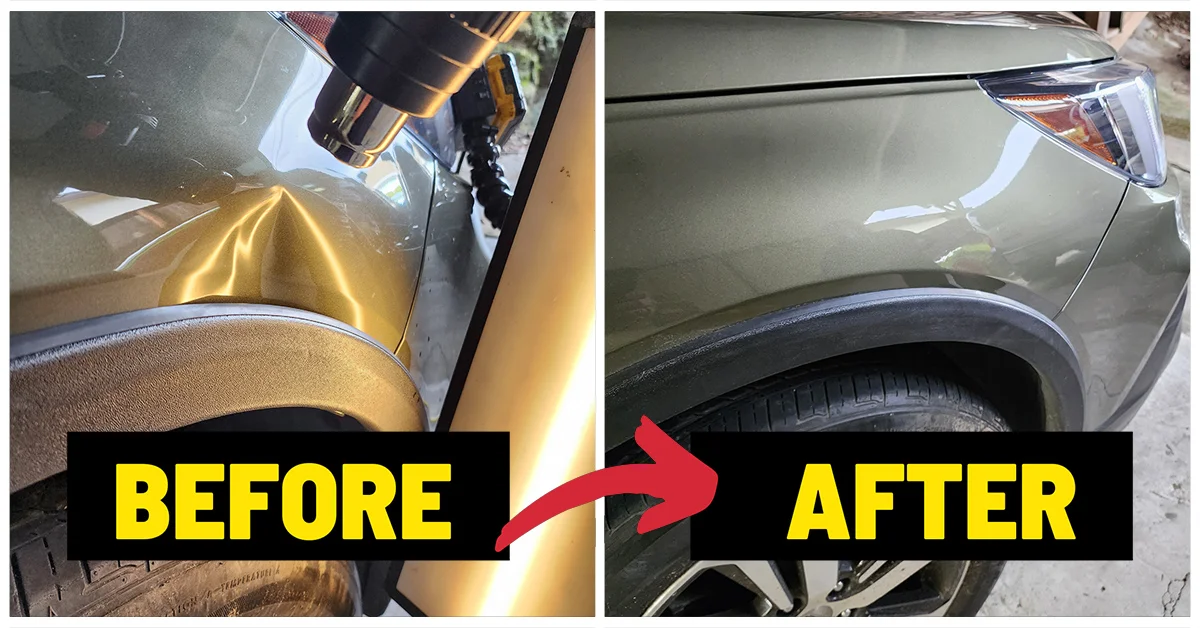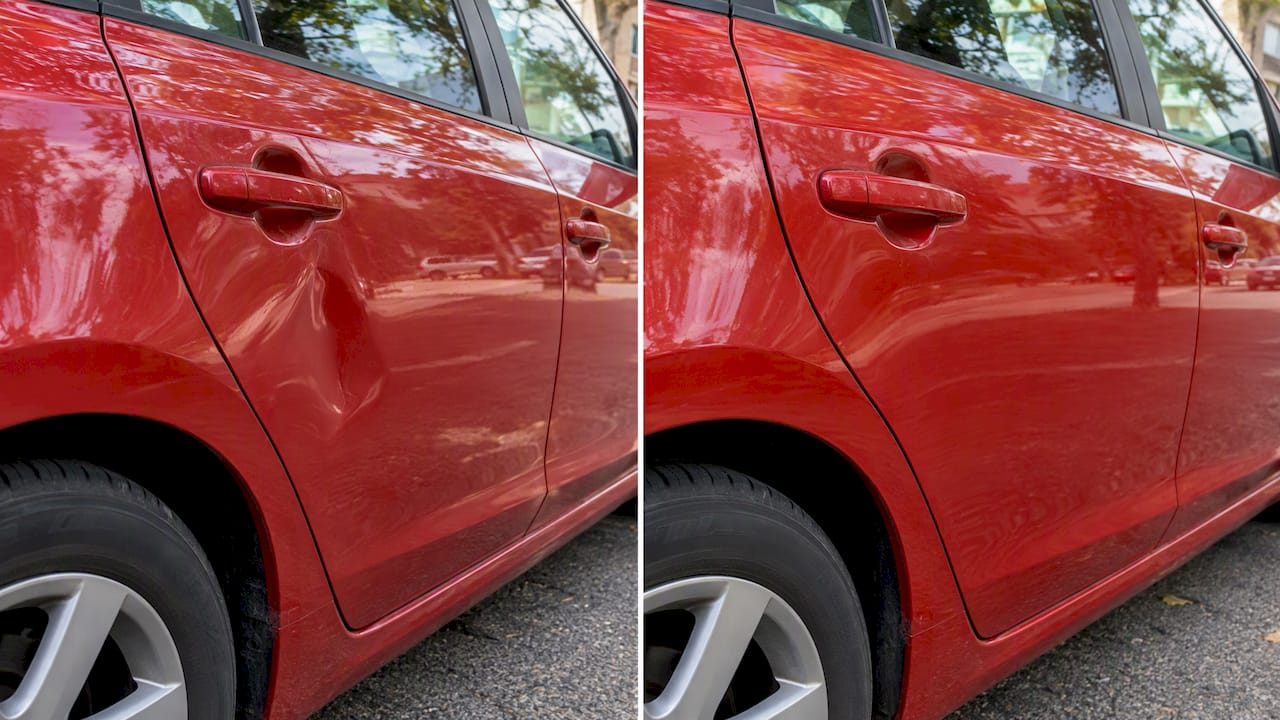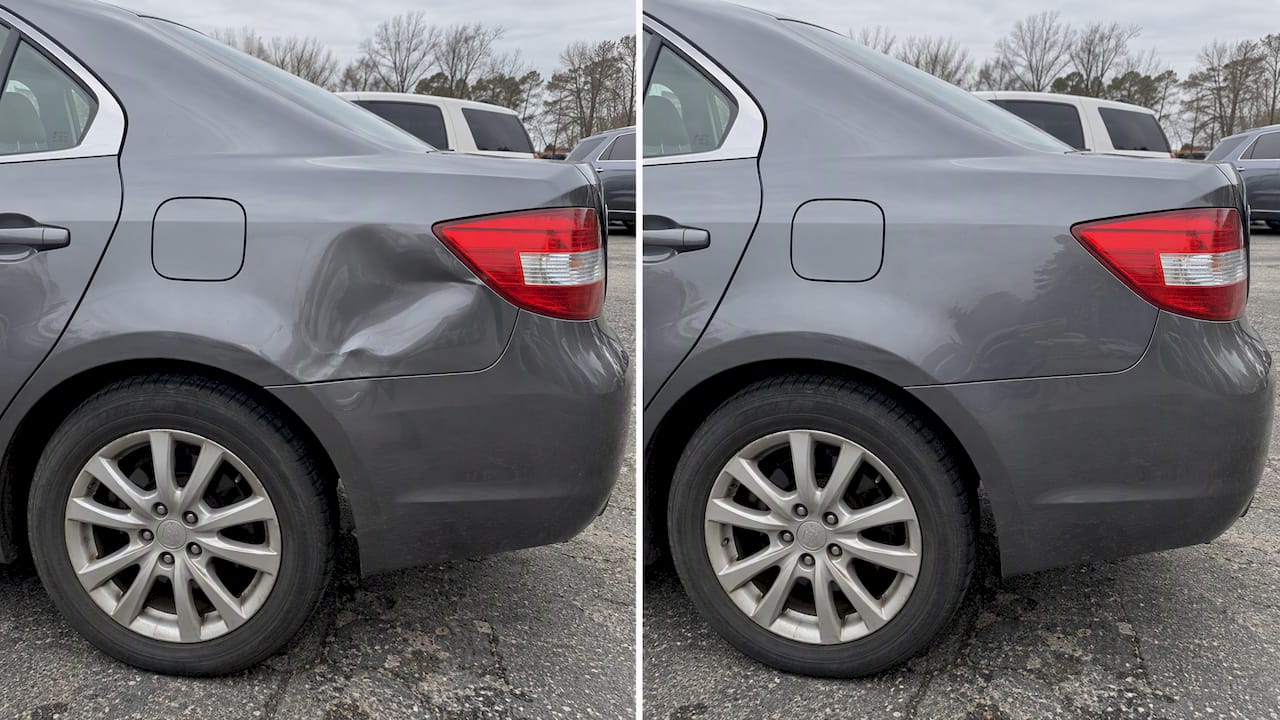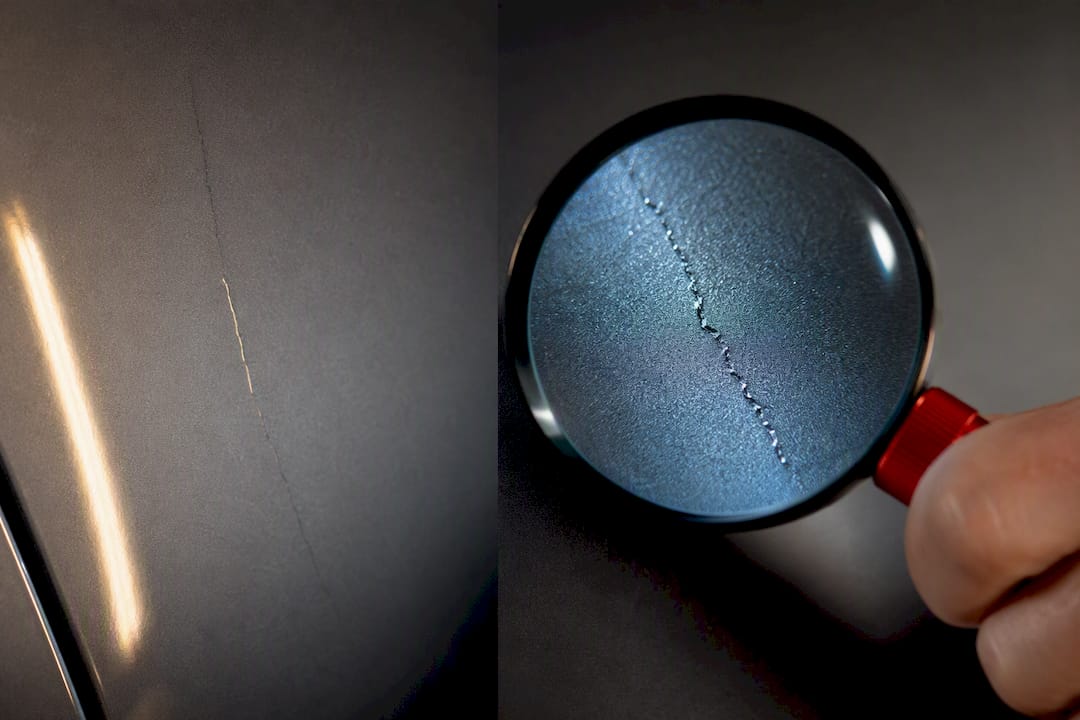
Paintless dent repair cannot reliably fix a dent once the paint above it is cracked. Once the clear coat and color coat split open, the coating loses the flexibility PDR depends on, and pushing or massaging that metal usually widens the crack instead of closing it. Hybrid repairs exist for exactly this scenario, but the right call always starts with a real inspection, not a guess from a photo taken in your driveway—see guidelines from fleet collision repair experts for thorough evaluation best practices.
TL;DR:
- Cracked paint automatically disqualifies pure PDR because the adhesion between the coating and metal is compromised, risking crack spreading during repair.
- Proper inspection relies on reflected light, magnification up to 30x, and checking for micro-cracks, paint integrity, and access, not just visual assessment from a distance.
- Attempting PDR on cracked or previously repainted panels often causes crack propagation and delamination, increasing repair costs and possibly exposing bare metal.
- Hybrid repairs like push-to-paint or spot touch-ups are suitable for cracked paint and can reduce costs compared to full repaint; full repaint is reserved for widespread cracking or extensive filler.
- An in-person inspection before booking can determine the correct repair method, with costs ranging from $100 to over $1,500 depending on damage extent and access.
Table of Contents
- Can PDR Fix Cracked Paint When the Dent Is Shallow?
- Why Cracked Paint Rules Out Pure PDR
- How Do Technicians Check Paint Before Starting PDR?
- What Happens if You Force PDR on Cracked Paint?
- Hybrid Repairs: PDR, Push-to-Paint, and Full Repaint
- What Should You Ask a Technician Before Booking?
- What Does Each Repair Path Cost and How Long Does It Take?
- How Denterasersllc Approaches Cracked-Paint Cases
- The Honest Take on Cracked-Paint Dent Repair
- Book an Inspection Before You Commit to a Repair
- Sources
- FAQ
Can PDR Fix Cracked Paint When the Dent Is Shallow?
Even a shallow dent needs three things to be a genuine PDR candidate: intact paint, a rounded shape, and backside access for tools. Miss any one of those, and pure PDR stops being an option no matter how minor the dent looks.
Intact factory paint matters more than dent depth. Factory finishes flex a little with the metal beneath them, which is why a technician can massage a door ding back into shape without cracking a single layer of clear coat. Once that paint has been compromised, the flexibility is gone.
The dent’s shape matters just as much. PDR shines on smooth, rounded impacts, not sharp creases:
- Door dings from a neighboring car door in a parking lot, usually dime to golf-ball sized
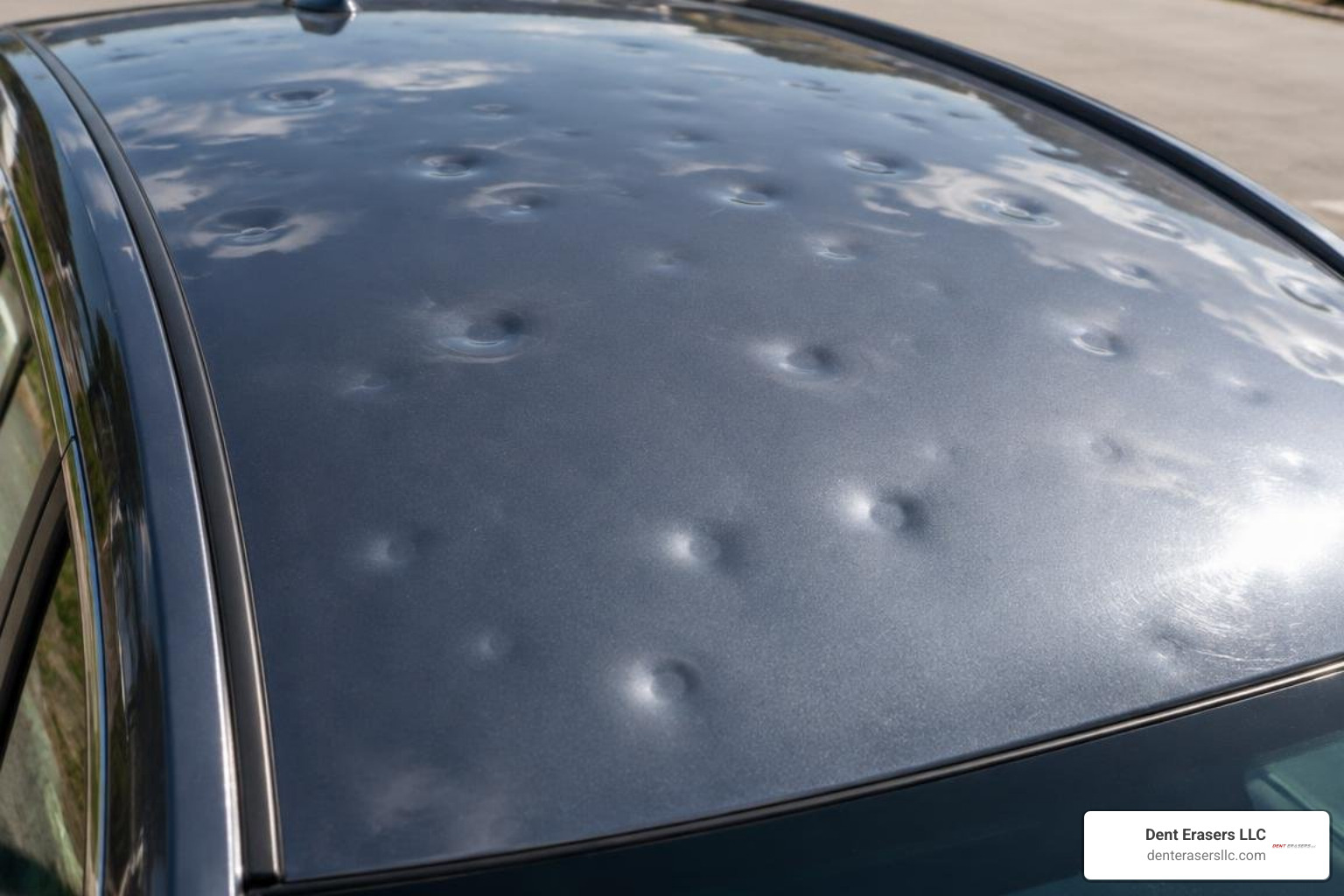
- Hail damage, where dozens of shallow, evenly spread dents cover a hood or roof without cracking the finish
- Shallow impacts from shopping carts, low-speed backing incidents, or a stray branch
Access is the third piece, and it’s the one drivers forget. A technician needs to reach the backside of the panel with specialized rods or tools to push the metal back into place from behind. A dent tucked against a rigid brace or a reinforced pillar might be perfectly round and perfectly paint intact, and still be off the table for PDR because there’s no way to get a tool behind it.
Before you call a shop, run a quick check yourself. Look at the paint under bright light for any hairline breaks. Run a fingernail lightly across the dent’s edge. Feel any grit or a rough lip? That’s often a crease, not a rounded dent, and creases behave differently than smooth impacts once a technician starts working the metal.
Why Cracked Paint Rules Out Pure PDR
Cracked paint disqualifies pure PDR because it breaks the one property the process depends on: adhesion between the coating and the metal. A factory finish is a layered system, typically an e-coat, a primer, a color coat, and a clear coat, bonded to the panel and to each other so the whole stack moves together when the metal flexes. PDR relies on that unified movement. When you push the dent out from behind, the paint above it needs to stretch and settle back into shape right along with the steel or aluminum.
A crack breaks that bond at the exact point where stress concentrates. Once adhesion fails, the coating no longer moves as a single unit with the metal. PDR on cracked paint risks spreading that damage rather than fixing it, because the manipulation that would normally reshape the panel instead pulls at the broken edges of the coating, widening the crack or triggering spider-webbing outward from the original break.
The distinction technicians care about most: visible cracks versus micro-cracks. A visible crack is obvious; you can see the paint has split open. A micro-crack is invisible to the naked eye but shows up under magnification, and it’s just as disqualifying. Industry guidance treats micro-cracking as a hard stop for PDR-only work, because a crack you can’t see today can propagate into one you can very much see the moment metal movement puts stress on it.
Here’s the number that surprises most car owners: technicians inspect panels at up to 30x magnification specifically to catch this kind of hidden failure before it becomes a bigger problem mid-repair. That’s not overkill. It’s the only way to catch damage that’s already there but hasn’t announced itself yet.
How Do Technicians Check Paint Before Starting PDR?
Technicians rely on reflected light and magnification, not eyeballing the dent from three feet away in a parking lot. A proper inspection starts with a directional reflection board, a large panel with alternating light and dark stripes, positioned so the technician can see the dent’s true contour reflected in the paint. That reflection reveals distortion invisible under flat daylight or shop lighting.
High-intensity handheld lights come next, angled low across the panel to throw shadows into any surface irregularity. Reflected-light inspection combined with magnification is standard practice precisely because micro-cracking hides from the naked eye until stress reveals it, usually mid-repair, which is the worst possible time to find out.
Pro Tip: If a shop skips the reflection-board step and goes straight to pushing on your panel, that’s worth questioning. A technician confident in their diagnosis will show you the inspection, not skip past it.
A full paint assessment covers more than just cracks:
- Magnification checks, typically in the 10x to 30x range, scanning specifically for micro-cracking along the dent’s stress points
- Paint feel, running fingers across the surface to detect grit, ridges, or a texture change that signals prior filler work
- Edge stress, checking whether the dent has a sharp crease or fold rather than a smooth curve
- Repair history, looking for slightly mismatched color, overspray on trim, or a different texture that suggests the panel was repainted before
- Access and stretch, confirming a tool can reach the backside and that the metal hasn’t stretched past what PDR can correct
Every one of these checks exists to answer one question honestly: will this paint move with the metal, or will it break?
What Happens if You Force PDR on Cracked Paint?
Attempting PDR on paint that’s already cracked or on a panel with a hidden repaint tends to make things worse, not better. The most common failure is crack propagation. What starts as a small hairline break spreads outward as the panel flexes, often turning into a spider-web pattern that spans several inches from the original point of impact.
Delamination is the second failure mode, and it’s the more expensive one. The clear coat separates from the color coat beneath it, sometimes exposing bare metal at the edges of the original dent. Once metal is exposed, you’re no longer looking at a cosmetic paint issue. You’re looking at a corrosion risk.
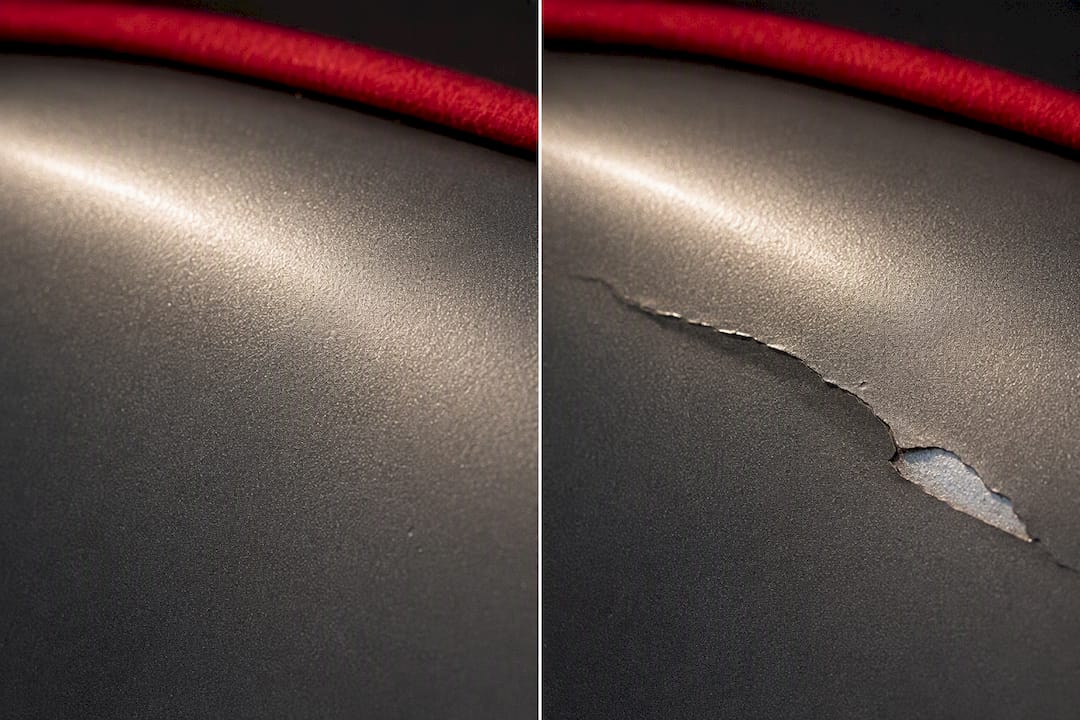
Here’s where the technical picture gets more specific: repainted panels and panels with heavy filler are measurably more brittle than factory-finished metal, which means they crack under PDR-induced movement far more easily than an original factory panel with intact paint. If your car has ever had bodywork done on that panel, even work you don’t know about because you bought the car used, that history changes the risk calculation entirely.
The downstream cost of forcing it is what stings most:
- A crack that spreads from a coin-sized area to a palm-sized area turns a simple touch-up into a blend job
- Delamination exposing bare metal often means primer, sealer, and a repaint the panel didn’t originally need
- A failed PDR attempt can push what would have been a $150 minor fix into full conventional-repair territory
This is the core reason a shop that inspects before it commits is protecting your wallet as much as your panel.
Hybrid Repairs: PDR, Push-to-Paint, and Full Repaint
Cracked paint doesn’t automatically mean you’re stuck with a full repaint. It means pure PDR is off the table, but there are three realistic paths forward, and picking the right one depends on how far the damage has spread.
- Push-to-paint hybrid. A technician uses PDR technique to push the metal back to its correct contour first, then hands the panel off for conventional prep and paint. Using PDR to minimize how much filler and paint the panel actually needs cuts material cost and shortens the paint booth time considerably compared with a panel that was never reshaped first.
- Spot touch-up or blending. If the crack is small and isolated, and the surrounding paint matches well, a technician can blend a repair into the immediate area without repainting the entire panel. This works when the damage is contained and the color match is close.
- Full panel repaint. When cracking has spread, when there’s existing filler underneath, or when the color has faded enough that a spot blend would stand out, the whole panel needs to come off and go back on fresh.
The trade-offs run in a predictable direction: push-to-paint hybrids cost less and take less time than a full repaint, but they still involve paint work, which means they’re never as cheap as PDR alone. Spot blending sits in the middle, cheaper than a full panel but riskier on color match, especially on metallic or pearl finishes where even slight mixing variance shows under direct sunlight. A full repaint costs the most and takes the longest, but it’s the only option that fully resets a panel with widespread cracking or hidden filler.
What Should You Ask a Technician Before Booking?
Start with a fast self-screen before you even pick up the phone. Look for a visible crack in the paint, feel for a sharp crease instead of a rounded dent, check whether the panel might have been repainted before (mismatched texture or slight color shift), and confirm there’s backside access for tools.
Once you’re talking to a shop, four questions separate a transparent technician from one guessing along with you:
- “Do you inspect under magnification, and can you show me what you find?”
- “Will you attempt PDR-only, or do you expect this needs a hybrid repair?”
- “What’s your estimated cost range for each approach, and why the difference?”
- “Does the repair carry any warranty, and what does it cover?”
Pro Tip: Ask to see the inspection, not just hear the verdict. A shop that’s confident in its diagnosis will happily show you the reflected-light distortion or the magnified crack under a scope. One that resists showing you anything is a red flag worth taking seriously.
A self-diagnostic photo check taken in bright, even light can also save you a wasted trip. If a photo makes the crack obvious, that’s a strong early signal you’re headed toward a hybrid conversation, not a pure PDR quote. Preventing paint cracks from ever reaching this point starts earlier than most drivers think, and a look at what actually causes paint cracking around dents is worth a few minutes if you want to protect a panel that’s still intact.
What Does Each Repair Path Cost and How Long Does It Take?
Cost and turnaround both scale with how much paint work gets added to the job. A pure PDR repair on an intact-paint dent is usually a same-day, mobile appointment, often wrapped up in an hour or two depending on the panel and dent size. Add paint into the mix, and both the price and the calendar stretch out.
The biggest cost drivers are dent size, panel location, how much of the paint is compromised, and whether the new work needs to blend into surrounding panels. A small crack on a door edge blends far more easily, and cheaply, than a crack near a body line that runs into two adjacent panels.
Rough timeline expectations look like this:
- PDR-only, mobile appointment: same day, typically one to two hours depending on dent count and size
- Push-to-paint hybrid: one to three days, since the panel needs to move between PDR work and a paint booth
- Full repaint or blend job: multiple days, factoring in prep, paint curing time, and clear coat cure before the vehicle can be driven in full sun or rain
If your vehicle is a lease return or under an insurance claim, get the paint condition documented before any repair starts. Lease-return inspections and insurance appraisers both look at whether cracking was pre-existing or repair-caused, and a clear before-and-after photo record protects you either way. For readers weighing where their repair might land on the cost spectrum, our breakdown of dent and paint repair cost factors walks through what typically moves the number up or down.
How Denterasersllc Approaches Cracked-Paint Cases
Brian Blanc has spent years running mobile PDR calls across Contra Costa County, and the cracked-paint question comes up constantly, usually from a driver hoping for good news they’re not going to get. Denterasersllc’s approach starts before any tool touches the panel: a photo review first, so we can flag an obvious crack or repaint history before you’ve scheduled anything.
When a case is borderline, judgment calls happen in person, not from a phone screen. That means bringing reflected-light inspection and magnification to your driveway or office parking lot, the same standard a shop would use, just without you having to drive anywhere. If pure PDR is genuinely the right call, we’ll say so and quote it. If the paint’s already cracked, we’ll walk you through what a push-to-paint hybrid looks like, cost and timeline both, before any decision gets made. You get a real quote, not a rounded-up guess.
The Honest Take on Cracked-Paint Dent Repair
Most of the confusion around this topic comes from PDR being marketed as a universal fix, when it’s really a precision tool with a narrow, well-defined job. The paint, not the dent, is what decides whether PDR works. That’s the piece the marketing glosses over, and it’s the piece that actually matters when you’re staring at a dent wondering what it’ll cost.
The conventional advice, “just get a PDR quote and see,” skips the step that actually protects your wallet: inspection before commitment. A technician who won’t show you a magnified check or a reflection-board reading is asking you to trust a guess. Push-to-paint hybrids get underused, too, mostly because drivers assume cracked paint means an expensive full repaint is their only option. It usually isn’t.
If you take one thing from this: send a clear, bright-light photo before you book anything. It costs you nothing and it tells a competent technician almost everything they need to know about which repair path actually fits your panel.
— Brian Blanc
Book an Inspection Before You Commit to a Repair
An alternative to guessing at a repair quote over the phone is to inspect the paint first, using reflected-light and magnification checks, whether the job is straightforward PDR or a push-to-paint hybrid.

Our mobile dent repair model means that inspection happens at your home or office, not at a shop you have to drive to and wait around in. If the dent qualifies for pure PDR, minor dent repair runs $100 to $500 one-off, and large dent repair runs $150 to $1,500 one-off depending on size and access. If the paint is cracked and a hybrid or conventional approach is needed, the technician can explain the options rather than force a repair that won’t hold.
Start by sending clear photos of the dent in bright light through our main services page, and we’ll tell you straight whether you’re looking at same-day PDR or a hybrid repair, along with a real cost estimate before you commit to anything.
Sources
These sources back the technical claims in this guide and are worth a closer read if you want the full detail behind the inspection standards technicians follow.
- PDR Limitations: Technical Analysis of When Paintless Dent Repair Won’t Work | DentAdvisor
- 5 Times Paintless Dent Repair Won’t Work | EZ Tech PDR
FAQ
What Can PDR Not Fix?
PDR can’t fix cracked, chipped, or delaminated paint, sharp creases that fold the metal rather than dent it, or damage on panels the technician can’t reach from behind. It also struggles with panels that have significant metal stretch or prior heavy filler work.
Can Cracked Paint Be Repaired?
Yes, but not with PDR alone. Cracked paint typically needs a push-to-paint hybrid repair, a spot touch-up if the crack is small and isolated, or a full panel repaint if the cracking has spread.
What Are the Limitations of Paintless Dent Repair?
PDR requires intact, flexible factory paint, a rounded dent shape, and backside tool access. Cracked paint, micro-cracking visible under magnification, sharp creases, and inaccessible panel backs all take PDR-only repair off the table.
How Much Does Paintless Paint Repair Cost?
Denterasersllc prices minor dent repair at $100 to $500 one-off and large dent repair at $150 to $1,500 one-off, depending on size and access. Hybrid or conventional repairs involving paint cost more since they add paint booth time and materials.