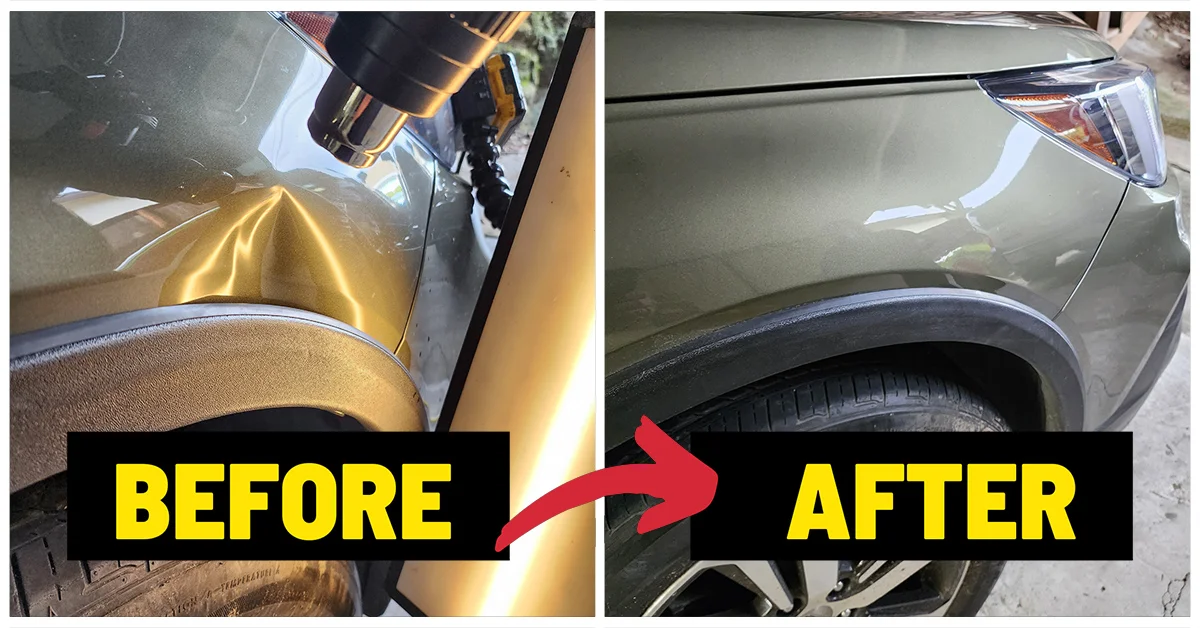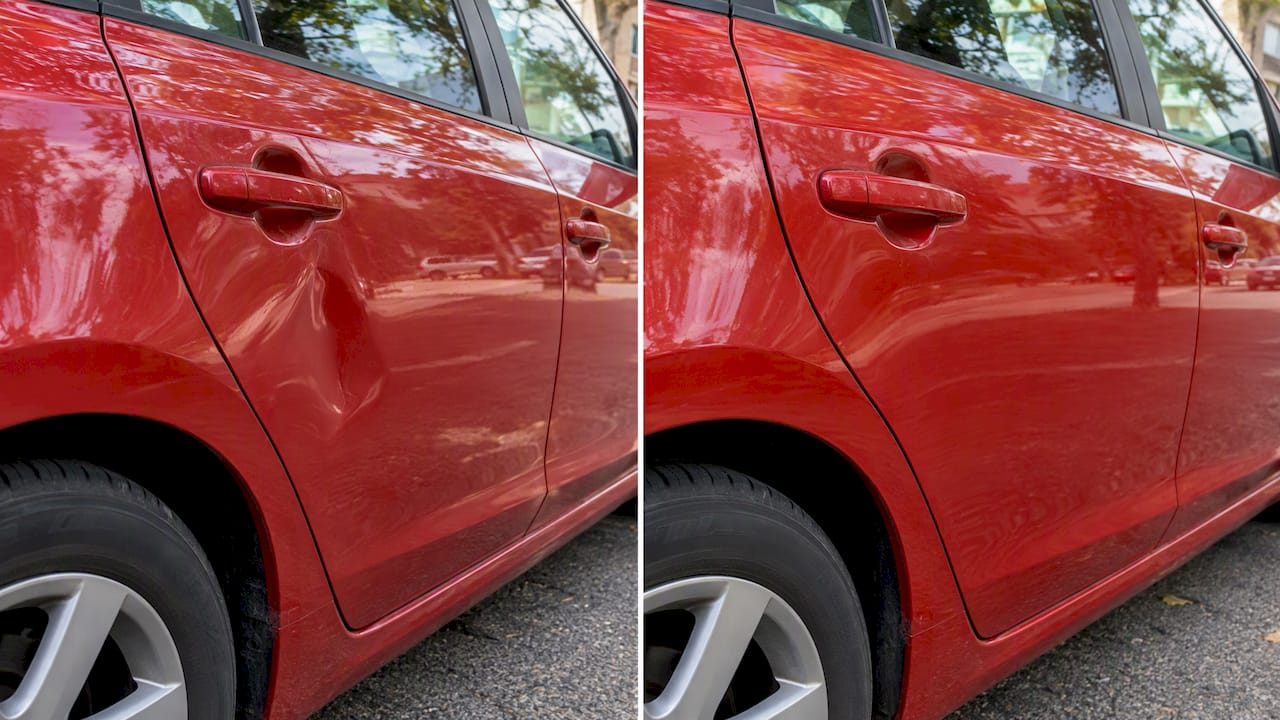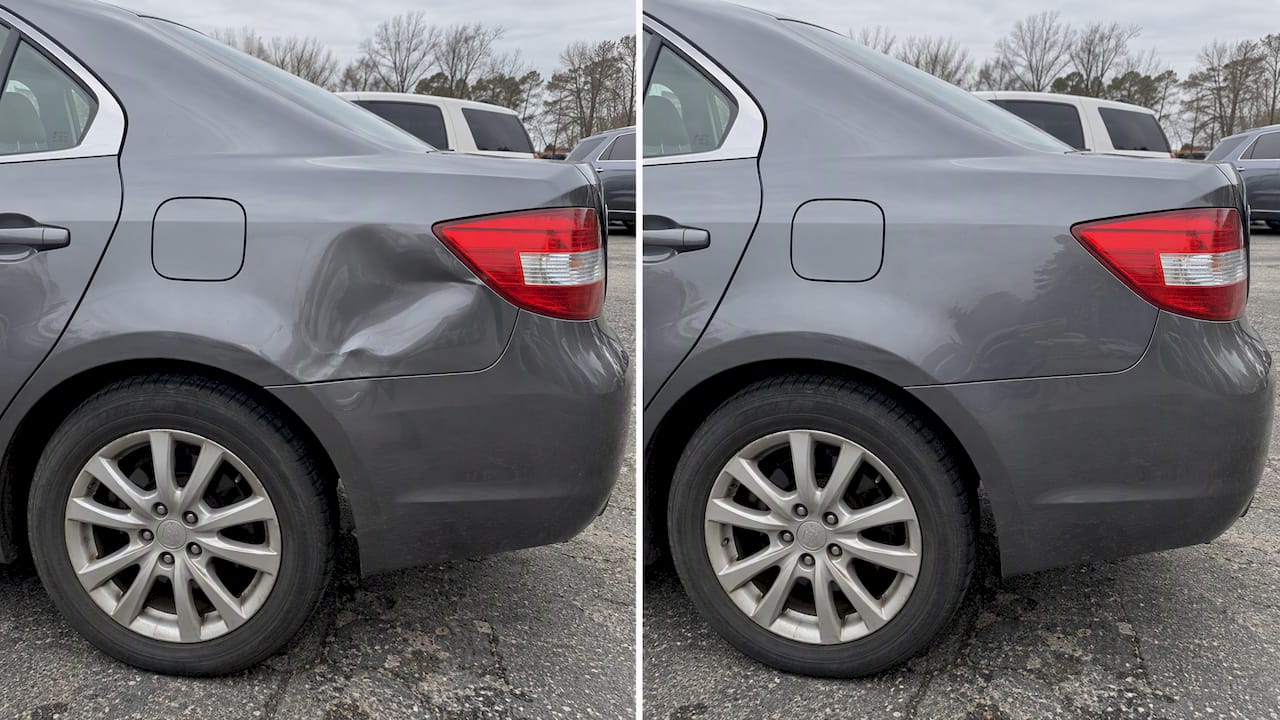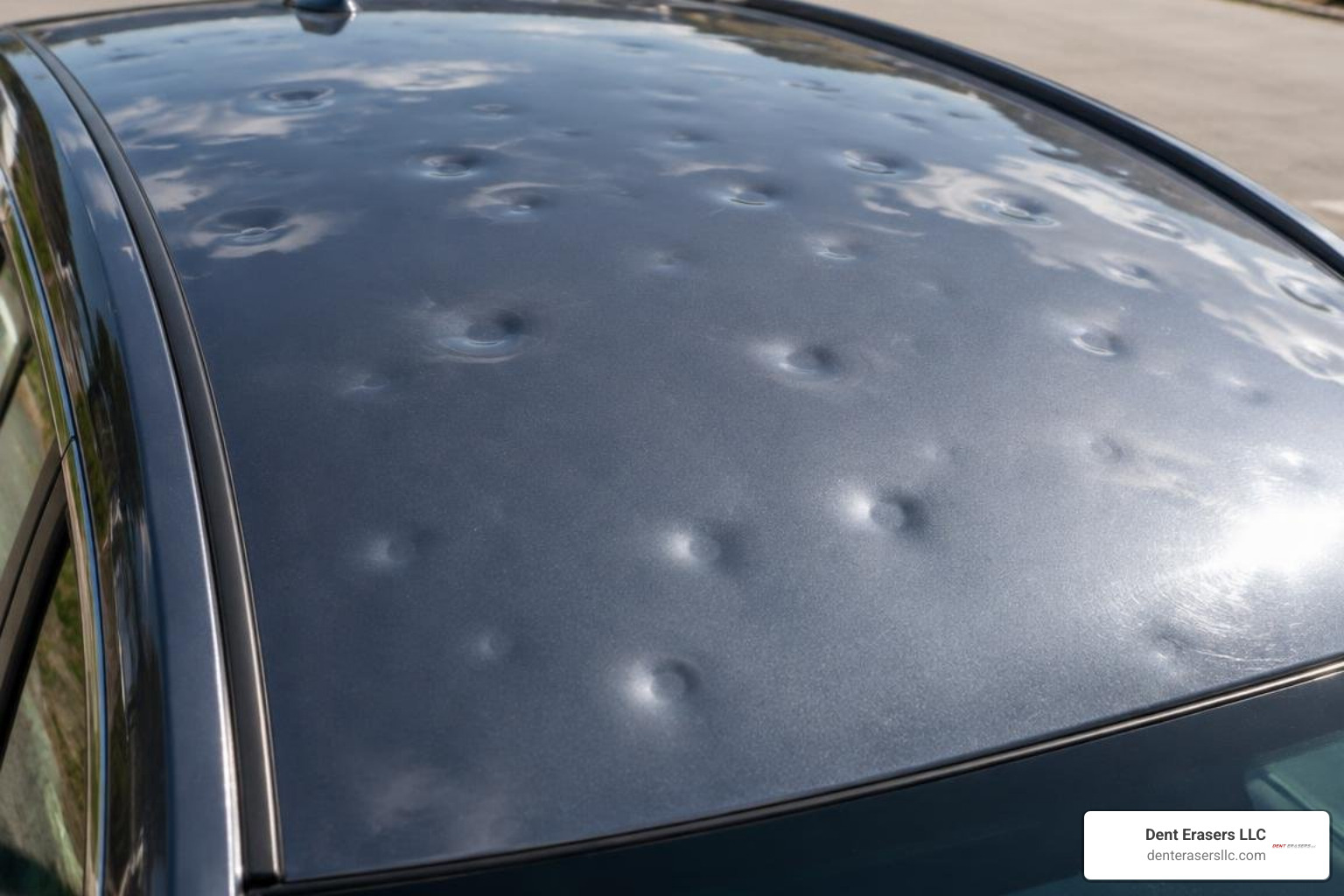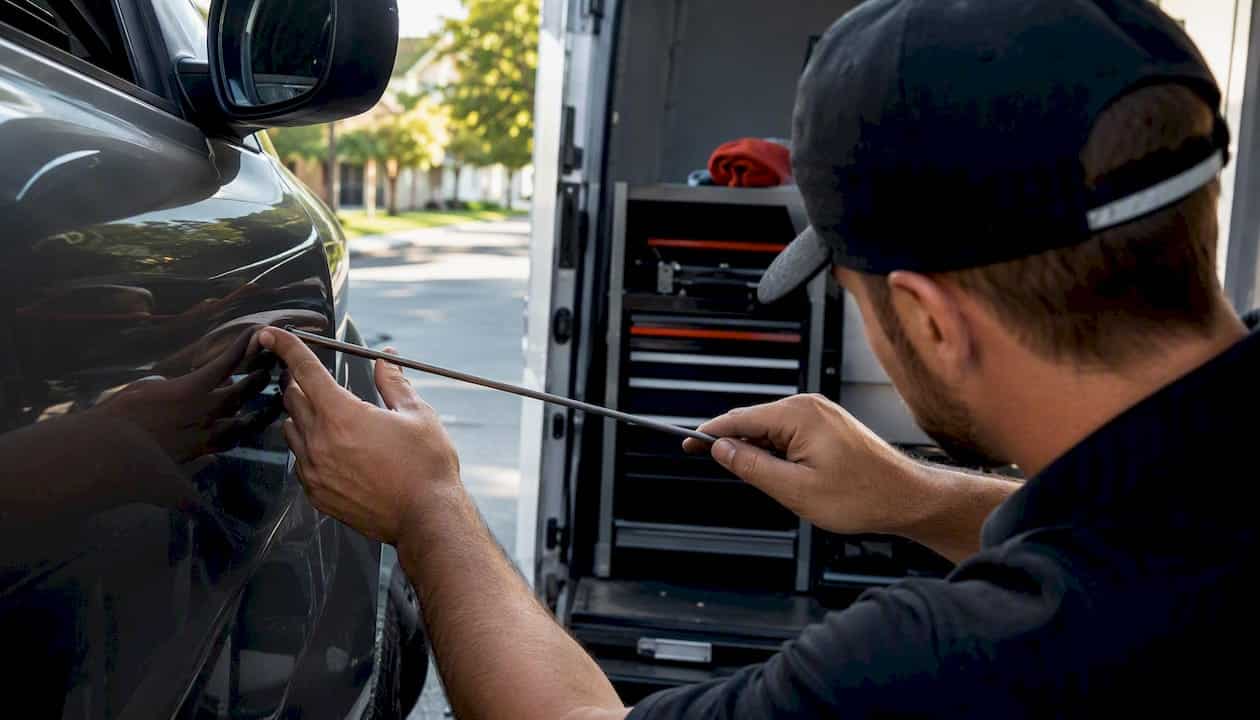
Start with paintless dent repair (PDR) for small dings and hail damage where the paint is still intact. Move to traditional filler and spot repaint for shallow scratches and minor creases. Choose panel replacement or fabrication when metal is creased beyond recovery. Reserve custom refinishing — candies, pearls, color-shift, matte — for appearance goals beyond restoring OEM color. And when structural points, frame rails, or safety sensors are involved, auto body repair and collision repair are fundamentally different jobs: cosmetic work restores appearance, while structural collision repair restores safety systems using OEM procedures, welding, and sensor recalibration.
Here is a quick-reference breakdown of the six main custom car body repair types:
- Paintless dent repair (PDR): Massages metal back from behind using specialized rods and picks. Works only when paint is uncracked and metal is not creased. Best for hail, door dings, and minor body line distortions.
- Traditional filler + blend/respray: Applies body filler (commonly called Bondo), sands, primes, and repaints. Suits scratches, shallow dents, and chips where PDR is not viable.
- Plastic and composite bumper repair: Uses plastic welding, heat reforming, or flexible filler to restore bumper covers and composite panels. Not appropriate when structural bumper beams are compromised.
- Panel replacement and metal fabrication: Cuts out damaged sections, welds in patch panels or full replacement panels, and reshapes sheet metal. Required for severe creases, rust-through, or collision damage beyond filler repair.
- Frame and chassis straightening: Uses hydraulic jacks and frame-pulling equipment to restore structural geometry. Mandatory after any impact that shifts frame rails or unibody points.
- Custom refinishing: Multi-stage systems including metallic, candy, pearlescent, color-shift, and matte finishes. Amplifies every surface flaw, so prep tolerances are far tighter than standard collision refinishing.
A few hard limits worth knowing before you read further: PDR cannot work if the paint has cracked or the metal has a sharp crease. Custom candy finishes will telegraph any sanding halo or surface irregularity directly through the topcoat. And Denterasers LLC handles mobile PDR, plastic bumper repair, and small-body repairs on-site — routing complex structural or full custom refinishing work to the appropriate specialist.
Key Takeaways
The right repair type depends on paint condition, metal integrity, and structural involvement — choosing the least invasive option that fully addresses the damage saves time, money, and resale value.
| Point | Details |
|---|---|
| Start with PDR | For small dents with intact paint, PDR is the fastest, most cost-effective fix and preserves factory finish. |
| Filler for shallow damage | Spot filler and blend suits scratches and chips where PDR is not viable; full respray for uniform color across aged paint. |
| Panel replacement for severe damage | Creases, rust-through, and major collision damage require welding and fabrication, not filler. |
| Custom refinishing demands prep | Candy, pearl, and color-shift finishes amplify surface flaws; a dedicated booth and I-CAR-trained technicians are non-negotiable. |
| Denterasers LLC for mobile repairs | Mobile PDR and plastic bumper repair are available on-site, preserving OEM paint without a shop visit. |
Table of Contents
- What does each custom car body repair type actually involve?
- Why custom paint and refinishing are more demanding than standard collision work
- What happens at a professional shop from estimate to delivery?
- What do repairs typically cost and how long do they take?
- How do you decide between PDR, filler, panel replacement, or custom refinishing?
- What technicians actually say about custom finishes and prep
- A perspective on what actually matters when choosing a repair path
- Ready for a fast, on-site dent repair without the shop wait?
- Sources
- FAQ
What does each custom car body repair type actually involve?
Understanding the mechanics behind each repair method helps you evaluate estimates, ask better questions, and avoid paying for the wrong fix.
Paintless dent repair (PDR)
PDR is the bread and butter of mobile auto body services. A technician accesses the back of the panel — through a door jamb, a removed trim piece, or a drilled access point — and uses steel rods or picks to slowly massage the metal back toward its original shape. The process relies on the metal’s memory: steel and aluminum both want to return to their formed shape when pressure is applied correctly. PDR works on steel and aluminum panels, though aluminum requires lighter, more deliberate pressure because it work-hardens faster than steel.
What it fixes: Hail damage, door dings, minor body line dents, and shallow panel distortions where paint is fully intact.
What it cannot fix: Any dent where the paint has cracked, the metal has a sharp fold, or the panel edge is involved.
Timeline: Fast turnaround time for most jobs.
Traditional filler, spot repair, and full respray
When PDR is not viable, the next step is body filler. A technician grinds the damaged area, applies polyester filler (Bondo is the most recognized brand name), shapes it by hand and machine sanding, then primes and repaints. A spot repair blends new color into the surrounding panel. A full respray covers the entire vehicle or panel set for color consistency.
The difference between a spot blend and a full respray matters for classic and antique car body repair options: a spot blend is faster and cheaper but risks a visible color boundary on older or faded paint. A full respray costs more but delivers uniform color across the vehicle.
Material note: Aluminum panels require epoxy primer before filler because standard polyester filler does not bond reliably to bare aluminum.
Plastic and composite bumper repair
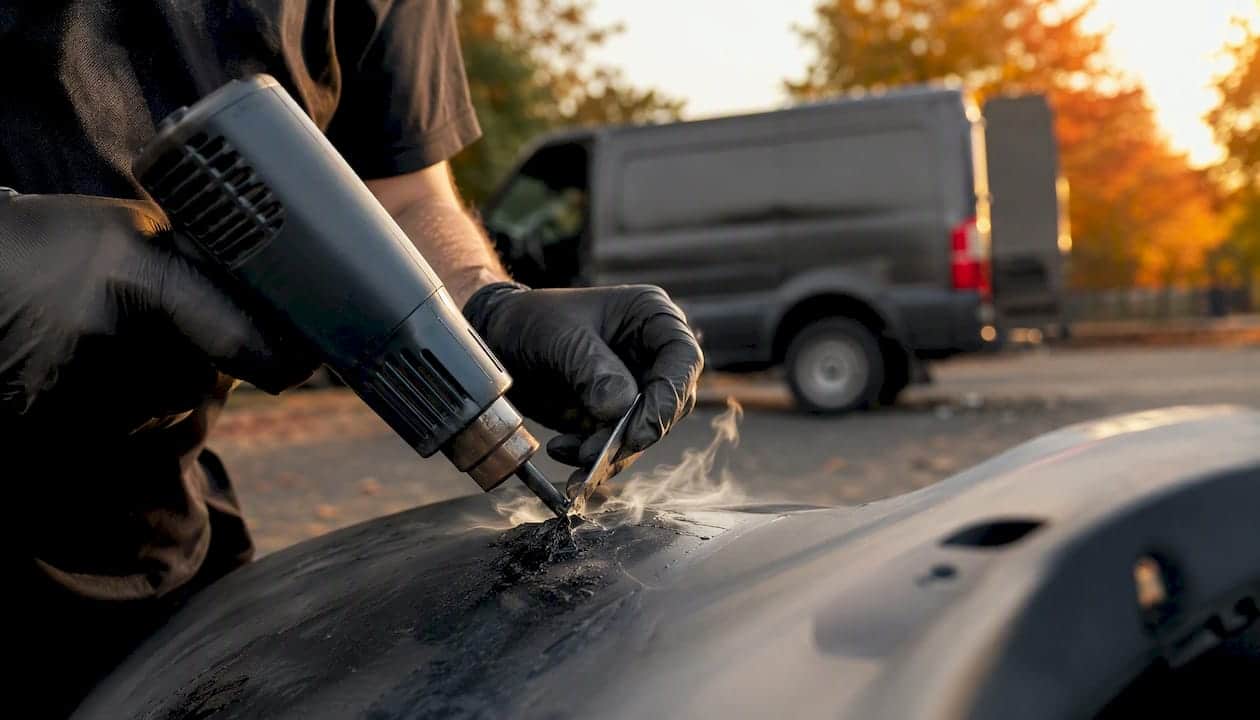
Modern bumper covers are thermoplastic, and most minor cracks, tears, and gouges can be repaired rather than replaced. Plastic welding uses a heat gun and compatible filler rod to fuse the crack from behind. Heat reforming works on minor distortions where the plastic has been pushed in but not torn. Flexible filler is applied over the repair and sanded before painting.
Carbon fiber and fiberglass composites use a different approach: two-part adhesive systems and fiberglass mat for structural backing, followed by surface filler and paint. Heat methods do not apply to composites.
Limit: If the structural bumper beam behind the cover is bent or cracked, the cover repair alone is cosmetic. The beam must be addressed separately.
Panel replacement and metal fabrication
Auto body fabrication — cutting, welding, and shaping metal — is the core method when damage exceeds what filler can address. A technician cuts out the damaged section and welds in a patch panel (a pre-formed piece of sheet metal) or a full OEM replacement panel. For classic and antique car body repair, fabricators sometimes form patch panels by hand when OEM replacements are unavailable.
Steel and aluminum require different welding approaches. Steel panels are typically MIG-welded. Aluminum requires MIG or TIG welding with aluminum wire and a clean, oxide-free surface. Mixing techniques or using the wrong filler wire creates weak welds and corrosion points. For more on body panel repair options, the substrate type is the first variable a technician should confirm before quoting.
Pros: Restores structural integrity; appropriate for rust-through and severe collision damage.
Cons: Higher cost, longer timeline, and color matching is more complex after welding.
Frame and chassis straightening
Automotive body repairers use pneumatic tools, hydraulic jacks, and dedicated frame-pulling equipment to restore a vehicle’s structural geometry to manufacturer specifications. This is not cosmetic work. Misaligned frame rails affect handling, tire wear, and crash performance. Any repair involving frame straightening should follow OEM procedures, particularly on vehicles with advanced driver assistance systems (ADAS) where sensors are mounted to structural points.
When it is required: Visible frame deformation, misaligned door gaps after a collision, airbag deployment, or wheel alignment that cannot be corrected by standard adjustment.
Custom refinishing
Custom refinishing covers metallic, candy, pearlescent, color-shift (chameleon/flip), and matte finishes. Each uses a multi-stage system where layers build on each other — and each layer amplifies whatever imperfections exist beneath it. This is the most prep-intensive category in the auto body shops industry, and it is where the gap between a capable shop and an average one shows most clearly.
Pro Tip: For any custom refinishing job, ask the shop to spray a test card in your chosen color and effect before committing. A test card shows you the actual flake orientation, candy depth, or pearl shift — not just a chip from a swatch book.
| Repair Type | What It Fixes | Main Steps | Pros | Cons | Typical Cost Range | Typical Timeline | Material Suitability | Visibility of Previous Damage |
|---|---|---|---|---|---|---|---|---|
| PDR | Small dents, hail, dings (paint intact) | Access panel, massage metal, QA | No paint, preserves OEM finish, fast | Requires intact paint, no creases | Moderate cost per dent | Same day to 2 days | Steel, aluminum | Invisible when done correctly |
| Filler + spot blend | Scratches, chips, shallow dents | Grind, fill, sand, prime, blend, clearcoat | Affordable, widely available | Color boundary risk on aged paint | Moderate cost per panel | 2–5 days | Steel, aluminum (with epoxy primer) | Low if blended well; higher on faded paint |
| Plastic/bumper repair | Cracks, tears, gouges in bumper covers | Weld or heat-form, flexible filler, paint | Saves cost of full replacement | Not for structural beam damage | Moderate cost range for bumper repair | Short turnaround | Thermoplastic, composites | Low to moderate |
| Panel replacement | Severe creases, rust-through, major collision | Cut, weld patch or OEM panel, fill, paint | Restores structure and appearance | Higher cost, longer timeline | Variable cost per panel | Up to two weeks turnaround | Steel, aluminum | Low with proper color match |
| Frame/structural repair | Frame deformation, unibody damage | Measure, pull, align, verify geometry | Restores safety and handling | Expensive, requires OEM procedures | Higher cost range for frame and structural repair | Several weeks turnaround | Steel unibody, full frame | Not visible externally if done correctly |
| Custom refinishing | Full color change, specialty effects | Multi-stage prep, prime, basecoat, effects layers, clearcoat, polish | Unique appearance, high visual impact | Amplifies surface flaws, high prep demand | Higher cost range depending on complexity | Several weeks or more turnaround | All substrates (prep varies) | High if prep is inadequate |
Why custom paint and refinishing are more demanding than standard collision work
Standard collision refinishing has one goal: match the OEM color and make the repair invisible. Custom refinishing has a different goal entirely — create an effect that does not exist from the factory. That distinction changes everything about how the job is prepared and executed.
Custom refinishing uses multi-stage systems — candies, pearls, flakes, and color-shift pigments — that magnify surface irregularities far more than a standard basecoat/clearcoat system. A sanding scratch that would disappear under a solid OEM color becomes a visible halo under a candy red. A small low spot in the primer telegraphs through three layers of pearl and clearcoat.
How the layering works
A candy finish starts with a chrome or silver base, then receives multiple translucent candy coats that build depth and color saturation. The more candy layers, the deeper the color — but each layer also multiplies any flaw in the surface below. Metalflake finishes add a layer of dry flake between coats, requiring a specialized dry-flake gun and an intercoat clear to lock the flakes flat before the topcoat goes on. Pearl finishes use mica particles suspended in the basecoat to create a shifting, light-reactive shimmer. Color-shift (chameleon) pigments change hue depending on the viewing angle, which means flake orientation and spray angle must be consistent across every panel.
Common visible flaws in custom work include:
- Sanding halos: Circular scratches from prep work that appear as rings under candy or pearl coats.
- Orange peel: Textured surface from incorrect spray distance, air pressure, or product viscosity.
- Flake orientation issues: Metalflake that lies at different angles on adjacent panels, creating a patchy appearance.
- Dry spray: Overspray that lands partially dried, creating a rough, dull texture at panel edges.
What the shop environment needs to look like
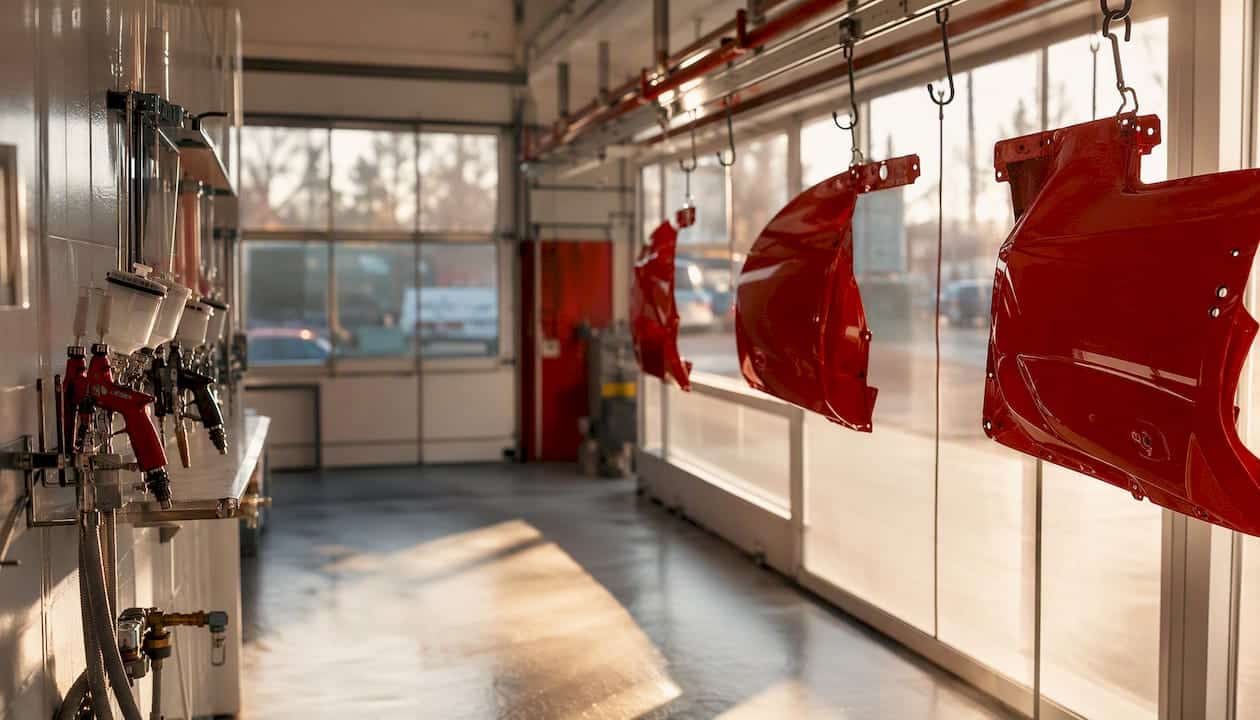
Custom work requires a dedicated spray booth with filtered, temperature-controlled, humidity-controlled air. Dust, humidity swings, and temperature drops cause adhesion failures and finish defects that are nearly impossible to correct without stripping and starting over. Shops that handle specialty auto repair at this level typically hold I-CAR training credentials or OEM refinish certifications, which signal that technicians have been trained to the standards the materials demand.
Pro Tip: Ask to see the shop’s spray booth before committing to a custom paint job. A booth with proper filtration, temperature gauges, and lighting is a non-negotiable baseline. If the shop sprays in an open bay, walk away.
A professional custom paint process follows a strict sequence: thorough surface prep, epoxy or urethane primer, spectrophotometer-driven color matching, basecoat, intercoat clear for flakes, wet-sanding between stages, topcoat clearcoat, and final polish. Skipping any step leads to adhesion failures or finish defects that show up weeks or months later. For long-lasting results, ask about ceramic sealing layers over the clearcoat — and for surface protection basics, resources on ceramic protection explain how topcoat sealants interact with paint chemistry.
What happens at a professional shop from estimate to delivery?
Knowing the workflow helps you ask the right questions at each stage and catch problems before they become expensive surprises.
- Inspection and damage appraisal. A technician examines the damage visually and physically, checking for hidden structural issues, panel alignment, and paint condition. On vehicles with ADAS, sensor locations are mapped before disassembly.
- Insurance estimate vs. out-of-pocket quote. Insurance estimates follow carrier-approved labor rates and parts sourcing. Out-of-pocket quotes may use aftermarket or recycled parts. Ask which applies to your job and whether OEM parts are available for your vehicle.
- Disassembly and damage verification. Panels come off, trim is removed, and the full extent of damage is confirmed. Hidden damage found at this stage can change the scope and cost of the repair.
- Metal work or PDR. Depending on damage severity, the technician either performs PDR (for eligible dents) or proceeds to welding, fabrication, or panel replacement.
- Filler and primer stages. Body filler is applied, shaped, and sanded. Epoxy or urethane primer seals the surface and provides a foundation for color coats.
- Color matching and basecoat. A spectrophotometer reads the existing paint to generate a formula. The technician sprays test cards to verify the match before applying basecoat to the vehicle.
- Clearcoat and curing. Clearcoat is applied in multiple passes and cured — either air-dried or baked in a heated booth. Baking accelerates cure and hardens the finish faster.
- Wet-sanding and polishing. Any texture or orange peel in the clearcoat is leveled by wet-sanding with progressively finer grits, then machine-polished to a gloss.
- Final QA and reassembly. Panels are reinstalled, gaps are checked, and the finish is inspected under direct lighting. ADAS sensors are recalibrated if structural work was performed.
Questions to ask at the estimate stage:
- Do you perform PDR on-site, or do you subcontract it?
- Do you use a spectrophotometer for color matching?
- Do you have a dedicated custom paint booth with temperature and humidity control?
- How do you protect surrounding panels during blending?
- Who performs the final quality inspection, and what does it include?
For mobile PDR specifically, the workflow is shorter: the technician arrives on-site, accesses the panel, massages the dent, and performs a final inspection — all without disassembly or paint. Mobile service is appropriate for PDR-eligible dents and minor bumper repairs. For mobile auto body repair convenience, on-site service eliminates the need to drop off your vehicle and wait days for a shop slot.
What do repairs typically cost and how long do they take?
Costs below are broad U.S. market estimates. Your actual quote will vary based on your vehicle, location, shop labor rate, and damage specifics.
- PDR (per dent): $75–$400. Fast turnaround time. Cost rises with dent size, location, and panel access difficulty.
- Small filler and spot blend (per panel): $200–$800. Few days turnaround. Color complexity and panel size are the main variables.
- Full respray (complete vehicle): Higher cost range depending on complexity. Multiple weeks turnaround. Multi-stage custom effects push toward the top of this range.
- Plastic bumper repair: Moderate cost range for bumper repair. One to three days. Structural beam damage adds cost.
- Panel replacement (per panel): $500–$2,500+. Five to fourteen days. Aluminum and carbon fiber panels cost more than steel; OEM parts cost more than aftermarket.
- Frame and structural repair: Higher cost range for frame and structural repair. Multiple weeks turnaround. ADAS recalibration adds cost when sensors are mounted to structural points.
- Custom refinishing (full vehicle): Higher cost range depending on complexity. Two to four or more weeks depending on curing time, number of effect layers, and parts availability.
Primary cost drivers across all categories:
- Severity and location of damage (door edges and body lines are harder to blend)
- Material type (aluminum and carbon fiber require specialized tools and more labor)
- Color complexity (metallics, multi-stage candies, and pearls increase both labor and materials)
- OEM vs. aftermarket parts (OEM parts cost more but maintain manufacturer fit and finish)
- ADAS recalibration when sensors are affected by structural work
- Shop labor rates (rates vary significantly by region and shop certification level)
These figures are starting points, not guarantees. A shop estimate after physical inspection is the only reliable number for your specific repair.
How do you decide between PDR, filler, panel replacement, or custom refinishing?
Work through these questions in order. The answers map directly to the right repair path.
Is the paint cracked or chipped at the damage site?
- Yes: PDR is off the table. Move to filler/blend or panel replacement depending on dent depth.
- No: PDR is likely viable. Confirm with a technician.
Is the metal creased or folded sharply?
- Yes: PDR cannot fully restore a sharp crease. Filler or panel replacement is required.
- No: PDR remains the first choice.
Are structural points, frame rails, or ADAS sensors involved?
- Yes: This is collision repair territory, not cosmetic work. OEM procedures and certified structural repair are required.
- No: Cosmetic repair options apply.
Does the owner want an appearance that exceeds OEM color matching?
- Yes: Custom refinishing is the path, but only after all structural and cosmetic repairs are complete and surfaces are properly prepped.
- No: Standard blend or respray is sufficient.
Insurance vs. out-of-pocket considerations:
Insurers typically prefer panel replacement when damage exceeds a threshold where filler repair would be structurally questionable. Owners sometimes prefer out-of-pocket PDR to avoid a claim and preserve their OEM factory paint, which has resale value advantages. A vehicle with original, unrepainted factory paint is generally more attractive to buyers than one with repainted panels.
Red flags that require immediate specialist attention:
- Misaligned door or hood gaps after a collision
- Airbag deployment (structural assessment is mandatory)
- Wheel pull or alignment that cannot be corrected by standard adjustment
- Visible frame deformation or bent subframe components
- Warning lights indicating sensor or ADAS system faults
For resale value, structural repairs should always follow OEM procedures. A cosmetic-only repair on a structurally compromised vehicle is a liability, not a solution. When evaluating shops, the 11 things to look for in a quality auto body repair shop checklist covers the key signals: dedicated booth, certifications, before-and-after galleries, and clear documentation of repair procedures.
What technicians actually say about custom finishes and prep
The gap between collision refinishing and custom refinishing is not just about materials. It is about tolerance for error — and in custom work, that tolerance is nearly zero.
Professional refinishers consistently point to prep as the variable that separates a great custom finish from a failed one. Custom systems like candies and color-shifts amplify even minor surface flaws, so the prep work in a custom booth is far more demanding than what a standard collision job requires. A technician working on a candy red finish cannot leave a 400-grit scratch in the primer and expect the candy layers to hide it. They cannot.
Key technician-sourced points on custom work:
- Prep tolerances for candy and pearl finishes require sanding to finer grits (600–800 wet before primer, 1,200–1,500 before clearcoat) compared to standard collision work.
- Spectrophotometer readings and test cards are not optional for multi-stage effects. A test card sprayed in the shop’s booth conditions shows actual flake orientation and candy depth before the car is touched.
- Custom paint sequences are non-negotiable: each layer depends on the adhesion and surface quality of the previous one. Skipping or rushing a stage leads to delamination or finish defects that appear weeks after delivery.
- Aluminum panels require a different welding approach than steel when fabrication is involved. Shops that handle both substrates must control metallurgy and welding technique carefully to avoid weak joints and corrosion.
A real-world example: a small paint chip on a vehicle with a standard OEM silver basecoat can be blended invisibly with a spot repair. The same chip on a vehicle with a candy blue finish over silver base will telegraph through the candy layers as a color variation — the depth of the candy differs at the repair boundary. Shops solve this by intercoat clearing the entire panel, wet-sanding to level the surface, and reapplying candy coats uniformly across the full panel rather than spot-treating.
To verify a shop’s capability before committing to custom work, ask for test cards from a recent similar job, a before-and-after gallery of comparable finishes, and confirmation that the booth is dedicated to custom work with documented temperature and humidity controls.
A perspective on what actually matters when choosing a repair path
Most car owners approach body repair the same way: they get one estimate, accept it, and hope for the best. That approach works fine for a simple door ding. It fails badly when the damage is more complex or when the owner has appearance goals beyond OEM restoration.
The repair type you choose has downstream consequences that go beyond the immediate fix. A filler repair on a panel that should have been replaced will show up as a ripple in two years when the filler shrinks. A custom candy finish applied over inadequate prep will delaminate or show halos within months. And a structural repair that skips OEM procedures can affect crash performance in ways that are invisible until the next impact.
The honest recommendation: start with the least invasive repair that fully addresses the damage. PDR first, if the paint is intact and the metal is not creased. Filler and blend for shallow damage where PDR is not viable. Panel replacement when the metal is beyond recovery. Custom refinishing only when the owner has a specific appearance goal and the budget and timeline to do it correctly. Rushing any of these steps, or choosing a cheaper option that does not fully address the damage, costs more in the long run.
One more thing worth saying plainly: the difference between a shop that can handle custom refinishing and one that cannot is not always visible from the outside. A clean waiting room and a professional website do not guarantee a dedicated custom booth or I-CAR-trained technicians. Ask the questions. Request the documentation. Look at the gallery. The shops that do this work correctly are proud to show it.
Ready for a fast, on-site dent repair without the shop wait?
If your vehicle has a dent, ding, or bumper scuff that qualifies for PDR or plastic repair, you do not need to leave your car at a shop for a week. Denterasers LLC brings the repair to you — on-site, at your home or office, with no paint, no filler, and no disruption to your factory finish.
The mobile service covers paintless dent removal for hail damage, door dings, and minor body line dents; plastic bumper repair for cracks, scuffs, and minor tears; and precision fender and panel repairs for small collision damage. The process is straightforward: contact Denterasers LLC for an estimate, schedule an on-site inspection, confirm the service window, and receive a final quality check before the technician leaves. PDR preserves your OEM factory paint — which matters for resale value — and avoids the environmental cost of repainting. One clear limit: PDR requires intact paint and undamaged metal. Complex structural work or full custom refinishing requires a shop-based repair, and Denterasers LLC will tell you that directly rather than take on work that falls outside the mobile service scope. To book or get a quote, reach out through the Denterasers LLC website.
Sources
- Collision Repair vs. Custom Refinishing Techniques
- How Custom Paint Processes Work: A Car Enthusiast’s Guide
- What is Auto Body Fabrication? Why It Matters in Vehicle …
- Automotive body and glass repairers (BLS occupational profile)
- Auto Body Shops in the United States – IBISWorld
- What’s the Real Difference Between Auto Body Repair and Collision Repair? | db Orlando Collision
FAQ
What are the different types of auto body repair?
The main types are paintless dent repair (PDR), traditional filler and repaint, plastic and composite bumper repair, panel replacement and metal fabrication, frame and structural repair, and custom refinishing. Each suits a different damage type and severity level.
When should you choose PDR over filler or panel replacement?
PDR is the right choice when the paint is fully intact and the metal has not been creased or folded. Once paint cracks or metal folds sharply, filler or panel replacement is required.
What is the best type of auto body filler?
Polyester filler (commonly called Bondo) is standard for steel panels. Aluminum panels require epoxy primer before filler application because polyester filler does not bond reliably to bare aluminum. Flexible filler is used for plastic and composite bumper repairs.
How does custom refinishing differ from standard collision paint work?
Standard collision refinishing matches OEM color and makes a repair invisible. Custom refinishing creates effects — candies, pearls, metallics, color-shift — that do not exist from the factory, using multi-stage systems that amplify surface flaws and require significantly tighter prep tolerances and a dedicated spray booth.
What types of repair shops handle different auto body services?
General collision shops handle most cosmetic and structural repairs. Specialty shops focus on custom refinishing, restoration, or specific substrates like aluminum and carbon fiber. Mobile services like Denterasers LLC cover PDR and small-body repairs on-site, which is the most convenient option for eligible dents and bumper scuffs.