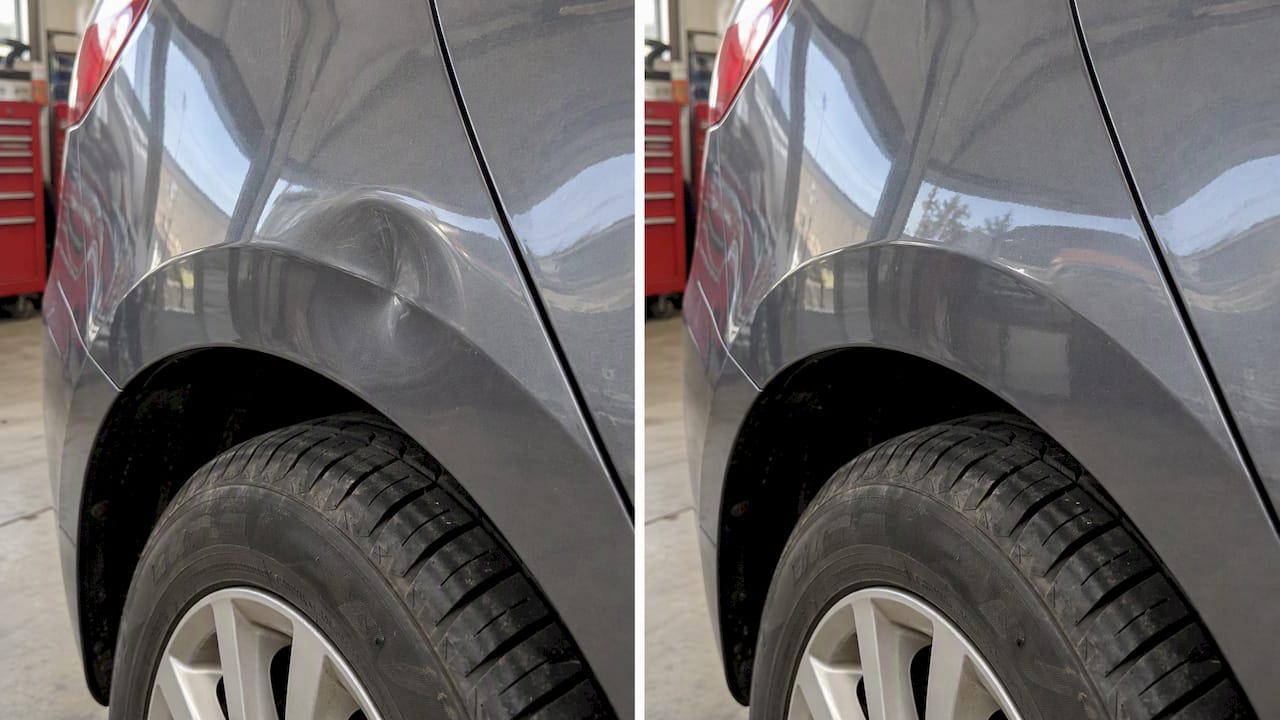
If the dent over your wheel arch is shallow, the paint is intact, and we can get rear access to the panel, paintless dent repair is usually the fastest, least expensive route. When the metal has creased, the paint has cracked, or access is blocked, traditional bodywork or a professional assessment makes more sense. A short inspection settles which path applies, and costs and timelines shift quite a bit depending on which one you need.
TL;DR:
- A technician should inspect paint under magnification, because hidden clear coat cracks rule out PDR even when the surface looks intact from arm’s length.
- Minor PDR typically costs $100 to $500 and often takes one to three hours; larger dents or creases can cost $150 to $1,500.
- For DIY repairs, support the vehicle on jack stands, remove the liner patiently, and stop when the panel is flat to avoid stretching metal.
- A dent that touches the tire or restricts wheel clearance needs prompt professional attention, while rust beneath cracked paint can weaken the arch over time.
Table of Contents
- How to Assess a Wheel Arch Dent for PDR Eligibility
- PDR Versus Traditional Bodywork for Wheel Arch Dents
- DIY Options for Small Wheel Arch Dents
- What a Wheel Arch Dent Repair Typically Costs
- What Pros Check During a Wheel Arch Inspection
- Does Repairing a Wheel Arch Dent Affect Safety or Structure?
- Maintenance Tips to Prevent Future Wheel Arch Dents
- Common Wheel Arch Dents We See and Questions Worth Asking
- How Denterasers LLC Can Help With Your Wheel Arch Dent
- FAQ
- Sources
How to Assess a Wheel Arch Dent for PDR Eligibility
Before deciding on a repair method, we look at the same four things every time: paint condition, dent shape, access, and material. These checks take a few minutes and tell us almost everything we need to know.
Paint condition comes first. Chips, scratches, and especially micro-cracking in the clear coat rule out paintless dent repair, because pulling the metal back into shape would only widen those cracks. Micro-cracks are often invisible at arm’s length, which is why manufacturer guidance for brands like Rivian recommends checking under magnification before attempting PDR; if cracking shows up, the panel needs sanding and refinishing instead.
Dent shape matters just as much. A shallow, rounded dent responds well to paintless techniques. A sharp crease or a spot where the metal has stretched past its original memory will not pop back cleanly, no matter how skilled the technician is.
Access is the third factor. Wheel arches are often double skinned, with an inner liner and sometimes a reinforcement brace behind the panel. Reaching the back side of the dent may require pulling the wheel and liner first.
Material changes the calculation too: steel holds metal memory and responds to traditional PDR tools, aluminum needs gentler technique and different tools, and plastic arch trim calls for heat and flexible-panel repair rather than metal-pulling methods.
Three quick yes-or-no checks point you in the right direction:
- Is the paint free of cracks, chips, and flaking? If yes, PDR stays on the table.
- Is the dent a smooth curve rather than a sharp crease? A clean curve favors PDR.
- Can you reach the back of the panel without major disassembly? Easy access keeps costs down.
PDR Versus Traditional Bodywork for Wheel Arch Dents
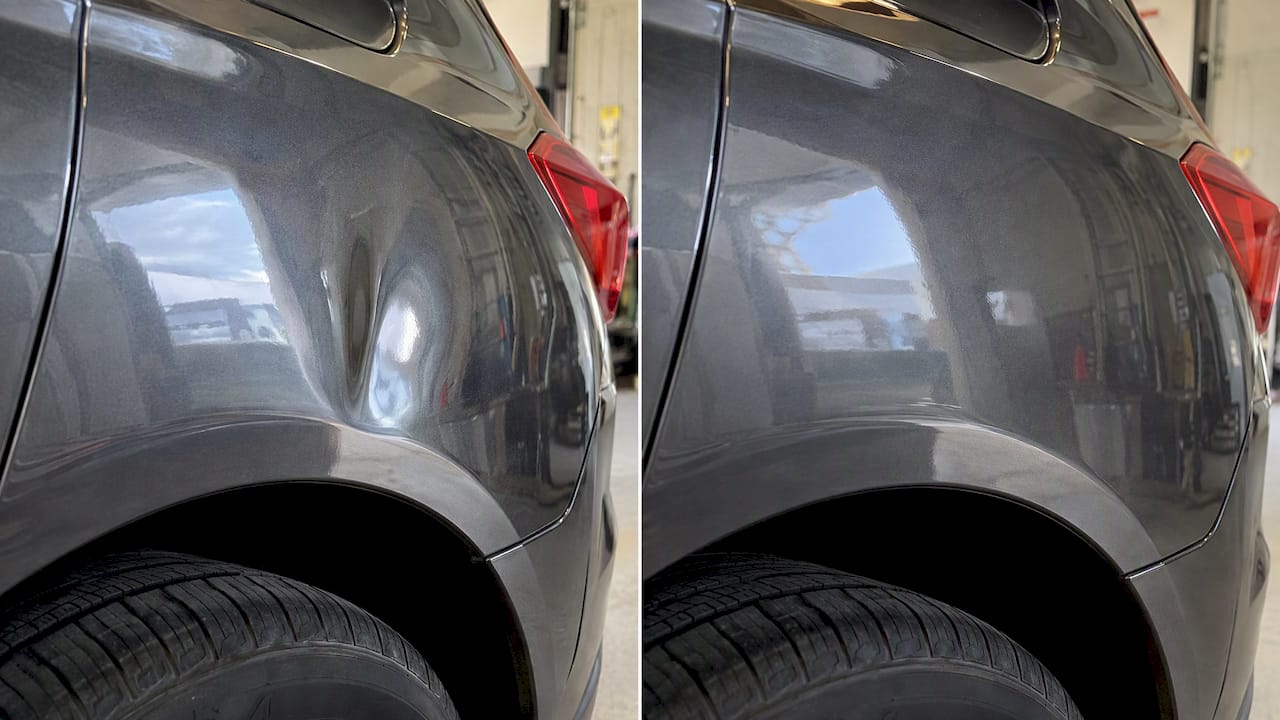
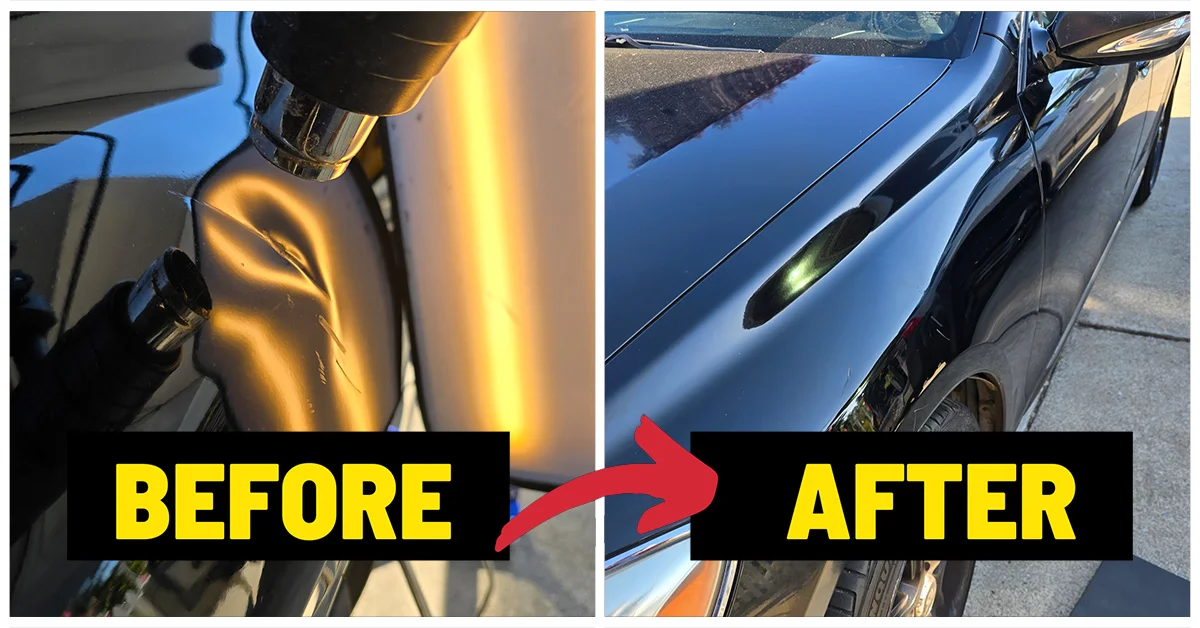
Paintless dent repair uses specialized rods, glue-pull tabs, and tap-down tools to massage the metal back into its original shape from behind or through small access points. It preserves the factory paint entirely, which matters for resale value and color matching. According to dent repair cost guidance, a qualifying PDR job often finishes in one to three hours, compared with days for conventional bodywork.
PDR is generally significantly cheaper than traditional bodywork when the paint is intact and the dent is accessible, according to cost guidance from Dent Repair Calculator, and that gap is the main reason we always check PDR eligibility first.
PDR has real limits. Skilled technicians can attempt it on dents up to several inches across, but success rates fall sharply once dents grow larger, and a crease that crosses a body line usually defeats the technique altogether, according to the same cost guidance. Reinforcement braces and wiring tucked behind wheel arch panels can also block the push-rod access PDR depends on.
Traditional bodywork takes a different path entirely:
- Body filler shapes the dent back to a smooth contour when the metal cannot be pulled cleanly.
- Sanding, priming, and color-matched painting follow, with blending into adjacent panels to hide the repair.
- Severe cases call for cutting out and welding in a new section of the arch, or replacing the panel outright.
Wheel arch curvature adds complexity to painting and blending, since the color has to match across a compound curve rather than a flat surface. If you are filing an insurance claim, the adjuster’s estimate serves as a benchmark rather than a final number. Consumers can request additional estimates and choose their own repair shop, and OEM versus aftermarket parts can shift the total depending on what your policy covers.
DIY Options for Small Wheel Arch Dents
A small, shallow dent with intact paint is often within reach for a careful DIYer, provided you respect the limits below. Rushing the access step is where most home repairs go wrong, so give yourself more time than you think you need.
Pro Tip: Keep a small parts tray next to your workspace and drop every clip and fastener into it as you remove it, in the order you removed it. Reassembly goes twice as fast.
- Gather tools and gear. You will want a jack and stands, a trim removal tool, a glue-pull kit or suction cup set, a flashlight or reflection board, and safety glasses.
- Lift and secure the vehicle. Jack the car at the manufacturer’s recommended point and support it on stands before removing the wheel. Never work under a vehicle held up by a jack alone.
- Remove the wheel and inner liner. Most liners attach with push-pin or screw clips that turn brittle with age. Wheel arch liner removal commonly requires patience and a trim tool rather than force, and keeping spare clips on hand saves a second trip to the parts store.
- Position a light source. Shine a work light or hold a reflection board against the panel so you can watch how the surface changes as you work. Reading the reflection tells you where the high and low spots remain.
- Apply glue-pull tabs or suction tools. Experienced technicians routinely finish small PDR jobs like this in under an hour once access is sorted, working the dent from the outside in small increments.
- Tap down high spots. As the dent rises, use a tap-down tool on any spots that overshoot the original contour, checking the reflection constantly.
- Stop pulling once the panel reads flat. Overworking the metal risks stretching it past the point where it can hold its shape, which turns a PDR job into a bodywork job.
If the paint is already chipped or cracked, filler is the more realistic route. Sand the area to bare metal, feather the edges so the filler blends into the surrounding panel, apply body filler in thin layers, sand it smooth, then prime and spray color in matching layers, blending outward past the repair edge so the new paint does not show a hard line.
A few signs mean it is time to call a professional rather than keep going:
- The metal feels loose, wavy, or shows a sharp crease that will not respond to gentle pressure.
- You find rust bubbling under the paint once you strip it back.
- The liner clips keep breaking and you cannot source replacements quickly.
- The reflection shows the panel is not returning to its original curve after repeated attempts.
For a deeper look at technique, our guide to removing dents from fenders and wheel arches walks through more examples.
What a Wheel Arch Dent Repair Typically Costs
Cost depends almost entirely on which repair category your dent falls into, so it helps to see the bands side by side.
| Repair scenario | Typical cost range |
|---|---|
| PDR, minor shallow dent | $100 to $500 (Minor Dent Repair pricing) |
| PDR, larger dent or small crease | $150 to $1,500 (Large Dent Repair pricing) |
| Filler, paint, and blending | Varies by shop and panel size |
| Rust or structural panel repair | $400 to $2,000 per arch (Cost Insider rust repair guide) |
Wheel arch repairs involving rust or structural damage commonly run $400 to $2,000 per arch, with mid-range jobs landing around $800 to $1,500, according to the Cost Insider wheel arch rust repair guide. Labor, materials, and how much paint blending the job needs are the biggest swing factors within that range.
A few things drive the final number beyond the repair category itself:
- Labor hours scale with how much disassembly the technician needs to reach the dent.
- Color matching and blending into adjacent panels adds time on anything requiring paint.
- Panel replacement, when rust has eaten through metal, adds parts cost on top of labor.
- Mobile PDR can lower overhead compared with a traditional shop, since there is no drop-off wait or shop bay cost built into the price.
If you are working through insurance, remember that the adjuster’s number is a starting estimate, not the final word — you can also compare local dent and hail repair shop quotes to find the best option. You are entitled to get your own independent estimate and to pick the shop that does the work. Asking for an itemized quote, bundling nearby dents into one visit, and confirming whether a mobile technician can work at your home or office are the simplest ways to avoid paying more than the job requires.
What Pros Check During a Wheel Arch Inspection
A thorough inspection catches problems a quick glance misses, and this is where experience pays off. We look past the obvious dent shape to the details that decide which repair method will actually hold.
- Magnified paint inspection reveals micro-cracking that is invisible from a normal viewing distance, and its presence rules out PDR in favor of refinishing.
- Checking behind the panel for reinforcement braces, wiring, or double-skin construction tells us whether push-rod access is even possible before we commit to PDR.
- Reviewing insurance paperwork early clarifies that the adjuster’s estimate is a benchmark, and that you keep the right to choose your repair shop and request a second opinion.
- Testing the panel’s flex and listening for the sound of metal movement during gentle pressure helps confirm whether the metal has retained its memory or stretched past recovery.
These checks take only a few minutes but prevent the frustrating outcome of starting a PDR job that was never going to finish cleanly.
Does Repairing a Wheel Arch Dent Affect Safety or Structure?
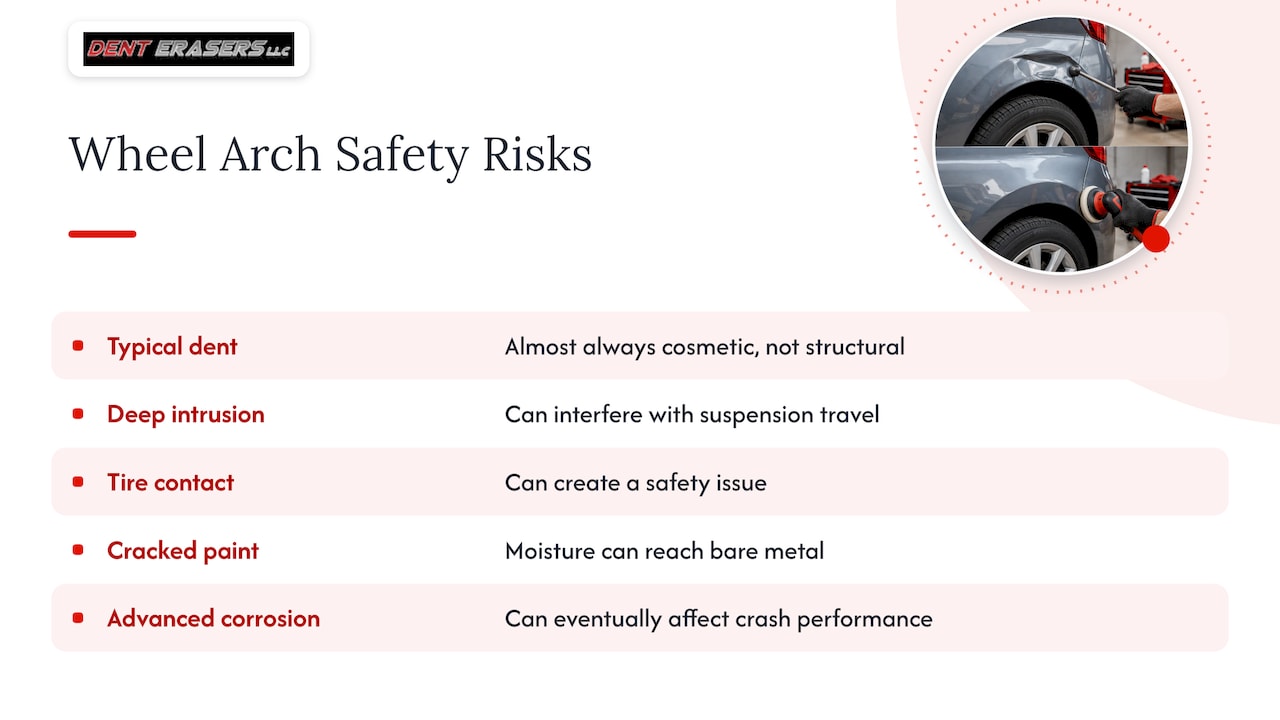
A dent over the wheel arch is almost always cosmetic rather than structural, since the arch itself is not a primary load-bearing component in most passenger vehicles. That said, the area does matter for a few practical reasons that go beyond appearance.
The wheel arch liner and the space behind it often house wiring, brake lines, or suspension components. A dent severe enough to intrude into that space can interfere with suspension travel or rub against a tire at full lock, which creates a genuine safety issue rather than just a cosmetic one. If a dent is deep enough to touch the tire or affect wheel clearance, that is no longer a job to leave until later.
Rust is the other safety-relevant concern. A dent that cracks the paint and goes unaddressed lets moisture reach bare metal, and corrosion weakens the panel over time. On vehicles where the arch contributes to overall body rigidity, advanced corrosion can eventually affect crash performance, which is part of why repair guides treat rust under a dent as a priority rather than a cosmetic afterthought.
For the vast majority of shallow dents with intact paint and no tire contact, neither PDR nor standard bodywork touches anything structural. The repair stays cosmetic, and the main safety question is simply whether moisture and rust have had time to start underneath.
Maintenance Tips to Prevent Future Wheel Arch Dents
A little routine attention around the wheel arches goes a long way toward avoiding another repair down the road.
Parking habits matter more than most people expect. Shopping carts, adjacent car doors, and curbs account for a large share of the small dents that land right over the arch, so parking at the edge of a lot or choosing wider spaces reduces exposure.
Inspecting the liner and arch edge every few months catches small issues before they grow. Look for chipped paint along the arch lip, loose liner clips, or early rust spots, and address any paint chip quickly with a touch-up pen before moisture gets underneath.
Washing the undercarriage and wheel wells periodically clears out road salt, gravel, and debris that collect against the arch and accelerate corrosion from the inside out, especially in regions that salt roads in winter.
If you drive gravel roads or frequently load the vehicle near its weight limit, consider a protective arch liner or mud flap, which absorbs minor impacts that would otherwise dent the metal directly.
Finally, address any dent while it is small. A shallow dent caught early is a straightforward PDR candidate, while the same dent left for months can develop paint cracking or rust that pushes it into a more expensive repair category.
Common Wheel Arch Dents We See and Questions Worth Asking
Most of the wheel arch dents that come across our bench are shallow, caused by a shopping cart, a curb tap, or a stray door ding, and the majority of those qualify for paintless dent repair once we confirm the paint hasn’t cracked. The smaller share that need traditional bodywork usually involve a crease along the arch lip or rust that got started before anyone noticed the chip in the paint.
When you are comparing repair options, three questions tell you almost everything you need to know about a shop’s approach:
- How will you access the back of the panel, and does that require removing the wheel or liner?
- Will you inspect the paint under magnification before committing to paintless repair?
- What is the expected turnaround, and is there a guarantee if the dent isn’t fully resolved?
A shop that answers these clearly, without hedging, is one that has done the inspection work properly.
— Brian Blanc
How Denterasers LLC Can Help With Your Wheel Arch Dent
We handle wheel arch dents onsite, using mobile paintless dent repair methods that preserve the factory finish without repainting. For dents that need more than PDR, we also offer plastic bumper repair and options for auto body and collision work.

Our approach keeps things simple:
- Mobile Dent Repair brings the inspection and the fix to your location, cutting the drop-off and wait time out of the process.
- Minor Dent Repair and Large Dent Repair cover the PDR range, from a small shopping cart ding to a larger crease.
- Plastic Bumper Repair and Auto Body & Collision Repair pick up where paintless techniques stop working.
Our work is described as fast, cost-effective, and onsite, focused on preserving existing paint rather than replacing it. If you want a straight answer on which category your dent falls into, request a free quote and we will walk you through what we see and what it will take to fix it.
FAQ
How to fix a dented wheel arch?
Start by checking whether the paint is intact and the dent is a smooth curve rather than a crease. If both hold true, paintless dent repair, done by gaining access through the wheel well or liner, is usually the fastest fix. When paint is cracked or chipped, sanding, filler, and repainting become the more reliable approach.
What dents cannot be fixed?
Dents with stretched or creased metal generally cannot be pulled back with paintless techniques, since the metal has lost its original memory. Micro-cracked paint also rules out PDR, because pulling the metal would only widen the cracks, and severe rust damage often means panel replacement rather than a simple repair.
How much is it to fix a wheel arch?
A paintless repair on a minor wheel arch dent typically runs $100 to $500, according to Minor Dent Repair pricing, while larger dents needing more work fall in the $150 to $1,500 range per Large Dent Repair pricing. Rust or structural repairs run higher, commonly $400 to $2,000 per arch, according to the Cost Insider rust repair guide.
How much does it typically cost to fix a dent in a car?
Costs vary by method and dent size, with paintless dent repair generally 50 to 70% cheaper than traditional bodywork when the dent qualifies, according to cost guidance from Dent Repair Calculator. A straightforward PDR job often finishes in one to three hours, while filler and paint work takes longer and costs more due to materials and labor.
Sources
- Dent Repair Cost Calculator — Dent repair cost guidance
- FAQs about direct repair programs and generic auto parts — Insurance Information Institute