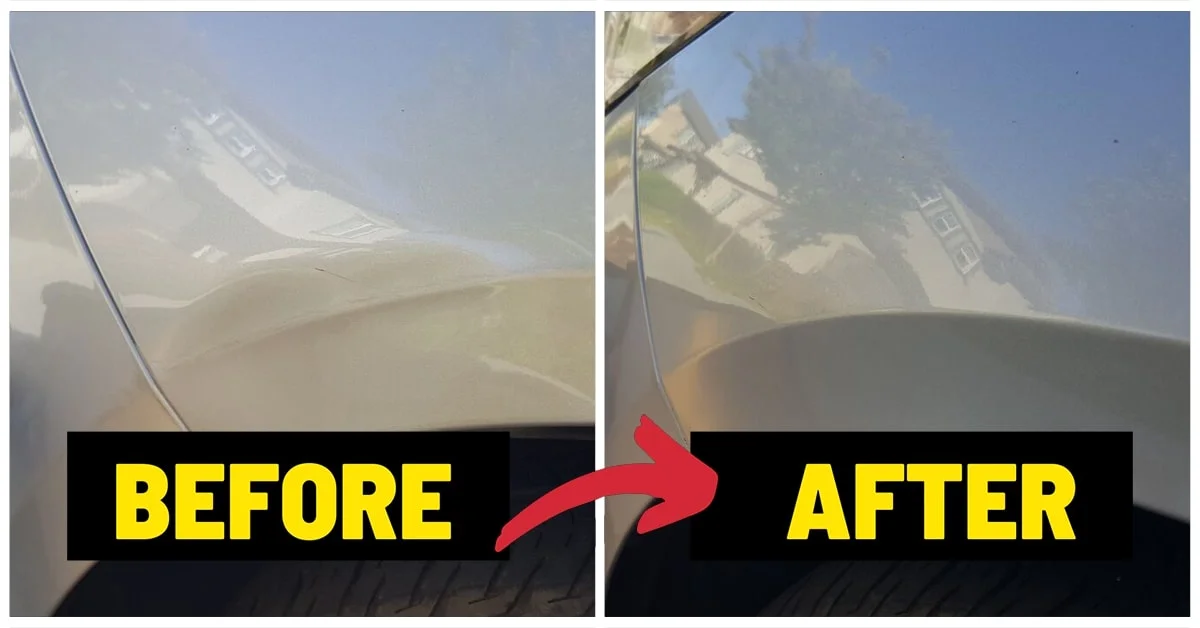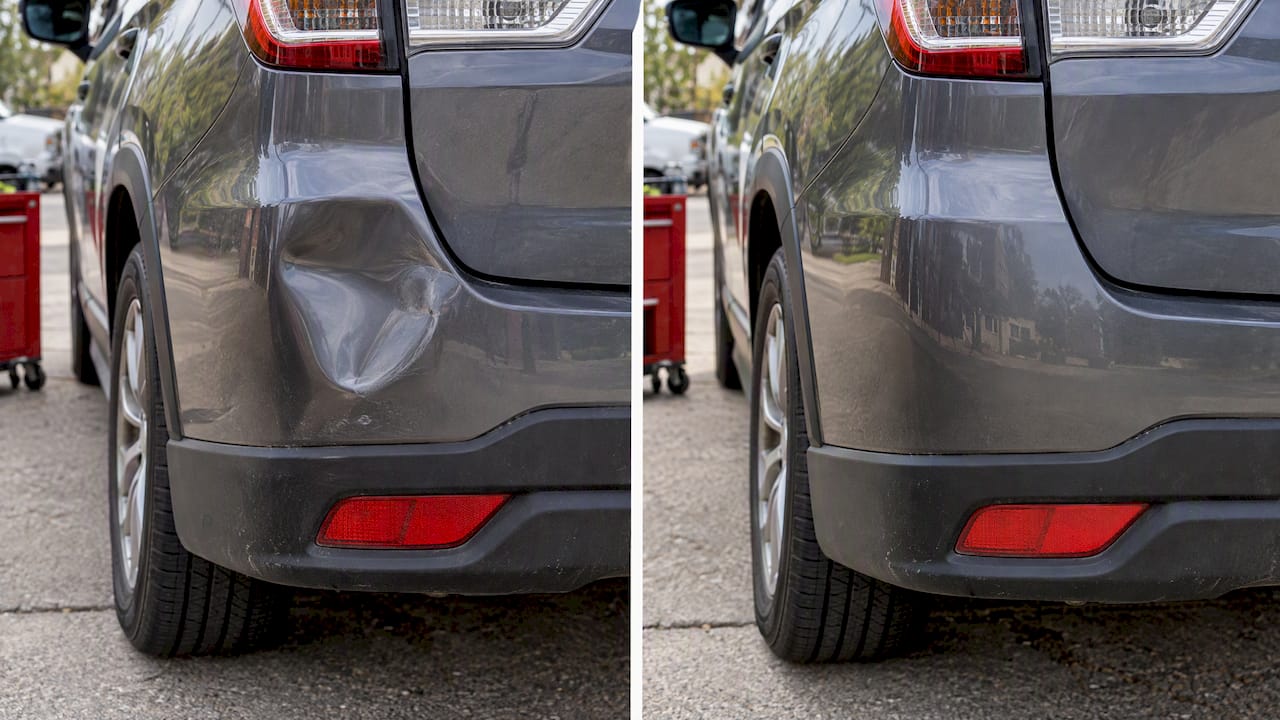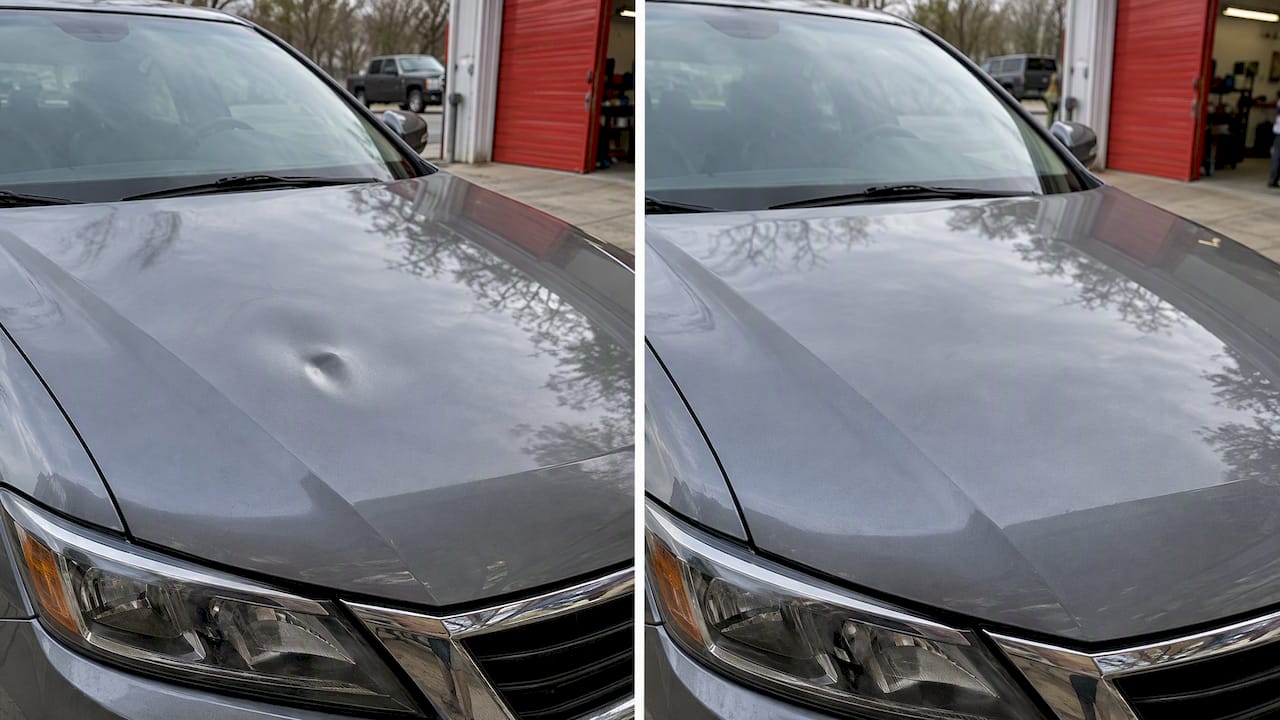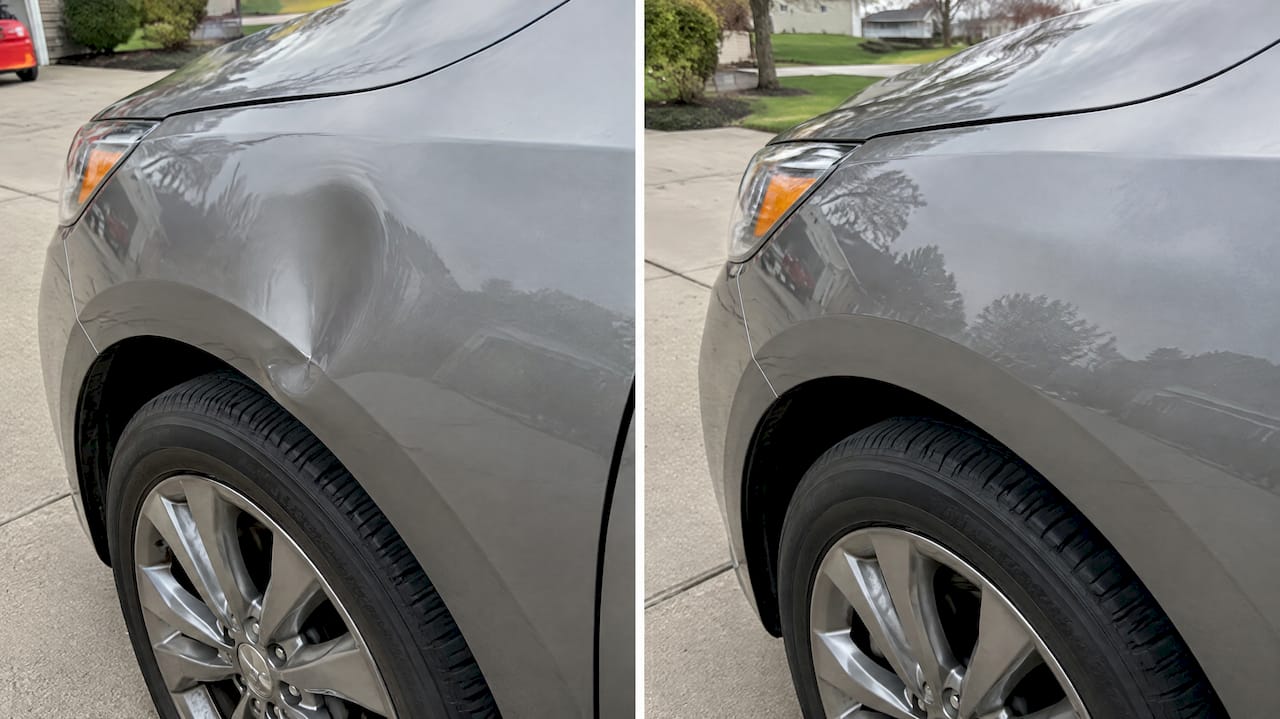
Most minor dents can be fixed without any paint at all, as long as the factory finish is intact and the dent is a moderate, accessible ding rather than a sharp crease. Paintless dent repair is the method that makes this possible, and it’s why so many owners now skip the body shop entirely. When those two conditions line up, you usually save money, save time, and keep your original paint exactly as the factory applied it.
TL;DR:
- Paintless dent repair is suitable only for shallow, non-creased dents with intact factory paint, primarily on steel, not aluminum or damaged surfaces.
- Proper diagnosis involves inspecting the dent’s tension and paint condition first, as cracks or prior repairs disqualify a no-repaint fix.
- DIY tools like suction cups or glue-pull kits may help small, flat steel dents but risk worsening the damage if misused.
- Aluminum panels require significantly more force and technician experience, making professional service essential for complex or high-value vehicles.
- Costs generally vary based on dent size and location, with most small fixes completed in under an hour, and larger or multiple dents taking longer.
Table of Contents
- What paintless dent repair is and why it preserves a factory finish
- How PDR works: step-by-step professional workflow
- Which dents are good candidates for repair without repaint
- DIY vs professional: tools, common methods, and risks to avoid
- Limitations and special cases worth knowing
- Cost and timeline: what to expect before booking
- Preserving resale value and caring for a repaired panel
- Our approach to mobile paintless dent repair
- Why metal tension matters more than most advice admits
- Get a quote for mobile paintless dent repair
- FAQ
- Sources
What paintless dent repair is and why it preserves a factory finish
Paintless dent repair, or PDR, reshapes metal from the inside out instead of sanding it down and refinishing it. A technician works the dent with specialized tools and controlled pressure until the panel returns close to its original contour, and because nothing gets filled or repainted, the factory clear coat stays untouched. Traditional body work goes the opposite direction: grind out the damage, apply filler, sand, prime, paint, and blend. That process works, but it adds labor, materials, and a color match that isn’t always perfect.
We rely on a few core techniques depending on the dent:
- Rod work from behind the panel, pushing the metal out gradually while watching reflections under specialized lighting
- Glue-pull repair, where a tab is bonded to the dent’s surface and pulled outward, useful when there’s no access from behind
- Knock-down techniques, which tap down high spots that form as metal springs back during the pull
Factory paint matters more than most owners realize. It was baked on in a controlled environment and bonds to the panel in a way aftermarket paint rarely replicates exactly, so keeping it intact protects both the car’s appearance and its resale value. PDR also skips the solvents, fillers, and paints that conventional repair depends on, which makes it the more environmentally friendly repair path as well.
How PDR works: step-by-step professional workflow
A no-repaint repair follows a sequence, and skipping steps is usually where results go wrong.
- Inspect and plan access. The technician examines the dent under bright, reflective lighting to map its exact shape and decide whether to work from behind the panel or use glue-pull tools from the front.
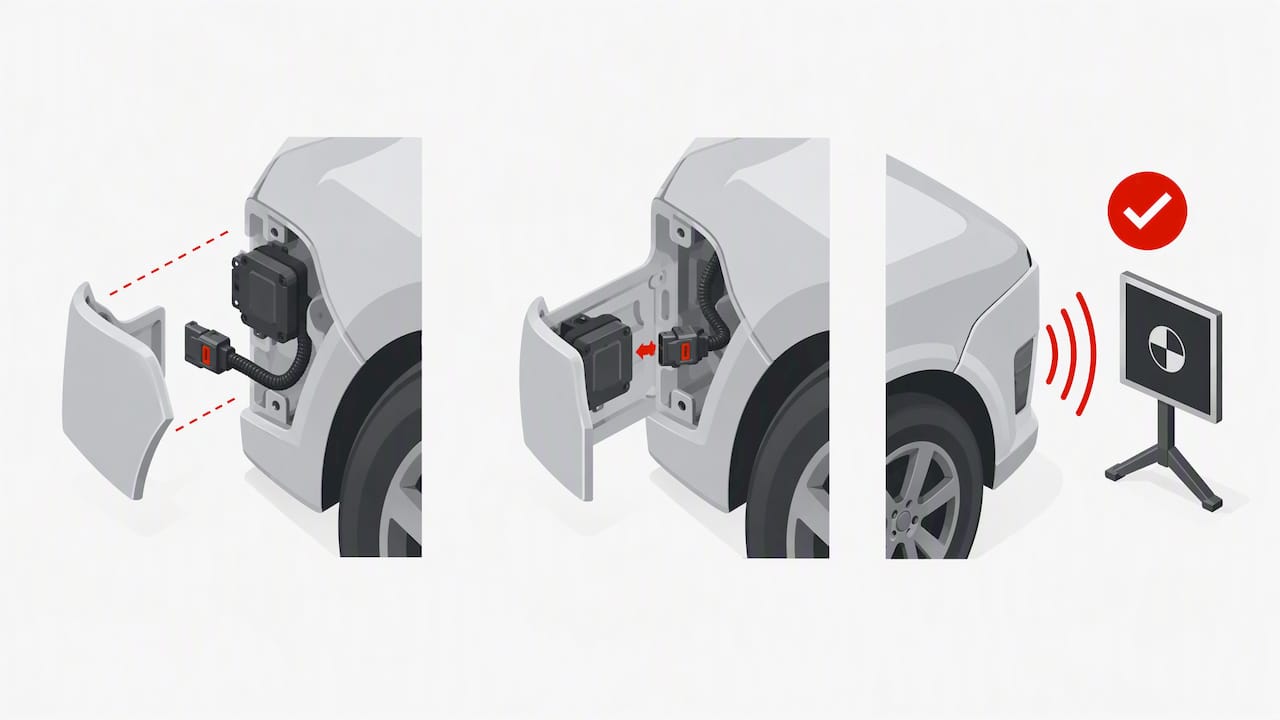
- Remove trim or panels if needed. Reaching the back of a dent sometimes means pulling door panels, tail lights, or liners, which should follow OEM removal and installation procedures to avoid snapping clips or disturbing wiring.
- Relieve perimeter tension first. Before touching the center of the dent, we knock down the surrounding metal that’s absorbed stress, since skipping this step commonly causes waves instead of a flat surface.
- Push and refine gradually. Using rods or tabs, the metal gets worked in small, progressive movements rather than one aggressive push, checking the reflection lines constantly.
- Finish and inspect. Once the contour matches the surrounding panel, the tech checks for any remaining high or low spots under direct light and reinstalls any trim removed earlier.
Pro Tip: Watch the light lines, not the paint. A trained eye reads the dent’s true shape through how reflections bend across the panel, which is more reliable than judging by color or shadow alone.
When a repair involves panels near sensors, cameras, or trim with embedded wiring, a careful technician checks whether disassembly could affect calibration, since reconnecting certain components without verification can leave systems like ABS or door electronics out of sync.
Which dents are good candidates for repair without repaint
Not every dent qualifies, and knowing the difference saves you a wasted inspection call.
Good candidates typically include:
- Shallow, rounded dings from shopping carts, doors, or small impacts
- Hail damage, even when it covers a wide area, as long as the paint didn’t crack
- Dents sitting away from body lines, edges, or structural braces
Poor candidates usually include:
- Sharp creases where the metal folded rather than stretched
- Any dent with cracked, chipped, or peeling paint over it
- Damage near edges, corners, or reinforced areas where metal has less give
- Panels that already went through a prior filler repair, since the surface won’t respond the same way
Material also changes the odds. Aluminum panels behave differently than steel under pressure, often requiring more force and a different technique, which we cover in more depth further down. If you’re trying to judge your own dent before calling anyone, take a few photos in direct sunlight from multiple angles. Clear images of the dent’s depth and the paint condition around it tell a technician almost as much as seeing the car in person.
DIY vs professional: tools, common methods, and risks to avoid
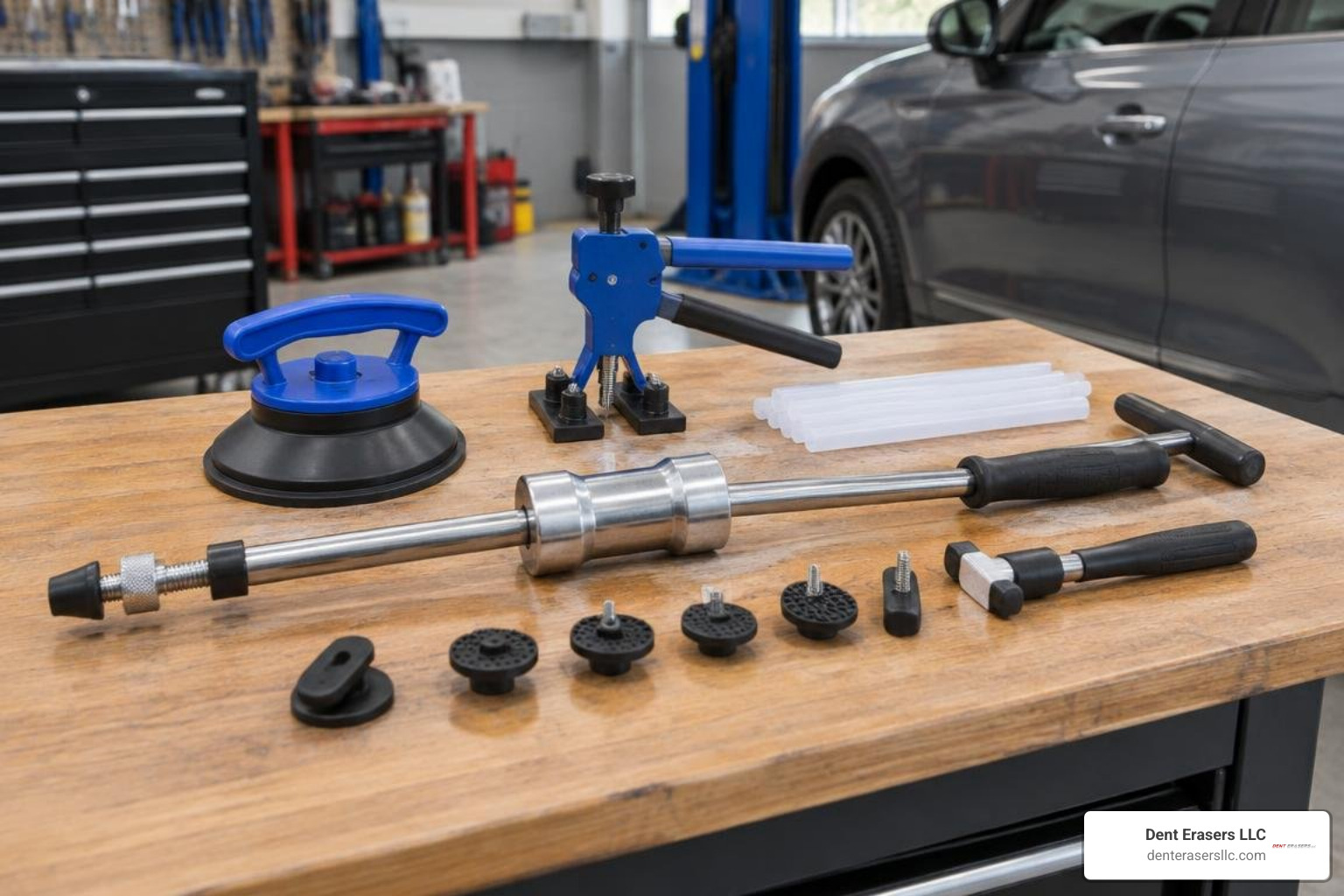
A lot of owners reach for a suction cup puller or an online glue-pull kit before calling anyone, and sometimes that’s reasonable. For a small, shallow ding on a flat section of steel panel, these tools can genuinely help.
- Suction cup pullers work on shallow dents with enough surface area for a strong seal, but they often leave a slight low spot or don’t fully release the tension
- Glue-pull kits can lift small dents when used carefully, though repeated pulls on the same spot risk stretching the metal unevenly
- Heat and cold methods (hair dryer followed by compressed air) sometimes work on plastic bumpers, but they rarely do much on metal panels
The real risk with DIY attempts isn’t failure, it’s making the panel harder to fix afterward. Pulling too hard or too fast creates waves in the metal, cracks paint that was previously intact, or work-hardens the steel so it resists reshaping even by a professional.
Pro Tip: If your first pull doesn’t fully release the dent, stop. A second or third attempt on work-hardened metal usually makes the eventual professional repair more expensive, not less.
Hire a trained technician for anything on a luxury finish, an aluminum hood or fender, or a vehicle where a bad outcome would be costly to reverse.
Limitations and special cases worth knowing
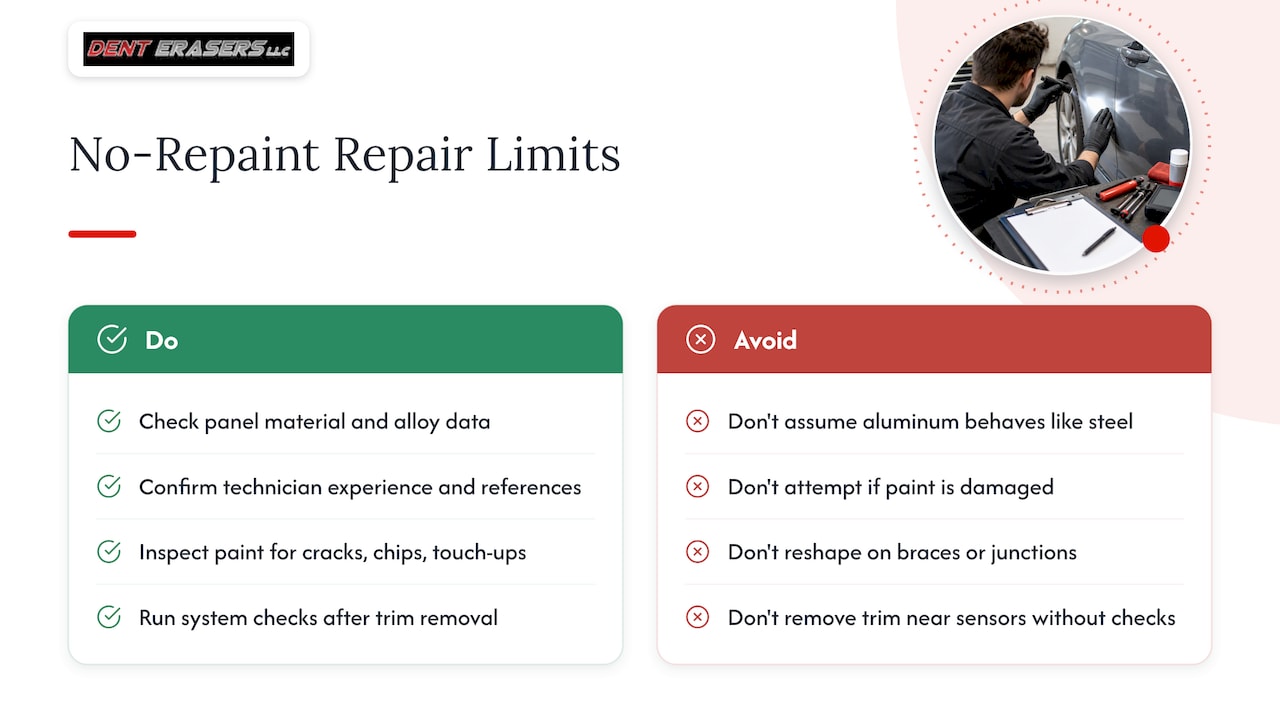
Aluminum is the biggest variable most owners don’t anticipate. According to the NAPDRT and ASA aluminum study, aluminum panels can require roughly 70 to 150% more force than steel to reshape, and different alloys and tempers respond differently with no visual way to tell them apart. That’s why aluminum repairs lean heavily on technician experience and manufacturer reference data rather than feel alone.
Paint condition is the other hard limit. Any crack, chip, or prior touch-up over the dent usually disqualifies it from a no-repaint repair, since pushing metal under damaged paint tends to widen the damage rather than hide it. Aftermarket paint jobs can behave unpredictably too, since they weren’t baked on under factory conditions.
Dents sitting on braces, reinforced edges, or complex panel junctions often resist reshaping no matter the technique, and any job that requires removing trim near sensors or cameras may call for a system check afterward to confirm nothing shifted out of calibration.
Cost and timeline: what to expect before booking
Pricing varies by dent size, panel material, and location on the vehicle, but a few patterns hold across most shops. A single small ding often falls in a lower range, while multiple dings or widespread hail damage costs more simply because of the added labor. Larger but shallow dents sit somewhere in between, since they’re more involved than a single ding but still avoid the complexity of a crease or paint repair.
Timelines follow a similar pattern. A single small dent can sometimes be finished in under an hour, while a hail-damaged vehicle with dozens of dents often takes a full day.
Before booking, it helps to ask:
- Can you give me an estimate from photos, or do you need to inspect it in person first?
- Will you need to remove any trim or panels to access the dent?
- What happens if the dent turns out to be a poor candidate once you start?
- Do you offer any guarantee on the finished work?
- Can you work directly with my insurance if this is a claim?
Preserving resale value and caring for a repaired panel
Buyers and appraisers both read original paint as a signal of a car’s history. A panel that still carries factory finish, with no refinishing history on record, almost always holds value better than one that’s been repainted, even when the repaint looks good. Because PDR never introduces filler or new paint, it avoids the long-term shrinkage and cracking issues that sometimes show up years after a conventional filler repair, which matters most on newer or higher-value vehicles.
After a repair, stick to gentle hand washing for the first few weeks and skip aggressive polishing or compounding until you’ve confirmed with your technician that the area is fully settled. If you’re dealing with bug splatter or road grime near the repaired panel, use a cleaner made for paint safety rather than scrubbing it off, since factory clear coat is more delicate than people assume.
Our approach to mobile paintless dent repair
We built our process around solving exactly these jobs onsite, without asking you to drop the car off anywhere. Our technicians handle everything from single door dings to wider hail damage, plus plastic bumper repair and specialty work on luxury, vintage, and motorcycle panels where factory finish matters even more.
A typical appointment starts with a quick look at your photos to estimate scope, followed by an onsite inspection where we confirm the dent’s depth, paint condition, and access before giving you a firm time estimate. Most single-dent jobs wrap up the same visit, and we explain upfront if anything about the panel, like aluminum construction or a nearby sensor, changes the approach.
Why metal tension matters more than most advice admits
Most online guidance treats dent repair like a strength problem: pull hard enough and the metal pops back. That’s backwards, and it’s the single biggest misconception we see from readers who’ve tried a DIY kit before calling a professional. The real skill in no-repaint repair is reading tension, knowing where to relieve stress first so the center doesn’t need to be forced at all.
The conventional advice also understates how much paint condition decides everything. A dent with cracked paint simply isn’t a PDR candidate, no matter how shallow it looks, and no technique changes that. If we had one piece of advice for readers evaluating their own dent, it would be this: check the paint before you check the depth. A hairline crack rules out the no-repaint path faster than any measurement of how deep the ding actually is.
— Brian Blanc
Get a quote for mobile paintless dent repair
We make this easy because we come to you. Send us clear photos of the dent from a few angles along with your vehicle’s year, make, and model, and we can usually give you a solid estimate before we ever show up.

On appointment day, we inspect the panel in person to confirm our estimate, walk you through the time it’ll take, and handle payment on the spot, including insurance claim assistance when the damage qualifies. Whether it’s a single minor dent or a larger panel that still qualifies for paintless work, our mobile dent repair service skips the drop-off entirely.
- Send photos and basic vehicle details for a fast estimate
- We confirm scope and timing during an onsite inspection
- Most repairs finish in a single visit, with payment handled on the spot
Ready to see what your dent will cost to fix without repainting? Request your free quote and we’ll take it from there.
FAQ
Can you fix a dent without painting?
Yes, as long as the paint over the dent is intact and the metal hasn’t creased or stretched past its limit. Paintless dent repair reshapes the panel from behind or with glue-pull tools, avoiding sanding, filler, and repaint entirely.
What dents cannot be fixed with paintless methods?
Dents with cracked, chipped, or peeling paint usually can’t be repaired without paint, since the surface damage needs filling and refinishing regardless of the metal’s shape. Sharp creases, dents on reinforced edges, and panels with a prior filler repair also tend to resist paintless techniques.
What are the downsides of paintless dent repair?
The main limitation is that it only works when paint is intact and the metal hasn’t been stretched too far, so some dents simply aren’t eligible. Aluminum panels can also require significantly more force and adjusted technique, which means not every technician handles them the same way.
Do suction cup dent pullers really work?
They can lift shallow, rounded dents on flat steel panels, but they often leave a slight imperfection and don’t fully relieve the surrounding metal tension the way professional tools do. Repeated or forceful pulls risk work-hardening the metal, which can make a later professional repair more difficult.