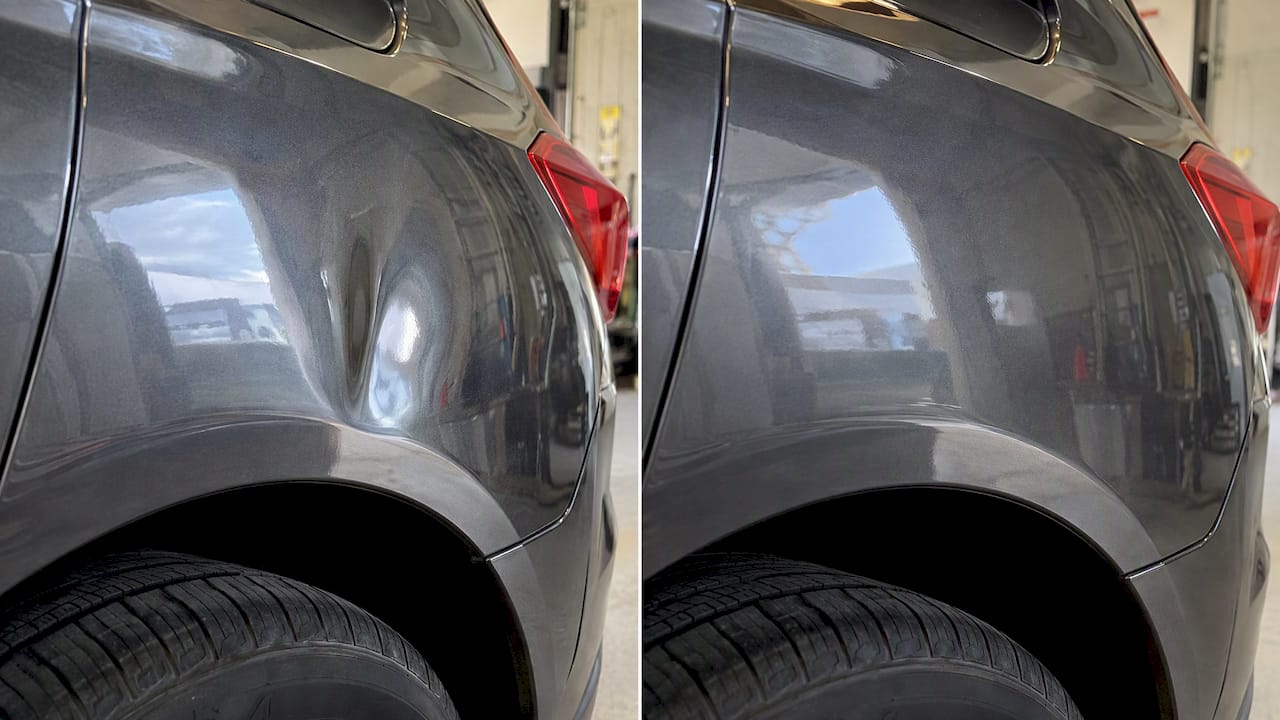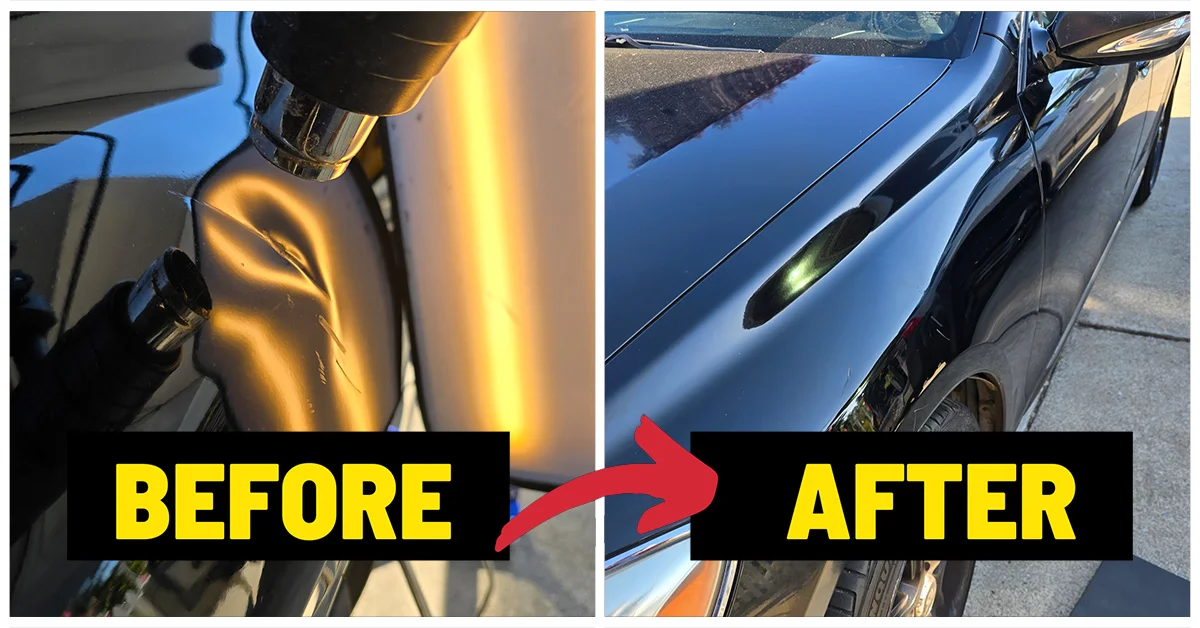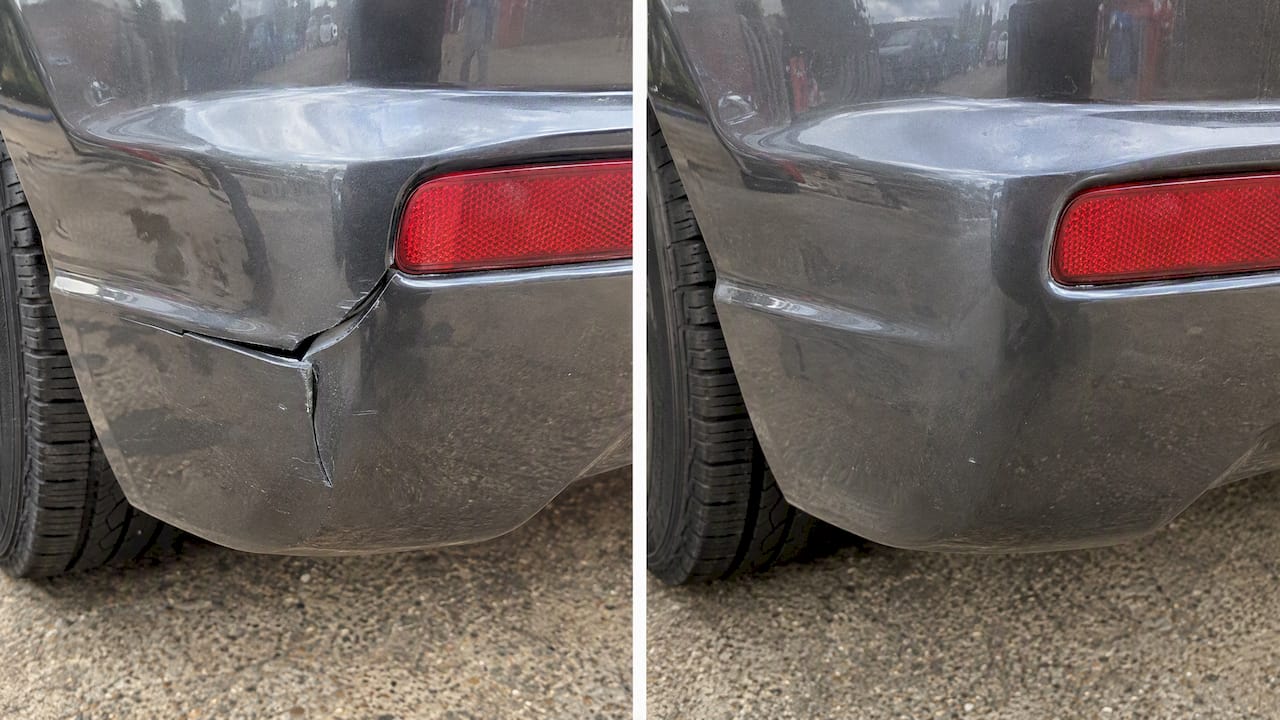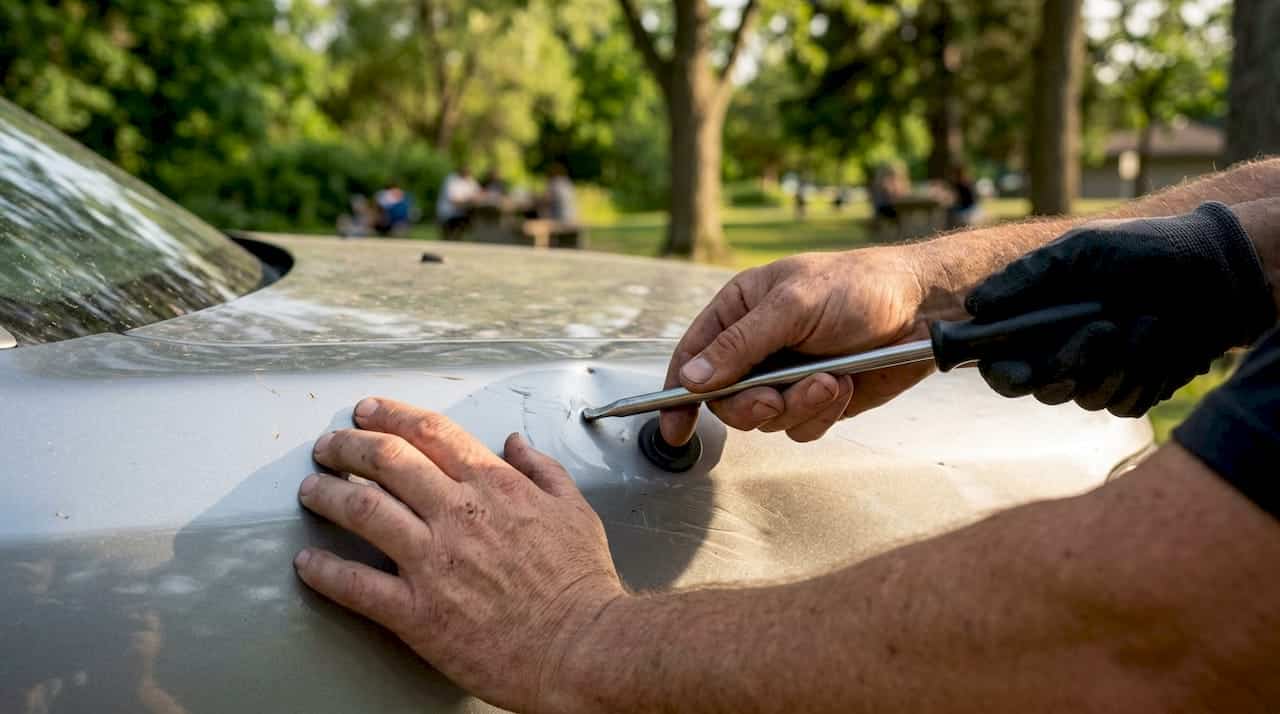
Most dents in car from hail are fixable, and if the paint is still intact, paintless dent repair (PDR) is usually the right tool for the job. Cracked paint, sharp creases, or torn metal push a repair into body shop territory instead. Either way, your first move is the same: document everything before you touch anything.
Grab your phone and photograph every panel in daylight, front to back, roof included. Note the date, the storm, and your vehicle’s VIN. Then do the math that actually matters here: does the damage look like it would cost more to repair than your insurance deductible? If you’re staring at a hood full of dents and a $500 deductible, you’re very likely looking at a comprehensive insurance claim, not a cash job.
- Photograph all exterior panels, including the roof, hood, and trunk, in even lighting.
- Record the date, time, and approximate location of the hailstorm.
- Check your policy for comprehensive coverage and deductible amount before deciding DIY vs. filing.
- Get one professional PDR estimate even if you plan to try DIY first. It costs you nothing and gives you a baseline.
Quick callout: When damage spans multiple panels, a comprehensive claim is usually your best financial move. A single, shallow dent on a door might be worth a DIY attempt or a low-cost cash repair instead.
Key Takeaways
Most dents in car from hail are repairable through paintless dent repair when the paint is intact, and documenting damage immediately is the single most important first step.
| Point | Details |
|---|---|
| Document before deciding | Photograph every panel and your VIN right after the storm, before any repair attempt. |
| PDR is the default fix | Intact-paint hail dents typically respond well to paintless dent repair, preserving factory finish. |
| DIY has narrow limits | Only attempt DIY on a single, shallow dent on a flat, non-critical panel. |
| Run the deductible math | File a comprehensive claim when estimated repair costs exceed your deductible. |
| Watch for stop signals | Cracked paint, creases, or body-line dents mean it’s time to call a professional. |
| Book Denterasersllc for mobile PDR | Onsite estimates, paint-preserving repair, and a written warranty make it a straightforward next step for hail damage. |
Table of Contents
- Can Dents in Car from Hail Actually Be Fixed?
- What Determines Whether a Hail Dent Can Be Fixed?
- What DIY Techniques Sometimes Work on Hail Dents?
- When Should You Call a Professional Instead?
- How Does Insurance Handle Hail Damage Claims?
- What Does Hail Dent Repair Cost and How Long Does It Take?
- How Does Paintless Dent Repair Actually Work?
- What Should You Do Immediately After a Hailstorm?
- Why a Mobile PDR Specialist Is Often Your Best Path
- Sources
- FAQ
Can Dents in Car from Hail Actually Be Fixed?
Yes, in the overwhelming majority of cases, hail dents come out clean, especially when paintless dent repair is on the table. PDR preserves your factory finish and typically costs less and moves faster than traditional bodywork, which is exactly why it’s become the industry-standard fix for hail damage when the paint hasn’t cracked. The metal gets massaged back into shape from behind the panel, not filled or repainted, so your car keeps its original factory paint job.
Here’s the fast version of how to choose your path. If you’ve got one or two shallow dings on a flat panel and some patience, DIY tools might genuinely work. If your car looks like it lost a fight with a golf ball machine but the paint is intact, mobile PDR is your best friend. If paint is cracked, metal is creased, or the damage sits on a body line, you’re headed to a body shop for conventional repair and repaint.
| Repair Route | Best For | Cost Type | Repair Time | Paint Preservation | Damage Extent Handled |
|---|---|---|---|---|---|
| DIY techniques | 1–2 very shallow dents, flat panels | Low, out-of-pocket (kit cost) | Hours to a day, plus trial and error | High risk if done wrong | Minimal, minor dents only |
| Mobile PDR | Most hailstorms with intact paint | Often insurance-covered, deductible applies | Usually 1–3 days | Preserves factory paint | Light to moderate, even dense clusters |
| Body shop | Cracked paint, creases, torn metal | Higher, insurance or cash | Several days to weeks | Requires repaint or panel replacement | Severe, structural, or edge damage |
- DIY fixes: Best for the occasional single dent on a hood or door where you’re not worried about ruining a whole panel. The main risk is overstretching the metal or paint with clumsy technique.
- Mobile PDR: Best for the classic hailstorm scenario, dozens of shallow dents scattered across the roof and hood with paint still intact. The main risk is choosing an inexperienced technician who can’t handle body-line dents cleanly.
- Body shop: Best when paint has chipped or cracked, or when a dent sits on a sharp crease. The main risk is a longer timeline and the need to match paint color and texture exactly.
What Determines Whether a Hail Dent Can Be Fixed?
Hail hits a car panel with focused impact energy, and what happens next depends entirely on where that energy goes. A direct hit on a flat section of a hood or roof usually creates a shallow, cup-shaped dent with the metal bent smoothly, like a dimple. That kind of dent is a textbook PDR candidate. A glancing hit near a body line, however, can create a sharp crease where the metal has actually stretched or work-hardened, and that’s a very different repair problem.
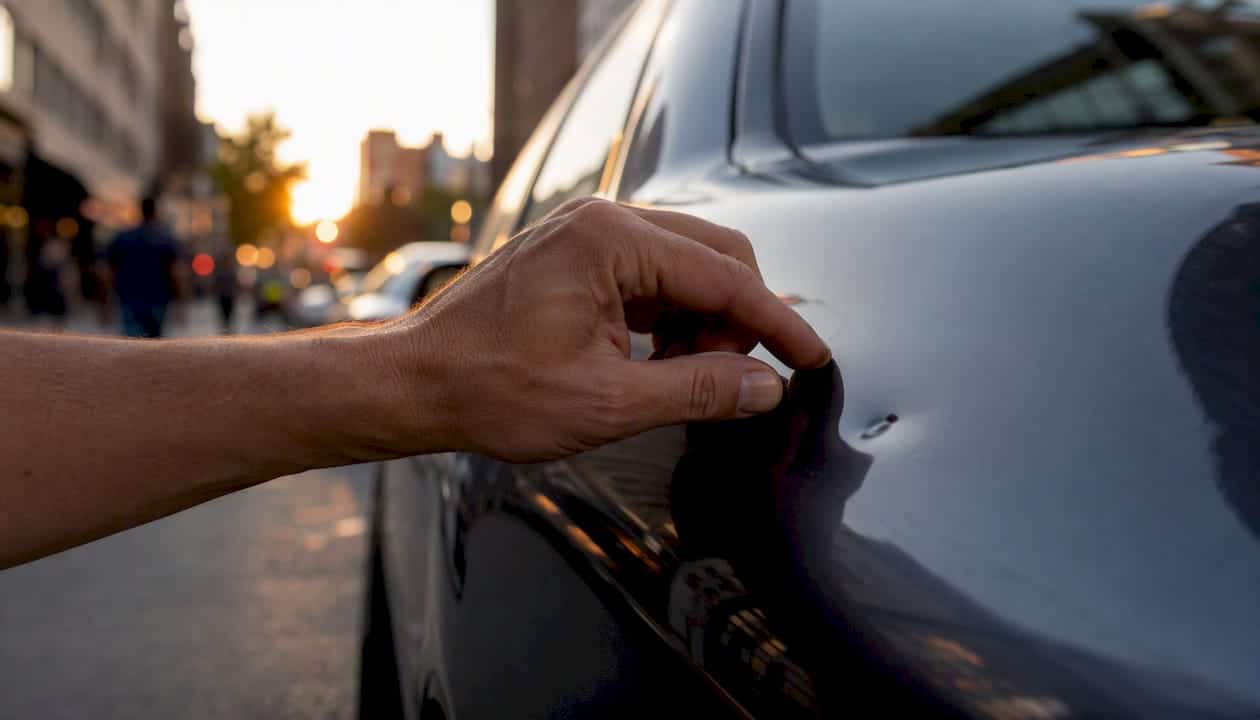
Paint intactness is the single biggest factor in whether PDR applies. If the paint is still bonded to the metal with no cracks or chips, a technician can push, pull, or tap the metal back into shape without disturbing the finish. Once paint has cracked, though, there’s no way around some amount of body filler or repainting to restore the surface.
A few more things determine repairability:
- Dent location on the panel. Center-of-panel dents are easier to access and correct than dents near edges, trim, or body lines.
- Aluminum vs. steel. Aluminum panels, common on newer trucks and luxury vehicles, behave differently under pressure and can crack more easily than steel if worked incorrectly.
- Backside access. Some panels have foam backing, wiring harnesses, or structural bracing that blocks the rods technicians use to push dents out from behind.
| Damage Type | Paint Condition | Typical Repair Method | Repairable? |
|---|---|---|---|
| Shallow cup dent, panel center | Intact | Paintless dent repair | Yes, usually straightforward |
| Sharp crease on body line | Intact or cracked | Body work, possible repaint | Sometimes, depends on severity |
| Dense dent cluster, roof/hood | Intact | Paintless dent repair | Yes, common hailstorm scenario |
| Torn or stretched metal | Cracked | Panel replacement or filler repair | Rarely PDR alone |
Pro Tip: Run your hand lightly over a dent in indirect light. If you can see a sharp shadow line rather than a soft, rounded shadow, that’s likely a crease, and it belongs in a body shop’s hands, not a DIY glue-pull kit.
What DIY Techniques Sometimes Work on Hail Dents?
For a genuinely shallow dent on an easy-to-reach flat panel, a couple of DIY methods have decent odds of success. Neither is magic, and both come with real limits worth understanding before you start.
Method A: Glue-pull kit.
- Clean the dent area thoroughly with rubbing alcohol so the glue tab bonds properly.
- Apply hot glue to a plastic pulling tab sized to match the dent’s diameter.
- Center the tab directly over the dent and let the glue set fully, usually a few minutes.
- Attach the slide hammer or bridge puller and apply steady, gradual pressure. Don’t yank.
- Release the tab, clean off residual glue with a plastic scraper and alcohol, and check your progress with a reflection board or shop light.
- Repeat gentle pulls as needed, checking often. Stop the moment you see any paint stress marks.
Method B: Heat and rapid cooling.
- Warm the dented area with a hairdryer on high heat for two to three minutes, keeping it moving to avoid concentrated heat spots.
- Apply compressed air (from an inverted can) or an ice pack directly to the warm spot for 30 to 60 seconds.
- The rapid contraction sometimes pops shallow dents back into place on flexible plastic or thin steel panels.
- Inspect under good light and repeat only once or twice. Repeated heat cycling can damage the clear coat.
Realistic DIY fixes can absolutely improve a single shallow dent, but on real hailstorm damage with multiple dents across several panels, DIY kits and tricks rarely match what a trained PDR technician delivers, and pushing too hard risks turning a fixable dent into a paint job.
Basic tool costs for a DIY attempt:
- Glue-pull dent puller kit: roughly $30 to $100 depending on tab variety and included tools.
- Knockdown hammer or tap-down tool: roughly $15 to $40.
- Compressed air can or dry ice for the heat/cold method: under $20.
- Safety glasses and gloves: under $15.
Pro Tip: If you see paint cracking, a crease forming, or the dent sitting anywhere near a trim edge or body line, stop immediately. Pushing forward at that point can turn a $75 PDR fix into a $600 repaint job, and that math never works in your favor.
If you’re weighing whether a puller kit is even worth buying, our guide on choosing the right dent puller for hail damage breaks down which tabs and pullers actually hold up.
When Should You Call a Professional Instead?
Certain warning signs mean it’s time to stop experimenting and call a technician. Trust these red flags:
- Paint chips or visible cracks anywhere on or near the dent.
- Dents sitting on a body line or panel edge, where metal is already under tension.
- Dense clusters of dents across multiple panels, which is standard for a real hailstorm and genuinely beyond safe DIY scope.
- Aluminum body panels, which crack more easily than steel and often need specialized rod pressure.
- Damage near sensors, cameras, or trim, common on newer vehicles with driver-assist hardware built into bumpers and mirrors.
- Any concern about structural or frame involvement, which is a body shop conversation, not a PDR one.
A professional technician’s process looks nothing like a weekend DIY attempt. It starts with panel mapping under a light board, which reveals every micro-dent invisible to the naked eye. From there, a thorough workflow documents each panel, the access route, and the intended tool stage rather than relying on a rough dent count. Technicians then gain access behind the panel, often removing interior trim or headliners, and use precision rods to push dents out from the back. Where rod access isn’t possible, they switch to glue-pull tabs on the outside. A final round of knockdown work and light-board reflection inspection confirms the surface is smooth before the job is called done.
When you’re evaluating a provider, ask for a documented estimate, before-and-after photos from prior hail jobs, proof of PDR-specific training, and a written warranty on the repair. Mobile service that comes to your driveway or office parking lot is a bonus that saves you a half day off work.
How Does Insurance Handle Hail Damage Claims?
Hail is a weather event, which means it typically falls under your comprehensive coverage, not collision, and it’s treated as a no-fault loss. That’s good news: your rates generally aren’t affected the way a collision claim might affect them, and insurers often cover PDR in full once the repair estimate clears your deductible.
Here’s the claims process broken into steps:
- Photograph every affected panel and your VIN plate immediately after the storm, before any repair attempt.
- Get at least one professional PDR estimate, even if you’re unsure whether you’ll file. This is your baseline number.
- Submit your photos and estimate to your insurer to open a comprehensive claim.
- Wait for an adjuster review or approval, then get written repair authorization before work begins.
- Ask about rental car coverage or valet-style pickup if your policy includes it, since many mobile PDR providers can work with insurer scheduling directly.
- Keep every signed document: the estimate, the authorization, and final repair paperwork, in case you need them for resale disclosures later.
Insurer resource pages walk through exactly what intake teams look for when a claim comes in, and general documentation guidance for vehicle owners can help you understand what to have ready before you call.
Decision math that actually matters: if your estimate comes in below your deductible, paying cash is usually cheaper and faster than opening a claim. If it’s above your deductible, especially with multi-panel damage, filing is almost always the better financial call. One caveat worth watching: severe hail years occasionally push some vehicles toward a total loss determination if repair costs approach the car’s actual cash value, so don’t be surprised if your adjuster raises that possibility on an older vehicle with dense damage.
What Does Hail Dent Repair Cost and How Long Does It Take?
Costs break down into a few realistic buckets depending on damage scope and repair route.
- Single-panel cash job: A door or fender with a handful of shallow dents often runs a modest flat fee when paid out-of-pocket through a mobile PDR provider, well below most insurance deductibles.
- Multi-panel PDR through insurance: Whole-vehicle hail jobs, hood, roof, trunk, and multiple panels, typically get billed directly to your insurer once your deductible is met, and this is the most common scenario after a real storm.
- Body shop repaint and replacement: Any panel with cracked paint or a torn crease pushes cost upward fast, since it involves filler work, sanding, primer, paint matching, and clear coat, sometimes full panel replacement on severe cases.
Variables that push cost toward the higher end include aluminum panels, dense dent clusters near body lines, and any need for OEM-matched paint on a specialty or luxury finish.
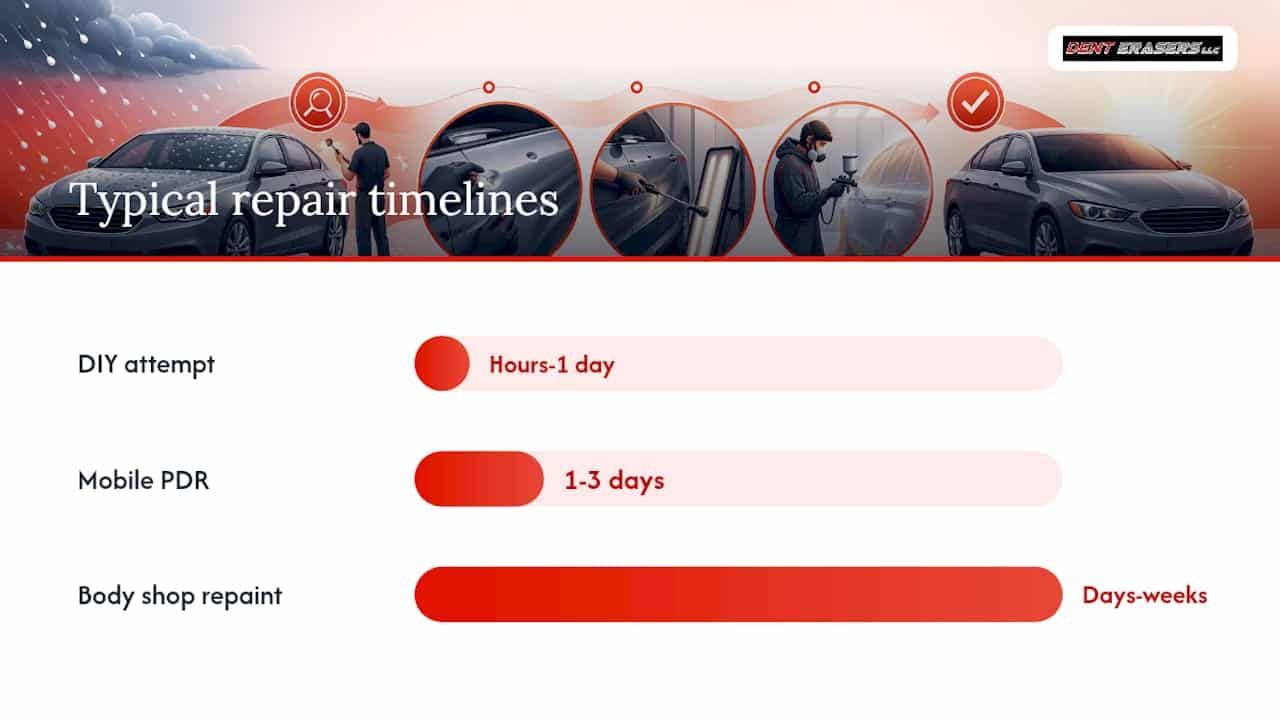
| Repair Path | Typical Timeline | What Affects the Timeline |
|---|---|---|
| DIY attempt | Hours to a full day, often with repeat tries | Your patience, panel access, dent depth |
| Mobile PDR | Often 1 to 3 days for most hail jobs | Number of panels, technician availability, insurer approval speed |
| Body shop repaint | Several days to multiple weeks | Paint curing time, parts availability, blending across panels |
Your deductible and your insurer’s internal workflow speed both affect how fast you actually get your car back. A quick photo-and-estimate submission moves faster than a claim that requires an in-person adjuster visit, so ask your insurer upfront which path applies to your policy.
How Does Paintless Dent Repair Actually Work?
PDR is a precise, mechanical process, not guesswork with a rubber mallet. It starts with inspection and mapping using a light board, which reveals dents and high spots invisible under normal shop lighting and lets a technician plan an exact repair route before touching the panel.
From there, the technician gains access to the panel’s backside, sometimes by removing interior trim, wheel wells, or headliners. Using specialized rods with different tip shapes, they apply gentle, controlled pressure from behind to push the metal back toward its original contour. Where the dent sits somewhere rods can’t reach, glue-pull tabs applied to the panel’s outer surface let the technician pull the metal back into place instead. Final knockdown work smooths any remaining high spots, and a last pass under the light board confirms the reflection is clean before the car leaves the shop.
Core tools involved:
- Light board or LED line board: maps every micro-dent and confirms final quality.
- Push rods, varying tip shapes: the workhorse tool for accessing dents from behind the panel.
- Glue tabs and lifters: used when backside access isn’t possible.
- Knockdown tools: fine-tune stubborn high spots after the main push.
| PDR Strength | PDR Limitation |
|---|---|
| Preserves factory paint completely | Doesn’t work once paint is cracked or chipped |
| Handles dense multi-dent clusters efficiently | Struggles with sharp creases or severe metal stretch |
| Often faster than a repaint job | Requires backside access, which some panels don’t allow |
| Typically less expensive than body work | Can’t correct structural or frame damage |
Pro Tip: Ask your technician to show you the panel under the light board before and after. It’s the fastest way to confirm the work is actually finished, not just “good enough” under regular daylight.
What Should You Do Immediately After a Hailstorm?
The first hour after a storm matters more than most people realize. Here’s your priority order:
- Move your vehicle to a covered area if the storm is ongoing and it’s safe to do so.
- Photograph every panel, wide shots and close-ups, in consistent daylight, including the roof, hood, trunk, and mirrors.
- Capture your VIN or license plate in at least one photo for a dated, provable record.
- Check the interior for damage if you heard a shock or impact through the cabin, including sensor housings near mirrors and bumpers.
- Avoid rubbing dents, pressing on panels, or attempting any risky DIY fix before you’ve documented everything.
- Cover any area with cracked paint or exposed metal with a tarp to prevent water intrusion and rust.
- Skip the pressure washer until repairs are complete. Force can drive water into gaps around already-stressed paint.
- If glass is cracked, get that inspected promptly since compromised windshields affect structural integrity in a collision.
- Store your photos somewhere backed up, not just on your phone, in case you need them weeks later for a claim.
Why a Mobile PDR Specialist Is Often Your Best Path
There’s a reason mobile paintless dent repair has become the go-to solution after a hailstorm: it comes to you, it preserves your original paint, and it typically moves faster than scheduling a body shop appointment and waiting in a queue. Denterasersllc handles exactly this scenario onsite, wherever your car happens to be, whether that’s your driveway, your office lot, or a friend’s garage.
Here’s what a visit typically looks like. A technician arrives, walks the vehicle with you, and provides an estimate based on visible damage and panel mapping. You’ll get a realistic time window for the repair, documentation you can hand directly to your insurer, and a warranty on the completed work. If your bumper took a hit alongside the dents, mobile bumper repair is handled in the same visit rather than requiring a separate shop trip.
- Photo galleries of completed repairs let you see real before-and-after results before you commit.
- Technician experience with paintless dent repair specifically, not general auto body work, matters for hail-specific damage.
- Mobile convenience means no dropping your car off and arranging a rental.
- A written warranty on completed repairs backs the work long after the technician leaves.
Pro Tip: When you request an estimate, send clear photos of every affected panel upfront. It speeds up the quote and helps the technician arrive with the right tools already loaded for your specific damage pattern.
When DIY Makes Sense and When It Doesn’t
Here’s my honest read after years of looking at hail-damaged panels: DIY is only worth attempting on a single, very shallow dent sitting on a flat, non-critical surface, somewhere like the middle of a door panel where a slightly imperfect result won’t bother you. The moment you’re dealing with more than that, a quick professional estimate almost always saves you time and money compared to hours of trial and error with a glue-pull kit.
The real risk isn’t wasted time. It’s that one overzealous pull or one too many heat cycles can crack paint that was previously intact, and that instantly converts a PDR job into a repaint job. That’s not a small jump. You go from a same-day fix that preserves your factory finish to a multi-day repair that involves color matching and, depending on how picky you are, permanently affects resale value if the paint match isn’t perfect.
If you’re genuinely unsure which category your damage falls into, use the checklist earlier in this article and get a no-pressure estimate before you pick up a heat gun. It costs you nothing to find out, and it saves you from turning a $75 fix into a $600 mistake.
Get a Mobile Estimate for Your Hail Damage
If your car came out of a storm looking like a golf ball, Denterasersllc brings the fix to you instead of sending you to a body shop waiting room. Mobile paintless dent repair, paint-preserving techniques, and plastic bumper repair are all handled onsite, at your home or office, with no drop-off required and your factory finish left completely intact.

Getting a quote is simple: send photos of the damaged panels along with your VIN and location, and you’ll get a realistic estimate and repair window back quickly. Every job comes with a warranty on the completed work, so you’re covered long after the technician packs up. Whether your vehicle is a daily driver or one of the specialty makes Denterasersllc regularly services, reach out today to book a mobile estimate and get your dents mapped out before you decide between DIY and a professional fix.
Sources
- Claims help for weather-related damage | Sonsio – Claims
- Insurers report rising hail damage claims | UPHelp
This article is general information, not a substitute for advice from a qualified financial advisor. Consult a qualified financial professional about your own circumstances before acting on anything here.
FAQ
Can Car Dents from Hail Be Fixed?
Yes, most hail dents are fixable, especially with paintless dent repair when the paint is still intact. Cracked paint or sharp creases usually require traditional body work instead.
What Happens If Hail Dents Your Car?
Hail typically leaves shallow, cup-shaped dents across flat panels like the hood, roof, and trunk, and sometimes cracks paint on harder impacts. Photographing the damage right away and getting a PDR estimate is the recommended first step.
How Much Does It Cost to Fix Dents from Hail?
Cost depends heavily on scope: a single-panel cash job is far cheaper than a multi-panel PDR job, and body shop repaints for cracked paint cost more than either. Most multi-panel hail damage gets covered by comprehensive insurance once the estimate clears your deductible.
Will Hail Dents Pop Out on Their Own?
No, hail dents don’t pop out without intervention. Some very shallow dents respond to careful DIY heat or glue-pull methods, but most require paintless dent repair or body work to fully correct.
How Long Does Hail Dent Repair Take?
Mobile paintless dent repair typically takes 1 to 3 days for most hailstorm damage, while traditional body shop repairs involving paint can take several days to multiple weeks. DIY attempts vary widely depending on the dent and your technique.