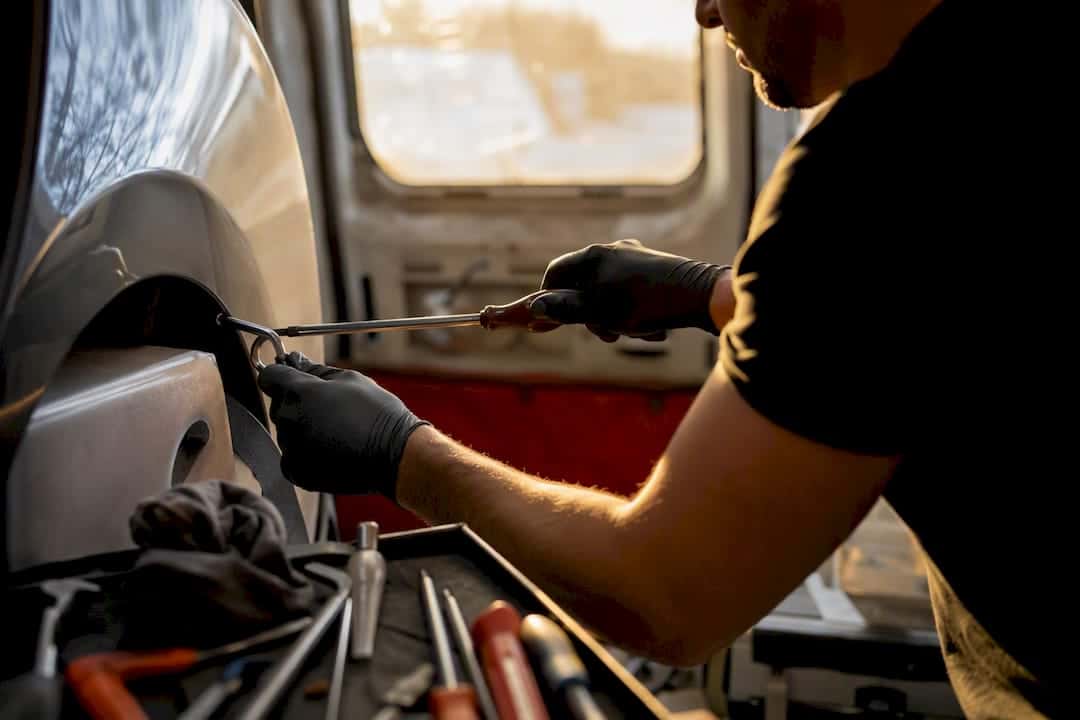
A small, unpainted fender dent typically runs $75 to $300 with paintless dent repair, while a dent with cracked paint or a sharp crease usually needs traditional bodywork starting around $300 and climbing past $1,000 with paint and blending. The rule of thumb: if your estimate lands at or below your deductible, pay it yourself and skip the claim.
TL;DR:
- Insurance claims are only beneficial when total repair costs exceed your deductible, especially for multi-panel damage or hail, which can reach several thousand dollars.
- Access, panel location, and panel material significantly influence repair estimates more than the dent’s size or appearance.
- Professional paintless dent repair usually costs between $75 and $450 depending on dent complexity, with same-day turnaround for small jobs.
- DIY dent repair kits are generally less effective and can lead to higher costs if they cause further damage, making professional repair more cost-efficient beyond shallow, flat dents.
- Always obtain a detailed, written estimate from a qualified shop that explains access and material challenges before deciding on a repair method or filing an insurance claim.
Table of Contents
- How Much Does Fender Dent Repair Cost in the US?
- What Factors Actually Drive Your Fender Dent Repair Estimate?
- Should You File an Insurance Claim for a Fender Dent?
- What Should You Ask Before Choosing a Repair Shop?
- Real Fender Repairs: What Denterasers LLC Has Actually Fixed
- DIY Dent Repair Kits vs. Professional PDR: What’s the Real Cost Comparison?
- Does Your Warranty Coverage Affect Long-Term Repair Costs?
- The Real Math Behind Fender Dent Repair Costs
- Get a Written On-Site Estimate for Your Fender Dent
- Sources
- FAQ
How Much Does Fender Dent Repair Cost in the US?
Fender dent repair cost splits into two very different price worlds, and knowing which one you’re in changes everything about your decision. Paintless dent repair, or PDR, works the metal back into shape from behind the panel without touching the factory paint. Traditional bodywork fills, sands, primes, and repaints. One is a same-day fix. The other is a multi-day project.
For PDR pricing, shops typically size jobs using a matrix based on panel, dent count, and dent diameter, sorted into coin-sized categories: dime, nickel, quarter, half-dollar. Here’s how that breaks down in real dollars.
- Small single dent: $75 to $150
- Typical small to medium dent, or a few dents: $150 to $450
- Larger or more complex dents (deep creases, tight access): $400 to $900 or more
Those PDR ranges hold up across most shops we’ve seen quote fender work. Traditional bodywork on a fender panel is a different animal. Once the metal needs filler, sanding, primer, and a repaint that has to blend into the surrounding panels, pricing starts around $300 and regularly exceeds $1,000 once labor and paint materials are added up.
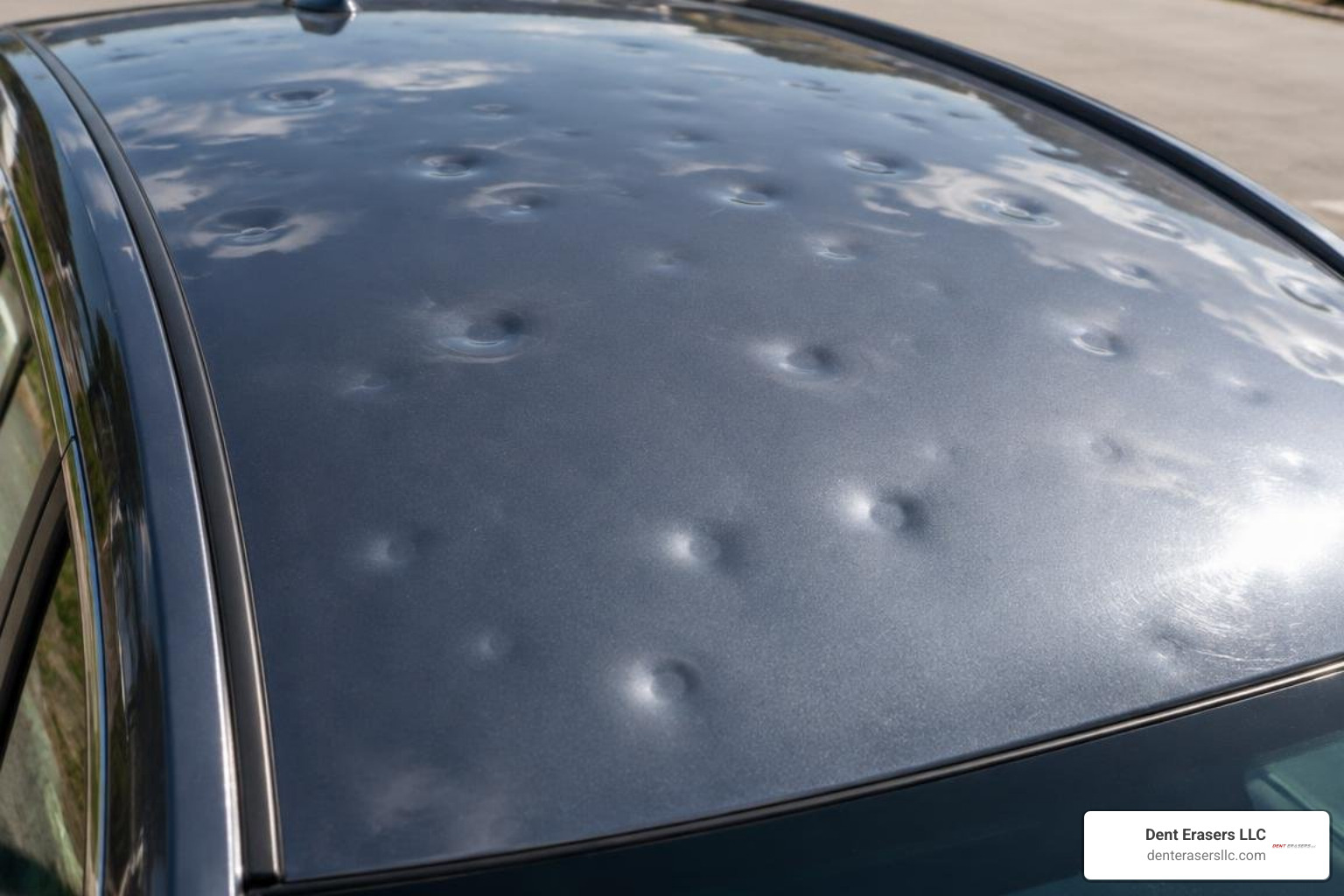
Hail damage or multi-panel dents change the math again. A car with a dozen small dents spread across the hood, roof, and both fenders commonly runs $300 to $3,000 total, depending on the dent count and whether any panel needs a full repaint.
| Repair type | Typical cost range | Turnaround |
|---|---|---|
| PDR, single small dent | $75–$150 | Same day, often a few hours |
| PDR, medium/multiple dents | $150–$450 | Same day to 1 day |
| PDR, large/complex dent | $400–$900+ | 1 day |
| Traditional bodywork, one panel | $300–$1,000+ | 2 days |
| Hail or multi-panel damage | $300–$3,000 | Varies by dent count |
That turnaround gap matters more than most people expect. PDR often wraps up in a single visit because there’s no paint to cure. Traditional repair needs days for primer, paint, and clear coat to properly set before the car can go back on the road. If a rental car is part of your budget math, that difference alone can tip the scale.
What Factors Actually Drive Your Fender Dent Repair Estimate?
The dent’s size on your fender is almost never the biggest cost factor. What actually moves the needle is what the technician can’t see just by looking at the dent.
Accessibility is the main unseen cost driver. A fender with internal bracing, a speaker housing, or a tight wheel-well cavity takes far longer to work than an open panel a technician can reach with a full range of tools. Access and the metal’s behavior under stress matter more to your final bill than how big the dent looks from the driveway.
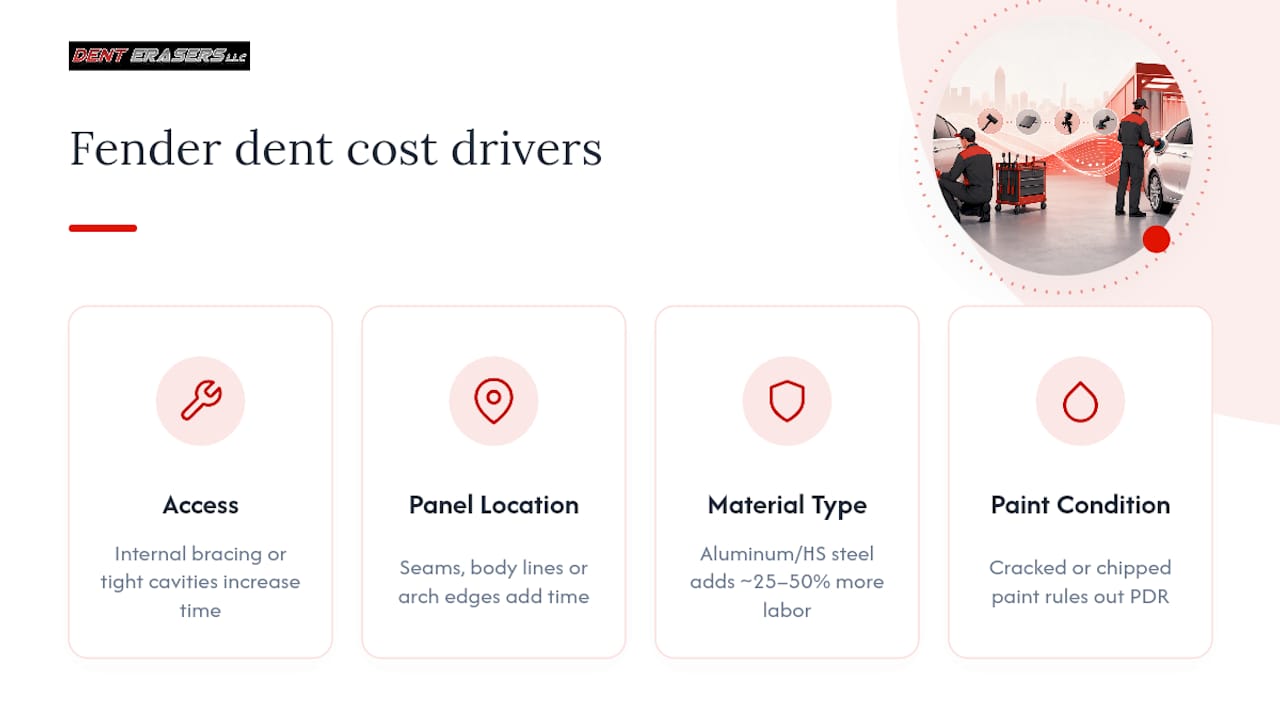
Location on the panel matters just as much. A dent sitting in the flat center of a fender is straightforward. A dent that crosses a body line, sits near a seam, or wraps around a wheel arch edge takes a technician longer to smooth out evenly, and that extra time shows up on your invoice.
Panel material adds its own surcharge. Aluminum and modern high-strength steels resist the massaging technique PDR relies on, which can add 25 to 50% more labor time compared to a standard steel fender. If your fender is aluminum, expect your quote to sit at the higher end of the range.
Paint condition decides which repair path you’re even eligible for. If the paint over the dent is cracked, chipped, or the metal has creased sharply enough to stress the clear coat, PDR usually isn’t an option and the job shifts into traditional territory. Shops may also charge extra for removing trim, door cards, or headliners to reach the back side of a dent, plus fees for recalibrating ADAS sensors if a bumper or fender sensor gets disturbed during the work.
Pro Tip: Ask the technician to explain why they’re quoting what they’re quoting. A shop that can point to specific access or material challenges is giving you a real estimate. A shop that just eyeballs the dent and names a number is guessing.
Should You File an Insurance Claim for a Fender Dent?
Comprehensive and collision coverage typically pay for dents from covered events like hail, a shopping cart, or another driver’s fender bender. Liability coverage only pays for damage you cause to someone else’s vehicle, so it won’t touch your own dent. Once you know which coverage applies, the decision comes down to simple math.
- Get a written estimate first. A PDR specialist can tell you quickly whether the paint is intact and the dent is accessible enough for paintless repair, which usually means a lower number.
- Compare that estimate to your deductible. Common deductibles run $250, $500, or $1,000. If the estimate comes in at or below your deductible, paying out of pocket is almost always the better move.
- Weigh the premium risk before you file. Filing a claim for a small repair can raise your future premiums and gets logged on your CLUE report, which future insurers can see when pricing your policy.
A PDR job costing less than a typical deductible amount means you pay it yourself either way, so filing a claim may just add a mark on your record with no financial benefit. Where it gets genuinely useful to loop in insurance is hail damage across several panels, where the total easily clears a $1,000 deductible and the PDR matrix pricing on multiple dents adds up fast. Our insurance and dent repair guide walks through more scenarios if you’re weighing a claim right now.
What Should You Ask Before Choosing a Repair Shop?
A few sharp questions on the phone will tell you more about a shop than any online review.
- Can they perform PDR on your specific dent, or does the damage require traditional repair?
- Do they warranty their paint work, and for how long?
- What’s the realistic turnaround, in days, not “soon”?
- Will they give you a written estimate listing per-dent pricing, trim removal fees, and any repaint or parts line items separately?
- If you’re filing a claim, will they handle supplements and communicate directly with your adjuster?
Treat a vague verbal quote as a red flag. So is a shop that won’t put pricing in writing, can’t explain their warranty terms, or gets cagey about how they’ll access the dent. A shop confident in its work documents everything before it touches your car.
Real Fender Repairs: What Denterasers LLC Has Actually Fixed
Numbers on a page only tell half the story. Seeing actual repairs helps you picture what your own fender dent might cost and how long it might take.
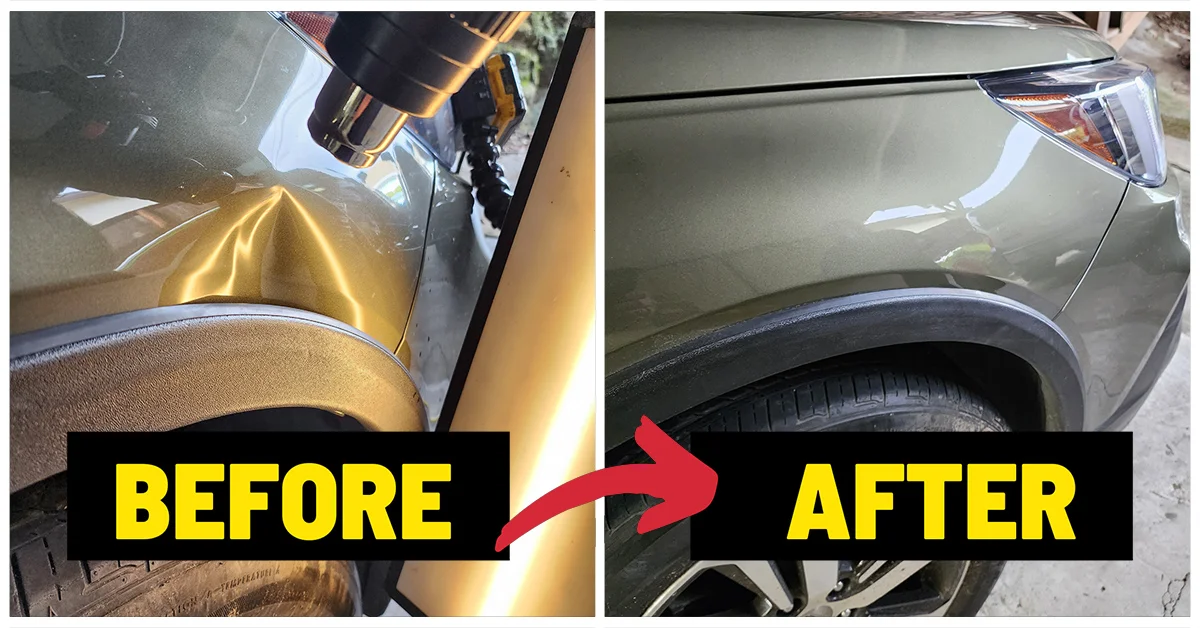
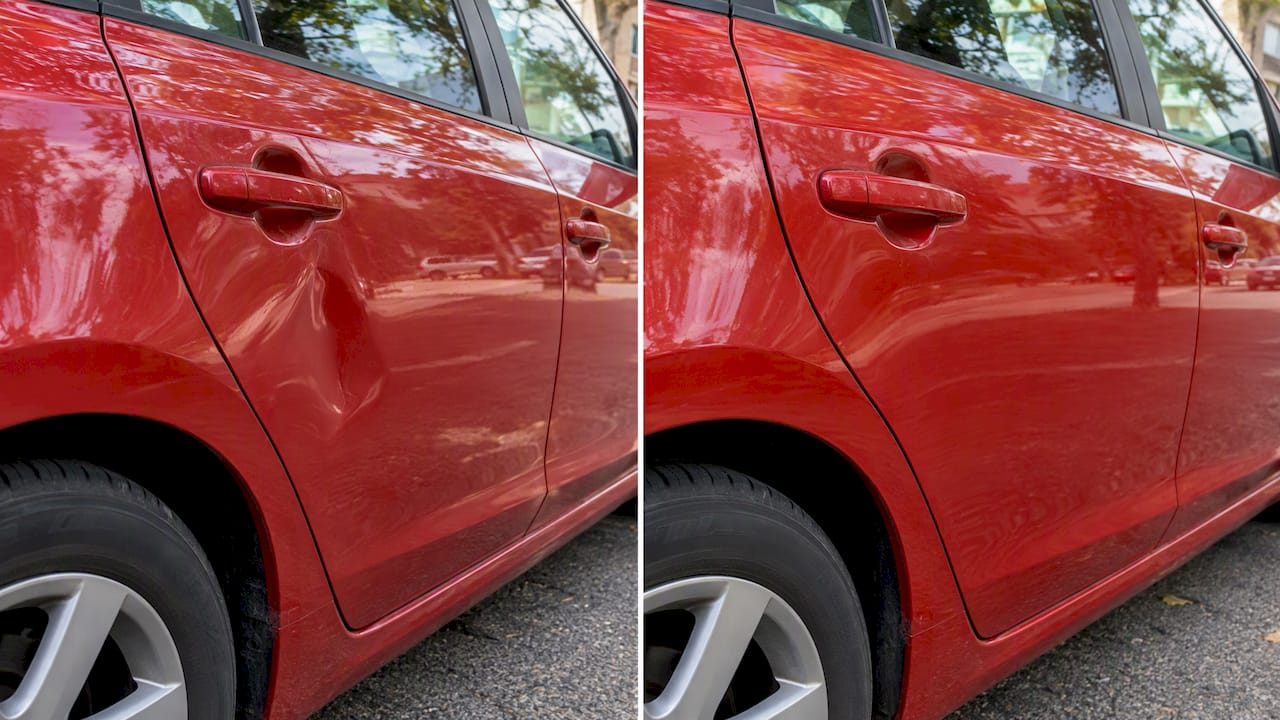
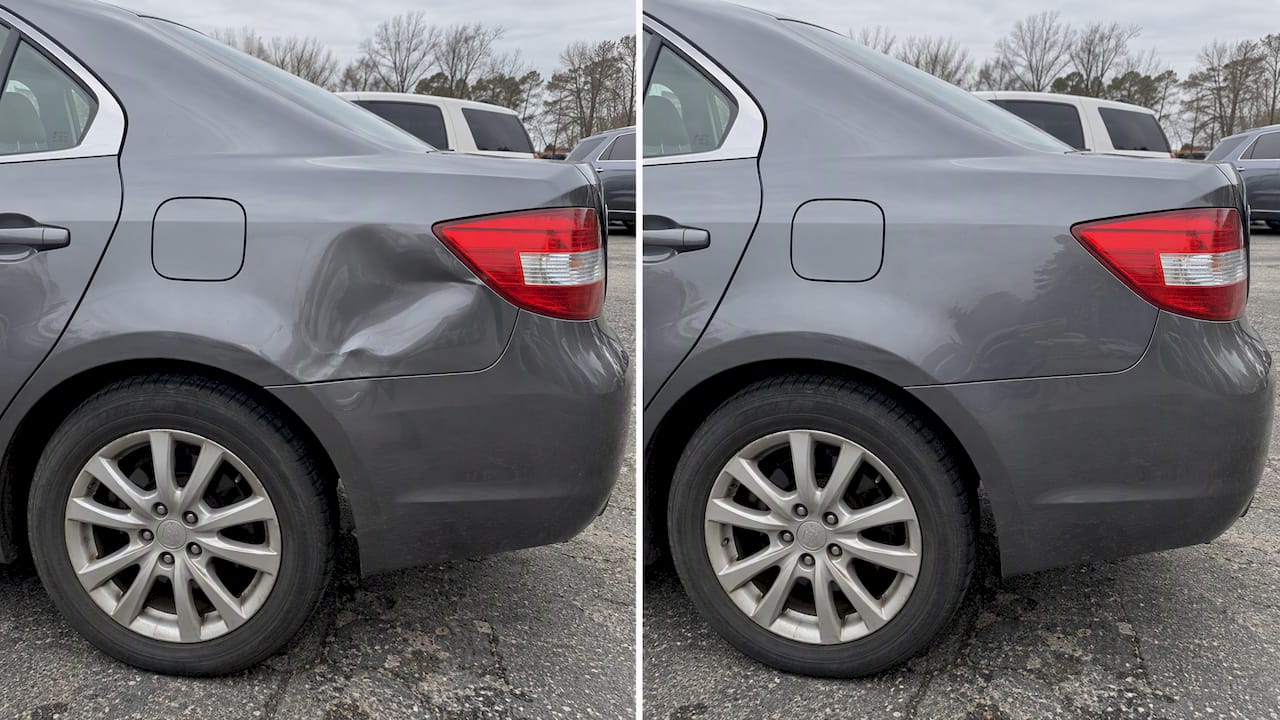
- A windstorm-damaged fender came in with a deep crease near the wheel arch. Our mobile PDR team completed the repair the same day, with the factory paint fully preserved and a standard workmanship warranty applied.
- A new driver’s minor parking-lot dent got a full before-and-after treatment. The techniques used, gentle glue-pulling and rod work from behind the panel, left no trace and no repaint needed.
- A brand-new truck fender with a fresh dent got precision on-site work, the same mobile workflow we use for most fender jobs: technician arrives, assesses access, and completes the pull without removing the truck from the owner’s driveway.
You can browse more before-and-after results in our photo galleries, read more from author Brian Blanc, or check our financing guide for larger repairs. Every job we complete comes with a documented estimate and a workmanship guarantee.
DIY Dent Repair Kits vs. Professional PDR: What’s the Real Cost Comparison?
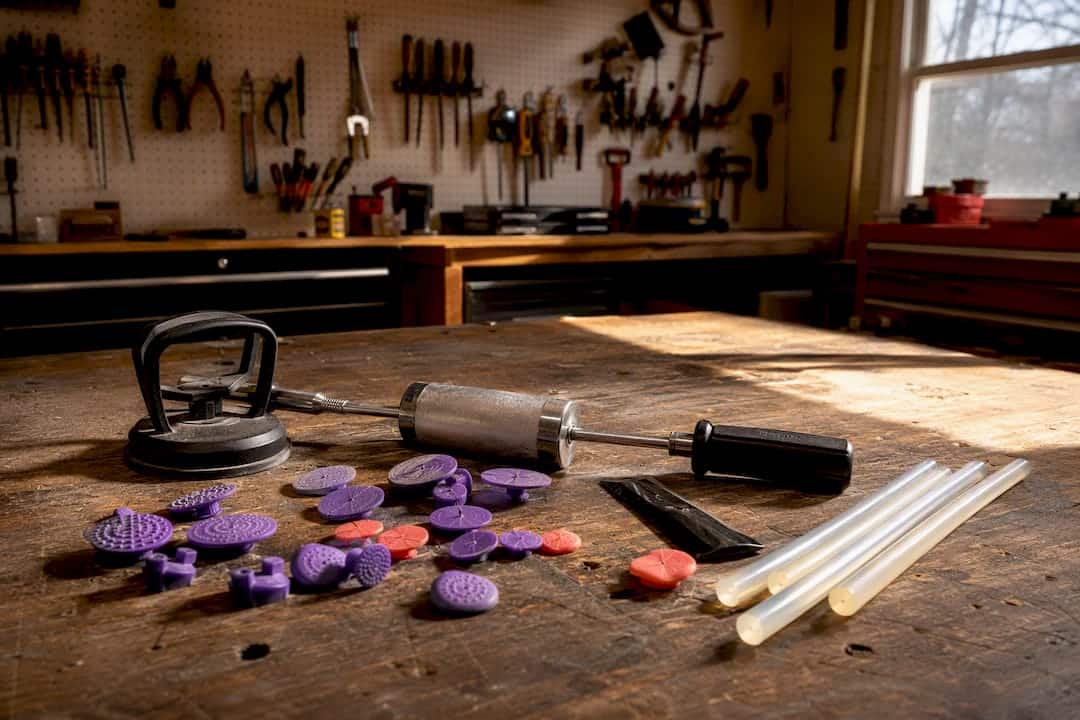
DIY dent-pulling kits, the suction-cup and glue-tab type sold at auto parts stores, usually cost $20 to $60. On paper, that beats any professional quote. In practice, the comparison isn’t that simple.
A DIY kit can work on a shallow, easily accessible dent with no crease and no paint damage, which describes a small slice of the dents drivers actually deal with. Most fender dents involve some curvature, a body line, or an access angle that a suction cup can’t properly leverage. Pull at the wrong angle and you risk stretching the metal further, cracking the paint, or leaving a slight ripple that then requires a technician to fix anyway, on top of undoing your DIY attempt.
That’s the hidden cost of the DIY route: when it fails, you’ve spent $20 to $60 and still need the professional repair, sometimes now at a higher price because the metal has been work-hardened or the paint compromised by the failed attempt. Professional PDR technicians train specifically to read how metal will respond to pressure and where to apply force without stressing it further. For anything beyond a shallow ding on a flat, open section of panel, a professional PDR quote in the $75 to $150 range is often the cheaper path once you account for the real odds of a DIY kit making things worse.
Does Your Warranty Coverage Affect Long-Term Repair Costs?
A repair’s price tag is only part of what it costs you over time. What happens after the technician leaves matters just as much.
Reputable PDR shops back their work with a workmanship warranty, typically covering the specific dent repaired against the metal popping back out or any new paint cracking at the site. Ask for that warranty in writing before the job starts, not after. Traditional body shop repairs should carry a warranty on both labor and the paint job itself, since blended paint is the part most likely to show problems down the road, like a slight color mismatch that becomes obvious after a few months of UV exposure.
Post-repair care is simple but easy to overlook. Avoid automatic car washes with aggressive brushes for the first few weeks after any paintwork, since fresh clear coat needs time to fully cure. For PDR repairs, there’s no cure time to worry about since the factory finish was never disturbed, which is one of the quieter benefits of leaving factory paint intact: no repaint means no curing window, no risk of a shade mismatch, and one less thing that can go wrong months later.
If a repaired panel ever needs touch-up work, keep your original written estimate and any warranty paperwork. A shop that stands behind its pricing will also stand behind the fix if something needs revisiting, and having documentation on hand makes that conversation a lot shorter.
The Real Math Behind Fender Dent Repair Costs
Most advice on this topic treats PDR pricing and insurance decisions as separate questions. They’re not. The PDR matrix that shops use to price a job and the deductible math you run before calling your insurer are the same conversation, just from two different angles.
Where conventional advice falls short is treating dent diameter as the main cost signal. It isn’t. Access and metal behavior decide almost everything, which is why two dents that look identical from across a parking lot can carry wildly different price tags. If you take one thing from this article, prioritize getting an honest, written PDR assessment before you assume traditional bodywork is your only option, and before you assume a claim is worth filing.
The gap between a $150 PDR job and a $1,000 traditional repair usually comes down to whether you called the right kind of shop first.
— Brian Blanc
Get a Written On-Site Estimate for Your Fender Dent
Every fender dent estimate above assumes you’re getting an honest read on your specific damage, and that’s exactly what a mobile assessment gives you without the wait of a body shop appointment. Denterasers LLC comes to your driveway or office parking lot, evaluates access and metal condition in person, and gives you a written estimate on the spot, often completing the actual PDR repair the same visit.

Before your appointment, snap a few photos of the dent from different angles, have your VIN handy, and confirm where you’d like the technician to meet you. In return, you’ll get a written estimate broken down by dent, photos suitable for an insurance claim if you decide to file one, and a clear answer on whether PDR fits your damage or traditional repair makes more sense. For a deeper look at pricing before you call, our PDR pricing guide walks through more real-world examples.
Ready to see what your fender dent actually costs? Schedule your on-site estimate and get a straight answer, in writing, before you decide whether to touch your deductible.
Sources
- Does Insurance Cover Paintless Dent Repair? Claims and Costs – LegalClarity
- PDR pricing and cost factors – DentAdvisor
- Paintless Dent Repair vs Traditional Body Work: Cost, Time, and Quality Comparison – Prime Time Collision
FAQ
How Much Does It Cost to Fix a Dented Fender?
A small dent typically costs $75 to $300 with paintless dent repair. Traditional bodywork for cracked paint or a sharp crease usually starts around $300 and can exceed $1,000 with paint and blending.
How Much Do Fender Benders Cost to Fix?
A minor fender bender with a clean dent and intact paint often falls in the $150 to $450 PDR range, while one involving cracked paint, a bumper, or panel misalignment typically needs traditional repair starting at $300 and climbing well past $1,000.
Are Fender Dents Repairable?
Most fender dents are repairable, and paintless dent repair handles the majority of them when the paint is intact and the technician can access the back of the panel. Dents with cracked paint, deep creases, or very limited access usually need traditional bodywork instead.
Will Insurance Pay for Dent Repair?
Comprehensive or collision coverage typically pays for dents from covered events like hail or another vehicle, but liability coverage won’t cover your own vehicle. If your estimate is at or below your deductible, paying out of pocket is usually the smarter move since a small claim can affect your premium and your CLUE report.