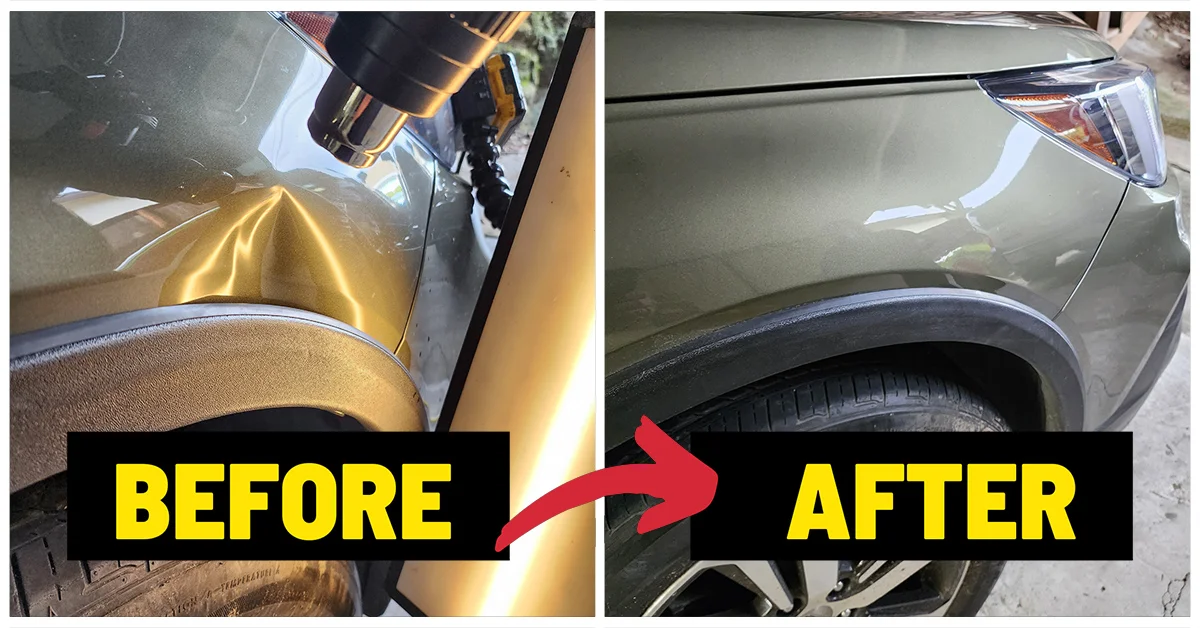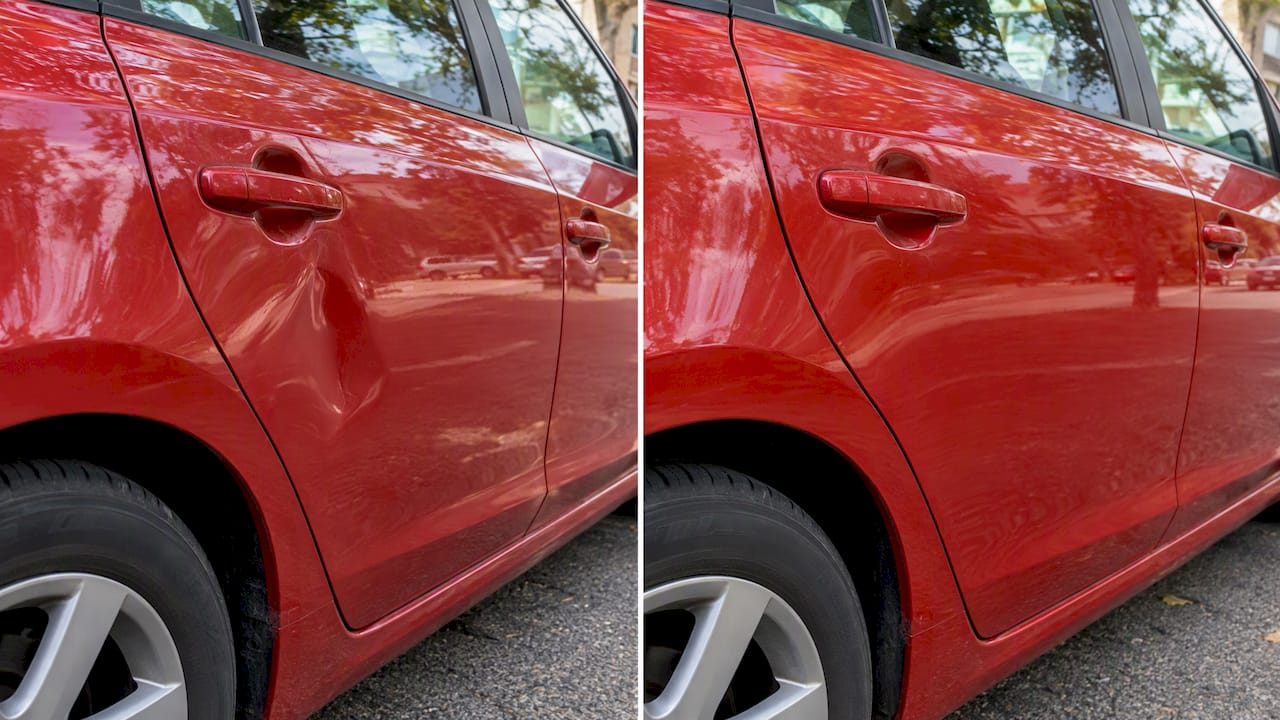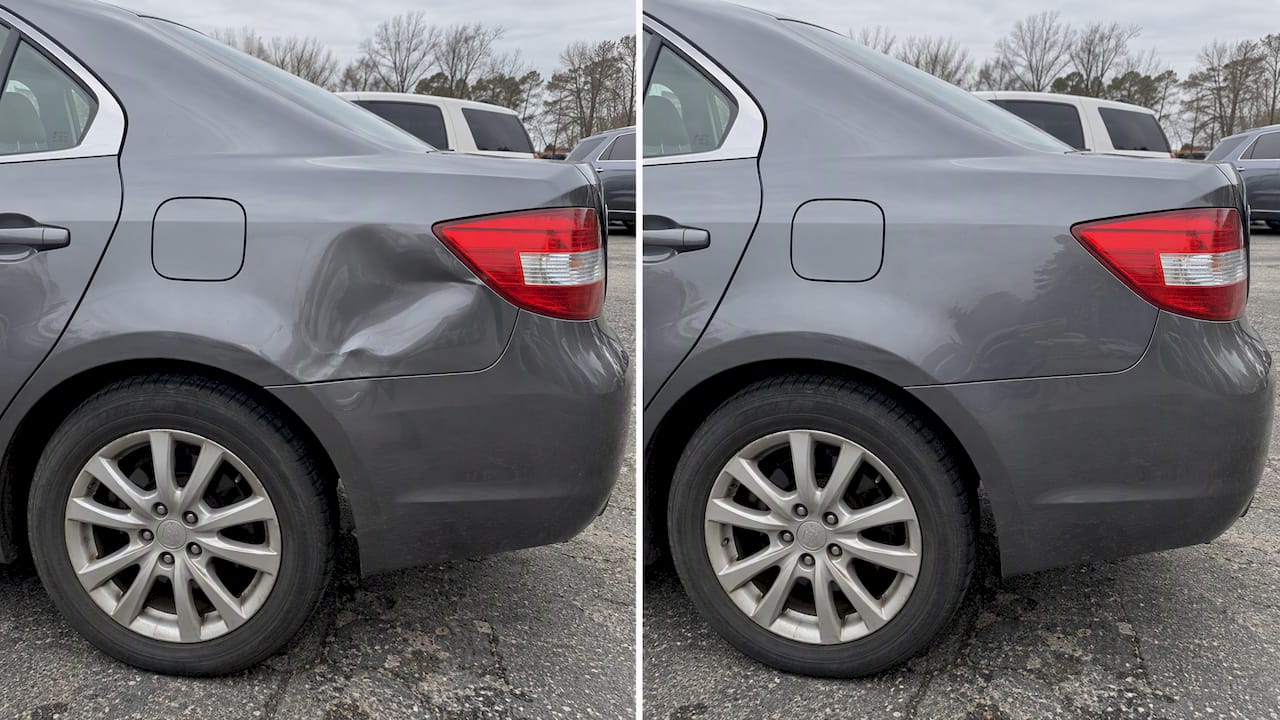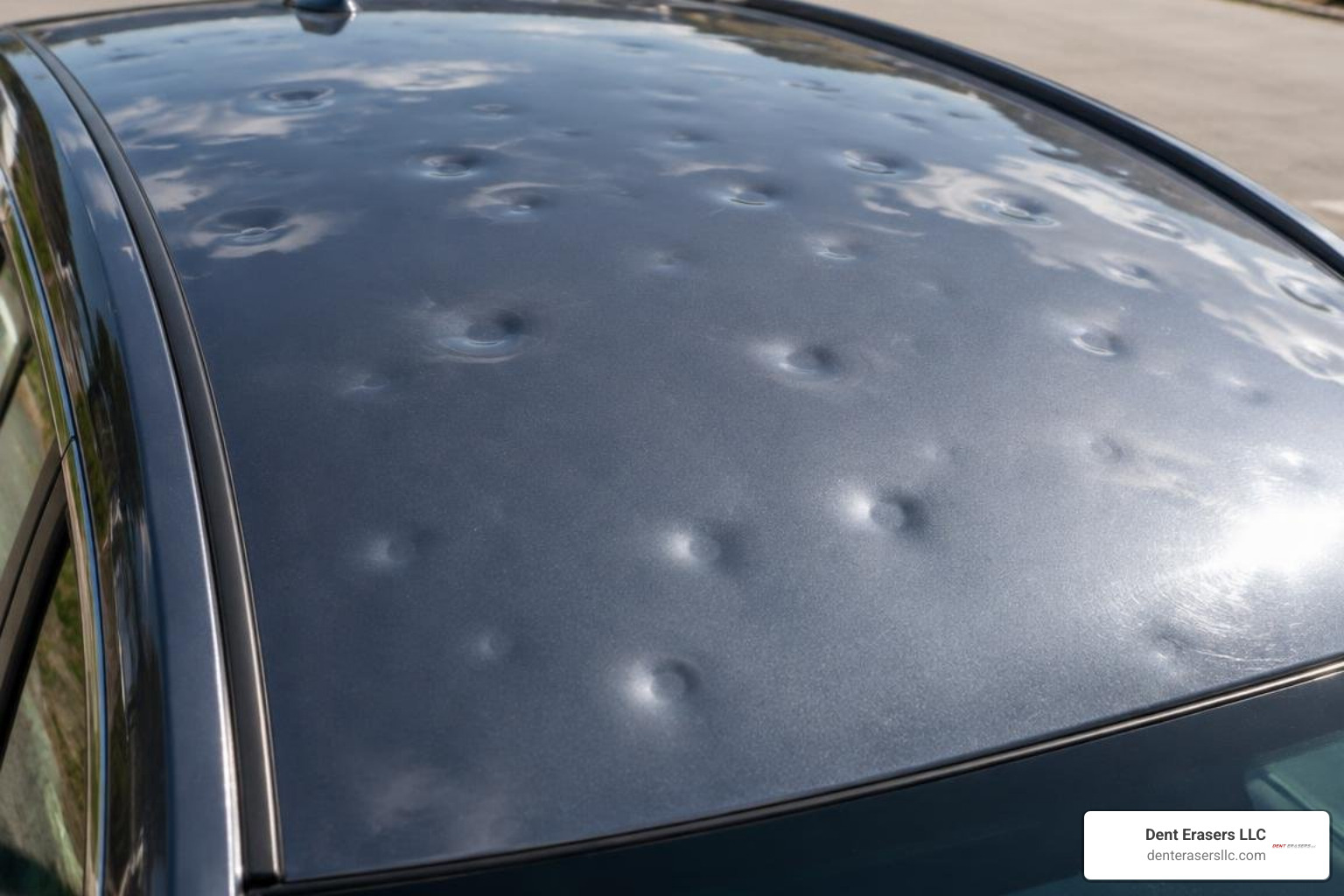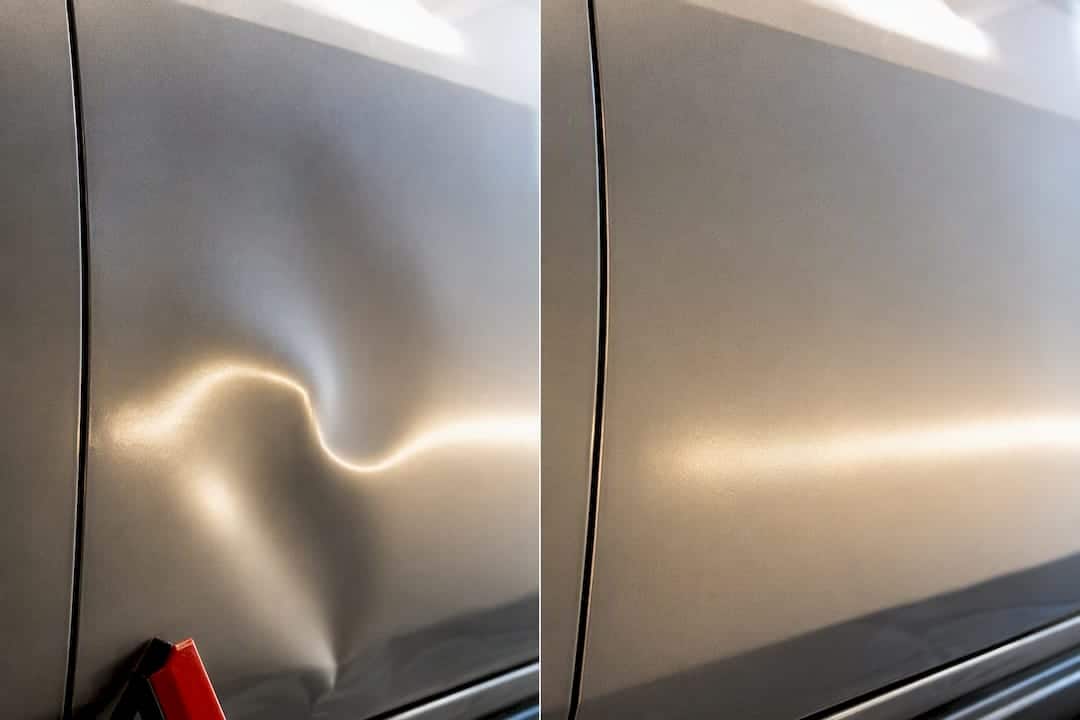
A large dent typically costs from a few hundred dollars to under a thousand dollars to fix with paintless dent repair if the factory paint is intact, or significantly more at a body shop if the paint is cracked or the metal is creased. The fastest way to pin down your number is simple: snap three photos of the damage and send them in for a photo estimate before you assume the worst.
TL;DR:
- Access to the backside of the panel is the primary factor influencing repair cost, often more so than the dent’s size or depth.
- Paintless dent repair typically costs between $75 and $350 for small to large dents with intact paint, making it significantly cheaper than body shop fixes.
- Creases and metal stretching usually require body shop repair, which involves repainting and can cost upwards of $1,200, especially if paint is cracked or panel damage is extensive.
- Accurate remote estimates depend on three photos showing overall shape, reflection, and depth; poor quality images or visible creases can lead to under- or overestimation.
- DIY repair suits shallow, round dents with fully intact paint, but attempts on large or creased dents often result in higher costs for professional correction.
Table of Contents
- How Much Does Large Dent Repair Cost by Method?
- PDR vs Body Shop vs DIY: Which Fits Your Dent?
- What Factors Actually Drive Your Dent Repair Price?
- How Do You Get an Accurate Dent Repair Quote?
- When Is DIY Dent Repair a Bad Idea?
- Should You File an Insurance Claim for a Large Dent?
- How Long Does Large Dent Repair Take?
- What Cost Variables Come From Your Vehicle’s Make and Model?
- How Does Dent Depth Change the Repair Cost?
- Do Dent Repairs Come With a Warranty?
- What New Technologies Go Beyond Traditional PDR?
- The Honest Take on Estimating Large Dent Repair Costs
- How Denterasers LLC Handles Large Dent Repairs
- Sources
- FAQ
How Much Does Large Dent Repair Cost by Method?
Here’s the honest breakdown, and it starts with a question I get almost every day: “Is my dent going to be cheap or expensive?” The answer depends less on how big the dent looks and more on what’s happening underneath the paint.
Round dents with smooth edges and unbroken paint are almost always paintless dent repair (PDR) candidates, and PDR is where the real savings live. PDR typically runs $75 to $350 for a single-panel dent where the paint hasn’t cracked, and it’s routinely 40% to 70% cheaper than sending the same panel through a body shop. Once you’re dealing with a genuinely large dent, spanning several inches or dipping deep into the panel, that price climbs but stays in PDR territory as long as the finish is intact.
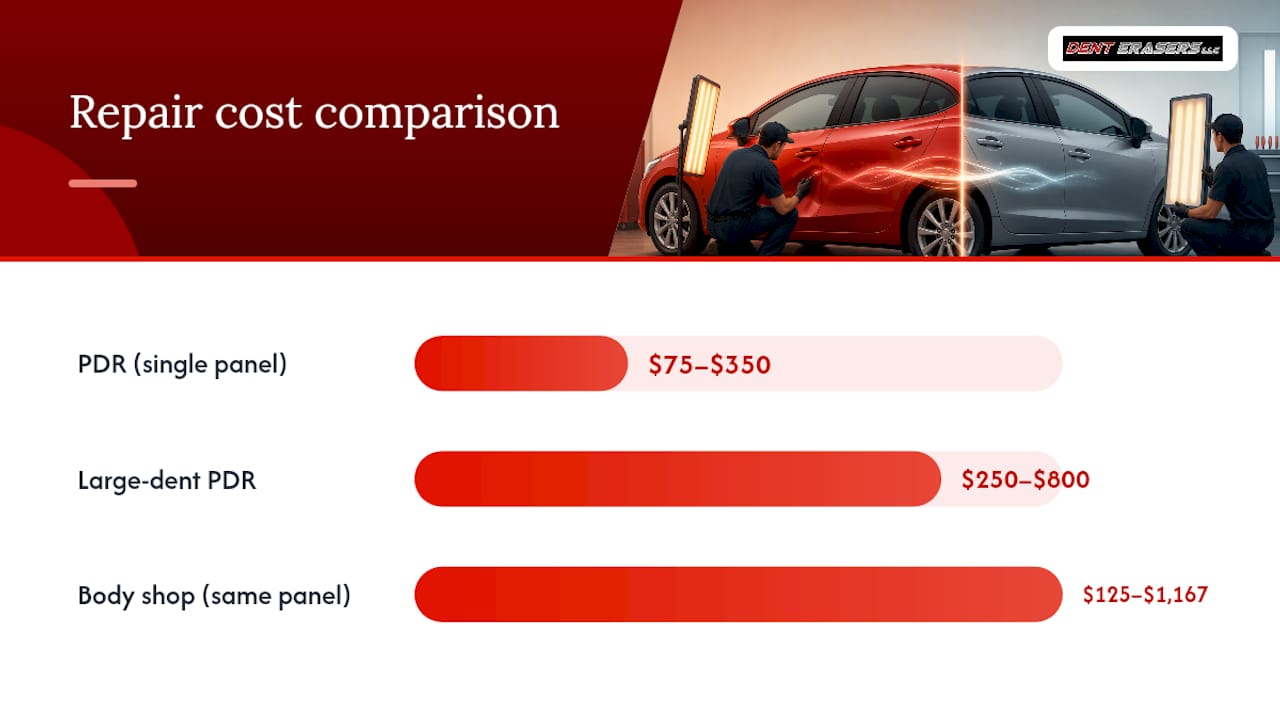
Creases are a different animal entirely. A long crease or large dent often costs $500 to $1,000 for PDR when it’s still eligible, but the moment paint and panel work enter the picture, that same damage typically runs $1,200 to $2,500 or more through a body shop.
Here’s a planning table based on common dent scenarios:
| Dent type | PDR range | Body shop range | Typical turnaround |
|---|---|---|---|
| Coin size (paint intact) | $50–$75 | $75–$350 | Same day |
| Door panel dent | $75–$350 | $500–$1,000 | Same day to 1 day |
| Palm size, no paint damage | $75–$350 | $500–$1,000 | Same day |
| Large dent (paint intact) | $250–$800 | $1,200–$2,500 | Same day to 2 days |
| Deep crease or paint cracked | Not PDR eligible* | $1,200–$2,500+ | 2–7 days |
| Hail damage (multiple dents) | $300–$2,500 | $1,200–$2,500 or more | 2–7 days |
*Some shallow creases with intact paint respond to advanced PDR techniques; deep or sharp creases usually need filler and paint.
A few things push you toward the higher end of any range. Luxury and specialty paint finishes, like tri-coat pearls or matte wraps, add labor because blending and clear-coat matching take more skill and time. Aluminum panels, common on trucks and newer luxury models, add cost on both sides of the table. And if a panel needs to be replaced rather than repaired, you’re paying for parts on top of labor.
Keep in mind these are planning ranges, not quotes. Your actual price depends on your region, your vehicle’s value, and what a technician sees once they’re standing in front of the panel. That’s exactly why a photo estimate beats guessing every time.
PDR vs Body Shop vs DIY: Which Fits Your Dent?
Every large dent puts you at a fork in the road, and picking the wrong path either costs you extra money or extra time. Let me walk you through how each option actually plays out.
Paintless dent repair works by massaging the metal back into shape from behind the panel, using specialized rods and glue-pull tools instead of fillers or paint. No sanding, no spray booth, no bake cycle. Preserving factory paint isn’t just a cosmetic win; it protects your resale value too, since a repainted panel shows up on a vehicle history or paint-meter check that buyers and dealers look for. PDR is your best option when the dent is round, the paint hasn’t cracked, and there’s reasonable access to the panel’s backside.
Body shop repair is the traditional route: fill the low spots, sand the panel smooth, then respray and blend the paint into the surrounding area. It’s required when paint is cracked, when the crease is sharp enough that the metal has actually stretched, or when the panel is damaged beyond what massaging metal can fix. Expect more money and more days on the calendar, since paint has to cure and blend properly before the car leaves the shop.
DIY repair sounds appealing on a large dent because the potential savings look big on paper. In practice, most DIY large-dent attempts either work on a shallow, round dent or turn into an expensive lesson. I’ll cover exactly where that line sits in the DIY section below, but the short version: creases and stretched metal are not a weekend project.
- PDR: cheapest and fastest, but only when paint is intact and access is workable
- Body shop: necessary for cracked paint, stretched metal, or panel replacement
- DIY: fine for shallow, easy-access dents; risky for anything large or creased
Pro Tip: If you’re not sure which category your dent falls into, run your fingernail lightly across the surface. If you feel a sharp ridge or the paint looks stressed and dull along the edge, you’re looking at a crease, not a simple dent, and PDR alone probably won’t fix it.
What Factors Actually Drive Your Dent Repair Price?
Size gets all the attention, but it’s rarely the biggest factor in your quote. Access to the backside of the panel is usually the single largest driver of price, more than the dent’s diameter or even its depth. A door panel with an accessible interior cavity is straightforward for a PDR technician to reach with rods and tools. A dent near the roofline, inside a trunk with limited clearance, or tucked under a headliner support brace takes significantly longer to access, and that time shows up on your invoice.
Round dents versus creases matters just as much. A round dent means the metal bent without stretching, so it can be pushed and massaged back to its original shape. A crease means the metal actually stretched past its “memory,” so it fights you the whole way back, sometimes requiring specialized crease-pulling techniques or, past a certain point, filler and paint instead.
Panel material changes the math too. Aluminum panels commonly add 25% to 50% to the labor and time required for both PDR and body-shop work, since aluminum behaves differently under pressure and cracks more easily than steel if handled wrong. Some shops even refer aluminum-heavy vehicles, like newer trucks and certain luxury sedans, to specialists rather than risk it.
- Backside access: the biggest single price driver, often more than size
- Round vs. crease: creases require more skill, time, and sometimes paint work
- Material: aluminum adds 25% to 50% more labor over steel
- Paint type: luxury or specialty finishes raise blending costs
- Multiple dents: bundling dents on one panel lowers the per-dent price since setup happens once
That last point surprises a lot of people. If your car picked up several dents in the same hailstorm or parking-lot mishap, don’t assume the total is just each dent priced separately. Shops routinely discount additional dents once the technician is already set up on that panel.
How Do You Get an Accurate Dent Repair Quote?
Getting a number you can trust starts before anyone touches your car. Here’s the process I recommend every time.
- Take three specific photos. Shoot one straight-on from about three feet away to show overall shape, one at an angle that catches the reflection across the dent (this reveals depth and edge sharpness better than a flat shot), and one close-up of the deepest point showing the paint surface clearly. This three-photo approach lets a technician estimate PDR eligibility in a single response instead of a back-and-forth guessing game.
- Ask the right questions. Confirm the proposed method (PDR versus filler and respray), whether the panel needs to come off the car, what warranty covers the finished work, whether the quote breaks out labor from materials, and whether OEM paint blending is required for a color match.
- Watch for red flags. Vague, unitemized pricing, a jump straight to “panel replacement” without explaining why PDR or repair wasn’t tried first, a suspiciously large contingency line, or a turnaround time that seems oddly short or long without explanation, all deserve a follow-up question before you approve anything.
- Insist on an in-person look when the photos show a crease, a sharp edge, or paint that’s clearly cracked or lifted. Remote estimates work well for straightforward dents, but stretched metal and damaged clearcoat need a hands-on inspection to price accurately.
Following this checklist protects you from both underpaying for work that later needs to be redone and overpaying for a “replacement” that a skilled technician could have repaired for a fraction of the cost.
When Is DIY Dent Repair a Bad Idea?
Shallow, round dents in easy-to-reach spots, like a door panel dinged by a shopping cart, with paint that’s fully intact, are reasonable DIY territory. A suction puller or the classic hot-water-and-plunger trick genuinely works on these, and you can save yourself the cost of a service call.
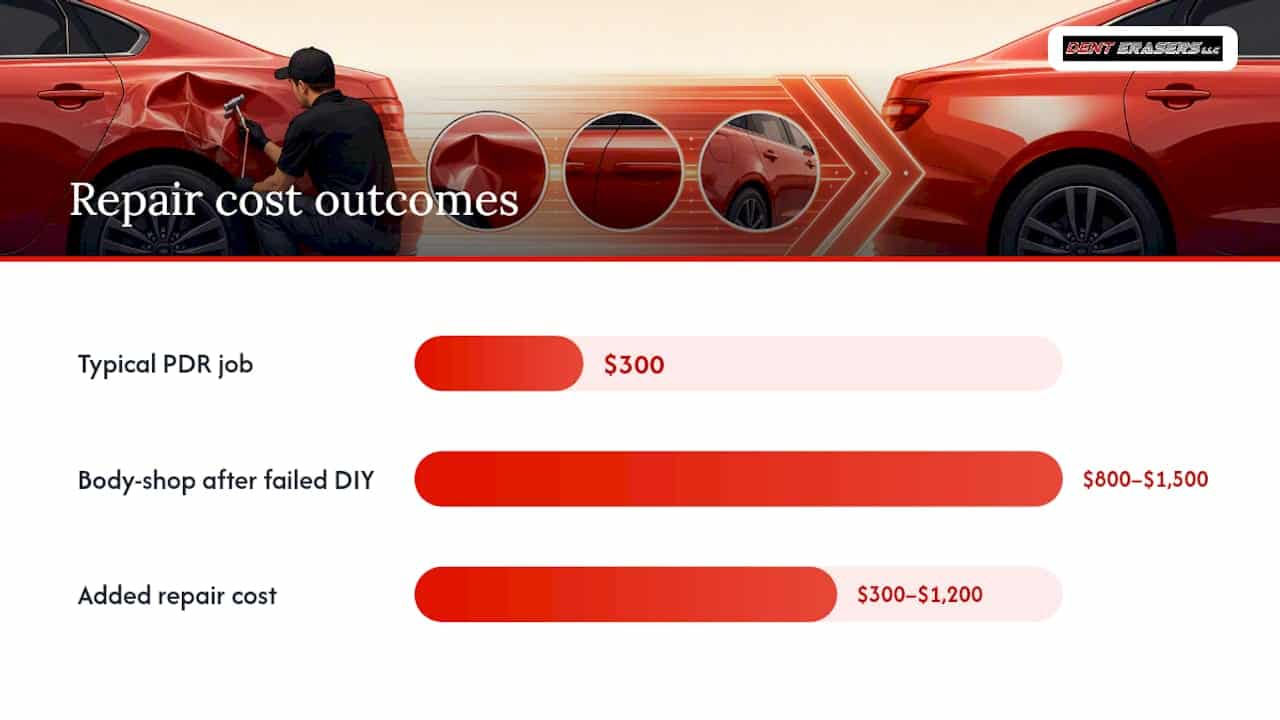
Large dents and creases are where DIY attempts go sideways. The most common failures I see are stretched metal from overaggressive pulling, cracked clearcoat from heat guns or dry ice applied too aggressively, and glue-pull residue that has to be sanded off before any repair can proceed. Each of these failure modes commonly adds $300 to $1,200 to the eventual professional repair, because now the technician isn’t just fixing the original dent, they’re fixing your fix.
- Good DIY candidates: shallow, round, easy-access dents with intact paint
- Bad DIY candidates: creases, deep dents, anything near an edge or seam
- Failed DIY often turns a $300 PDR job into an $800 to $1,500 body-shop job
Pro Tip: If you’ve already attempted a DIY fix and it didn’t fully pop back, stop there. Don’t reach for a heat gun as a next step. Get it looked at before the “almost fixed” dent becomes a fully creased, paint-damaged one.
For a full breakdown of which situations still favor a DIY approach, see our guide on removing large dents without a body shop.
Should You File an Insurance Claim for a Large Dent?
This is the question I probably field more than any other, and the honest answer is: it depends on the math, not the size of the dent.
Filing makes sense when the repair cost clearly exceeds your deductible plus the long-term premium risk you’re comfortable accepting, particularly for hail damage or multi-vehicle incidents where the total climbs into the thousands. Insurance adjusters increasingly favor PDR for hail and multi-dent claims because it’s faster to approve, preserves factory paint, and often means you’re not waiting on a rental car for a week of body-shop turnaround.
Paying out of pocket usually wins for smaller PDR-eligible jobs. If your repair estimate is less than twice your deductible, you’re often better off paying directly, since filing a claim, even a small one, can affect your premium history depending on your insurer and state.
- File a claim when: cost is well above deductible, multiple dents are involved, or it’s hail damage
- Pay out of pocket when: the job is a single PDR-eligible dent under roughly twice your deductible
- Rule of thumb: compare total cost to double your deductible before deciding
For more on how paint damage changes claim economics, our cost to fix dent and paint guide breaks down the budgeting side in detail.
How Long Does Large Dent Repair Take?
Mobile PDR on a large dent typically takes 30 minutes to a few hours, and most mobile technicians can complete the job the same day they inspect it, sometimes while you’re at work or running errands.
Body-shop repair runs longer because paint needs proper cure time between coats and blending has to be done carefully to avoid a visible seam; see our guide on how to remove swirl marks from your car’s paint for more on paint finish care. Expect 2 to 7 business days for sanding, filling, painting, and clear-coat curing, with the longer end reserved for panel replacement or when a part has to be ordered.
- Mobile PDR: 30 minutes to a few hours, often same-day
- Body-shop paint and blend work: 2 to 7 business days
- Panel replacement: add days for parts ordering and fitting
- Insurance approval or parts backorders can add several more days on top
Schedule around these windows rather than around the dent itself. If you need your car back the same day, PDR eligibility isn’t just a cost question, it’s a scheduling one too.
What Cost Variables Come From Your Vehicle’s Make and Model?
Not every large dent costs the same, even at identical size and depth, once you factor in what you’re driving. Luxury brands with specialty coatings, tri-coat pearls, matte finishes, or ceramic-protected paint, cost more to match if a respray becomes necessary, since color blending on these finishes takes extra skill and materials.
Vintage vehicles bring their own wrinkle: older steel often work-hardens differently than modern alloys, meaning a technician experienced with classic cars gets a cleaner result than someone used to only modern panels.
Panel curvature also varies by model. Sports cars and certain SUVs have sharply contoured body lines, which limits how a PDR rod can approach the dent from behind and sometimes rules out PDR on dents that would be simple on a flatter panel. Motorcycle tanks and fenders present a similar challenge in miniature, thin gauge metal that dents easily but also responds well to PDR in the hands of someone trained on two-wheeled bodywork specifically.
The takeaway: your neighbor’s $300 door dent repair and your $700 quote on a similar-looking dent aren’t necessarily inconsistent. Different vehicle, different paint, different access, different price.
How Does Dent Depth Change the Repair Cost?
Depth matters, but not in a straight line. A shallow dent, even a large one across the surface area, is often easier to massage back into shape than a smaller, deep dent that has pushed the metal past its “memory” point.
Once a dent crosses a certain depth threshold, the metal doesn’t just bend, it stretches. Stretched metal resists returning to its original contour, which is why deep dents and sharp creases frequently need more time on the tool, more specialized technique, or in the worst cases, filler and paint instead of PDR at all.
Complexity compounds depth. A dent sitting near a body line, seam, or edge is harder to access and harder to shape correctly, since panel curves change the way pressure needs to be applied. A dent in the flat middle of a hood is usually the easiest scenario a technician sees; the same depth of dent folded around a wheel arch or door edge takes considerably longer.
This is exactly why two dents that look similar in photos can get very different quotes once a technician examines them in person or reviews your close-up photo of the deepest point. Depth and complexity together, not surface size, tend to decide whether you’re looking at a same-day PDR fix or a multi-day body-shop job.
Do Dent Repairs Come With a Warranty?
Reputable PDR and body-shop providers stand behind their repair work, and you should treat the absence of any warranty as a red flag worth asking about directly.
Most legitimate PDR warranties cover the repaired panel against the dent reappearing or the repair failing to hold, typically for as long as you own the vehicle, since the process doesn’t involve materials that degrade over time the way filler or paint can. Body-shop warranties usually separate labor from paint. Paintwork commonly carries its own manufacturer-backed warranty on the coating itself, separate from the labor guarantee on the repair.
Ask specifically what’s covered and for how long before you approve any repair. A shop or mobile technician who can’t answer that question clearly, or who hedges with vague language, is telling you something about how confident they are in their own work.
What New Technologies Go Beyond Traditional PDR?
Paintless dent repair itself keeps evolving. Glue-pull systems, which attach specialized tabs directly to the dent’s surface and pull from the outside, have expanded what PDR can fix, including some creases and edge damage that used to require filler and paint. Induction heating tools, which briefly heat a panel’s clearcoat to relax stress before massaging the metal, have made certain stubborn dents workable without sanding.
On the diagnostic side, LED reflection boards have become standard equipment for skilled technicians, using rows of light to reveal a dent’s true shape and depth far more precisely than the eye alone. Some shops now use paint-thickness meters as a quick way to confirm a panel has never been repainted before quoting PDR, which protects you from paying for “original finish preservation” on a panel that’s already been touched up once.
None of this replaces skilled hands. The tools extend what a trained technician can fix without paint, but the fundamentals, access, depth, and whether the metal has stretched, still decide the price and the method.
The Honest Take on Estimating Large Dent Repair Costs
Most of the advice out there treats dent repair pricing like a simple size chart: bigger dent, bigger bill. That framework is misleading, and it costs readers money in both directions. I’ve seen genuinely large dents fixed for a few hundred dollars because the paint held and access was clean, and I’ve seen a “small” crease near a door edge run well past a thousand because the metal had actually stretched.
What conventional guidance underestimates is how much access and paint condition matter compared to raw size. If I could get readers to prioritize one thing, it would be this: send photos before assuming a large dent means a large bill. The three-photo checklist isn’t a nice-to-have, it’s the entire difference between an accurate estimate and a guess. Skip that step and you’re either overpaying for unnecessary panel work or underestimating a crease that truly needs body-shop attention. Get the photos right, and the rest of the decision, PDR or body shop, in-house repair or insurance claim, gets a lot simpler.
— Brian Blanc
How Denterasers LLC Handles Large Dent Repairs
Denterasers LLC is the mobile alternative to sitting in a body-shop waiting room for a week over a dent that paintless repair could fix in an afternoon. We come to you, whether that’s your driveway, office parking lot, or wherever the car happens to be, and we handle large dents, plastic bumper repair, and specialty work on luxury, vintage, and motorcycle vehicles without ever putting your factory paint at risk.
Starting is simple: send us photos using the same three-shot approach covered earlier, straight-on, angled, and a close-up of the deepest point, and we’ll come back with a photo estimate that tells you whether your dent qualifies for PDR and roughly what it’ll cost. On-site appointments typically get scheduled within a few days depending on your location, and most large PDR jobs wrap up the same visit. Ready to find out what your dent actually costs? Get your photo estimate started at Denterasers LLC and skip the body-shop guesswork entirely.
Sources
Pricing bands in this guide draw on UseCalcPro’s dent repair cost data, The Dent Dude’s PDR versus body-shop comparison, and Dent Press’s pricing driver breakdown. For deeper pricing detail, see our ultimate paintless dent repair pricing guide and our piece on why traditional body shops often cost more.
- Car Dent Repair Cost: 2026 Averages by Dent Size & Method | UseCalcPro
- Dent Repair Cost by Size: 2026 Pricing Guide (with Real Numbers) – autobodyrepairs
FAQ
How much does it cost to fix a big dent in my car?
A large dent typically costs $250 to $800 with paintless dent repair when the paint is intact, or $800 to $2,500 or more at a body shop if the paint is cracked or the metal is creased.
How much does a major dent with paint damage cost?
Once paint is cracked or a panel needs replacement, expect $1,200 to $2,500 or more, since respray and blend work plus potential panel replacement push costs well past standard PDR pricing.
Does dent size affect repair cost?
Size matters less than most people assume. Access to the panel’s backside, depth, and whether the metal has stretched into a crease drive the price more than how large the dent looks on the surface.
Is PDR cheaper than a body shop for large dents?
Yes, when the dent qualifies. PDR runs 40% to 70% cheaper than conventional body-shop repair because it skips filler, sanding, and repainting entirely.
Should I file an insurance claim for a large dent?
File a claim when the repair cost clearly exceeds your deductible plus acceptable premium risk, particularly for hail or multi-dent damage; pay out of pocket for smaller PDR-eligible jobs under roughly twice your deductible.