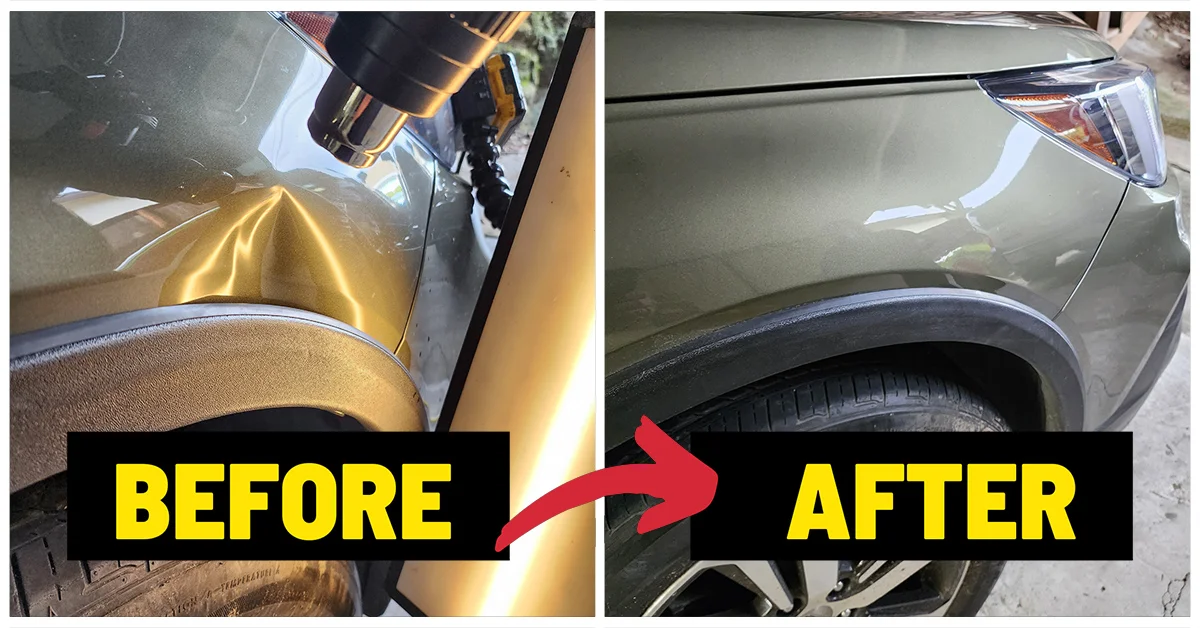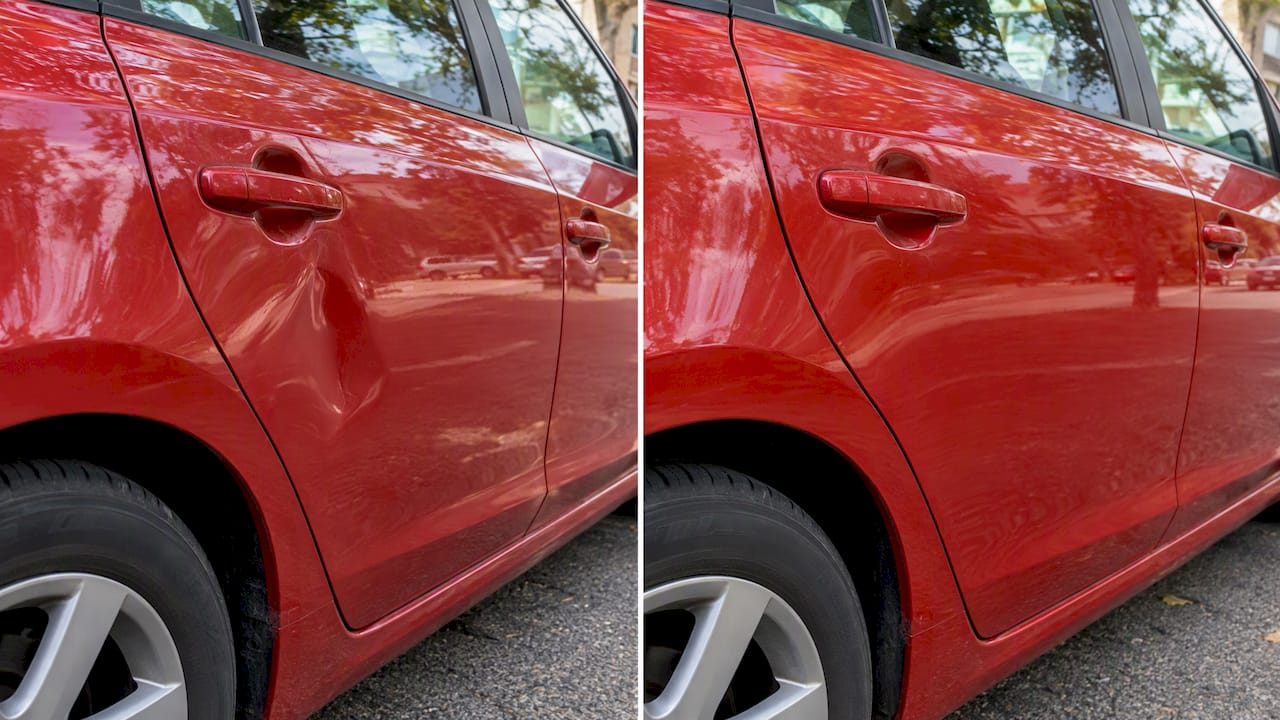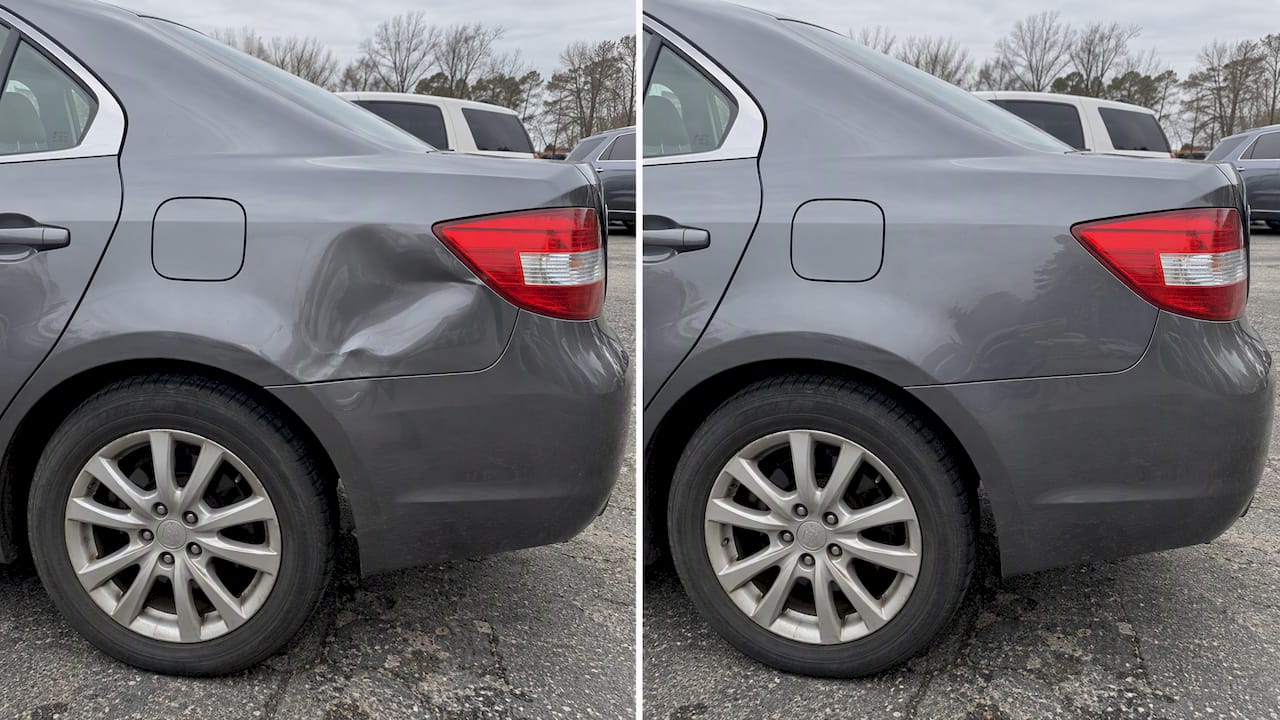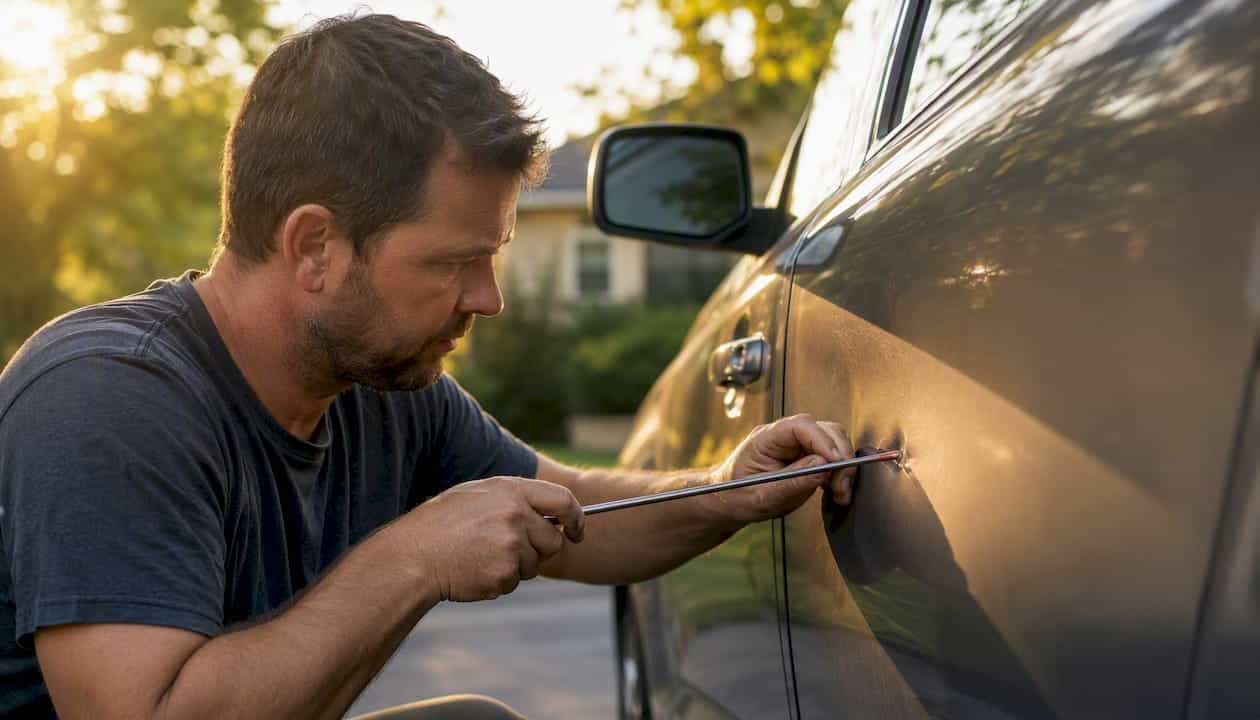
Most minor dent damage falls into eight categories: door dings, round dents, creases, body-line creases, edge dents, hail dents, oil-canning, and bumper scuffs with chipped paint. If the paint is still intact, paintless dent repair (PDR) is almost always the first-choice fix. Once paint has cracked or metal has stretched, traditional body and paint work takes over.
That single distinction, paint intact versus paint broken, drives nearly every repair decision you’ll make. It determines whether a mobile technician like Denterasers LLC can pull the dent same-day in your driveway, or whether the panel needs filler, primer, and a respray at a body shop. It also affects whether filing an insurance claim makes sense, since a claim tied to bodywork can show up down the road, while a paint-preserving PDR repair paid out of pocket typically leaves no such mark on your vehicle’s history.
Here’s the quick-reference version before we get into the details:
- Door ding (parking lot dents, no paint damage): PDR, usually same-day.
- Round dent, small to medium (shopping carts, minor impacts): PDR, if metal isn’t stretched.
- Crease (a fold or line dent): PDR possible for shallow creases; deep ones may need body work.
- Body-line crease (dent crossing a factory character line): Often harder PDR, sometimes hybrid repair.
- Edge dent (near a panel’s edge, door jamb, or wheel arch): Frequently requires glue-pull or body shop work.
- Hail dents (multiple shallow dings): PDR, priced per dent or per job.
- Oil-canning (a soft, wavy panel flex without a sharp crease): Sometimes self-corrects; PDR if not.
- Bumper scuff or chipped paint: Plastic repair techniques, separate from metal PDR.
Key Takeaways
Matching your dent’s category to the right repair method, PDR for paint-intact damage, body shop work for broken paint or stretched metal, determines your cost, timeline, and vehicle history outcome.
| Point | Details |
|---|---|
| Paint condition decides the path | Intact paint usually means PDR is possible; cracked paint routes the job to a body shop. |
| Body lines and edges add difficulty | Dents crossing a factory ridge or sitting near a panel edge often need glue-pull or hybrid repair. |
| Cost scales with complexity | Door dings run $75–$150, while creases, edges, and hail clusters cost more per dent or per job. |
| Claim only past your deductible | Small dents often cost less out of pocket than a claim once premium impact is considered. |
| Denterasers LLC handles paint-intact cases onsite | Mobile PDR and bumper repair cover most of the categories above without a body shop visit. |
Table of Contents
- What Are the Main Minor Dent Damage Categories?
- How Do Pros Categorize Minor Dent Severity?
- Matching Each Dent Category to a Repair Method
- When Does Paintless Dent Repair Actually Work Best?
- What Do Minor Dent Repairs Typically Cost?
- Should You File an Insurance Claim for a Minor Dent?
- What DIY Fixes Actually Help, and Which Ones Make It Worse?
- How Do You Choose the Right Dent Repair Provider?
- What the Data Actually Tells You About Minor Dents
- How Denterasers LLC Handles These Minor Dent Categories
- Sources
- FAQ
What Are the Main Minor Dent Damage Categories?
Minor damage, by definition, doesn’t compromise your car’s safety or structural integrity. It covers small dents, scuffs, chips, and cracked trim, and single-panel repairs for this tier of damage commonly run under $1,000. But “minor” isn’t one category. It’s a spectrum, and where your dent lands on that spectrum decides your repair path, your price, and how long your car sits in a shop.
The clearest way to sort minor dents is by shape and location, because those two factors predict how the metal behaved when it was hit.
- Door dings come from another car door, a shopping cart, or a stray shoe. They’re shallow, usually round, and rarely stretch the metal, which is exactly why they’re the easiest PDR job on the list.
- Round dents are similar but slightly larger, often from a ball, hail, or a light bump. Size and depth determine difficulty more than shape here.
- Creases form when something narrow, a bike pedal, a cart rail, presses in a line rather than a point. The sharper the fold, the more the metal has actually stretched rather than just displaced.
- Body-line creases sit right on a factory character line, the sculpted ridge running down a door or fender. These lines are already work-hardened during manufacturing, so a dent crossing one behaves differently than the same dent on a flat panel.
- Edge dents happen near where a panel meets a jamb, wheel arch, or trim piece. Limited access to the backside of the metal is the defining problem here, not the dent’s size.
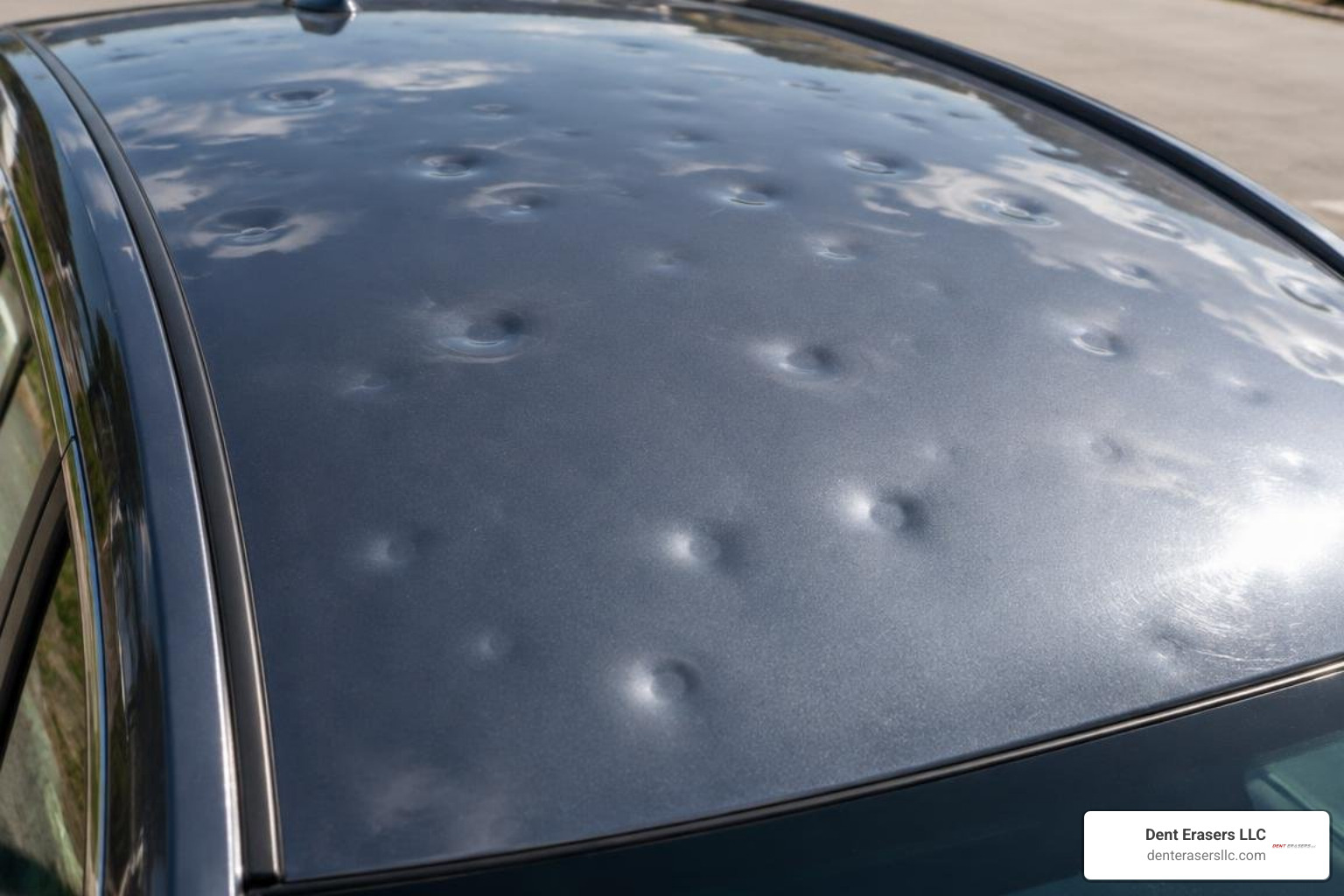
- Hail dents show up as a cluster of small dings across the hood, roof, and trunk after a storm.
- Oil-canning isn’t a true dent. It’s a stress wave in a large, flat panel that flexes in and out. Sometimes it pops back on its own; sometimes it needs the same massage-the-metal technique used on a real dent.
- Bumper scuffs and chipped paint involve plastic, not sheet metal, so they follow an entirely different repair logic than everything above.
How Do Pros Categorize Minor Dent Severity?
A trained eye judges a dent on six criteria: size, depth, how sharp the crease is, whether the paint has cracked, how much room there is behind the panel, and whether the metal has actually stretched or just moved. Get those six right, and you know almost instantly whether PDR is realistic or whether the car needs to head to a body shop.

Size and depth matter, but not as much as most owners assume. A dent the size of a dinner plate but only a quarter-inch deep is often an easier PDR job than a dime-sized dent that’s sharp and deep, because sharpness usually means the metal has been stretched past the point where it wants to spring back.
Technicians run through a quick field checklist before ever touching a tool:
- Run a fingernail across the dent. If you feel a crisp edge rather than a smooth dip, the metal has likely stretched.
- Check the paint under bright, raking light for hairline cracks. Cracked paint usually rules out pure PDR.
- Assess backside access. Door panels, trunk liners, and wheelwells sometimes need to come off to reach the dent from behind.
- Note the dent’s position relative to any factory body line. Crossing a body line adds difficulty and time.
- Look for a “memory” test: pressing gently near the dent to see if the panel wants to return to shape on its own.
Pro Tip: Body lines are the single most underestimated factor in whether a dent is PDR-friendly. A dent sitting entirely on a flat panel section, even a fairly large one, is often a faster and cheaper fix than a small dent that crosses a factory crease line, because the ridge itself resists the tools used to push and tap the metal back into place.
A mobile specialist evaluating a job on-site is essentially running this same checklist in real time, which is why photo-based triage works well for straightforward door dings but often needs an in-person look for anything crossing a body line or sitting near a panel edge.
Matching Each Dent Category to a Repair Method
The table below reflects typical outcomes technicians see across these categories, though every dent is ultimately judged case by case.
| Category | Visual Cues | Common Causes | PDR Fixable? | Ballpark Cost/Time |
|---|---|---|---|---|
| Door ding | Small, round, shallow, no paint break | Adjacent car doors, carts | Yes | $75–$150, same day |
| Round dent (small/medium) | Rounded, moderate depth | Balls, minor impacts | Yes, if paint intact | $150–$300, same day |
| Crease | Linear fold, sharper edge | Cart rails, narrow impacts | Conditional | Higher end of PDR range, 1–2 days |
| Body-line crease | Crosses a factory ridge | Sideswipes, door edges | Conditional, often harder | Premium PDR pricing, 1–2 days |
| Edge dent | Near jamb, arch, or panel edge | Limited-access impacts | Often no, or glue-pull only | Body shop range, several days |
| Hail cluster | Multiple shallow dings | Hailstorm | Yes, per-dent pricing | $50–$150 per dent |
| Oil-canning | Wavy flex, no sharp line | Panel stress, thin metal | Sometimes | Varies, often quick |
| Bumper scuff/chipped paint | Scraped plastic, exposed primer | Curbs, low-speed contact | No (plastic repair, not PDR) | Separate line item, 1–2 days |

Edge dents and body-line creases deserve their own callout: because that steel was work-hardened at the factory and access behind the panel is often restricted, a meaningful share of these cases, 15 to 20 percent by some estimates, end up needing a glue-pull system or limited paint blending rather than pure PDR. If your dent sits right on a crease line or tucks into a wheel arch, budget extra time for the estimate process alone.
Bumper repair follows a completely different playbook. Plastic doesn’t respond to the same metal-massaging technique. It gets heat, reshaping, adhesives, or filler depending on how deep the scuff or crack runs, which is why a bumper repair is almost always quoted as its own job rather than folded into a PDR estimate.
When Does Paintless Dent Repair Actually Work Best?
PDR is the right call whenever the paint is intact and the metal hasn’t been stretched past its limit, and that combination shows up far more often in daily minor-damage claims than most owners expect. The technique preserves your factory finish entirely, working the metal from behind or alongside the panel rather than sanding, filling, or repainting anything.
The case for PDR when it fits:
- Your original paint stays exactly as the factory applied it, with no color-match risk down the road.
- Mobile technicians can often complete the job same-day at your home or office, since there’s no drying time for paint or filler.
- Paying out of pocket for PDR typically avoids adding a bodywork entry to your vehicle’s history, unlike a claimed repair that involved respray work.
But PDR has real boundaries. Cracked paint, deep creases, torn metal, and dents sitting hard against a body line or panel edge all push a job toward traditional body and paint work instead. If a technician tells you a dent isn’t a good PDR candidate, it’s usually one of these four issues, not a sales tactic to upsell a bigger job.
Pro Tip: If you’re unsure whether your dent qualifies, get an in-person or photo-based evaluation before attempting anything yourself. A dent that looks simple in a phone photo can hide a hairline paint crack that only shows up under angled light, and starting a DIY pull on a compromised paint surface almost always turns a $150 fix into a $600 one.
What Do Minor Dent Repairs Typically Cost?
Prices vary by category, but here’s what U.S. owners commonly see for straightforward jobs with reasonable access:
- Door ding: roughly $75 to $150 via mobile PDR, same day.
- Small to medium round dent: roughly $150 to $300.
- Crease or body-line crease: runs higher, often scaling with length and how close it sits to a ridge.
- Hail damage: priced per dent, commonly $50 to $150 each, though whole-storm jobs with 150 or more dents can run into the thousands as a package price.
- Edge dents or deep impacts: closer to body shop pricing once filler and respray enter the picture.
- Bumper scuffs or chipped paint: quoted separately from metal panel work, since it’s a plastic repair process.
Turnaround time follows the same logic as cost. Mobile PDR on an accessible panel is frequently same-day to 48 hours. A body shop job involving filler, primer, and paint matching typically takes several days, partly because paint needs curing time between coats. Panel access changes both numbers: a dent that requires pulling a door panel or trim piece adds labor time before the actual repair even starts.
Light hailstorms in the 30 to 75 dent range are usually billed per dent, while severe storms pushing past 150 dents often shift to a flat per-job rate, since counting and pricing each individual dent stops being practical for either the shop or the insurer.
Should You File an Insurance Claim for a Minor Dent?
File a claim when the repair cost clearly exceeds your deductible or when a comprehensive policy already covers storm and hail events. Otherwise, paying out of pocket for a small door ding or single round dent usually makes more financial sense once you weigh a possible premium increase against the repair cost.
Run through this before deciding:
- Compare your deductible against the actual repair estimate, not a guess. If the deductible eats most of the cost, a claim rarely pays off.
- For hail damage covered under comprehensive coverage, a claim often makes sense, especially for whole-storm damage with dozens of dents.
- Ask your insurer whether they’ll approve PDR directly. Many now prefer it for paint-intact dents since it’s faster and cheaper than a body shop claim.
- Photograph the damage from multiple angles and note the date and likely cause before contacting your insurer.
Pro Tip: Take timestamped photos of the dent the same day it happens, including a wide shot showing the panel’s overall condition. Clear documentation speeds up an insurer’s decision and gives you leverage if they try to steer you toward a shop rather than the mobile PDR option your policy should allow.
What DIY Fixes Actually Help, and Which Ones Make It Worse?
A shallow round dent on a plastic bumper sometimes responds to a suction tool or the hot-water-and-cold-air trick, but attempting the same thing on painted metal risks cracking the finish or stretching the panel further. Knowing the difference before you try anything yourself can save you a much larger repair bill.
Safe, low-risk moves:
- Cover any spot where bare metal is exposed to prevent rust from setting in before a proper repair.
- Try a gentle suction cup only on shallow, round dents where the paint shows no cracking.
- Use gradual heat and cool air on plastic bumper dents, not on painted metal panels.
Actions to avoid entirely:
- Pounding the dent from behind with a hammer or blunt object; this almost always stretches the metal and turns a PDR job into a body shop job.
- Chemical paint strippers or aggressive rubbing compounds near the dent site.
- Applying body filler yourself without experience matching contour and color, since a mismatched respray is expensive to correct later.
| Situation | Recommended Move |
|---|---|
| Shallow round dent, plastic bumper | Try gentle suction or heat/cool method |
| Any dent with visible paint cracking | Skip DIY, call a technician |
| Dent near a body line or panel edge | Skip DIY, request a professional evaluation |
| Exposed bare metal | Cover to prevent rust, then book a repair |
How Do You Choose the Right Dent Repair Provider?
Pick a provider whose scope actually matches your dent category: mobile PDR specialists for paint-intact dents, and a body shop for anything involving broken paint or bonding work. Matching the provider to the damage, not just picking whoever answers the phone fastest, is what separates a clean repair from a frustrating redo.
Before booking, ask:
- Do you evaluate dents by photo first, and can you give a ballpark estimate before an in-person visit?
- What’s your typical turnaround for a dent like mine, and does that change if you need to remove interior panels?
- Is there a written estimate and a warranty on the completed work?
- Can I see before-and-after photos or references from similar jobs?
A checklist for choosing a PDR provider can help you compare quotes apples to apples, and reviewing a step-by-step PDR checklist beforehand means you’ll know what to have ready, registration, insurance details if relevant, and clear access to the vehicle, when the technician arrives.
What the Data Actually Tells You About Minor Dents
Most guides treat every dent the same way: get a quote, pick a shop, move on. That misses the real decision point, which isn’t cost, it’s whether the metal has stretched. Two dents that look nearly identical to an untrained eye, one PDR-friendly and one not, can carry a price difference of several hundred dollars and a timeline difference measured in days, not hours.
Conventional advice also tends to oversell DIY kits for anything beyond the shallowest plastic bumper dings. A suction tool from an auto parts store works fine on a soft plastic panel. On painted sheet metal, especially anything near a body line, that same tool risks stretching metal that a trained technician could otherwise have massaged back into shape without ever touching your paint.
If there’s one thing worth prioritizing above all else, it’s getting an honest assessment of paint condition and metal behavior before choosing a repair path, not after. That single check, more than the size of the dent or where it happened, is what actually determines your cost, your timeline, and whether your factory paint survives the process.
How Denterasers LLC Handles These Minor Dent Categories
Denterasers LLC specializes in mobile paintless dent repair and plastic bumper repair, which means most of the categories covered above, door dings, round dents, creases, hail clusters, and bumper scuffs, get triaged and often fixed without you ever driving to a shop.

A typical service visit starts with a quick photo-based estimate, so you know roughly what you’re looking at before a technician ever shows up. From there, most paint-intact dents get resolved on-site, same day, using the same panel-access checks and metal-behavior assessment described above. Have your vehicle accessible, note where the damage happened, and keep any photos you took right after the impact. If your damage involves cracked plastic or a chipped bumper rather than a metal dent, the Plastic Bumper Repair service page covers that separate repair path and pricing. Ready to find out which category your dent falls into? Request a photo estimate and get a same-day answer on whether PDR is your fastest, paint-preserving option.
Sources
You can request a photo estimate directly through Denterasers LLC’s service page if you’d rather skip the research and get a straight answer on your specific dent.
FAQ
What Counts as Minor Dent Damage?
Minor dent damage includes small dents, dings, creases, and bumper scuffs that don’t affect your car’s safety or structure, and single-panel repairs for this tier commonly run under $1,000.
Can All Minor Dents Be Fixed With PDR?
No. PDR works well for paint-intact dents like door dings and round dents, but cracked paint, stretched metal, and dents near edges or body lines often require traditional body shop repair.
How Much Does a Typical Door Ding Cost to Repair?
A standard door ding through mobile PDR typically costs $75 to $150 and is often completed the same day.
Should I File an Insurance Claim for a Small Dent?
File a claim when the repair cost clearly exceeds your deductible or the damage came from a covered event like hail; otherwise, paying out of pocket often avoids a premium increase for minor damage.
Is DIY Dent Repair Safe to Try?
DIY suction or heat methods can work on shallow plastic bumper dents, but attempting the same approach on painted metal risks cracking paint or stretching the metal further, which turns a small fix into a bigger repair.