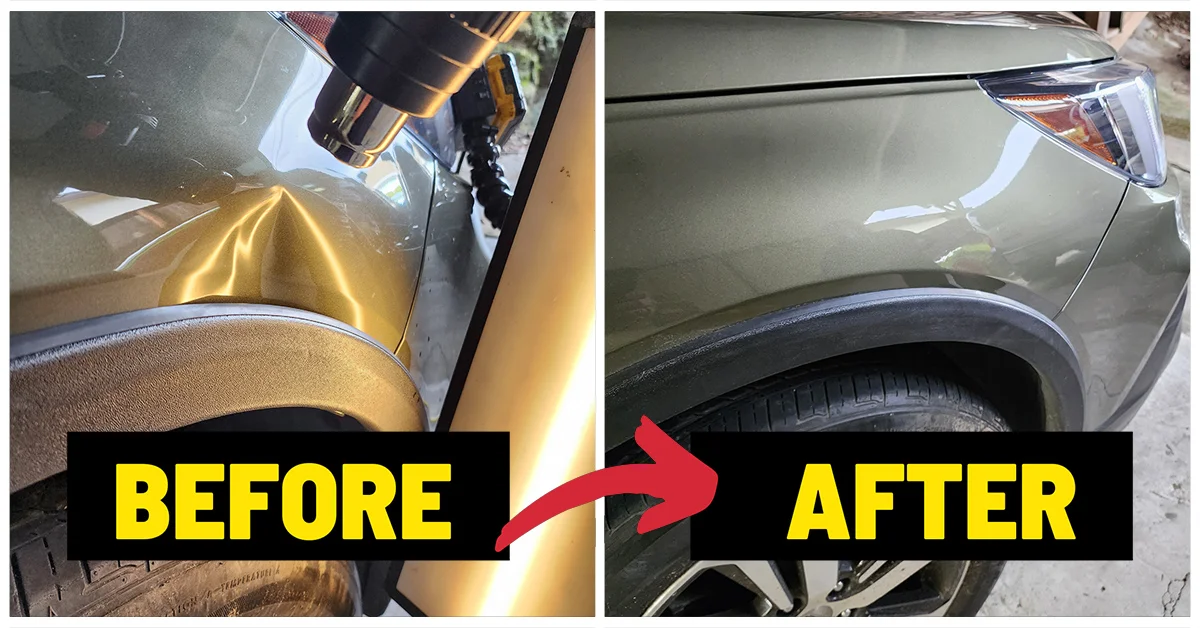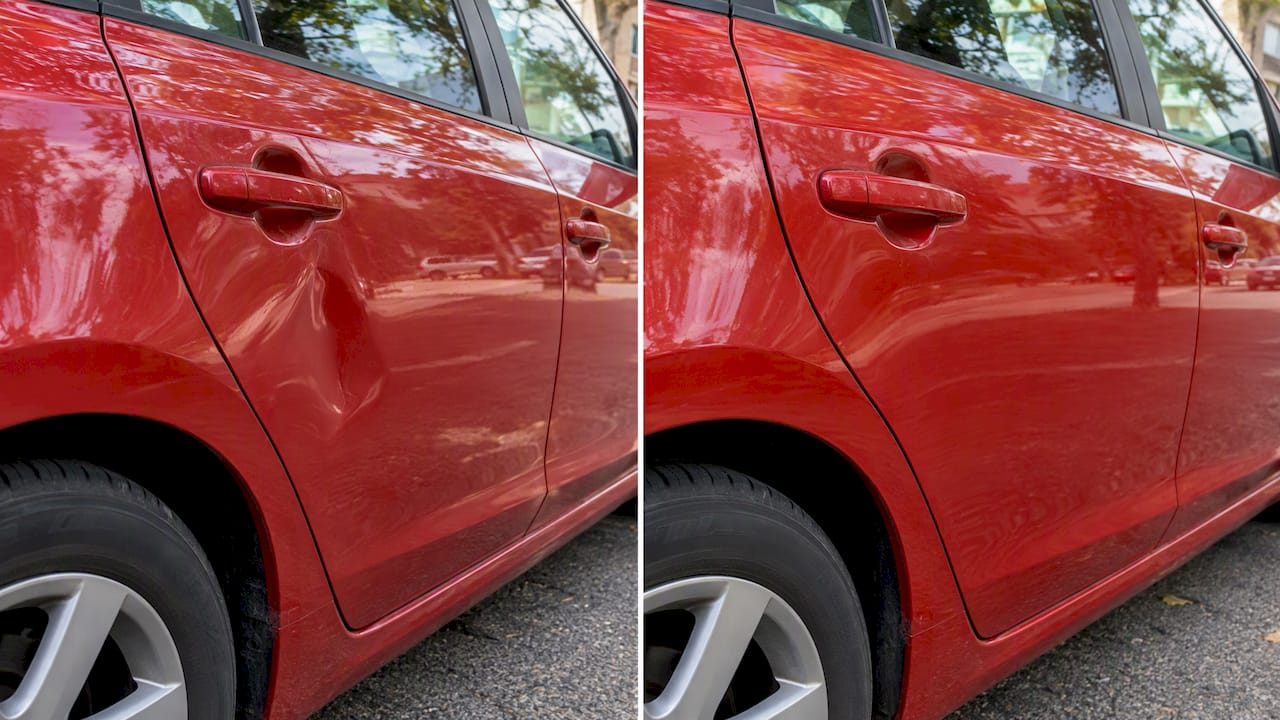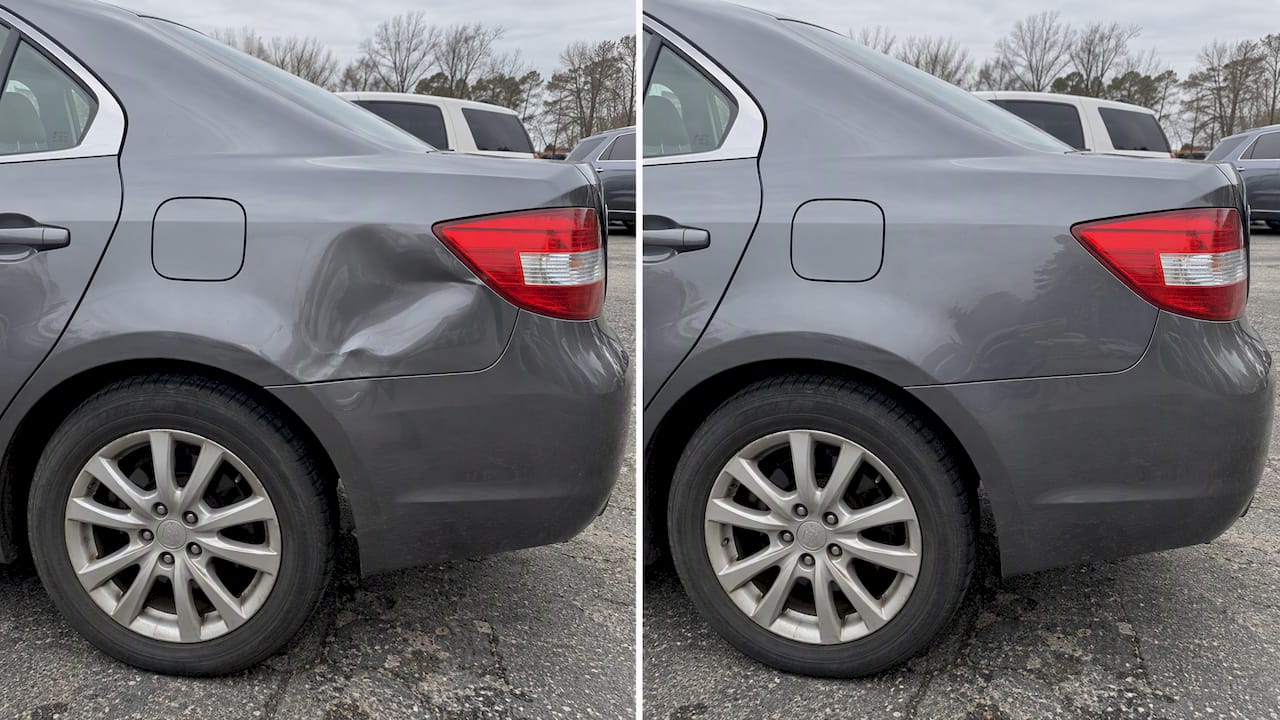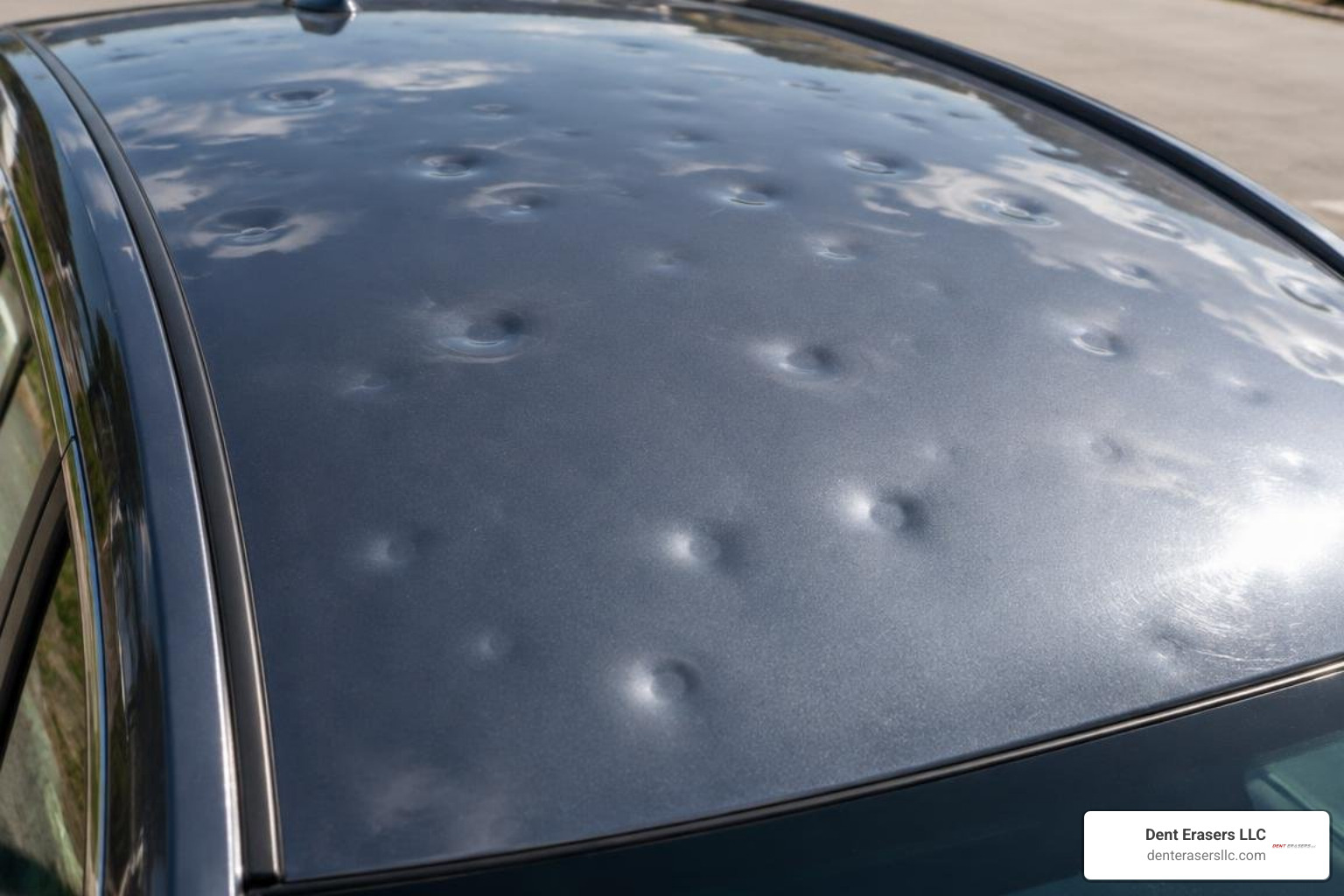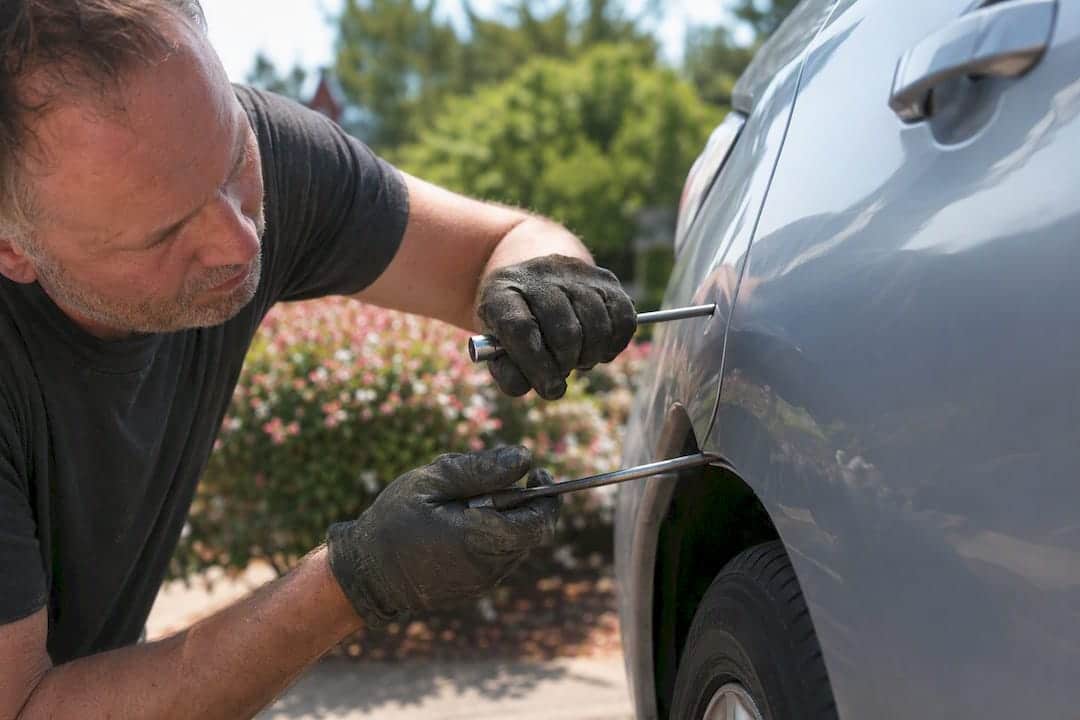
A small door ding usually runs $75 to $300, a medium body-panel dent lands around $250 to $450, and a large or multi-panel dent can push $500 to $1,200 or more. Multi-panel hail damage is its own category entirely, often falling between $1,200 and $4,000+ depending on how many panels took a hit and how deep the damage runs.
Those numbers provide general cost bands rather than guarantees. Actual quotes depend on dent location, depth, crease presence, panel material, and other factors. Understanding these lets you estimate your dent’s likely cost more accurately before a technician can assess it.
- Coin-sized ding: $75–$150
- Small door ding: $150–$300
- Medium dent (fist-sized or larger): $250–$450
- Large dent or crease: $500–$1,200+
- Multi-panel or hail damage: $1,200–$4,000+
Quick math: Mobile PDR services often add a trip or convenience fee of $25 to $75, but that’s frequently offset by not having to rent a car or take a day off work to sit in a shop lobby. If insurance is covering the repair, your deductible, not the shop’s rate, usually determines what you pay.
Key Takeaways
Paintless dent repair costs scale with size, depth, panel material, and access, not just the visible size of the dent, and mobile service typically saves 50 to 70% over body-shop repair.
| Point | Details |
|---|---|
| Know your price band | Coin dings run $75–$150, small dings $150–$300, medium dents $250–$450, and large or hail damage $500–$4,000+. |
| Crease changes everything | A dent with a crease or stretched metal costs far more than a smooth dent of the same size. |
| Aluminum adds cost | Aluminum and double-wall panels commonly carry a 25% or greater surcharge over steel repairs. |
| Photos speed up quoting | Distance shots, scale objects, and multiple angles let a technician give a close estimate before an in-person visit. |
| Denterasers LLC offers mobile quotes | Denterasers LLC provides photo-based estimates, warranty-backed repairs, and mobile service across Contra Costa County. |
Table of Contents
- How Much Does Paintless Dent Repair Cost by Damage Type?
- What Factors Actually Drive the Price of a Dent Repair?
- Is Paintless Dent Repair Cheaper Than a Body Shop?
- How Do You Get an Accurate Paintless Dent Repair Quote?
- What Dents Are Bad Candidates for Paintless Repair?
- What Should You Expect from a Trustworthy PDR Provider?
- Why Most Pricing Guides Get PDR Costs Wrong
- Get a Fast, Honest Quote From Denterasers LLC
- Sources
- FAQ
How Much Does Paintless Dent Repair Cost by Damage Type?
Every PDR quote starts with a simple question: how big is the dent, and did it crease the metal? Those two variables do more to set your price than almost anything else, and once you understand them, a repair estimate stops feeling like a mystery number and starts feeling like something you can predict yourself.
Coin-sized dents ($75–$150). These are the shopping-cart dings and the small hail pockmarks, usually under an inch across with no sharp crease. A technician can often “massage the metal” back into shape from one access point in 15 to 30 minutes. This is the fastest, cheapest category, and it’s often where mobile service shines because there’s barely any setup time involved.
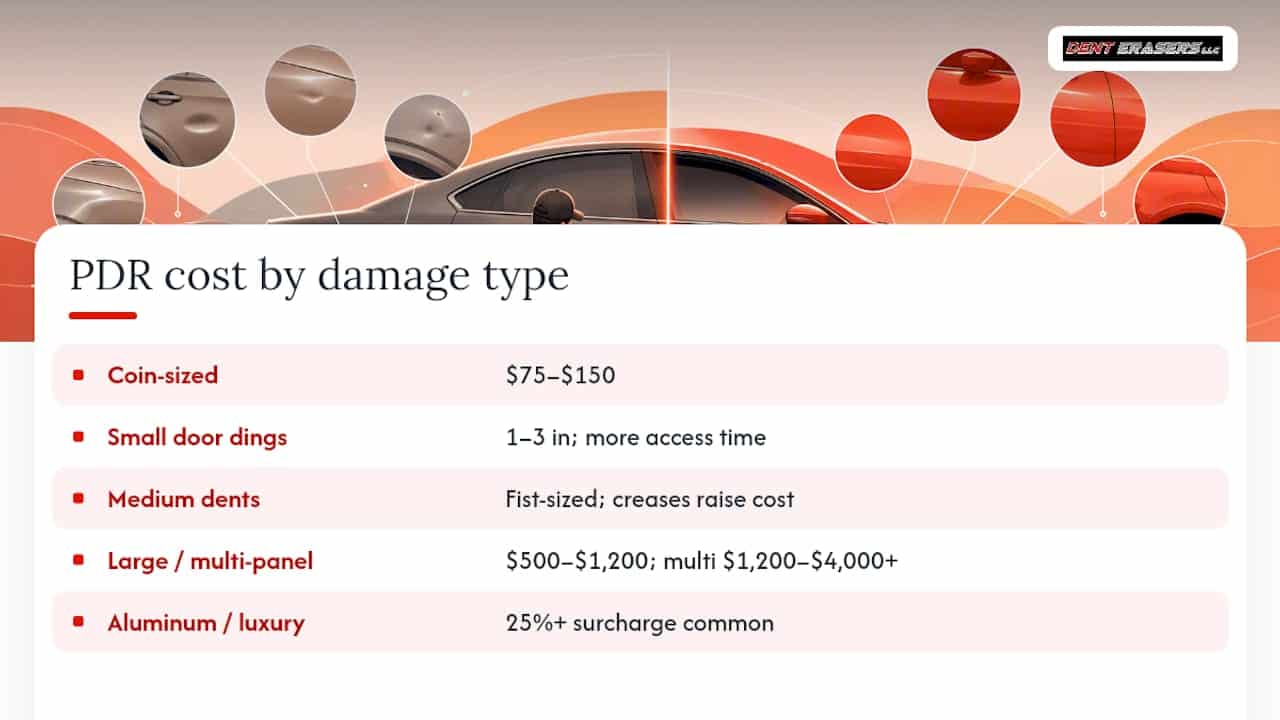
Small door dings. These are roughly one to three inches, sometimes with a shallow crease line. These often require more access effort, such as working from inside the door panel, which adds time even if the dent appears minor.
Medium dents. These are generally fist-sized or larger, especially on curved panels. Creases rather than smooth dents increase repair complexity and cost due to work-hardened metal requiring careful repeated work.
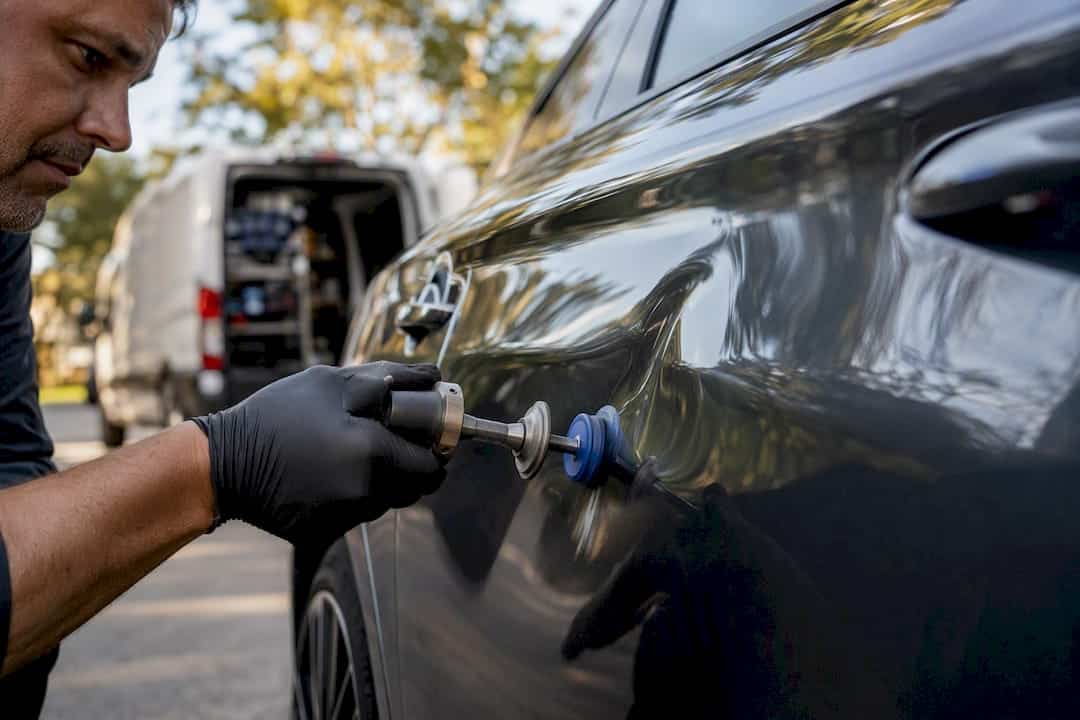
Large dents and multi-panel jobs ($500–$1,200+). A dent that spans more than four or five inches, sits across a body line, or shows up on multiple panels moves into a different pricing tier. The same principle applies at scale during hail season, when a vehicle might need repair on the hood, roof, and trunk simultaneously, which is why those jobs frequently land in the $1,200 to $4,000+ band depending on panel count and severity.
Watch for surcharges on aluminum, EVs, and luxury trims. Aluminum body panels, increasingly common on trucks, EVs, and higher-end vehicles, don’t spring back like steel does. Techs commonly build in a 25% or greater surcharge for aluminum or double-wall panels because the metal is thinner, more prone to cracking under pressure, and often reinforced in ways that make access harder. If you drive a Tesla, F-150, or a German luxury sedan, ask upfront whether that surcharge applies to your estimate.
What Factors Actually Drive the Price of a Dent Repair?
A quote isn’t just “size times a rate.” Several factors stack on top of each other, and understanding them turns a confusing number into something you can question intelligently.
- Dent size and complexity. Size alone doesn’t scale the price in a straight line. A dent twice as large doesn’t automatically cost twice as much, but a dent with a crease can cost three or four times more than a smooth dent of the same size. That’s because a crease means the metal has been bent past its elastic limit. Getting it back requires slow, deliberate pressure from multiple points, sometimes with heat, rather than one clean push.
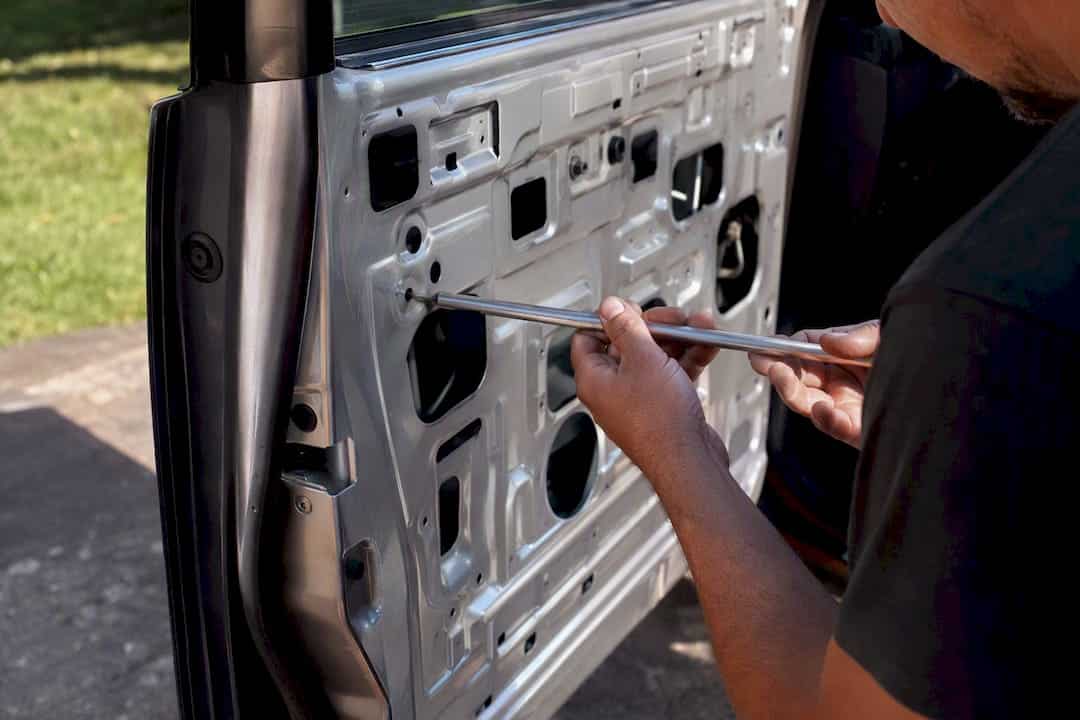
- Panel location and access. Roofs, quarter panels, and areas behind trim or headliners take longer because reaching the backside of the dent might mean removing interior panels first. A dent on a flat door skin with easy backside access is a quick job. The same size dent on a roof rail, where the tech has to drop the headliner, adds real labor time even though the visible damage looks similar.
- Panel material. Steel flexes predictably. Aluminum doesn’t, which is why it usually carries that surcharge mentioned above. Double-wall construction, common on doors and rear quarter panels, also adds cost because there’s a second layer of metal to work around.
- Dent count on one panel vs. multiple panels. Multiple small dents on the same panel often qualify for a volume discount because the setup and access work only has to happen once. Spread those same dents across four different panels, and you lose that efficiency. Each panel means new access points and new setup.
- Technician skill, warranty, and shop overhead. A more experienced tech charges more per hour but usually finishes faster and with less risk of cracking paint or leaving a slight low spot behind. That skill gap is part of why warranty terms vary so much between providers.
- Region and mobile trip fees. Labor rates shift by metro area, and mobile providers typically add a modest trip fee, often in the $25 to $75 range, to cover travel to your driveway or office parking lot instead of you driving to a shop.
Pro Tip: Ask whether the quote is “per dent” or “per panel.” Per-panel pricing with a volume discount almost always beats paying full per-dent rates for three or four dings clustered on the same door.
Is Paintless Dent Repair Cheaper Than a Body Shop?
Yes, usually by a wide margin, and the reason isn’t just labor rates. PDR skips the parts of a traditional repair that actually cost the most: filler, primer, paint, clear coat, and the blending work needed to match factory color across panels. That’s why PDR typically runs 50% to 70% less than a comparable body-shop repair when the paint itself is intact.
Here’s how that plays out on two common jobs:
- A small door ding: PDR runs $150–$300. A body shop doing filler and paint on the same ding often starts around $400–$600 once you factor in materials, booth time, and labor.
- A medium panel dent: PDR runs $250–$450. Traditional repair on the same panel, with paint and blending into the adjacent panel to avoid a color mismatch, frequently climbs past $800.
PDR also finishes faster, often in hours rather than days, since there’s no paint cure time. That speed and the preserved factory finish both help protect resale value down the line.
Body-shop repair becomes necessary, not optional, when the paint is cracked, the metal has stretched beyond its memory, or the damage sits near a structural component. In those cases, PDR isn’t a cheaper alternative. It’s simply the wrong tool, and a good technician will tell you that upfront rather than attempt a repair that won’t hold. For a closer side-by-side, our PDR versus traditional repair breakdown walks through more scenarios.
How Do You Get an Accurate Paintless Dent Repair Quote?
Getting close to a real number before a technician arrives comes down to giving them enough visual information to judge depth, size, and access.
- Take photos from a slight distance first, showing the whole panel so the tech can judge scale relative to a door handle or wheel well.
- Add a scale reference, like a coin or a hand near the dent, so size isn’t guesswork.
- Shoot from multiple angles, including a raking light angle across the surface, since that’s what reveals a crease that a straight-on photo hides.
- Include interior access shots if you can get them, particularly for door dents, since backside access changes the labor estimate significantly.
Photos get you close, but they aren’t the final word. An in-person look is usually needed before a firm number, because hidden factors like a second layer of metal or a previous poor repair attempt only show up once a tech has their hands on the panel. Online calculators and estimator tools can give you a rough range, but treat them the way you’d treat a Zillow estimate on a house. Directionally useful, not gospel.
If you’re going through insurance, ask how the adjuster’s matrix classifies your dent, since insurance matrices standardize pricing by size and panel type, and that classification affects whether your deductible even makes the claim worth filing. And whether you’re paying out of pocket or through a claim, ask the estimator directly: Does an aluminum surcharge apply? Is there a trip fee? What’s the warranty length? Is this priced per dent or per panel? A provider like Car Geeks Collision, which offers free collision estimates, is a solid model for how a proper photo-to-quote process should feel: transparent about what they can tell from pictures and clear about what still needs an in-person look.
What Dents Are Bad Candidates for Paintless Repair?
PDR works by manipulating metal from the back or with specialized tools from the front, without disturbing the factory paint. That only works if the paint and metal are still cooperating.
- Cracked, flaked, or aftermarket paint. If the clear coat is already compromised, the flexing involved in PDR can cause it to crack further, and a repaint becomes unavoidable anyway.
- Severe creases or stretched metal. Once metal has stretched past its limit rather than just being pushed in, it won’t spring back cleanly. That usually means filler or panel replacement instead.
- Damage near sharp edges or panel seams. These areas have less flex tolerance and are prone to cracking during the repair process.
- Structural or frame-adjacent damage. Anything affecting a structural rail, crumple zone, or safety component belongs at a body shop, full stop. A dent that looks cosmetic but sits directly over a structural member needs a professional inspection before anyone touches it with PDR tools.
What Should You Expect from a Trustworthy PDR Provider?
A quote is only as good as the provider standing behind it, and there are a few concrete things worth checking before you hand over your keys, or your driveway, for a repair.
- Written, itemized estimates. A reputable technician breaks down per-dent or per-panel pricing rather than quoting one lump number with no explanation.
- Clear warranty terms. Most legitimate PDR work includes some guarantee against paint lifting or a repair not holding, with a defined rework window if something needs a second look.
- Visible track record. Before-and-after photos and real customer feedback tell you more about a shop’s actual skill level than any sales pitch does.
- Transparent surcharge policy. A provider should tell you upfront, not after the job’s done, if aluminum, EV battery-adjacent panels, or hard-to-reach areas will bump the price.
- Structured multi-dent pricing. Ask how they price three dings on one door versus three dings spread across the car. The answer tells you whether they understand their own cost structure or are just guessing.
A warranty is often the clearest signal of quality in this trade. Anyone can push a dent out once. The providers worth trusting are the ones willing to put their name behind that repair holding up over time.
Denterasers LLC builds its mobile service around exactly this kind of transparency: photo-based estimates, clear pricing explanations before the appointment, and a track record documented through customer galleries and completed jobs across Contra Costa County.
Why Most Pricing Guides Get PDR Costs Wrong
Most online pricing guides treat dent repair like a vending machine: put in a size, get out a number. That’s not how estimating actually works, and it sets readers up to feel misled when a real quote comes in different from what a calculator promised.
The bigger miss in conventional advice is that it treats size as the dominant variable when access and material matter just as much, sometimes more. I’ve seen smaller dents on aluminum quarter panels quote higher than larger dents on a flat steel door, and that surprises people every time. Depth and crease presence do more damage to a budget than raw square inches ever will.
If you take one thing from this guide, let it be this: stop trying to estimate your own repair from memory of “what a dent usually costs.” Send photos with a scale reference and ask specific questions about surcharges and access. That habit alone will get you a more accurate number than any generic price chart, including this one.
Get a Fast, Honest Quote From Denterasers LLC
If you’ve read this far trying to figure out what your dent will actually cost, the fastest way to find out is to skip the guesswork and send us a photo. Denterasers LLC handles mobile paintless dent repair across Contra Costa County and the surrounding area, which means a technician comes to your driveway, office lot, or wherever your car happens to be, rather than you losing a day at a body shop.
We work on everything from a single coin-sized ding to full multi-panel hail damage, plus plastic bumper repair for cracked or dented bumper covers that PDR alone can’t fix, and specialty work for luxury, vintage, and motorcycle owners who need a technician who understands their vehicle’s quirks. Send us a few photos with a scale reference (a coin or your hand works fine) and you’ll typically get a realistic price range back same day, with a firm number confirmed once we’re on-site. Every repair comes with warranty coverage against paint lifting, and we’re upfront about any aluminum or access surcharges before we start. Check our brand and service history to see the kind of work we stand behind, then reach out for your photo estimate.
Sources
FAQ
How much should paintless dent repair cost?
Most single dents run $75 to $500 depending on size, depth, and panel material, while multi-panel or hail damage can reach $1,200 to $4,000 or more.
Will insurance pay for PDR?
Insurance typically covers PDR when the damage exceeds your deductible and the claim is approved, and adjusters often use standardized pricing matrices to set the payout amount.
Why is paintless dent repair so expensive on some vehicles?
Aluminum panels, hard-to-reach locations, and creased or stretched metal all add labor time and skill requirements, which is why identical-looking dents can carry very different price tags.
What dents cannot be removed with PDR?
Dents with cracked or flaked paint, severely stretched metal, or damage near structural components generally aren’t good candidates for paintless repair and need traditional body-shop work instead.
Does Denterasers LLC offer free estimates?
Denterasers LLC provides photo-based price estimates before scheduling, with a final number confirmed once a technician inspects the damage in person.