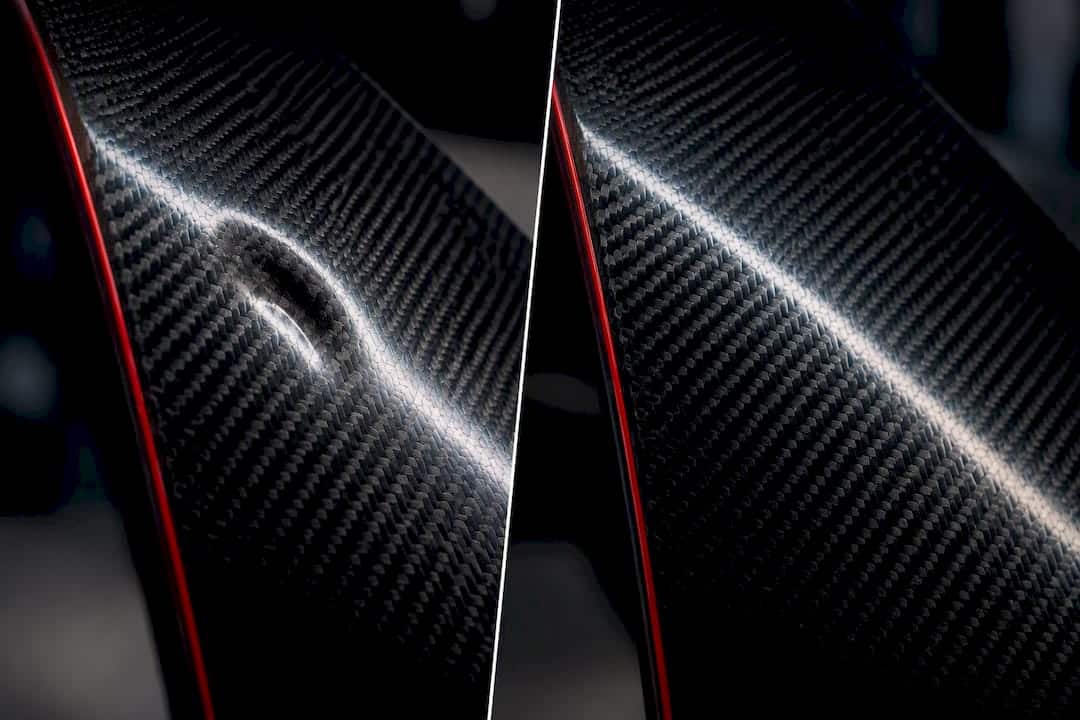
Paintless dent repair can work on carbon fiber, but only under specific conditions: the panel must be non-structural, the paint layer must be intact, and inspection must rule out internal delamination. When those boxes aren’t checked, PDR isn’t the right call. A proper assessment always starts with tap testing or ultrasound, followed by OEM repair rules for that specific vehicle, before any technician touches the panel.
TL;DR:
- Paintless dent repair is only suitable for carbon-fiber panels that are non-structural, have intact paint, and show no signs of internal delamination.
- Visual inspection must be supplemented with nondestructive testing, such as tap testing or ultrasound, to accurately assess hidden internal damage.
- Damage with exposed fibers, cracking, or internal delamination requires composite repair or replacement, not PDR, regardless of superficial appearance.
- Choosing a technician trained in composites and equipped with proper NDT tools is essential to avoid improper repairs that could compromise panel integrity.
- For optimal results, repairs should be approached cautiously on structural or exposed weave panels, as cosmetic fixes may not restore original strength or appearance.
Table of Contents
- What makes carbon-fiber panels behave differently than metal
- How technicians check carbon-fiber damage before touching it
- When PDR makes sense and when it doesn’t
- What a careful carbon-fiber PDR process actually looks like
- Choosing a mobile PDR technician for carbon-fiber work
- How we think about carbon fiber at Denterasers
- Book a carbon-fiber inspection with Denterasers
- Sources
- FAQ
What makes carbon-fiber panels behave differently than metal
Carbon-fiber reinforced polymer, or CFRP, isn’t one material with one set of rules. It’s woven or unidirectional carbon fibers locked into a cured resin matrix, and how those fibers are laid out changes how the panel absorbs an impact. That’s a different animal from sheet metal, which stretches and yields in a predictable way, and different again from SMC (sheet molding compound) or fiberglass, which use chopped or random fiber strands instead of a woven structure.
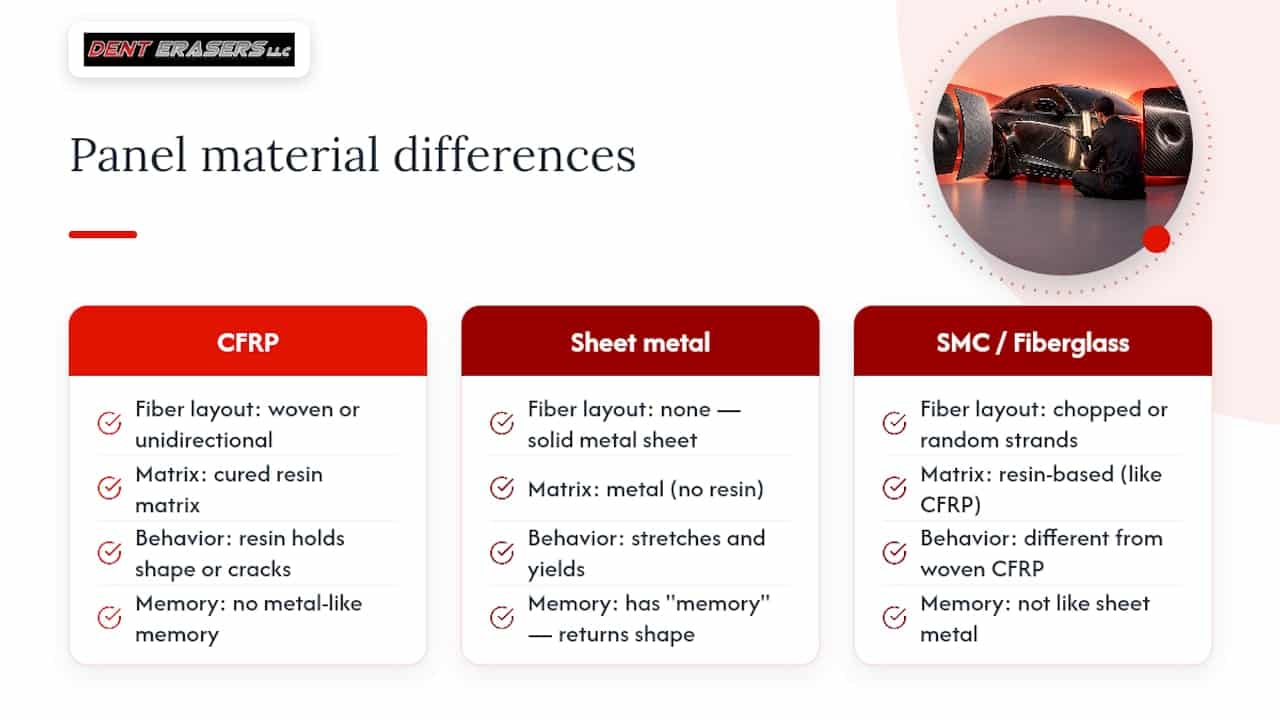
Metal has what techs call “memory.” Push it out, and it wants to return close to its original shape, which is the whole premise behind paintless dent repair. Carbon fiber doesn’t have that memory. The resin matrix either holds its shape or it cracks, and there’s very little in between.
That’s what makes barely visible impact damage, or BVID, the real hazard with composites. A low-speed impact can separate the resin from the fiber layers underneath a surface that still looks fine. Academic research on impact damage has found that this kind of hidden delamination can cut a laminate’s structural strength by as much as 30%, even when the outer surface shows almost nothing. That’s why “it looks okay” is never the standard for a carbon-fiber panel.
How technicians check carbon-fiber damage before touching it
Before any repair decision gets made, the panel needs a real inspection, not a glance under shop lights. Visual cues matter, but they only tell part of the story.
- Paint that’s cracking, spidering, or sinking at the point of impact.
- A change in panel geometry, even subtle, when sighted along the surface.
- Any area where the weave pattern looks slightly duller or different in texture from the surrounding panel.
Visual signs point technicians toward a problem, but they can’t confirm what’s happening underneath. That’s where nondestructive testing, or NDT, comes in. Tap testing, tapping a coin or small hammer across the surface and listening for a change in pitch, is a fast field method that flags suspicious zones. Ultrasonic scanning and thermography go further, mapping the depth and size of any separation between plies.
Damage invisible from the surface can significantly reduce a laminate’s structural strength, according to composite impact research, which is why tap testing alone shouldn’t be the final word on a suspected impact site. When a tap test raises questions, or the panel sits on a structural component, the next step is a certified composite assessment following I-CAR’s composite repair guidance, not a cosmetic fix.
When PDR makes sense and when it doesn’t
Once inspection results are in, the decision usually sorts itself into one of two clear paths.
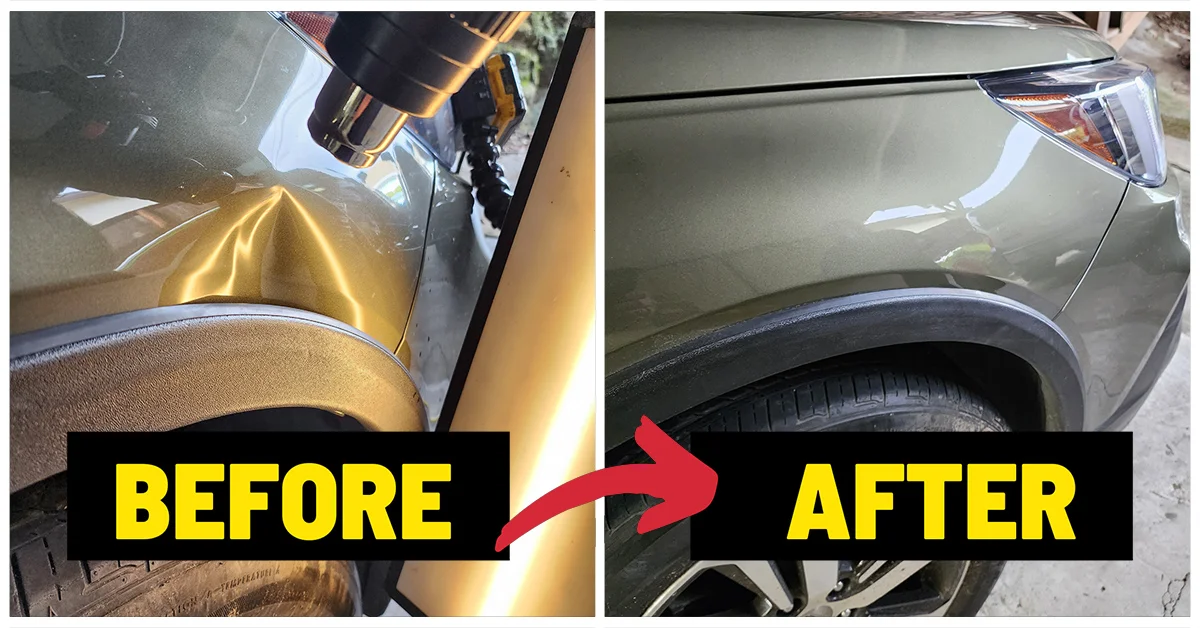
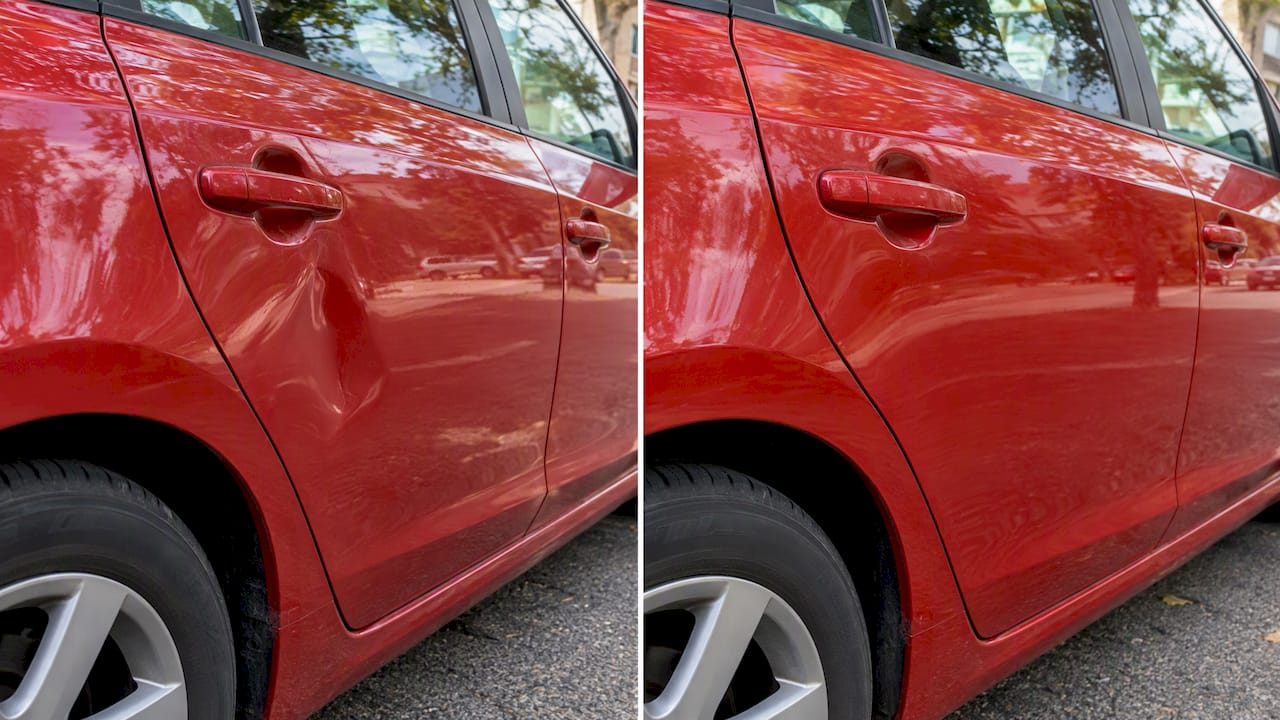
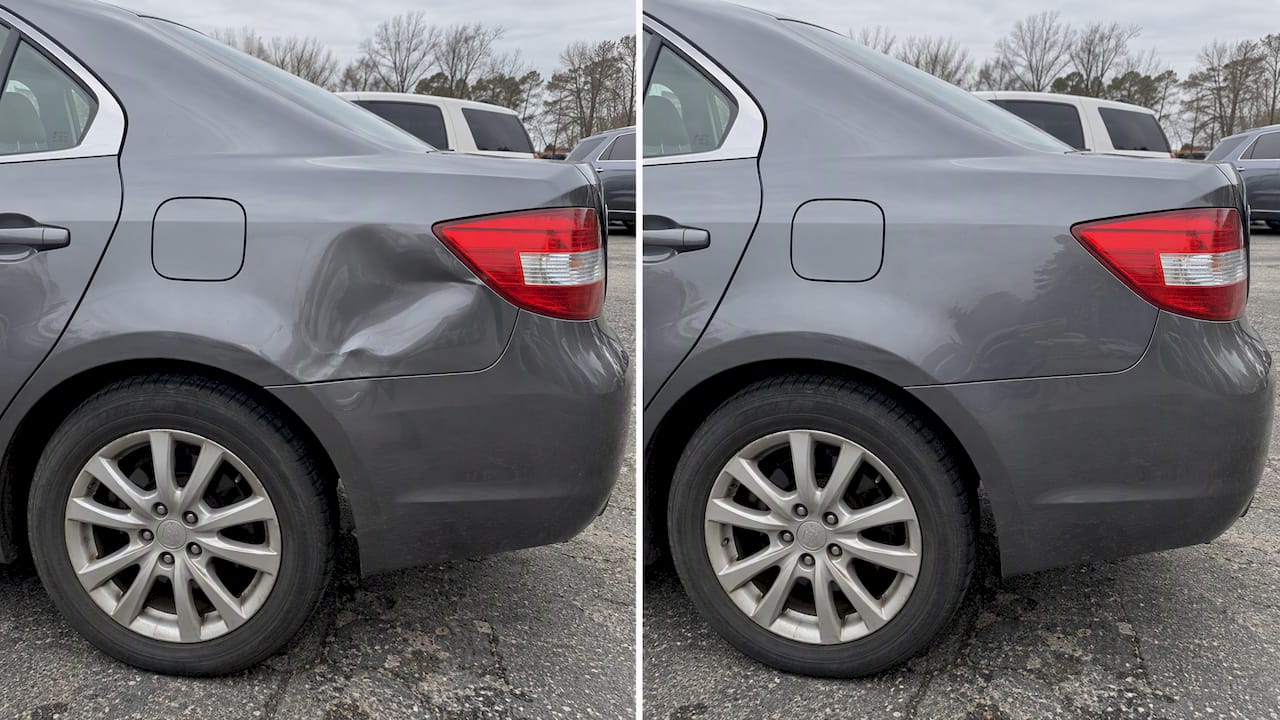
- PDR is a reasonable option when the paint and clear coat are intact, the dent is shallow with no cracking, and NDT shows no sign of delamination beneath the surface.
- Composite repair or replacement becomes necessary when the weave is exposed, fibers show visible cracking, the part carries structural load, or ultrasound or thermography detects internal separation.
- OEM policy can override both options. Some manufacturers, according to composite repair research, prohibit repair altogether on certain structural carbon-fiber components and require replacement regardless of how minor the damage appears.
This is the cosmetic versus structural line every owner needs to understand. A painted hood scoop or fender flare that’s purely decorative gives a technician more room to work conservatively. A structural rocker panel or a part tied to crash performance does not, and no amount of careful technique changes that math. When in doubt, the panel’s function, not its appearance, decides the approach. Reviewing what makes a dent a good candidate for PDR before booking a repair can save an owner from paying for an estimate that was never going to work out.
What a careful carbon-fiber PDR process actually looks like
A technician who takes carbon fiber seriously doesn’t start pushing on the panel. The process is slower and more deliberate than metal PDR, and it should be.
- Pre-inspection and NDT to confirm the damage is limited to the surface, with no delamination underneath.
- Selective technique on painted, non-structural areas only, often using glue-pulling or gentle bridging rather than traditional metal-pushing methods.
- A second round of NDT after initial work to confirm nothing shifted or worsened beneath the surface.
- Final visual and tactile inspection, with refinishing only if the clear coat needs blending.
Heat and force both need a lighter hand than they would on steel. Resin softens at lower temperatures than most people expect, and too much pressure in one spot can crack plies that would have flexed just fine on a metal panel. According to I-CAR’s Back-To-Basics guidance, some cosmetic-only techniques can improve the look of a repair without restoring the panel’s original strength, which is a distinction owners deserve to hear upfront.
Pro Tip: If the weave is exposed at all, expect a visible repair line afterward. Perfect invisibility on exposed carbon weave usually means panel replacement, not a touch-up.
Choosing a mobile PDR technician for carbon-fiber work
Not every PDR technician has spent time with composites, and that gap shows up fast on a carbon-fiber hood or fender. A short conversation before booking tells you most of what you need to know.
- Ask directly whether they’ve completed composite training such as I-CAR’s coursework, not just general PDR certification.
- Ask what NDT equipment they carry and whether they’ll run a tap test or scan before quoting a price.
- Ask for a written recommendation that states plainly whether the job is PDR, composite repair, or replacement, along with warranty terms.
| What to check | Why it matters |
|---|---|
| Composite training (I-CAR or OEM courses) | Confirms the technician understands ply behavior, not just metal memory |
| NDT equipment on hand | Tap testing or ultrasound catches delamination invisible to the eye |
| Written scope and warranty | Protects you if hidden damage surfaces after the repair |
Walk away from anyone who refuses to inspect before quoting, promises a flawless fix on visibly exposed weave, or leans on heavy heat and force to “loosen things up.” Those aren’t shortcuts, they’re the fastest way to turn a repairable panel into a replacement. A closer look at when PDR isn’t the right call covers more of these red flags in detail.
How we think about carbon fiber at Denterasers
I’ve spent enough years under hoods and fenders to know that carbon fiber punishes shortcuts. Our approach starts with inspection, not optimism: we’d rather tell an owner a panel needs composite work or replacement than force a cosmetic fix that fails in six months. Mobile paintless dent repair is our core service, but on luxury vehicles with carbon-fiber trim, that service always begins with an honest look at what the panel actually needs before we talk price.
— Brian Blanc
Book a carbon-fiber inspection with Denterasers
If you’re staring at a dent on a carbon-fiber hood, fender, or trim piece, the fastest way to get a straight answer is an on-site inspection. Mobile paintless dent repair, large and minor dent repair, auto body and collision repair, and specialty services for luxury vehicles can often be performed onsite, providing a convenient alternative to waiting at a shop for a diagnosis.

- We check the panel with the same inspection-first mindset outlined above before recommending any repair path.
- Painted, non-structural dents often qualify for Paintless Dent Repair, while larger or borderline damage gets a closer look through Large Dent Repair.
- For panels that need more than PDR, we also handle Auto Body & Collision Repair so you’re not left chasing a second shop.
If you’re also planning to keep the finish looking sharp afterward, safe heat limits for polishing glass and panels are worth knowing, since composite surfaces are just as heat-sensitive as glass. Schedule a mobile inspection through our booking page and get a firm answer on whether PDR is the right move for your carbon fiber before any work begins.
Sources
- Characterizing intralaminar distal crack and delamination in multidirectional laminates (BVID research)
- Back-To-Basics: Fiber-Reinforced Plastic Repair — I-CAR / RTS
- Manufacturing and repair considerations for CFRP in vehicles — PMC/academic article
FAQ
Is PDR safe for carbon-fiber panels?
PDR can be safe when the panel is non-structural, the paint is intact, and inspection rules out internal delamination. It becomes unsafe once fibers are cracked, the weave is exposed, or the part carries structural load, per OEM repair guidance.
How do technicians inspect carbon fiber for hidden damage?
Technicians start with a visual check for cracking or sinking, then use tap testing as a quick field method. For anything uncertain, ultrasound or thermography is used to confirm whether delamination exists beneath the surface, following methods described in impact damage research.
What’s the difference between PDR and composite repair for carbon fiber?
PDR gently manipulates a dent from a painted, undamaged surface, while composite repair involves techniques like scarfing, adhesive bonding, or vacuum bagging to rebuild damaged plies, as outlined in I-CAR’s composite repair materials. Composite repair is required once fibers are cracked or delamination is confirmed.
Can a repaired carbon-fiber panel look factory-new afterward?
Painted panels with shallow, surface-only dents often can be restored to a clean finish through PDR. Panels with exposed or damaged weave usually show a visible repair line afterward, and full aesthetic and strength restoration may require replacement rather than repair.
What should I ask a technician before booking carbon-fiber dent repair?
Ask whether they’ve completed composite-specific training, what nondestructive testing equipment they use, and whether they’ll provide a written recommendation before starting work. A technician who skips inspection or promises an invisible fix on exposed weave is a clear warning sign.