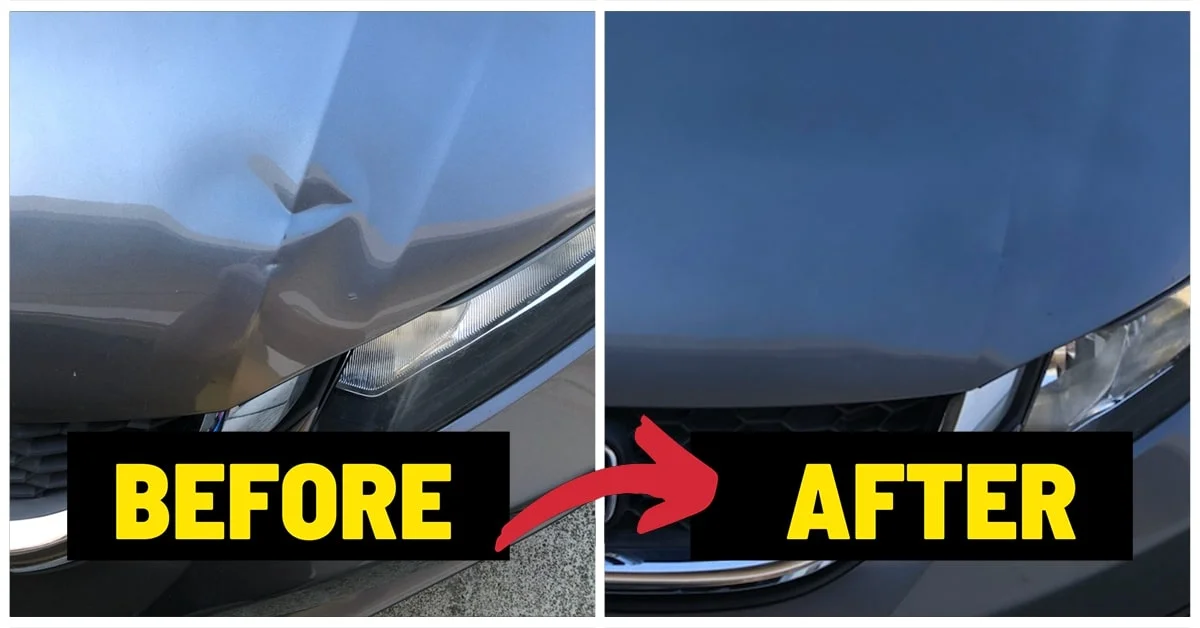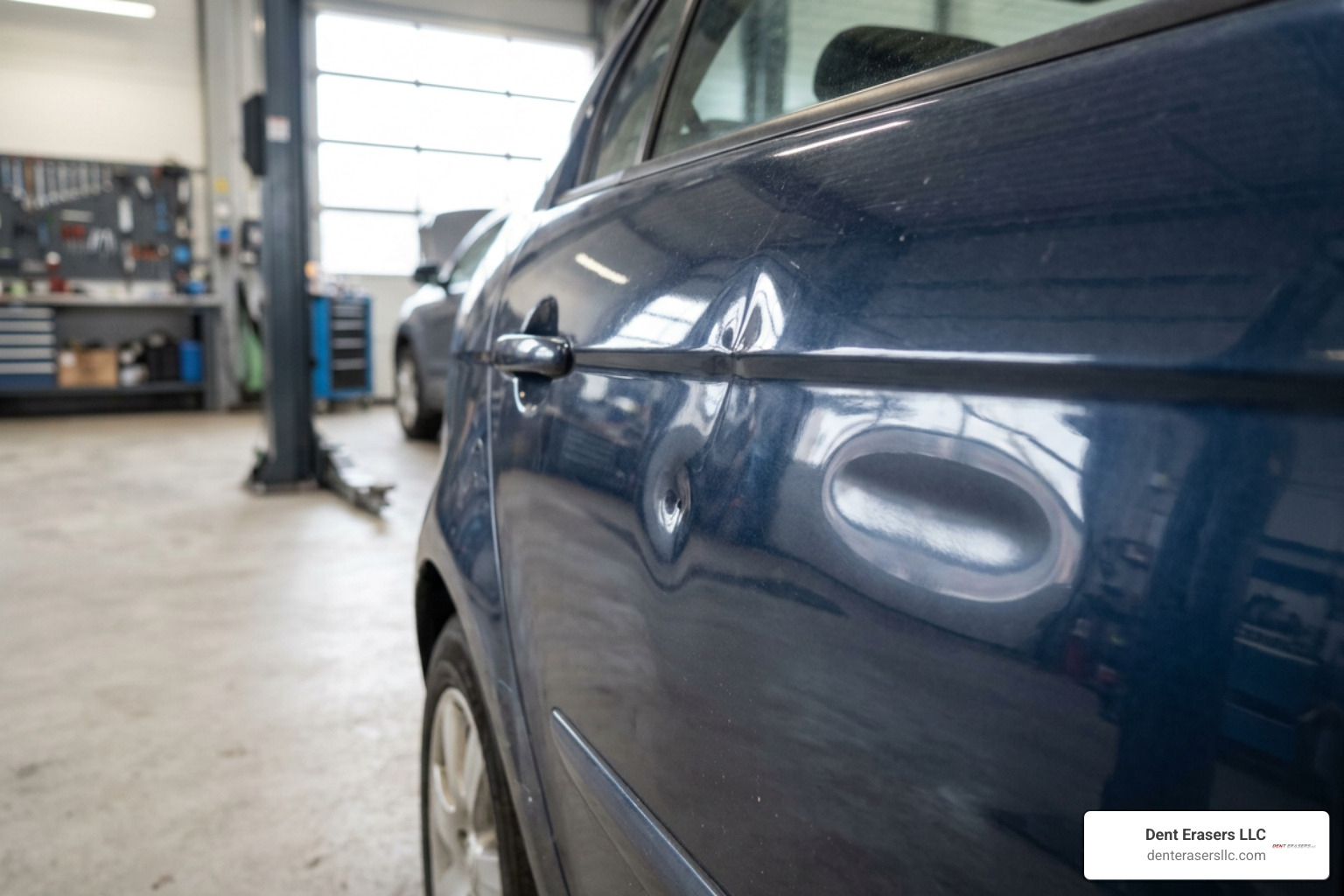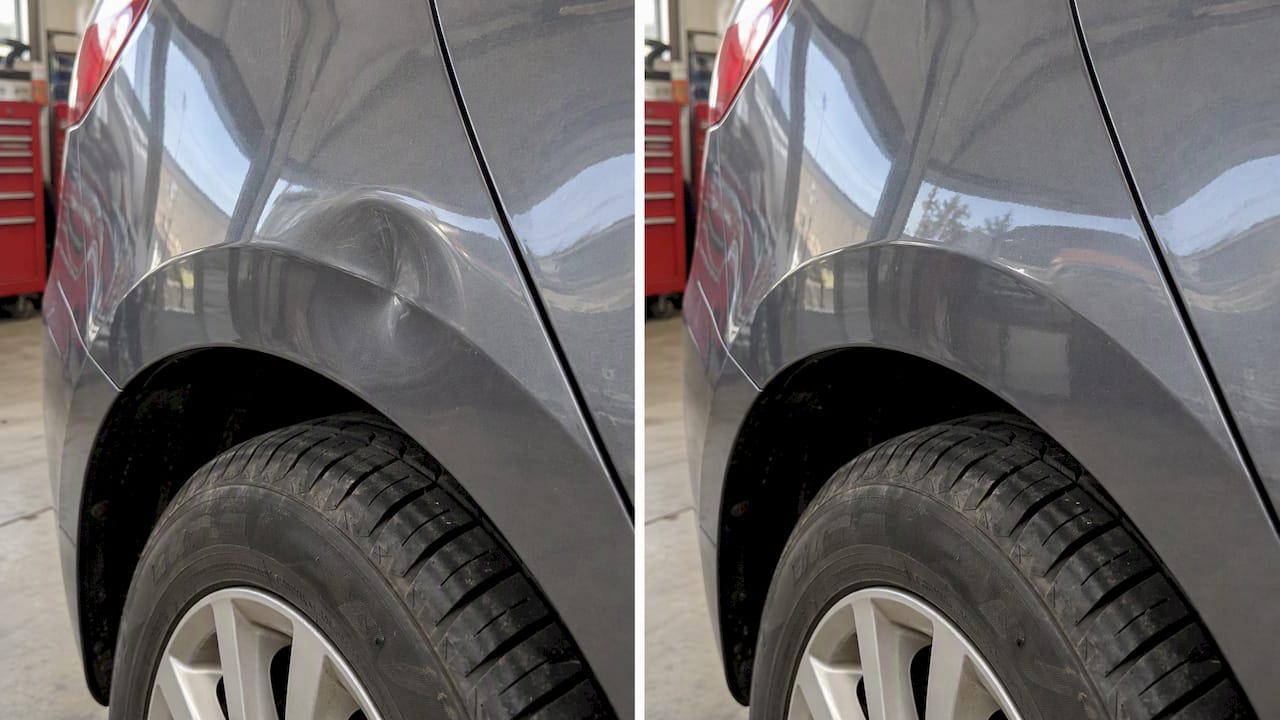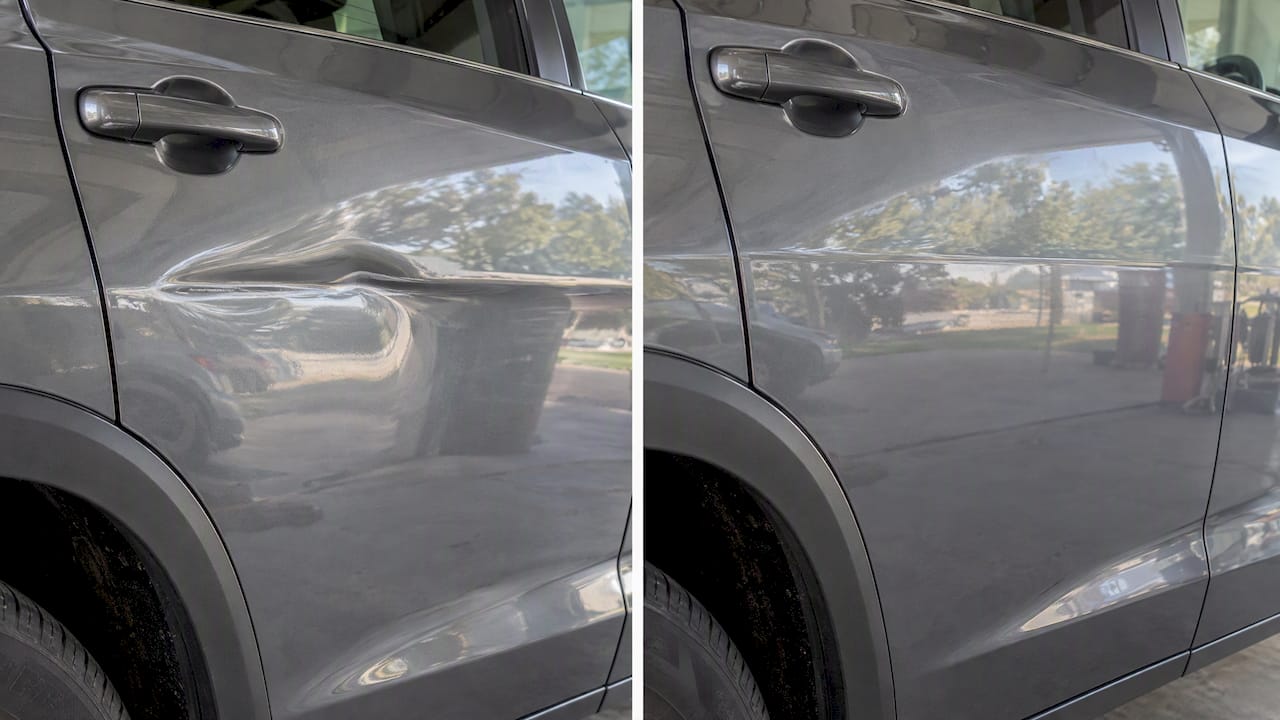
A body line crease repair typically runs from about $150 for a minor paintless dent repair fix up to $1,500 or more when panel replacement and repainting enter the picture, with paint condition and crease severity driving most of that spread. Before you book anything, weigh the estimate against your insurance deductible: paying out of pocket is often the cheaper route.
TL;DR:
- When the paint remains intact, paintless repair averages about 65% less than traditional bodywork, although crease complexity and panel access still affect the quote.
- Chipped or cracked paint requires filler, sanding, primer, and color blending, while kinked metal or damage to structural areas may require panel replacement.
- A smooth bend may be repairable, but a sharp kink can compromise metal; ask whether the proposed method follows your vehicle’s manufacturer repair guidance.
- Before filing, compare the estimate with your deductible; repairs below that amount generally cost less out of pocket than an insurance claim.
- Send photos from several angles, your vehicle’s year, make, and model, and paint condition; request an itemized quote and compare repair methods.
Table of Contents
- What Does Body Line Dent Repair Cost in the U.S.?
- What Affects the Price of a Body Line Dent Repair?
- How Do the Different Repair Methods Compare?
- When Is a Body Line Dent Repairable Versus Beyond Repair?
- Should You File an Insurance Claim or Pay Out of Pocket?
- How Does Combining Services Change the Total Cost?
- What Fees Should You Watch for Before You Book?
- How Can You Estimate Your Repair Cost Before Booking?
- Does Your Location Affect Dent Repair Pricing?
- Our Take on Pricing Body Line Dents Fairly
- Get a Free Mobile Quote for Your Body Line Dent
- FAQ
- Sources
What Does Body Line Dent Repair Cost in the U.S.?
Most owners want a number before they want an explanation, so here it is in plain terms. A shallow dent on a flat panel, away from the body line, sits at the low end of the market. Once that dent straddles a crease or character line, the labor climbs because the technician has to work the metal without stretching the factory contour.
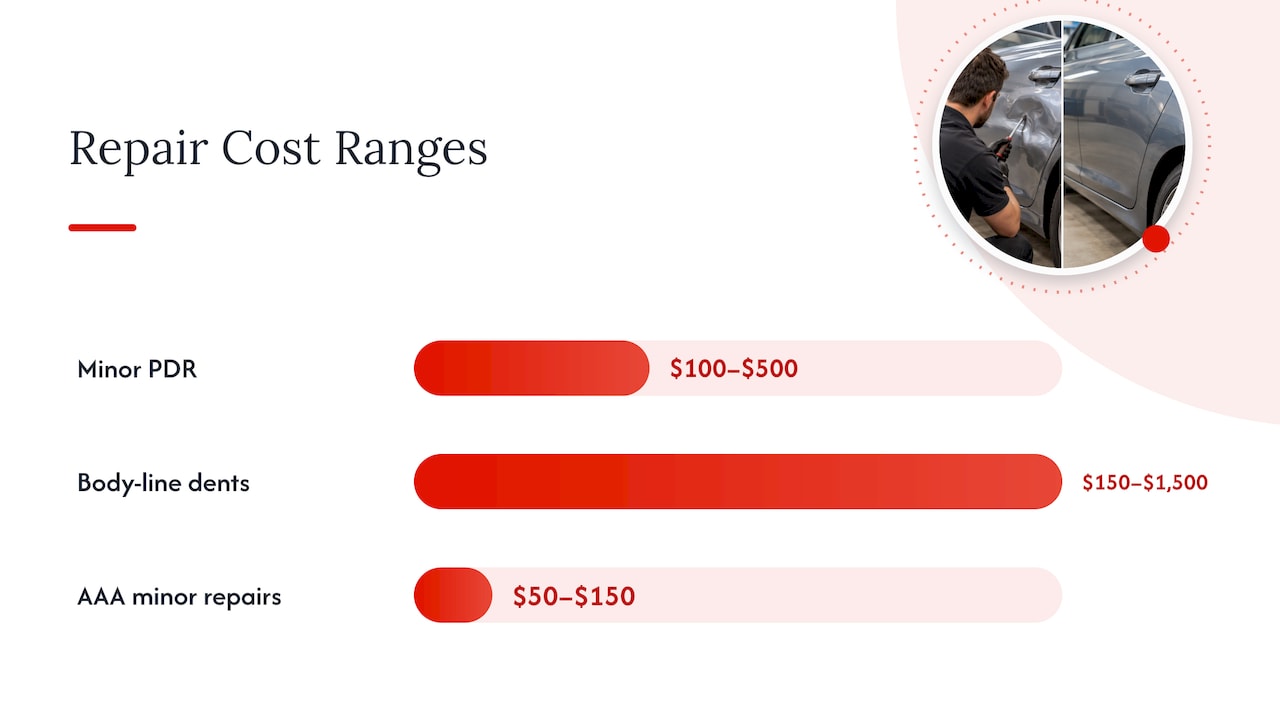
For a single minor dent with no paint damage, paintless dent repair generally runs from $100 to $500, a range that reflects dent size, panel access, and whether the crease itself is involved. Larger or more complex dents, including those that sit directly on a body line, tend to run from $150 to $1,500, since these jobs take more time and sometimes require specialized pulling equipment rather than traditional push-rod access. These figures track closely with AAA Automotive’s reporting that minor dent repairs typically fall between $50 and $150 per dent, with costs rising once paintwork, rust, or deep scratches are involved.
Here’s how the main scenarios tend to shake out:
- Small, shallow dent, paint intact: usually the cheapest fix, often resolved with paintless dent repair relatively quickly.
- Body line crease, paint intact: moderate cost increase because the crease adds labor time and sometimes requires glue-pull tools instead of simple massage techniques.
- Dent with chipped or cracked paint: pushes the job into filler and repaint territory, which multiplies labor and material costs.
- Hail cluster or multi-panel damage: priced per dent but billed as a package, which can add up quickly across several panels.
- Kinked metal or structural crease: often means panel replacement rather than repair, the most expensive outcome.
Paintless dent repair generally costs about 65% less than traditional body shop repair when the paint surface is intact, according to AAA. That gap exists because PDR skips filler, sanding, and repainting entirely, work that otherwise consumes most of a traditional shop’s labor hours. It’s also why we always check for paint integrity first: it’s the single biggest fork in the road for pricing.
What Affects the Price of a Body Line Dent Repair?
Several variables do most of the work in determining your final bill, and understanding them helps you read a quote with confidence instead of guesswork.
Crease complexity sits at the top of the list. A body line is a factory-formed stiffener, and when a dent crosses it, the metal around that crease carries lateral tension that resists simple push-and-pull correction. AAA Mid States notes that body-line dents are more complex precisely because that crease acts as a structural stiffener, often requiring specialized lateral tension techniques to avoid stretching the metal further. Get this step wrong and you risk permanent deformation that forces a replacement instead of a repair.
Paint condition is the second major driver. A dent with intact paint stays in PDR territory. The moment paint chips, cracks, or shows a crease line of its own, you’re now paying for filler, sanding, primer, and color-blend painting, work that requires matching your exact factory shade and often blending into adjacent panels for a seamless finish.
Panel material matters more than most owners realize. Older steel panels flex and respond to massage techniques. Modern high-strength steels and aluminum panels, increasingly common on newer vehicles, resist that kind of manipulation and are more prone to kinking rather than bending, which raises the odds of a replacement recommendation.
A few other factors shift price at the margins:
- Vehicle type: luxury and vintage finishes often need extra care and specialized tools, adding to labor time.
- Panel type: plastic bumper covers price differently than steel body panels and sometimes repair faster.
- Access: dents near trim, antennas, or tight body creases take longer to reach safely.
Pro Tip: Ask any technician whether your dent sits on a true body line crease before you get a quote. That single detail often explains why two seemingly similar dents carry very different price tags.
How Do the Different Repair Methods Compare?
Each repair method carries its own cost and time profile, and matching the right method to your dent is what keeps the bill reasonable.
Paintless dent repair applies when the paint is intact and the metal hasn’t kinked. A technician accesses the back of the panel and massages the metal back into shape, with the time required depending on the dent. Because there’s no filler or paint involved, PDR preserves your factory finish exactly, which is one reason it stays on the lower end of the cost spectrum.
Glue-pull repair, sometimes called GPR, and other lateral tension methods come into play for more complex body-line creases where traditional push-rod access isn’t possible or where pulling from the exterior surface is safer for the panel. These methods take more time than a straightforward PDR job and cost more accordingly, but they still avoid the expense of repainting when paint integrity holds.
Traditional body shop repair becomes necessary once paint is compromised. This involves filler application, sanding, primer, and blend painting to match surrounding panels, a multistep process that adds both material cost and labor hours compared to any paintless method. You can see how paint-specific costs break down in our guide to dent and paint repair costs.
Panel replacement is the most expensive path, reserved for kinked metal, safety-critical structural areas, or damage too extensive to straighten reliably. Parts and labor both climb here, and turnaround depends on parts availability. For a closer look at how paintless methods compare across these scenarios, our paintless dent repair pricing guide walks through real cost examples.
- PDR: fastest, least expensive, preserves original paint.
- Glue-pull/lateral tension: moderate cost increase for complex creases, still paint-safe.
- Traditional repair: required once paint is chipped or cracked, adds filler and paint labor.
- Panel replacement: highest cost, needed for kinked or structurally compromised panels.
When Is a Body Line Dent Repairable Versus Beyond Repair?
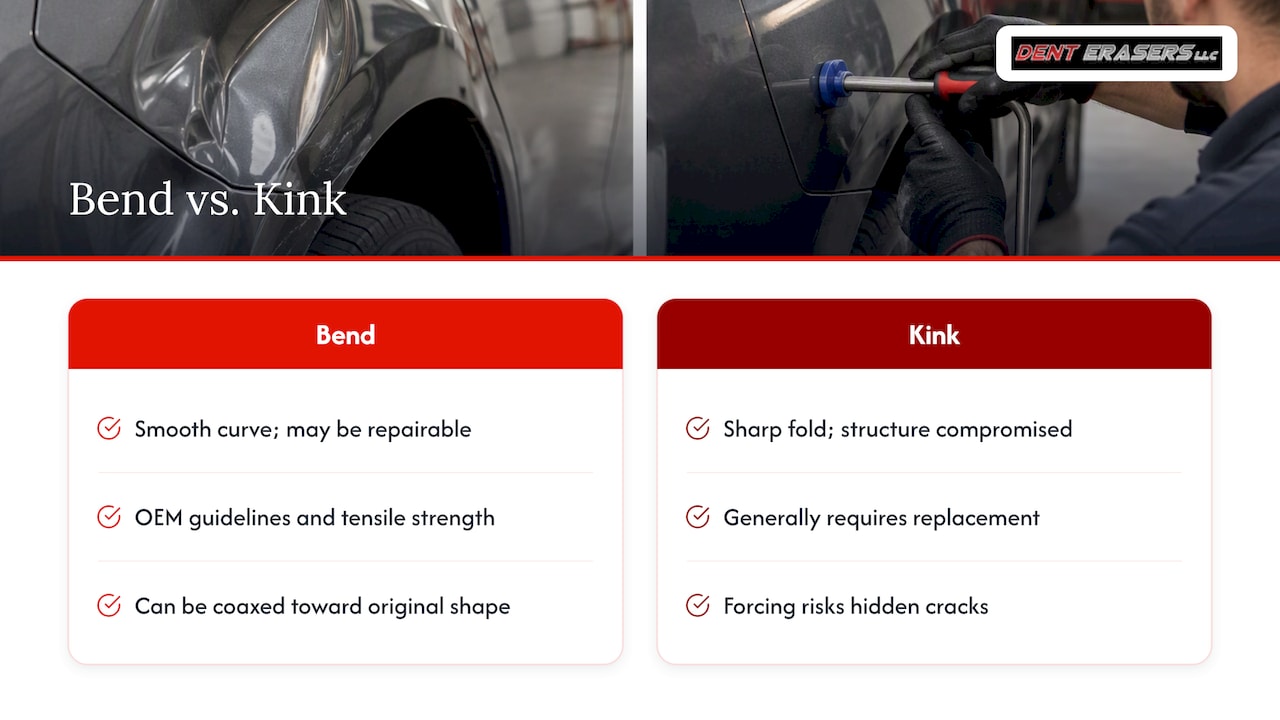
The industry distinguishes between a bend and a kink, and that distinction decides whether your car gets repaired or replaced. I-CAR’s “Kink vs. Bend” guidance explains that kinked metal generally requires replacement, while bent metal may be repairable depending on OEM guidelines and the material’s tensile strength. A bend is a smooth curve the metal can often be coaxed back toward its original shape. A kink is a sharp fold where the metal’s structure has been compromised, and forcing it back risks hidden cracking or weakened areas that won’t show up until later.
Tensile strength plays directly into this decision. Modern vehicles increasingly use high-strength steels designed to absorb impact in specific, engineered ways, and repairability assessments weigh that tensile strength heavily when deciding whether a panel can be safely straightened. That’s why OEM repair manuals matter: they specify which areas of a panel are safe to manipulate and which ones demand replacement for structural or safety reasons.
Improper technique introduces its own risks, including micro-cracking in the metal and loss of the factory corrosion protection on a panel’s backside. Push-rod access can disturb that protective coating, while glue-pull methods work from the exterior and avoid disturbing it, a distinction noted in Rivian’s repair guidance for modern panel materials. Before committing to a repair, it’s worth asking your technician whether they follow OEM repairability guidance for your specific make and model.
Should You File an Insurance Claim or Pay Out of Pocket?
Comprehensive coverage typically applies to non-collision damage like hail, vandalism, or falling objects, while collision coverage applies when your car hits something or something hits it, including potholes. Triple-I notes that collision coverage reimburses repair costs after your deductible, and recommends comparing your repair estimate to that deductible before filing, since a repair under your deductible amount costs less out of pocket than filing a claim at all. Our comparison of insurance versus out-of-pocket payment walks through that math in more detail.
Turnaround time varies sharply by method:
- PDR: turnaround depends on the dent and the provider’s schedule.
- Traditional repair with paint: turnaround depends on the work involved.
- Panel replacement: turnaround depends on parts availability.
- Hail or multi-panel events: insurers often batch-process these claims, which can extend timelines further.
How Does Combining Services Change the Total Cost?
If you’re already getting a body line dent repaired, it often makes sense to address other cosmetic issues at the same visit, and doing so can actually save money compared to scheduling separate appointments. Bundling a dent repair with plastic bumper work, for instance, means one service call, which can cut down on repeat diagnostic time and travel fees for mobile services.
That said, combining services doesn’t always mean a flat discount. Each repair still carries its own labor and material cost, so a quote for a dent plus a cracked bumper cover will reflect both jobs priced individually, then combined into one invoice. The savings usually come from efficiency, one technician visit, one round of paint matching if needed, rather than a reduced per-service rate.
Where this matters most is when paint blending is required. If your dent repair needs color-matched paint and you have another panel with minor scuffs nearby, blending both in the same session is more cost-effective than paying for two separate paint jobs on adjacent panels. It’s worth mentioning any other cosmetic issues when you request your quote, since a technician can often price the combined work more efficiently than tackling each one separately down the road.
What Fees Should You Watch for Before You Book?
Not every cost shows up in the headline estimate, and a few line items catch owners off guard. Mobile service call fees are one example: some providers charge a separate trip fee on top of the repair cost, particularly for locations outside their normal service radius.
Paint matching and blending fees are another area where estimates can shift. If your vehicle’s paint has faded or the factory color code isn’t an exact match to current paint stock, a technician may need to blend into an adjacent panel for a seamless look, which adds labor time beyond the original quote.
Teardown and reassembly charges sometimes apply when a dent sits near trim, moldings, or body hardware that needs to be removed for proper access. Diagnostic fees can also appear if a shop needs to inspect a dent closely before confirming whether paintless repair is possible or whether the damage has progressed to a kink requiring replacement.
The best defense against surprise charges is asking directly: request an itemized estimate that separates the base repair cost from any trip fees, paint matching, or teardown work before you confirm your appointment.
How Can You Estimate Your Repair Cost Before Booking?
Getting a reliable estimate before you commit to a repair starts with good photos. Clear images from multiple angles, including a shot that shows the dent relative to the body line and the overall panel, let a technician assess depth, location, and paint condition without an in-person visit first.
Beyond photos, a few details speed up an accurate quote: your vehicle’s year, make, and model, since panel material and paint type vary by manufacturer; whether the paint shows any visible chips, cracks, or color change at the dent site; and the dent’s approximate size, often easiest to describe by comparing it to a coin or the palm of your hand.
Once you’ve gathered this information, requesting quotes from a couple of providers lets you compare not just price but also proposed method. A quote that jumps straight to panel replacement without mentioning paintless options is worth a second opinion, since many body line dents with intact paint are good PDR candidates. For a deeper look at what preserves a factory finish and when PDR makes sense, see our explanation of paintless dent repair and its benefits. If you’re also thinking about protecting your paint after a repair, Diamondbrite’s guide to removing swirl marks covers practical aftercare steps for keeping a freshly repaired panel looking sharp.
Does Your Location Affect Dent Repair Pricing?
Pricing for body line dent repair varies by region, and local market conditions play a real role in that variation. In Contra Costa County and the surrounding Bay Area, mobile dent repair pricing reflects a mix of local labor rates, vehicle density, and the prevalence of luxury and newer vehicles that may require more specialized tools or materials.
Mobile services add another layer of location-based variability. A technician traveling to your home or office in a denser suburban area typically faces shorter travel times than one serving more rural stretches of the county, and that travel factor can influence whether a trip fee applies. Areas with a higher concentration of luxury and specialty vehicles also tend to see technicians investing in more advanced equipment, which can shift baseline pricing compared to markets with a more uniform mix of standard vehicles.
The takeaway for Contra Costa County owners is straightforward: get a quote specific to your location and vehicle rather than relying on national averages, since local market factors can move the price meaningfully in either direction.
Our Take on Pricing Body Line Dents Fairly
We’ve found that the biggest pricing mistake owners make is assuming every dent needs paint and filler work. Many body line creases, even ones that look dramatic, have intact paint and respond well to paintless methods once a technician accounts for the crease’s lateral tension correctly.
When we quote a body line dent, we assess the dent’s relationship to the crease, the vehicle’s year and model, and any signs of paint damage before naming a number. That upfront review is what keeps a quoted price close to the final invoice, since surprises usually come from damage details that weren’t visible in a first glance. Customers can expect a clear explanation of the proposed repair method before work begins.
— Brian Blanc
Get a Free Mobile Quote for Your Body Line Dent
We handle body line dents onsite, at your home or office, using paintless methods that preserve your factory finish whenever the damage allows for it. That convenience factor matters: skipping a shop visit saves time, and PDR is typically faster and less expensive than any repair that requires paint work.
To get a quote, send us:
- Clear photos of the dent from several angles, including one showing its position relative to the body line.
- Your vehicle’s year, make, and model.
- The dent’s approximate size and location on the panel.
- Whether the paint shows any chips, cracks, or color damage.
Request your mobile dent quote today, and we’ll follow up with a cost estimate based on your photos and vehicle details.
FAQ
How much does a dent doctor cost?
Mobile paintless dent repair technicians typically charge from $100 to $500 for a minor dent and from $150 to $1,500 for larger or more complex dents, depending on size, location, and panel access. Dents on a body line crease often sit at the higher end of that range because of the extra labor involved.
Can I fix car dents myself?
DIY dent repair attempts frequently cause further damage, such as stretched paint or cracked metal, which often raises the final repair cost compared to having a professional handle the original dent. AAA Mid States warns that amateur attempts can turn a simple fix into a more expensive repair, particularly on body line creases where lateral tension makes the metal less forgiving.
What dents cannot be removed with paintless methods?
Dents where the metal has kinked, rather than simply bent, generally cannot be corrected with paintless techniques and often require panel replacement. Dents with chipped, cracked, or significantly stretched paint also fall outside PDR and need traditional filler and repaint work instead.
How much will a dent cost to fix if paint is involved?
Once paint is chipped or cracked, repair costs rise because the job now requires filler, sanding, primer, and color-blend painting rather than a paintless fix. Minor dent repairs with paint work often start around $50 to $150 per dent, with more extensive damage or color-matching costing more, according to AAA Automotive.
Should I file an insurance claim for a body line dent?
Compare your repair estimate to your deductible first, since a repair priced below your deductible usually costs less paid out of pocket than filed as a claim. Triple-I recommends this comparison before filing, particularly for collision-related damage like pothole impacts where coverage kicks in only after the deductible is met.
Sources
- Aaa
- Kink vs. Bend
- Ding Dong the Dent is Dead | AAA Mid States
- Does my auto insurance cover damage caused by potholes? – Triple-I®