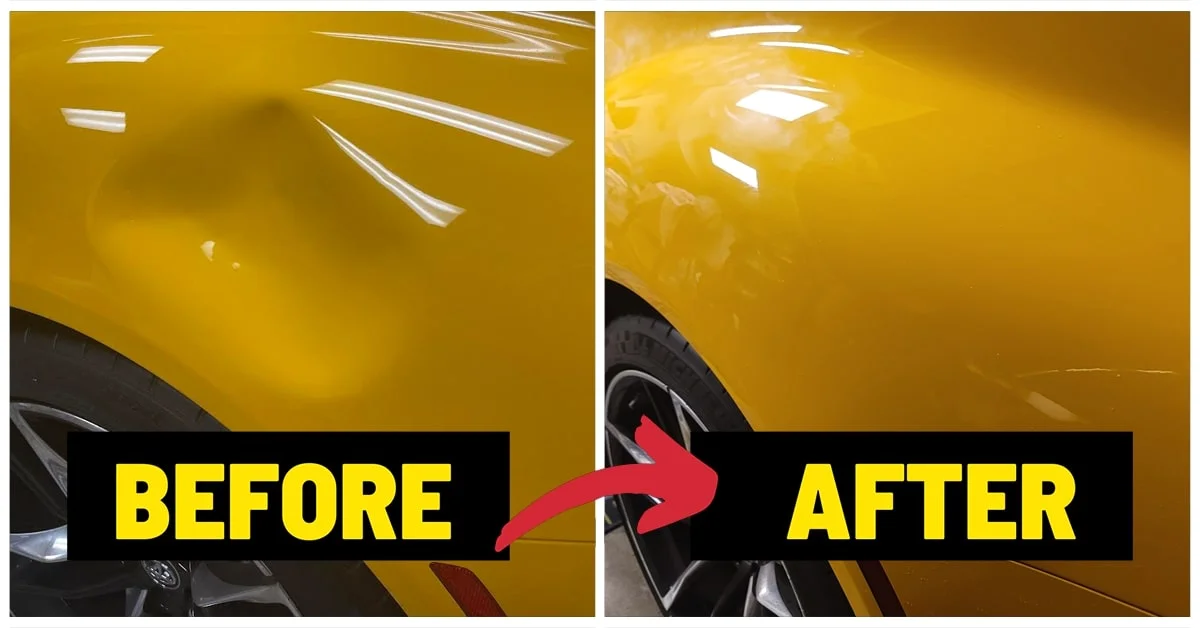
Auto Body Repair Cost Estimator: What Might You Pay?
Start with the damage, not a single price. In 2026, minor scrapes and small dents may cost $150-$1,500. A painted single-panel repair may run $500-$3,500, a multi-panel collision $2,500-$8,500, and structural damage $5,000-$20,000 or more. These ranges are a starting point, not a quote. A small dent with intact paint may qualify for paintless dent repair (PDR), which can cost less than sanding and repainting.
Your final price depends on the dent’s size and location, paint damage, vehicle type, and any damage hidden behind the panel. Get an in-person assessment before deciding whether to pay cash or file an insurance claim.
I’m Brian Blanc, founder of Dent Erasers LLC, and I’ve spent nearly 30 years helping drivers restore dents while protecting factory finishes. I use an auto body repair cost estimator as a starting point, then assess the actual damage to explain which repair options make sense.
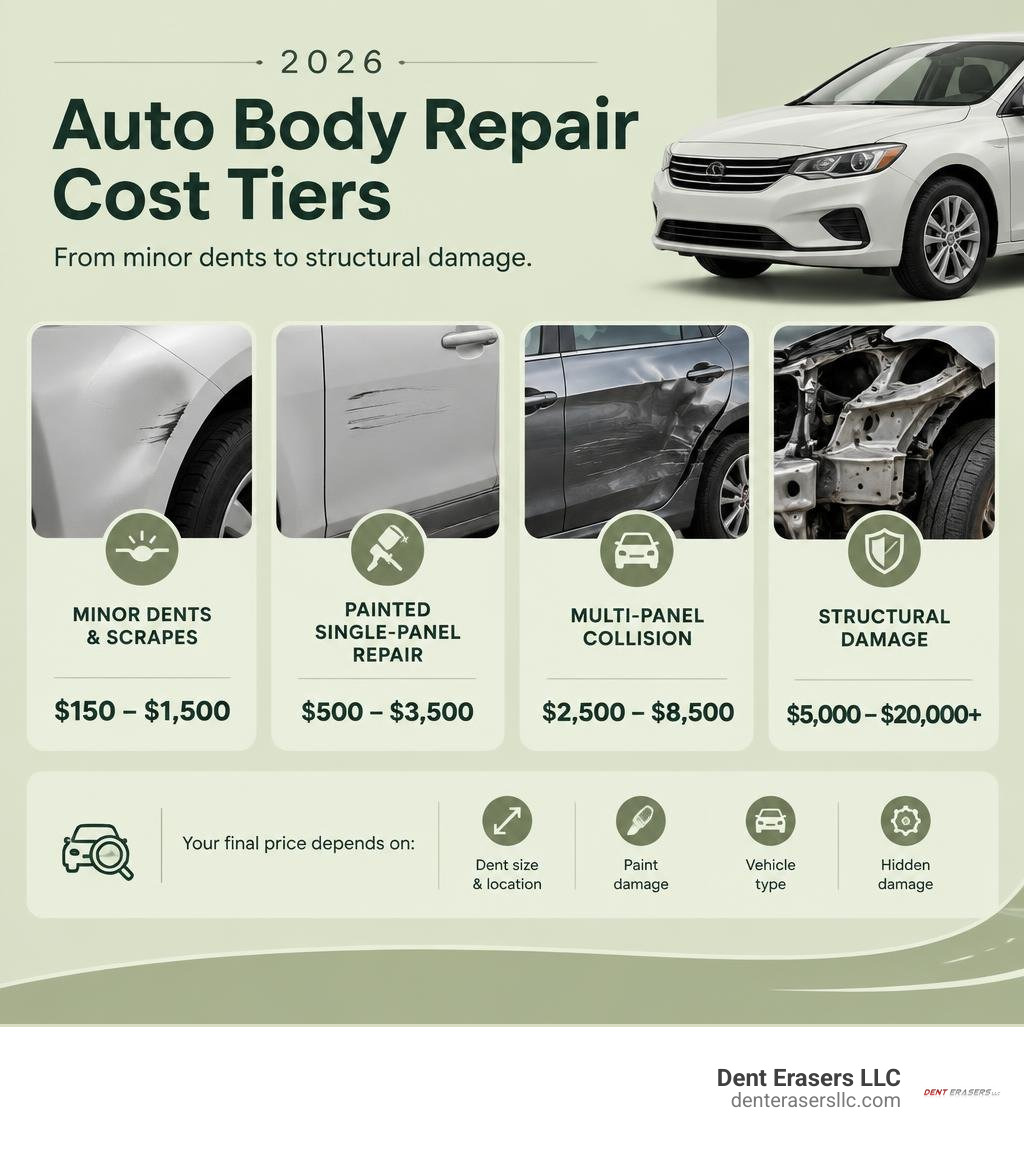
Terms related to auto body repair cost estimator:
How an Auto Body Repair Cost Estimator Works
When you enter your vehicle details into online auto body repair cost calculator tools, the system does not simply pull a number out of thin air. Instead, it relies on a standardized mathematical formula that balances parts, regional labor, paint materials, and severity.
Most digital platforms calculate baseline costs using this core structure:
$$\text{Estimated Cost} = (\text{Panel Base Cost} \times \text{Severity Multiplier} \times \text{Class Multiplier}) + (\text{Paint Add} \times \text{Class Multiplier})$$
Here is how each variable impacts the math:
- Panel Base Cost: Every panel has an established baseline reflecting the labor hours required to remove, repair, or replace it. For example, a front bumper shell generally carries an initial benchmark around $850 before factoring in specific damage.
- Severity Multiplier: Light surface scuffs might use a minor factor (such as 0.25 to 0.40), whereas heavy impact, stretched metal, or crushed body lines push this multiplier toward 0.85 to 1.0+.
- Vehicle Class Factor: Standard passenger economy cars sit at a baseline multiplier of 1.0. Premium luxury models, rare sports cars, and heavy-duty trucks often feature a class multiplier of 1.4 to 1.6 due to high-tensile steels, specialized fasteners, and delicate clear coats.
- Paint Add: If base metal or primer is exposed, the software factors in a standard paint application fee (frequently around $350 base), scaled upward by the vehicle class.

For a transparent breakdown of how these components combine into a final quote, see our step by step guide to car body repair price.
Accuracy of an Auto Body Repair Cost Estimator vs. Real Shop Quotes
Digital estimators provide useful preliminary ballparks, but they cannot see behind the sheet metal. In the auto body industry, walk-in initial estimates frequently change once a technician tears down the damaged area.
Across insurance claims involving multi-panel damage, 63% require a supplemental claim averaging $1,200 to $1,800 after teardown reveals hidden mechanical brackets, deformed impact bars, or severed wiring harnesses.
Modern driver-assist systems add another layer of complexity. If a dent sits near an Advanced Driver Assistance Systems (ADAS) radar or blind-spot sensor, the vehicle often requires precision digital recalibration. That step alone can add $300 to $1,000+ to the final bill.
For cosmetic damage where the paint finish remains unbroken, scheduling a mobile auto body repair estimate gives you a fast, reliable evaluation right in your driveway across Concord, Walnut Creek, Pleasant Hill, and nearby East Bay communities.
The Four Main Cosmetic Damage Tiers in 2026
Auto repair costs in 2026 have risen roughly 8% to 12% compared to 2024 levels, driven by the widespread transition to premium waterborne paint systems, specialized aluminum tooling, and mandatory sensor recalibrations.

To help you gauge where your vehicle stands, we classify cosmetic and structural collision work into four standard tiers:
| Damage Tier | Typical Scope of Damage | PDR Eligible? | Estimated Cost Range (2026) | Typical Turnaround |
|---|---|---|---|---|
| Tier 1: Minor Cosmetic | Door dings, hail spots, shallow crease (paint intact) | Yes (Primary Method) | $150 – $500 | Same Day (1–3 Hours) |
| Tier 2: Moderate Single-Panel | Deep dent with scratched paint, bumper gouge | Partial (PDR + Touch-up / Respray) | $500 – $3,500 | 2 – 5 Business Days |
| Tier 3: Major Multi-Panel | Crushed fender, compromised door shell, panel replacement | Rare (Conventional Bodywork) | $2,500 – $8,500 | 1 – 3 Weeks |
| Tier 4: Structural / Frame | Unibody sway, damaged pillars, crumpled frame rails | No (Frame Rack & Structural Pulls) | $5,000 – $20,000+ | 3 – 8 Weeks |
For an exhaustive analysis of labor allocations and parts pricing across every type of collision repair, review the complete guide to auto body repair costs.
Tier 1 and 2: Scratches, Minor Dings, and Paintless Dent Repair (PDR)
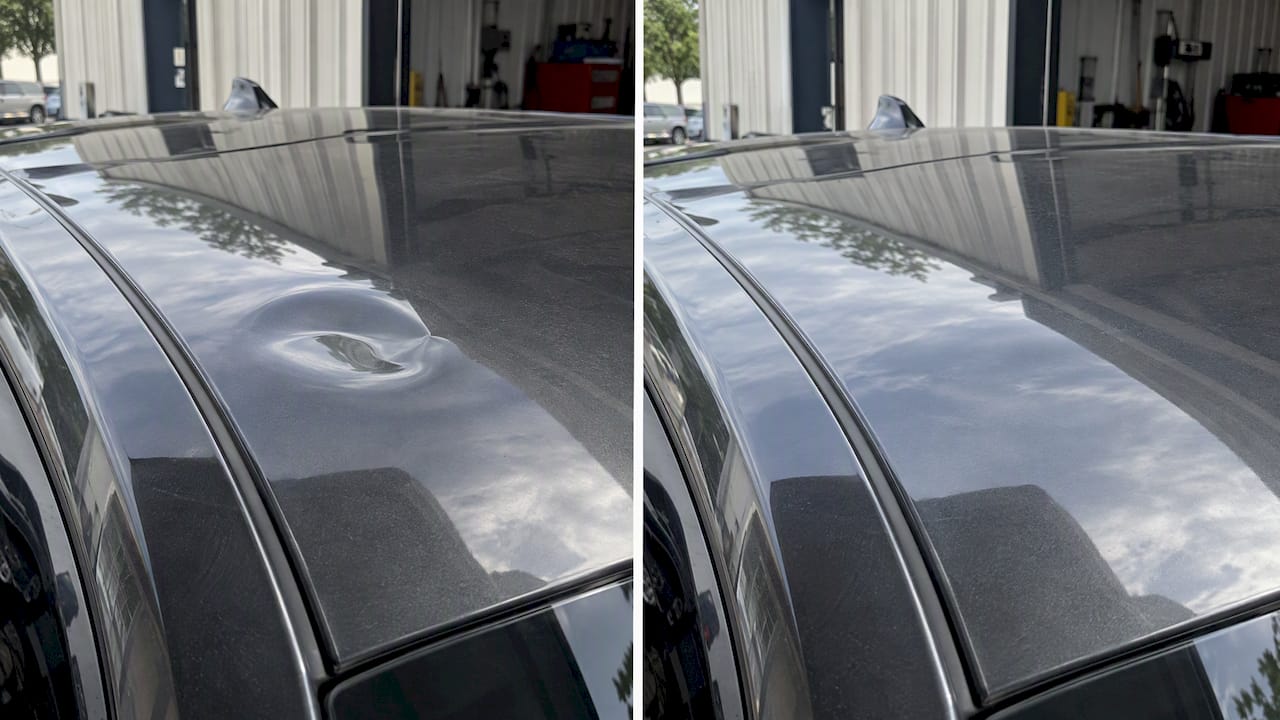
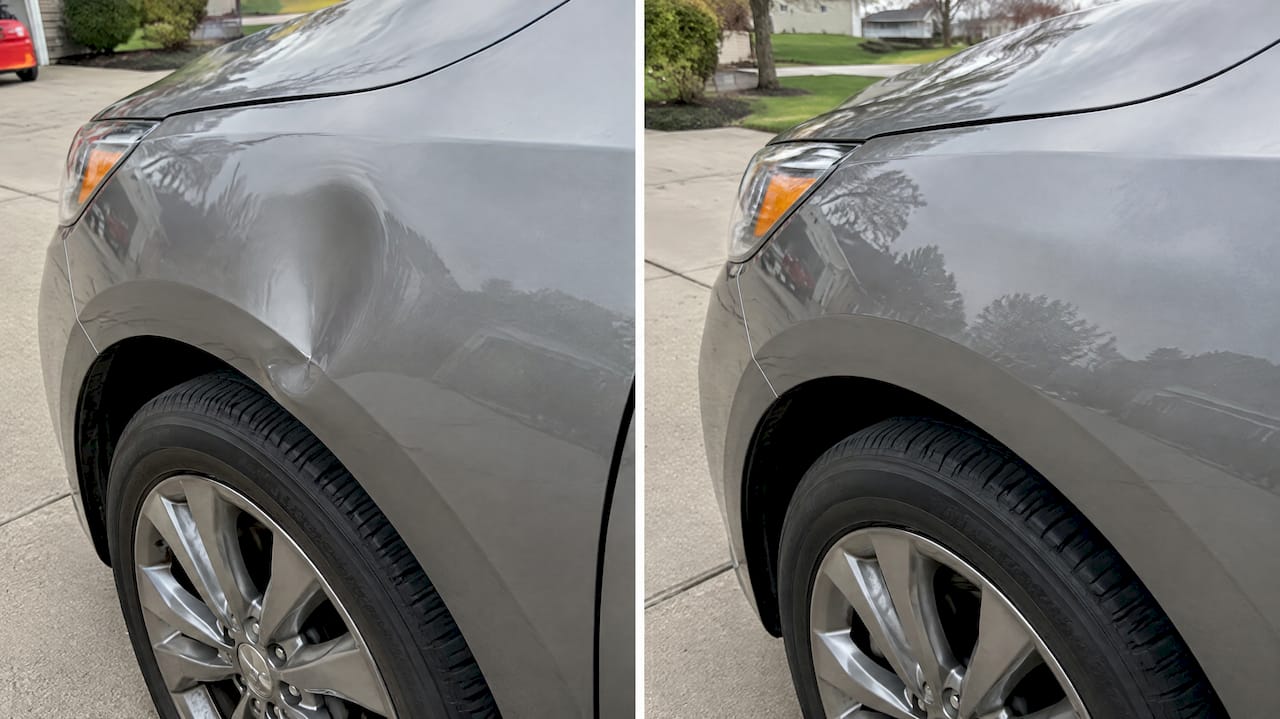
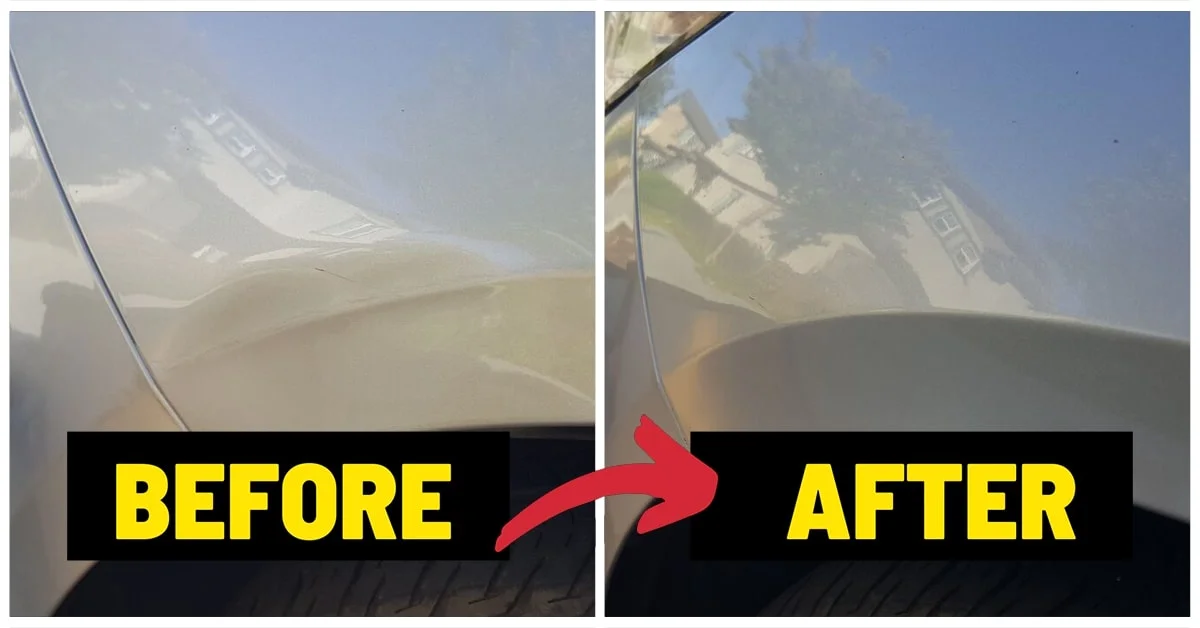
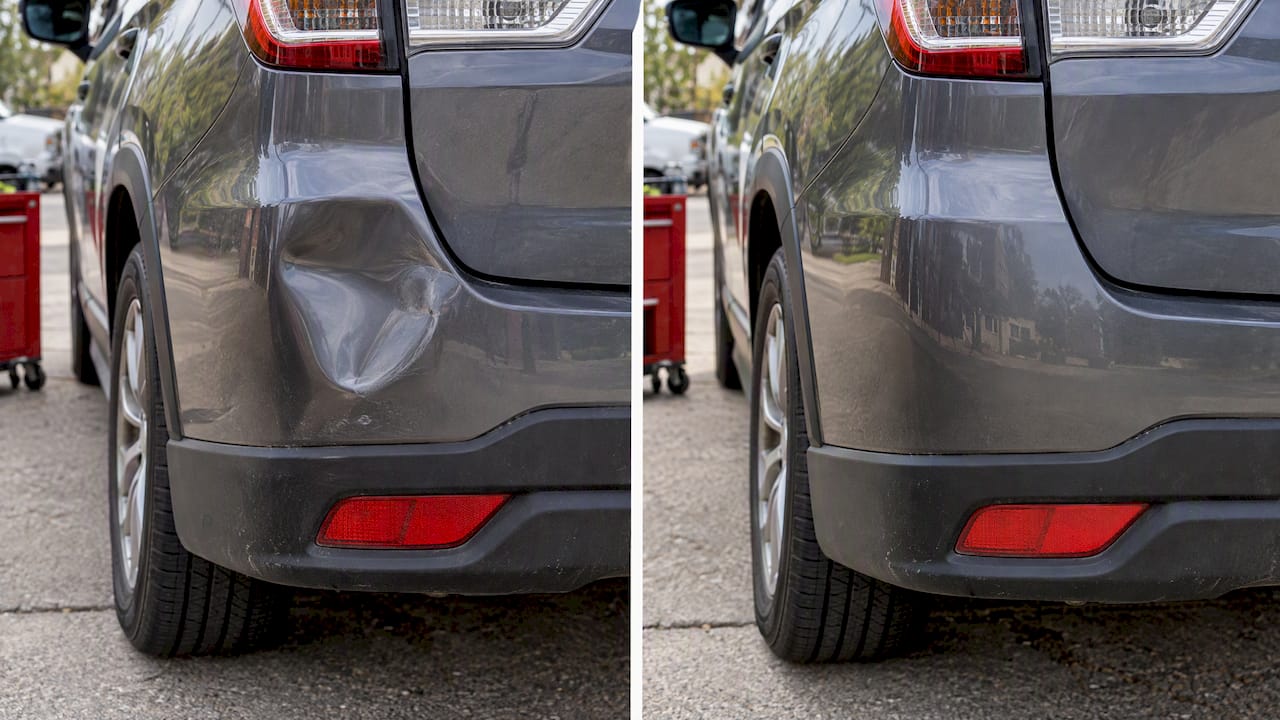
When the factory clear coat is unbroken, Paintless Dent Repair (PDR) is the fastest and most cost-effective solution.
Rather than grinding off your car’s original paint, applying synthetic body filler, and spraying aftermarket clear coat, PDR technicians use specialized hand tools behind the panel. By applying precise leverage to the metal’s natural memory points, we gently massage the dented sheet metal back to its original factory contour.
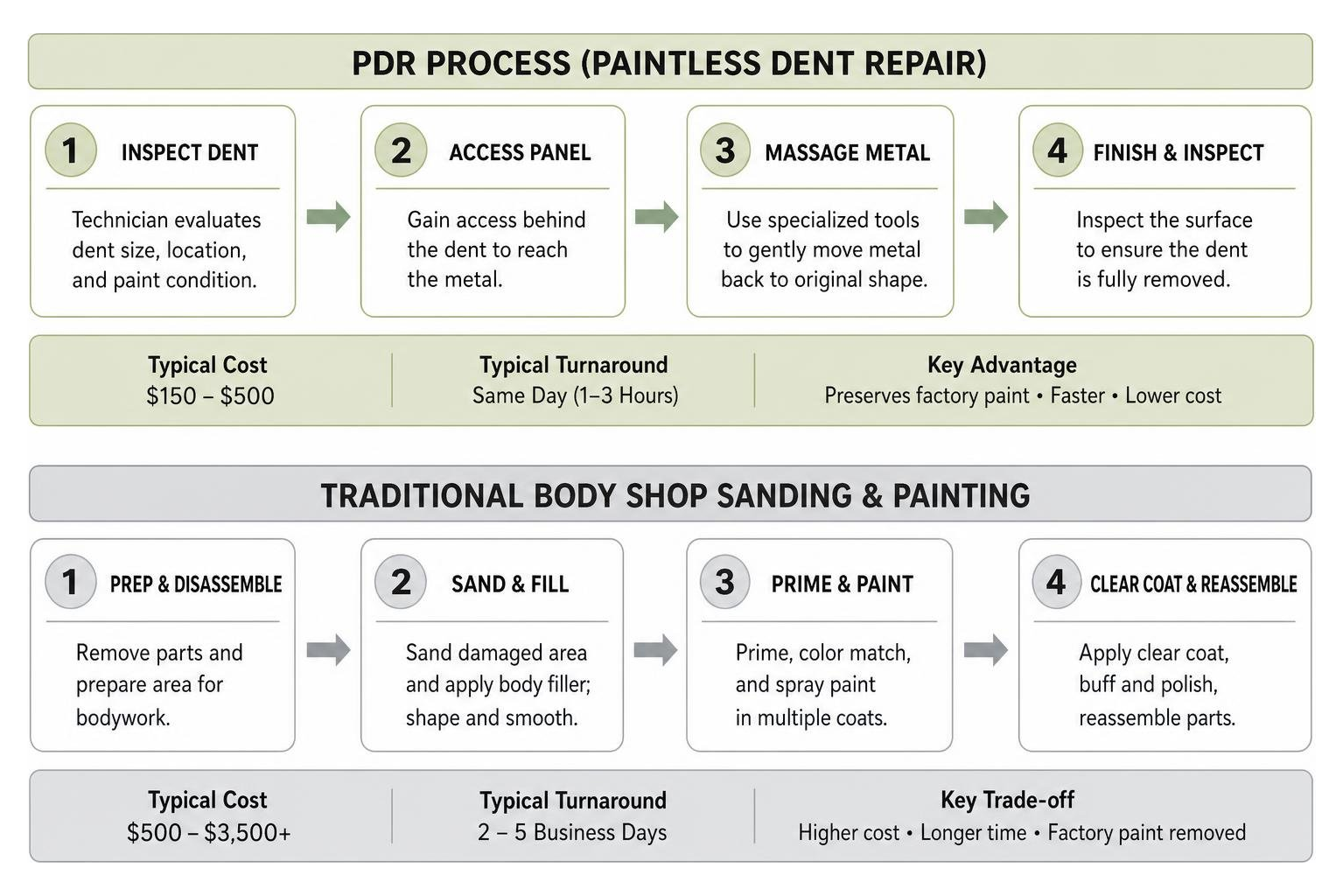
PDR provides significant advantages:
- Cost Efficiency: Minor dings typically run $150 to $500, saving you 50% to 70% compared to traditional body shop methods.
- Preserving Original Finish: Maintaining your factory OEM paint protects your vehicle from finish mismatches and safeguards resale value.
- Speed: While conventional body shops might keep your car for days, mobile PDR work is typically completed at your home or office in under two hours.
To review realistic pricing scenarios for shallow dings versus paint blemishes, check our guides on car dent scratch repair cost and dent removal service cost.
Tier 3 and 4: Larger or Complex Dents and Damage Outside PDR Eligibility
When damage involves ripped metal, deep paint fractures, or compromised frame geometry, traditional body shop reconstruction is required.
According to 2026 collision damage benchmarking, paint work is often the biggest driver of the final bill on a single panel repair. Automotive finishes do not work like house paint; you cannot simply apply a brush stroke to the center of a door and expect it to blend invisibly under sunlight.
Full panel resprays generally cost $600 to $1,500 per panel, with premium waterborne basecoats and multi-stage clear coats costing $150 to $300 in raw materials alone.
To prevent noticeable color differences, painters must “blend” (feather basecoat into undamaged adjacent panels before clearing the entire section). Blending adds $400 to $1,200 per adjacent panel.
Key Cost Drivers: Dent Size, Access, and Vehicle Class
No two repairs carry the exact same price tag. When assessing body damage, three primary factors determine the final total:

- Dent Size, Sharpness, and Depth: A broad, shallow 3-inch dent from a basketball is far simpler to resolve than a sharp 1-inch crease caused by a shopping cart corner that stretched the metal alloy.
- Backside Access & Obstructions: To perform PDR, tools must reach the inner skin of the panel. Double-walled door reinforcements, window regulator brackets, acoustic insulation, or roof headliners can require extra labor to access properly.
- Panel Metallurgy & Vehicle Class: Aluminum panels—common on modern trucks, sports cars, and European luxury vehicles—have less elasticity than standard mild steel. Aluminum requires specialized heat guns and greater mechanical leverage, which increases labor time.
To understand how these physical variables translate to out-of-pocket expenses, read our breakdown on your wallet vs the dent.
Using an Auto Body Repair Cost Estimator to Decide: Cash vs. Insurance
After getting a repair estimate, drivers often face a tough question: Should I file an insurance claim, or pay out of pocket?
A helpful guideline is the 2x Deductible Rule:
$$\text{If Repair Cost} < (2 \times \text{Your Comprehensive/Collision Deductible}) \implies \mathbf{Pay\ Cash}$$
$$\text{If Repair Cost} \ge (2 \times \text{Your Comprehensive/Collision Deductible}) \implies \mathbf{File\ Claim}$$
Why follow this guideline?
- Insurance Premium Surcharges: Filing a single at-fault collision claim typically raises insurance premiums by $200 to $400 annually for 3 to 5 years, costing you $600 to $2,000 over time.
- Insurance Administrative Overhead: Body shops often bill insurance carriers 10% to 30% higher rates due to mandatory OEM procedures, digital scanning, and administrative documentation.
- Out-of-Pocket Savings: When paying cash, choosing mobile PDR can save you 15% to 30% or more compared to conventional body shop quotes while preserving your vehicle’s original factory finish.
For more strategies on saving money on minor body repairs, explore our 7 proven tips to score the best price auto body repair.
Frequently Asked Questions About Auto Body Repair Costs
How much does it cost to fix a scratched bumper or minor door ding?
A minor door ding or shallow bumper dent with unbroken paint handled via mobile Paintless Dent Repair typically costs $150 to $500. If the plastic bumper cover is deeply gouged, cracked, or requires complete repainting and color blending, costs at a conventional body shop usually range from $500 to $1,500. For a deeper look at cosmetic repair thresholds, read about the price of perfection for car dent repairs.
How do panel access and vehicle type affect a PDR estimate?
PDR requires direct mechanical access behind the dented panel. Dents located in open areas (like the center of a hood or fender) take less time to address than dents behind internal impact braces, window tracks, or sunroof assemblies. Additionally, luxury vehicles and aluminum bodies demand specialized technician certification and tooling, which raises labor rates slightly compared to standard steel panels.
What damage is outside PDR eligibility?
PDR is designed for metal that retains its finish. The following conditions fall outside PDR eligibility and require conventional body shop repairs:
- Paint chipped down to the metal, cracked, flaking, or crazed.
- Severely torn or punctured metal edges along seam welds.
- Structural unibody or frame damage where the underlying safety architecture has warped.
If your vehicle exhibits frame misalignment, specialized frame racks are needed to pull the structural components to factory tolerance. Severe structural damage that exceeds 60% to 80% of the vehicle’s Actual Cash Value (ACV) will cause the insurance company to declare the car a total loss.
Conclusion
Understanding body repair pricing helps you make confident decisions after an accident. Whether dealing with a minor parking lot ding in Concord or evaluating multi-panel collision damage in Antioch, using realistic pricing benchmarks prevents unexpected shop bills.
Before committing to expensive body sanding, aftermarket fillers, or filing a claim that could increase your monthly premium, verify whether your damage qualifies for non-invasive repair.
At Dent Erasers LLC, we specialize in mobile Paintless Dent Repair across Contra Costa County—including Walnut Creek, San Ramon, Martinez, Brentwood, and surrounding areas. We come directly to your home or office, removing door dings, creases, and hail damage in just a few hours while preserving your vehicle’s factory paint.
Contact us today to schedule your on-site assessment for professional paintless dent repair and restore your car’s appearance without the body shop wait.