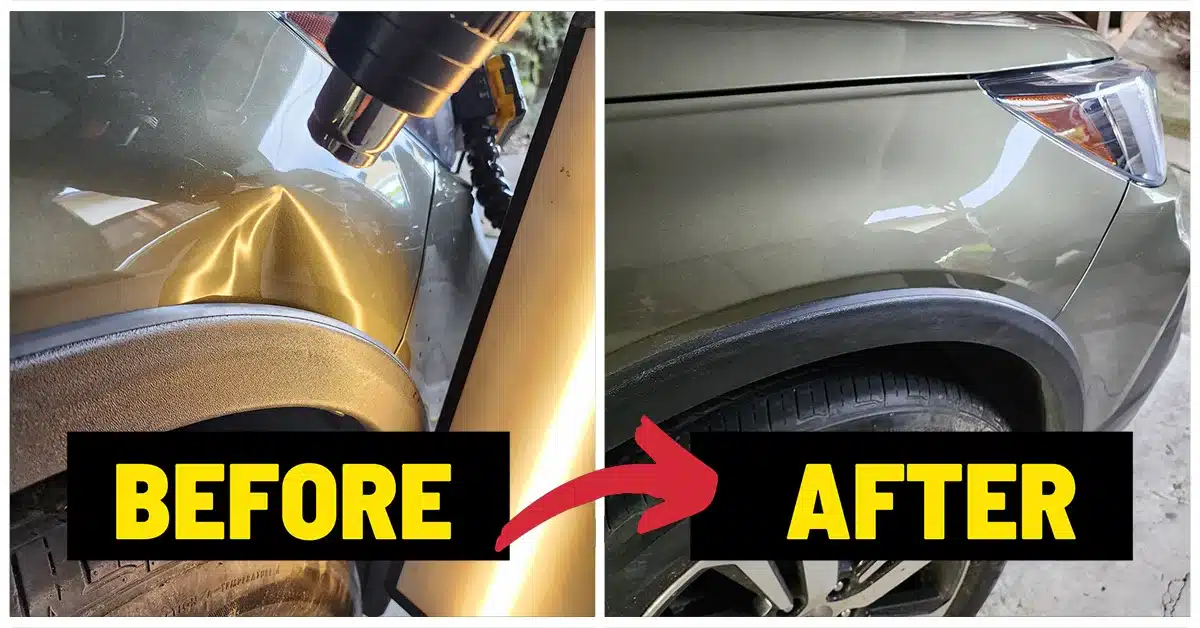
What Does Dent Removal Service Cost in 2026?
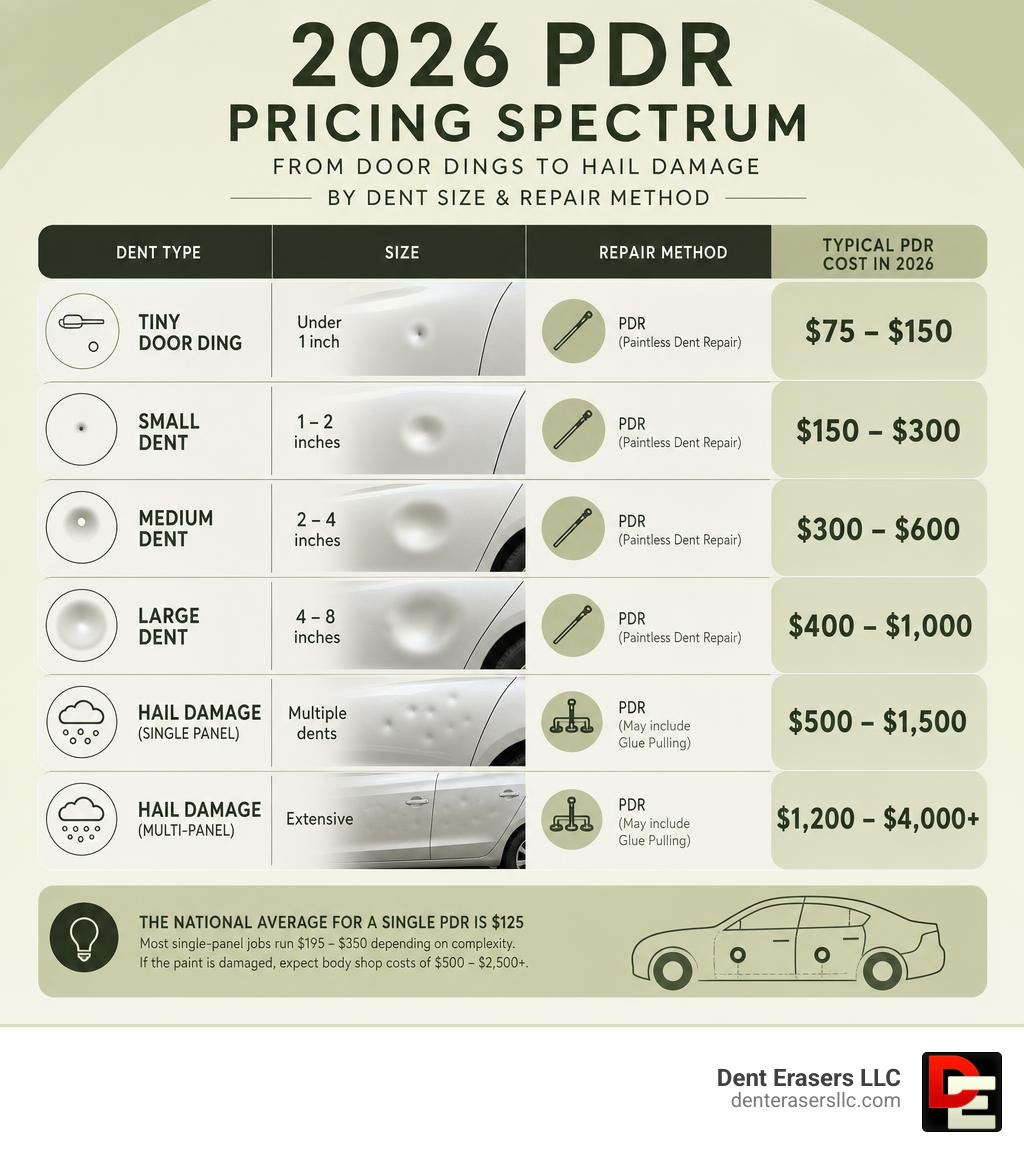
Understanding dent removal service cost upfront can save you hundreds of dollars and help you avoid unnecessary trips to a body shop. Here’s a quick snapshot of what you can expect to pay in 2026:
| Dent Type | Size | Typical PDR Cost |
|---|---|---|
| Tiny door ding | Under 1 inch | $75 – $150 |
| Small dent | 1 – 2 inches | $150 – $300 |
| Medium dent | 2 – 4 inches | $300 – $600 |
| Large dent | 4 – 8 inches | $400 – $1,000 |
| Hail damage (single panel) | Multiple dents | $500 – $1,500 |
| Hail damage (multi-panel) | Extensive | $1,200 – $4,000+ |
The national average for a single paintless dent repair (PDR) is $125, though most single-panel jobs run $195 – $350 depending on complexity. If the paint is damaged, expect body shop costs of $500 – $2,500+.
Those numbers can swing significantly based on your vehicle’s panel material, dent location, and whether you choose mobile or in-shop service. That’s what this guide breaks down clearly.
I’m Brian Blanc, owner of Dent Erasers LLC and a mobile PDR specialist with nearly three decades of hands-on experience in dent removal service cost estimation, factory finish preservation, and mobile repair across the East Bay. Everything in this guide reflects what I’ve seen in the real world — not just what looks good on paper.
Know your dent removal service cost terms:
- automotive paintless dent removal
- paintless dent removal estimate
- paintless dent removal for hail damage
Understanding the Dent Removal Service Cost in 2026
When you walk out to your car in a grocery store parking lot in Concord or Walnut Creek and spot a fresh dent, your first thought is usually, “How much is this going to set me back?”
In 2026, the average national cost of paintless dent repair sits at $125 per dent. However, this average is a blend of tiny, easily accessible dings and much larger, more complex projects. If we look at the trajectory of the auto repair industry over the last five years, prices have climbed about 16.8%—up from a national average of $107 back in 2022. This increase is driven by rising labor rates, more complex vehicle construction, and the integration of advanced driver-assistance systems (ADAS) that require recalibration when certain panels are removed.
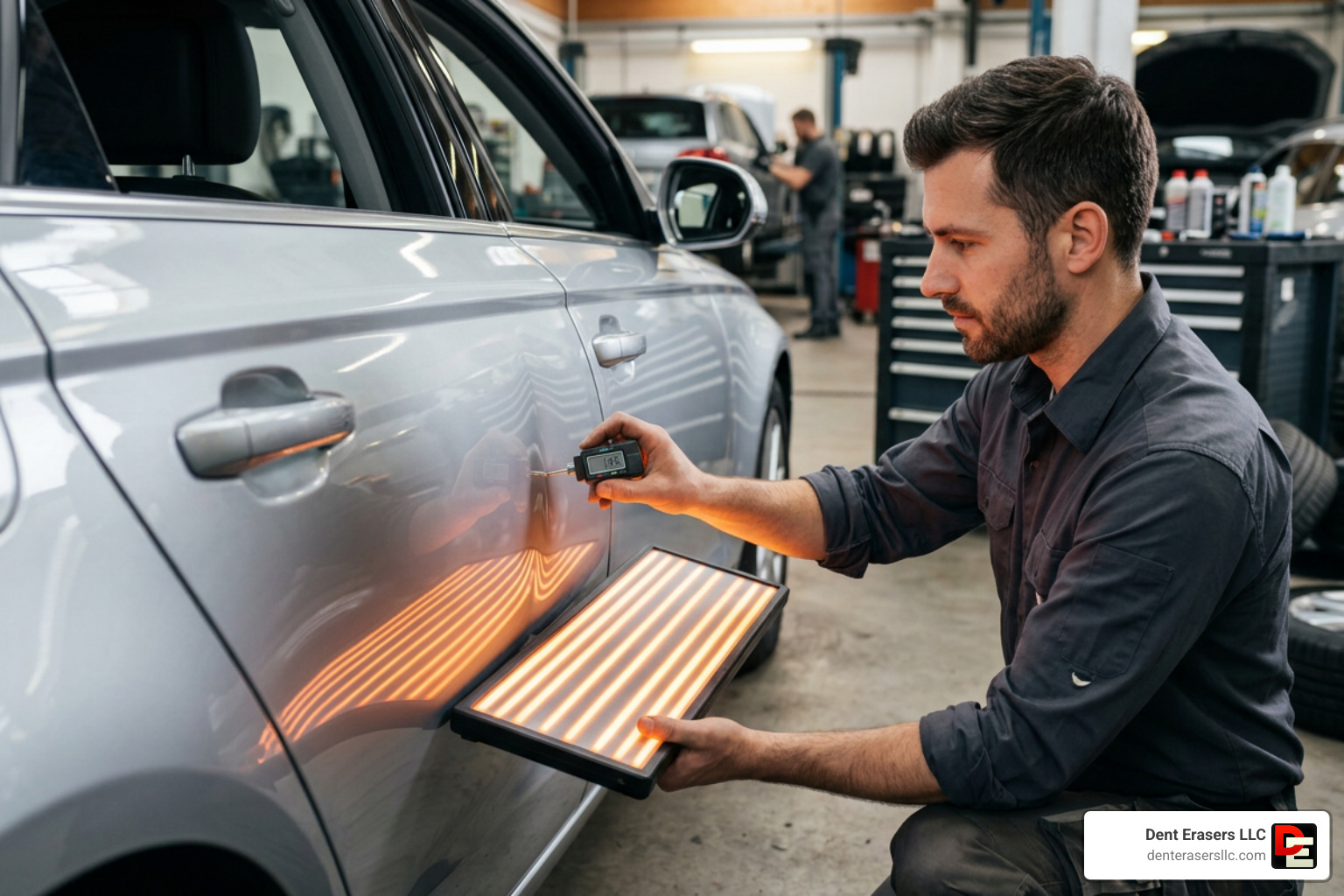
To help you map out your potential expenses, we have structured The Complete Guide to PDR Pricing and Estimates, which details how local market dynamics in Contra Costa County influence final repair bills. Generally, an average single-panel PDR job in our service areas—such as Richmond, Antioch, or San Ramon—will run between $195 and $350.
Below is a comprehensive breakdown of how different dent sizes translate to actual out-of-pocket costs when the paint remains completely intact.
| Dent Classification | Visual Reference | Repair Timeframe | Average PDR Cost Range |
|---|---|---|---|
| Tiny Ding | Dime to Quarter-sized (Under 1″) | 20 – 60 minutes | $75 – $150 |
| Small Dent | Quarter to Golf Ball-sized (1″ – 2″) | 30 – 90 minutes | $150 – $300 |
| Medium Dent | Soda Can to Palm-sized (2″ – 4″) | 45 – 90 minutes | $300 – $600 |
| Large Dent | Dinner Plate-sized (4″ – 8″) | 1.5 – 4 hours | $400 – $1,000 |
| Very Large / Creased | Skillet-sized or Deep Crease (8″+) | 3 – 7 hours | $800 – $2,500+ |
How Size and Depth Impact Your Dent Removal Service Cost
It is a common misconception that size is the only metric that matters when calculating a dent removal service cost. In reality, depth and metal stretching play an equally critical role.
A large, shallow dent on a flat panel is often much easier (and cheaper) to repair than a tiny, razor-sharp ding. When a dent is incredibly deep, the metal at the center point stretches. Think of metal like a piece of plastic wrap; once it is stretched beyond its elastic limit, it loses its structural integrity. PDR technicians must slowly massage the metal back into place without causing “high spots” or cracking the paint.
For example, a standard coin-sized door ding usually costs between $75 and $150 because the metal has not been severely stretched, and the repair can be completed in under an hour. However, if that same small ding was caused by something sharp—like a golf ball or a high-velocity stone—the depth increases, pushing the cost closer to $195 to $225 due to the extra precision required.
Creases present another layer of difficulty. A crease dent is a line-shaped impact that stretches the metal along a defined path. Crease dent repairs typically range from $225 to $400 because the technician must meticulously work the entire length of the crease, rebuilding the flat plane of the panel millimeter by millimeter.
The Cost Advantage of PDR Over Conventional Body Shop Methods
If your vehicle’s paint is undamaged, choosing Paintless Dent Repair over a traditional body shop is one of the smartest financial decisions you can make.
Traditional body shops operate on a “replace and repaint” model. Even for a medium-sized dent, a conventional shop will grind down your factory paint, fill the dent with plastic body filler (Bondo), spray primer, apply base paint, and then blend the clear coat into the surrounding panels to ensure a color match. This multi-step process is highly labor-intensive, taking anywhere from 3 to 5 days, and typically costs 3 to 5 times what PDR costs.
Let’s look at the math:
- PDR Method: A palm-sized dent on a steel door panel costs between $150 and $350. The repair takes 1 to 3 hours, preserves your original factory paint, and requires zero paint blending.
- Traditional Body Shop Method: The same palm-sized dent requires panel stripping, body filler, paint, and clear coat blending. The bill easily reaches $500 to $1,000, and your car is stuck in the shop for half a week.
Beyond the immediate savings, PDR offers massive long-term financial benefits. Repainting a panel can lower your vehicle’s trade-in value by 5% to 15% on mainstream cars, and up to 25% on luxury or sports cars, because vehicle history reports (like Carfax) will flag the repaint as previous damage. PDR is completely invisible, leaves no history-report flags, and preserves the factory-baked finish. For more cost-saving strategies, you can explore The Cheapest Ways to Fix a Car Dent.
Key Factors That Drive Up Paintless Dent Repair Prices
While size and depth set the baseline, several technical factors can quickly double or triple a PDR quote. Understanding these variables will help you make sense of your professional estimate.
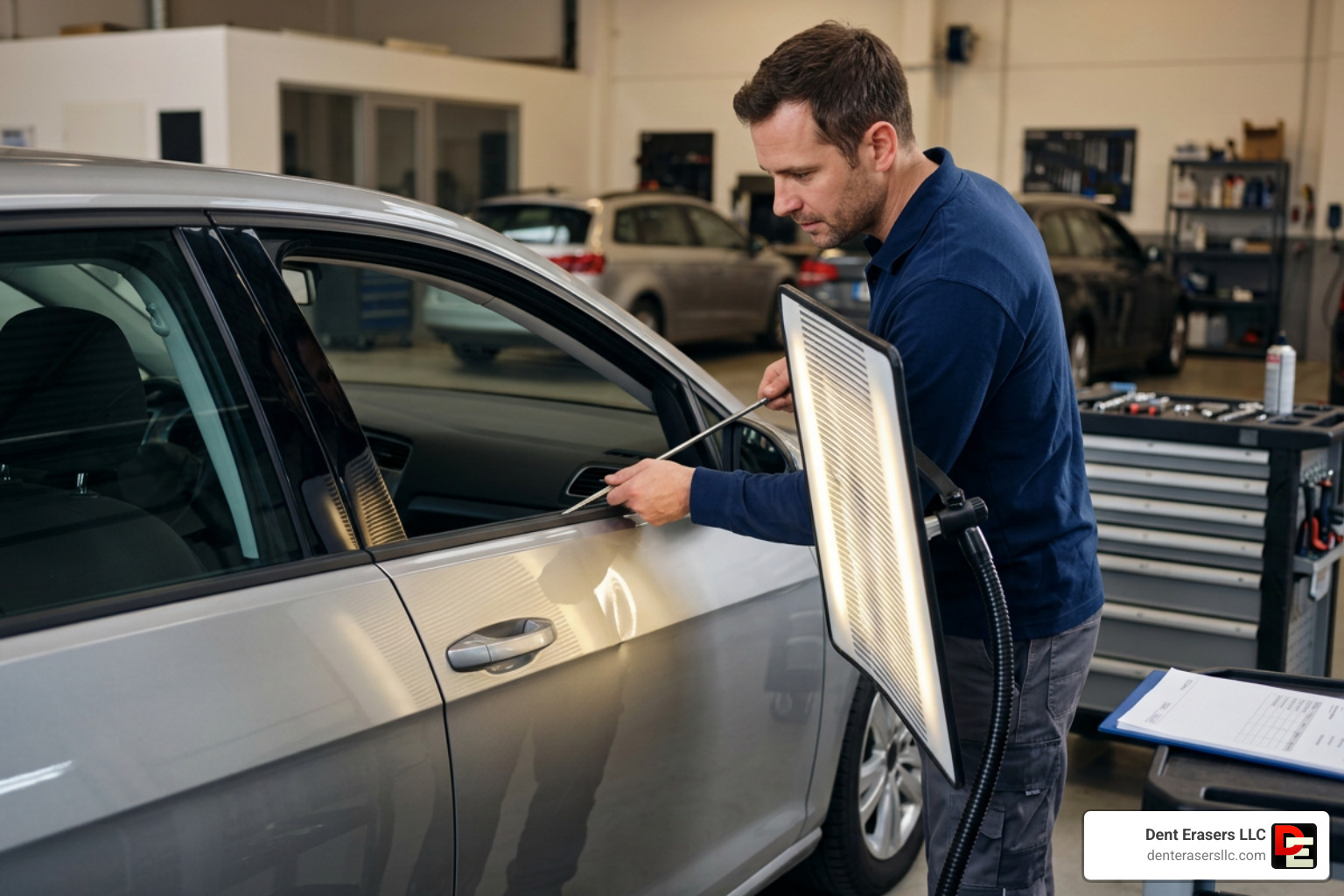
Aluminum Panels and High-Strength Steel
The material of your car’s body panels is a major price driver. Historically, almost all vehicles were made of mild steel, which is highly malleable and holds its shape well when massaged back into place. Today, manufacturers use aluminum and high-strength steel to shed weight and improve fuel efficiency.
Aluminum is common on modern vehicles, including the Ford F-150 (2015+), many Tesla models, and luxury vehicles from BMW, Audi, and Mercedes. However, aluminum is much stiffer than steel and has no “metal memory.” It requires significantly more force to move, work-hardens rapidly (meaning it gets harder and more brittle as you work on it), and requires specialized heat-assist techniques to prevent the paint from cracking.
Because of these properties, aluminum panels typically carry a 30% to 50% surcharge (and in some complex cases, up to 100%) over standard steel pricing. A dent that costs $200 on a steel Honda Civic door might cost $300 to $400 on an aluminum Tesla Model 3 door. If you own an EV or luxury vehicle, we highly recommend reading The Price of a Panel and What Fixing Your Hood Really Costs to understand how panel-specific materials impact your bottom line.
Body Lines and Panel Edges
Where is the dent located? If it is dead center on a flat, open panel, access is simple. But if the dent sits directly on a body line (the sharp, structural folds designed into your car’s sheet metal), the complexity skyrockets.
Body lines are the strongest parts of a panel. Pushing a dent out of a body line requires extreme precision and substantial force. Proximity to a body line typically adds 25% to 40% to the base PDR price.
Similarly, dents located on the very edge of a panel (within 1 to 2 inches of the seam) are incredibly difficult to repair. Panel edges are double-walled or hemmed, leaving virtually no room for a technician to get a metal rod behind the dent. In these scenarios, technicians must rely on “glue pulling”—attaching specialized plastic tabs to the front of the dent with hot-melt glue and pulling it outward. This process is highly effective but takes much longer, driving up the labor cost.
Mobile PDR vs. In-Shop Service Costs
When booking your repair, you will often choose between a mobile technician who comes to your driveway or taking your car to a physical shop.
| Feature | Mobile PDR Service | In-Shop PDR Service |
|---|---|---|
| Convenience | High (Repaired at your home/work) | Low (Requires drop-off/pick-up) |
| Environment | Outdoor lighting, weather-dependent | Controlled LED lighting, climate-controlled |
| Pricing | Often lower overhead, but may include travel fees | Standard shop rates, higher fixed overhead |
| Best For | Simple dings, minor creases, single panels | Heavy hail damage, complex aluminum panels, EV repairs |
At Dent Erasers LLC, we bring the shop to you across Contra Costa County, providing expert mobile paintless dent repair in Concord, Antioch, Richmond, San Ramon, Pittsburg, Walnut Creek, and Brentwood. While some mobile operators charge a flat travel fee (often around $75), we build our travel into our competitive, transparent on-site pricing structure, keeping your out-of-pocket costs between $150 and $500 for most standard repairs.
Insurance Claims vs. Out-of-Pocket Costs for Dent Repair
Deciding whether to file an insurance claim or pay cash is a common dilemma. The decision usually comes down to simple math: comparing your deductible against the total cost of the repair and the potential long-term increase in your insurance premiums.
When to Pay Out of Pocket
If your dent repair estimate is under $500, we almost always recommend paying out of pocket.
Most drivers carry a deductible of $500 or $1,000. If you file a collision claim for a $350 dent, your insurance company won’t pay a dime because the cost is below your deductible. Worse, the claim will still go on your insurance record, which can cause your monthly premiums to spike by 20% to 40% for the next three years.
Consider this real-world example:
- Scenario A (Insurance): You file a claim for a $600 dent. You pay your $500 deductible, and the insurance pays $100. Over the next three years, your premiums increase by $25 a month. Total cost to you: $1,400.
- Scenario B (Out of Pocket): You pay the $600 repair cost directly to a professional PDR technician. Your insurance record remains clean. Total cost to you: $600.
By paying cash, you save $800 in the long run. If you are looking for local, cost-effective options that keep you from having to involve your insurer, check out our guide on How to Find Affordable Dent Removal for Your Car.
Handling Hail Damage and Catastrophe Claims
Hail damage is a completely different story. Unlike a parking lot ding (which falls under collision coverage), hail damage is classified as a “comprehensive” claim. Comprehensive claims cover events out of your control—such as storm damage, animal strikes, or vandalism. Filing a comprehensive claim rarely raises your insurance rates.
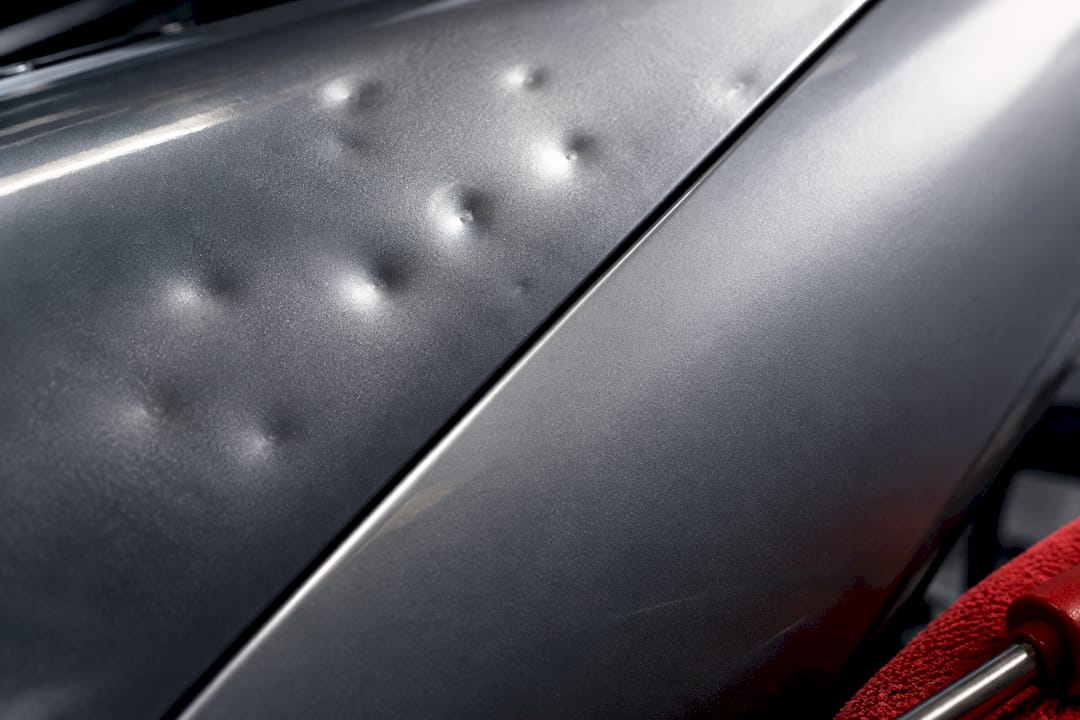
Furthermore, hail damage is rarely isolated to a single panel. A single hailstorm can leave 20 to 100+ tiny dents across your hood, roof, trunk, and door frames. PDR is the preferred repair method for insurance companies dealing with hail because it preserves the factory paint and costs significantly less than a full-body repaint.
Multi-panel hail damage PDR typically costs between $1,200 and $4,000+. Because this easily exceeds a standard $500 deductible, filing a claim is highly recommended. Many insurance companies will even waive your deductible during declared catastrophe events.
A word of warning: After a major storm, “storm chasers” (out-of-state dent companies) often flood affected areas. Always work with a reputable, locally established business and avoid signing “Assignment of Benefits” forms before your insurance adjuster has personally inspected the vehicle.
Frequently Asked Questions About Dent Removal
Can all car dents be fixed using paintless dent repair?
No. While PDR is highly versatile and can fix roughly 60% of common vehicle dents, it has clear limitations. PDR is not a viable option if:
- The paint is cracked, chipped, or scraped: If the paint’s surface is broken, the metal underneath is exposed to rust. These dents require a traditional body shop for sanding, filling, and repainting.
- The metal is severely stretched or creased: If a dent is extremely deep and sharp, the metal may be too stretched to return to its original shape.
- The panel is made of plastic: PDR only works on metal (steel and aluminum). Plastic bumpers require a different heat-shaping and refinishing process.
- Previous repairs used body filler: If a panel has been repaired before using Bondo, attempting to push the dent from behind will cause the filler to crack and pop off.
Is DIY dent repair worth the risk to save money?
In most cases, no. DIY dent repair kits (which cost $15 to $80 online) have a success rate of only 30% to 60% in the hands of an amateur.
PDR is an art form that requires years of daily practice to master. DIY kits—such as suction cups or cheap glue pullers—often cause more damage than they fix. The most common DIY mistake is “over-pulling” the dent, which creates a sharp high spot. Once metal is stretched outward, it is incredibly difficult for a professional to correct, often turning a simple $150 repair into a $1,000 traditional body shop job. If you want to explore cheap but safe alternatives, consult The Cheapest Ways to Fix a Car Dent before touching your vehicle’s metal.
How long does a professional paintless dent repair take?
One of the greatest benefits of PDR is its speed:
- Door dings (under 1 inch): 20 to 60 minutes.
- Medium dents (2 to 4 inches): 45 to 90 minutes.
- Large dents (4 to 8 inches): 1.5 to 4 hours.
- Severe hail damage: 1 to 3 days (depending on the number of dents).
Because we provide mobile service, we complete almost all single-panel repairs right in your driveway or office parking lot in a single afternoon, saving you from the hassle of renting a car.
Conclusion
Navigating a dent removal service cost does not have to be a guessing game. By choosing Paintless Dent Repair, you preserve your car’s factory paint, protect its resale value, and save up to 70% compared to traditional body shop rates.
At Dent Erasers LLC, we specialize in high-end, mobile paintless dent repair for cars, motorcycles, luxury models, and classic vehicles across Contra Costa County. Whether you are in Concord, Antioch, Richmond, San Ramon, Pittsburg, Walnut Creek, or Brentwood, we bring our expert, on-site service directly to your location, keeping your repairs quick, flawless, and affordable ($150 to $500 for most jobs).
Don’t let a minor ding affect your vehicle’s value. Schedule Professional Paintless Dent Repair with us today, or send us a few photos of your damage for a fast, honest estimate!