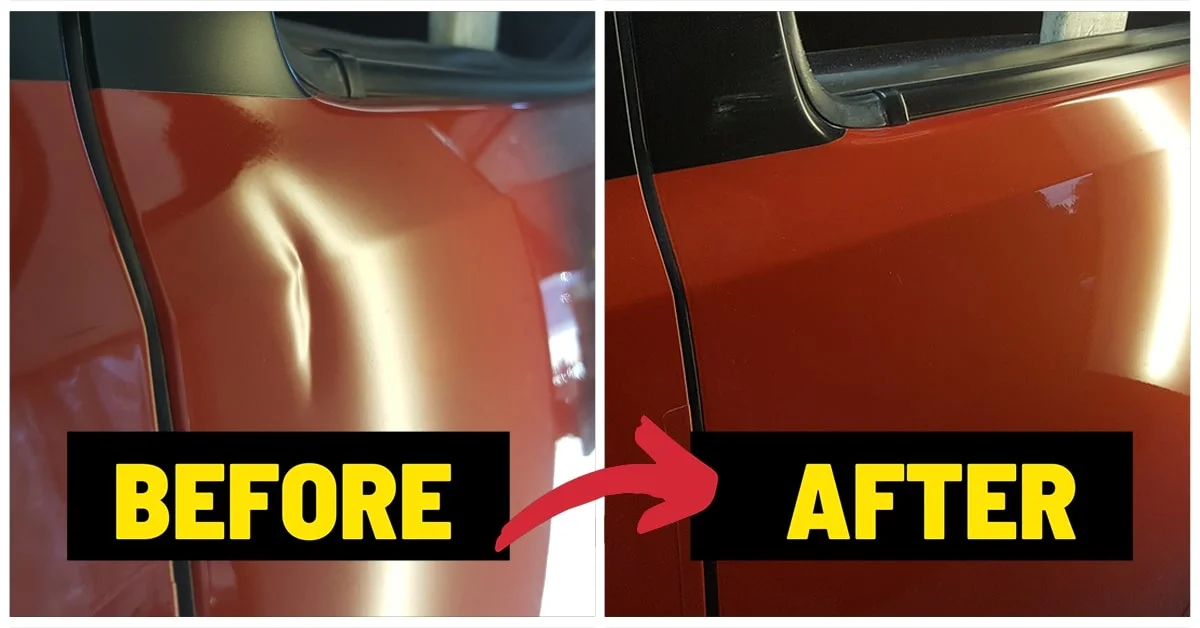
Small Dents, Big Headaches: What You Need to Know Before You Fix Them
To remove tiny dents from car panels quickly, here are your best options:
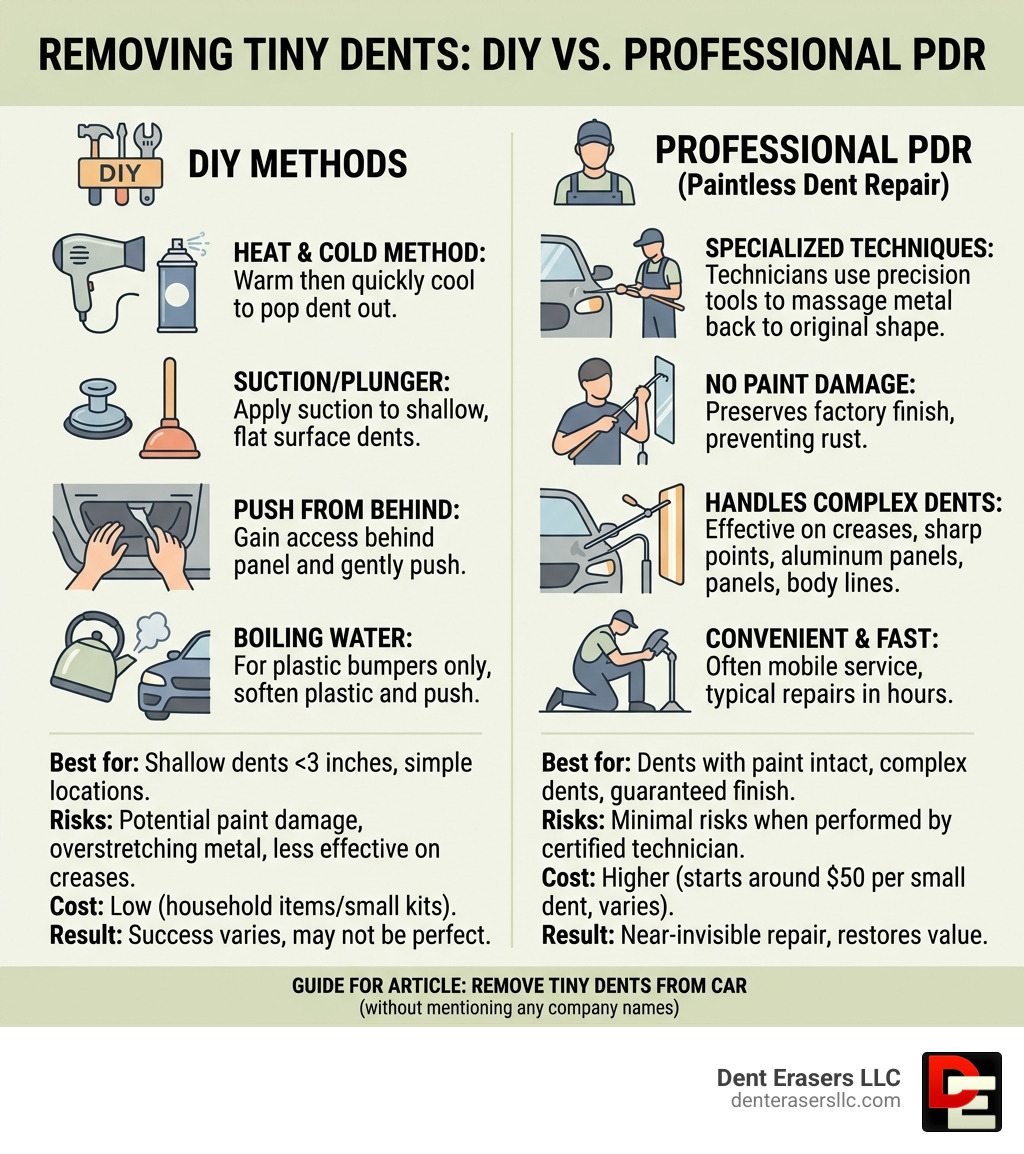
- Heat and cold method — Use a hairdryer for 2–5 minutes, then spray upside-down compressed air to contract the metal and pop the dent out.
- Suction/plunger method — Wet the dent and a cup plunger, press firmly, then pull steadily. Works best on shallow, flat-surface dents under 3 inches.
- Push from behind — Remove the door panel or loosen the fender liner, then gently press the dent out with a soft tool or your thumbs.
- Boiling water — For plastic bumpers only, pour boiling water over the dent to soften it, then push from behind.
- Professional PDR — For dents with paint damage, creases, or tricky locations, a paintless dent repair (PDR) technician is your safest bet, often starting at $50 for a single small dent.
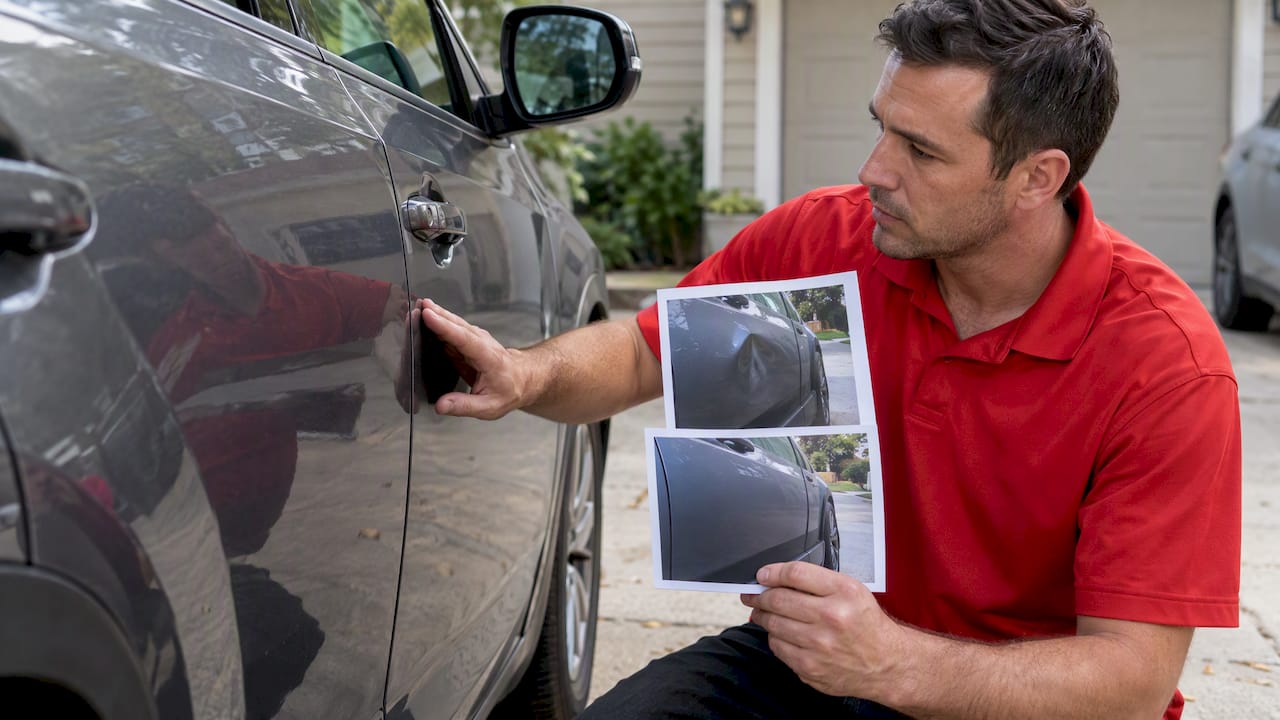
You walk past your car on a Tuesday morning, coffee in hand, and there it is — a tiny dent on your door that wasn’t there yesterday. It’s small. It’s shallow. But it’s all you can see now.
Parking lots, rogue shopping carts, careless car doors — minor dents happen to every vehicle. And while they may seem like a small cosmetic issue, even tiny dents can chip away at your car’s resale value and paint integrity over time if left untreated.
The good news? Many shallow dents under 3 inches in diameter can be addressed at home. But the wrong approach — too much force, the wrong tool, or the wrong surface — can turn a simple ding into a much bigger (and more expensive) problem.
This guide walks you through how to assess your dent, which DIY methods actually work, and when it makes more sense to call in a professional.
I’m Brian Blanc, founder of Dent Erasers LLC, and with 28 years of hands-on experience in mobile paintless dent repair across the East Bay Area, I’ve seen what works — and what makes a tiny dent worse — when car owners try to remove tiny dents from car panels on their own. That experience shapes every recommendation in this guide.
Assessing the Damage: Can You Remove Tiny Dents from Your Car at Home?
Before you grab a plunger or a hairdryer, you need to play detective. Not every dent is a candidate for a home remedy. In fact, attempting to fix the wrong kind of damage can lead to stretched metal or cracked paint, turning a $150 professional fix into a $1,000 body shop nightmare.
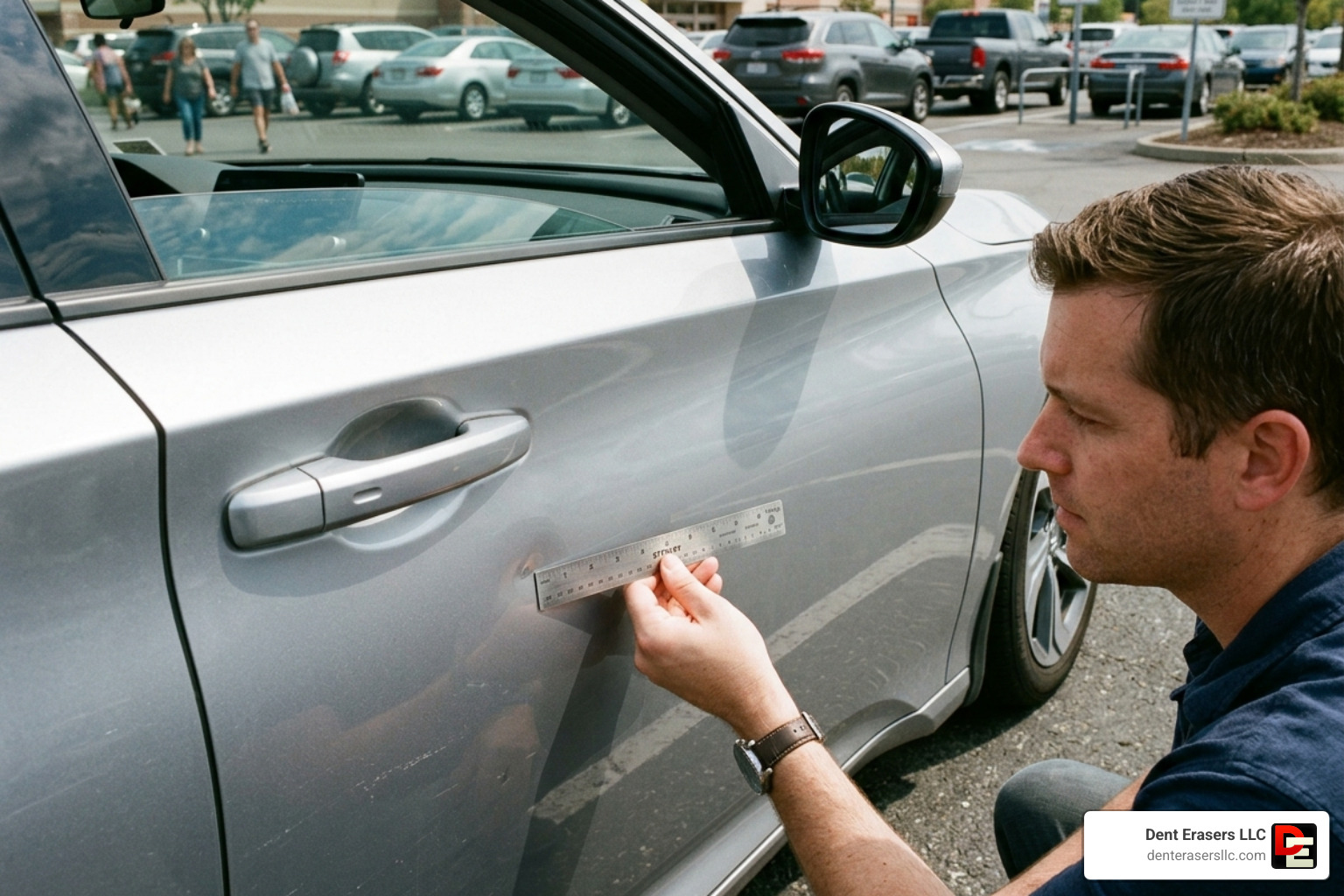
The first rule of thumb is the 3-inch rule. Generally, DIY methods are most effective on shallow depressions that are no larger than 3 inches in diameter. These are often the result of “soft” impacts—think a basketball hitting a fender or a gentle nudge from a plastic shopping cart.
When you learn how to remove small dents and dings from your automobile, the first thing to check is the paint. If the paint is cracked, flaking, or scratched down to the primer, DIY suction or heat methods will likely make the peeling worse. Furthermore, you need to differentiate between metal panels and plastic bumpers, as the techniques for each vary wildly. For very minor imperfections where the metal isn’t stretched, Minor Dent Repair is often the most straightforward path.
When to Avoid DIY and Seek Professional Help
There are certain “red flags” that should make you put down the tools and call a specialist. If the metal is creased—meaning there is a sharp line at the bottom of the dent rather than a smooth curve—the metal has been “stretched.” DIY suction won’t fix a crease; it requires the precise massage techniques of a PDR pro.
Dents located on the edges of panels or directly on body lines are also incredibly difficult to repair at home. These areas have high structural tension. If you have a luxury or classic vehicle, the stakes are even higher. High-end paint finishes and aluminum panels (common in modern luxury cars) react differently to heat and pressure than standard steel. In these cases, there are 5 reasons to choose paintless dent repair over traditional methods, primarily because it preserves that expensive factory finish.
Assessing Accessibility and Panel Material
Before starting, determine what your car is made of. Most older vehicles use steel, which has a “memory” and wants to return to its original shape. However, many modern cars use aluminum for hoods or trunk lids to save weight. Aluminum is less forgiving; it doesn’t have the same “spring-back” property as steel and is much easier to over-stretch.
Then there is the accessibility factor. Can you get behind the dent? If you can’t reach the backside by removing a plastic liner or an interior door panel, you’re limited to “pulling” methods (suction or glue). If you can reach the back, you have the option of “pushing” the dent out. Understanding Paintless Dent Repair involves knowing that the best repairs often happen from the inside out.
Top DIY Techniques to Remove Tiny Dents from Car Panels
If you’ve determined your dent is a good candidate for a home fix, it’s time to choose your weapon. Each method relies on physics—either thermal expansion/contraction or vacuum pressure.
| Method | Best Surface | Success Rate | Risk Level |
|---|---|---|---|
| Heat & Cold | Metal Panels | Moderate | Low |
| Plunger/Suction | Large, Flat Metal | High (for shallow) | Low |
| Boiling Water | Plastic Bumpers | High | Low |
| Vacuum & Bucket | Large Panels | Moderate | Medium |
When you’re looking for how to fix a small dent, patience is your most important tool. For those in the East Bay who prefer a guaranteed result without the effort, our Mobile Dent Repair service brings professional tools directly to your driveway in Concord, Antioch, or Walnut Creek.
The Heat and Cold Method for Metal Panels
This is one of the most popular “internet hacks,” and it actually works on certain shallow dents. The science is simple: heat expands the metal, and rapid cooling causes it to contract. This sudden shift can “pop” the metal back into its original orientation.
- Heat: Use a hairdryer on its highest setting. Hold it about 5–7 inches away from the dent and move it in circles for about 2–5 minutes. The panel should be hot to the touch but not so hot that it smells like burning paint.
- Cold: Immediately spray the area with a can of compressed air (the kind used for cleaning keyboards) held upside down. This releases liquid CO2, which is freezing cold.
- The Pop: As the frost forms and then evaporates, you may hear a distinctive “thwack” as the metal returns to shape.
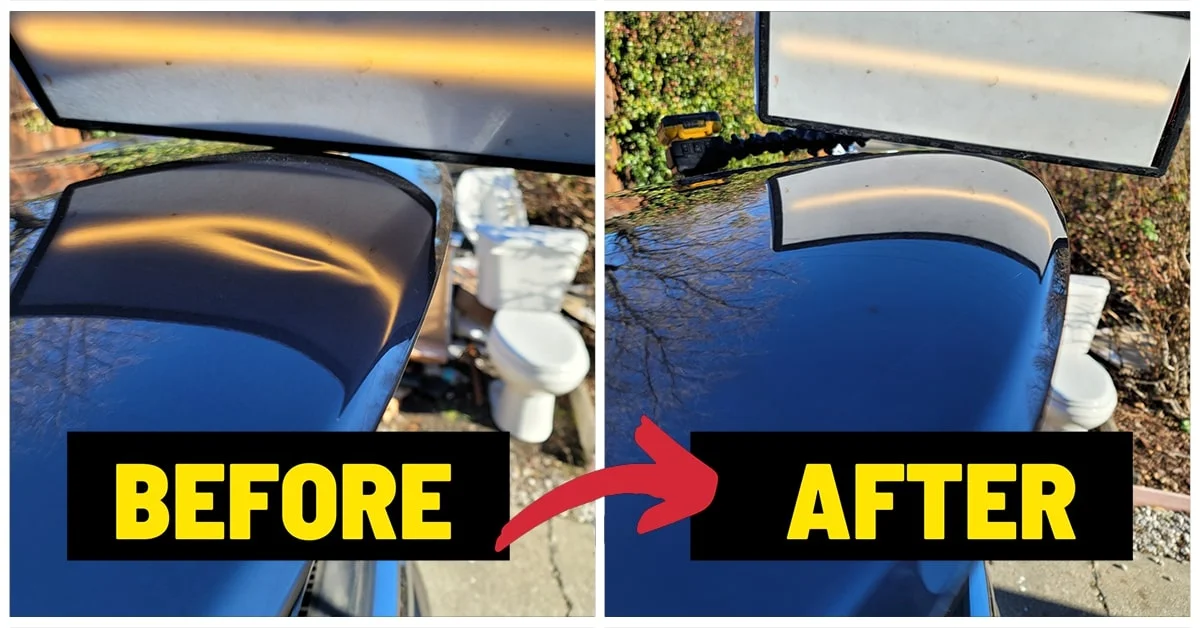
Using Suction to Remove Tiny Dents from Car Doors
The humble household plunger isn’t just for the bathroom. For a broad, shallow dent on a door or fender, a cup-style plunger (the one with the flat bottom, not the beehive shape) can create enough vacuum to pull the metal back.
To remove tiny dents from car surfaces with this method:
- Clean the area thoroughly. Any dirt will break the seal and could scratch your paint.
- Wet both the plunger rim and the car panel to create a better airtight seal.
- Push the plunger in slowly to burp the air out, then give it a firm, steady pull.
- Avoid violent jerking, which can cause the metal to “oil can” (pop back and forth) and create a permanent ripple.
If the plunger is too big, you can find dedicated automotive suction cups at local auto parts stores for under $20. For more complex dings, a DIY guide for small dents might suggest using a vacuum cleaner attached to a modified plastic bucket, though this requires a bit more “MacGyver” spirit.
Step-by-Step Guide: Fixing Dents on Plastic vs. Metal
The material of the dented panel dictates the repair method. Metal has “memory,” while plastic (used in almost all modern bumpers) is thermoplastic, meaning it becomes pliable when heated.
Repairing Plastic Bumpers with Heat
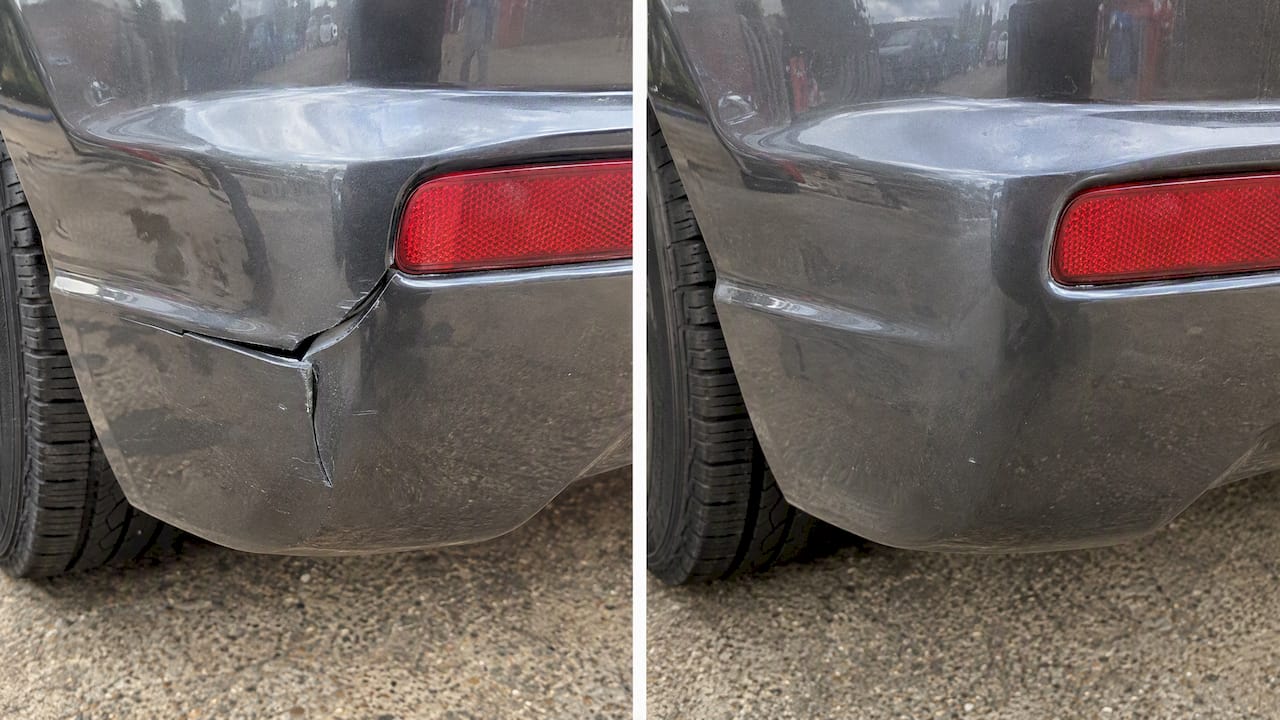
Bumpers are designed to absorb impact, but they often stay “pushed in” after a low-speed bump. Because they are plastic, they don’t respond well to suction alone.
- Step 1: Soften: Pour a kettle of boiling water over the dented area. This softens the plastic significantly.
- Step 2: Reach Behind: Reach behind the bumper (you may need to unscrew a few clips on the splash guard).
- Step 3: Push: Using a gloved hand or the rounded end of a wooden spoon, gently push the dent outward.
- Step 4: Set: Once the dent is out, pour cold water over the area to “lock” the plastic back into its original shape.
This is a great way to handle 10 common dents and how mobile repair can fix them.
Working with Steel and Aluminum Panels
Metal panels require a more delicate touch. If you have access to the back of the panel, you can try to “massage” the dent out. Professional PDR technicians use specialized steel rods, but a DIYer can sometimes use a rubber mallet and a wooden block wrapped in a microfiber towel.
The secret is to work from the outside in. Don’t just hit the center of the dent; that will stretch the metal and create a “high spot” (a bump sticking out). Instead, lightly tap the shallowest parts of the dent, gradually moving toward the center. This preserves the Paintless Dent Repair integrity of the panel.
If you fix small dents at home, always check your progress under a bright light held at an angle. This will show you the “shadows” of the dent, helping you see where the metal is still uneven.
The Risks of DIY and the Benefits of Professional PDR
While fixing a dent yourself is satisfying, it isn’t without risk. The most common mistake is over-correction. If you pull or push too hard, you create a “high spot.” High spots are much harder to fix than dents because the metal has been stretched beyond its elastic limit.
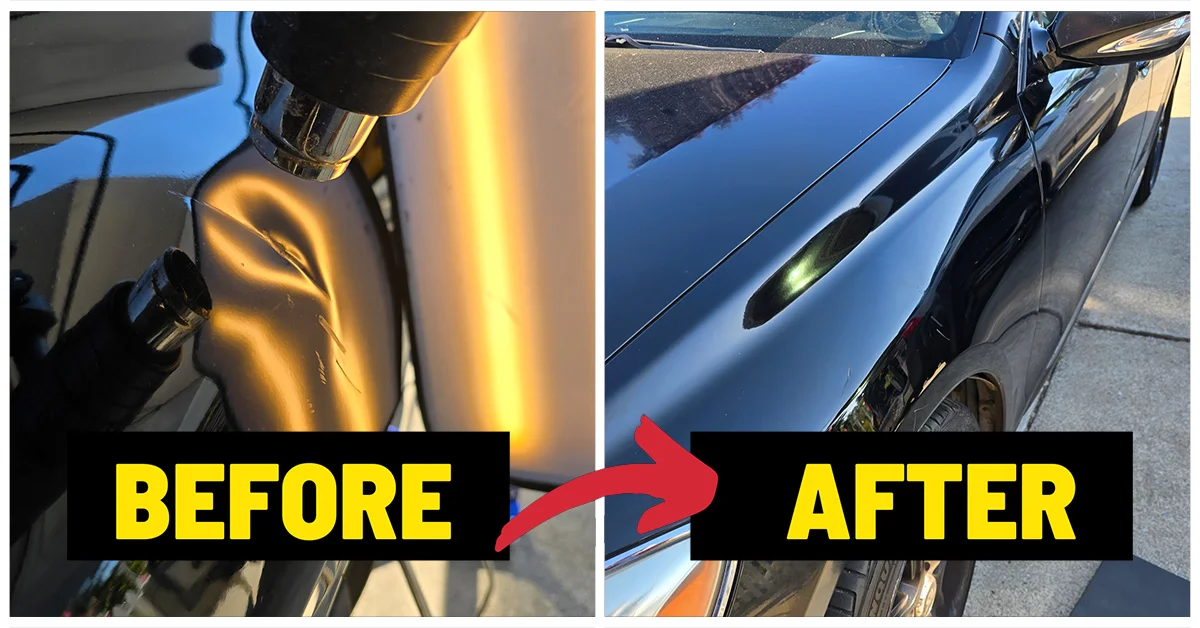
Another risk is paint cracking. Modern car paint is flexible, but it has limits. If you apply too much heat or cold, or if you bend the metal too sharply, the clear coat can shatter. This exposes the metal to rust and significantly lowers the car’s value. There are 5 benefits of paintless dent removal for car owners that DIY simply can’t match, including the use of professional-grade LED reflective boards to ensure the metal is perfectly flat.
Why Professional Paintless Dent Repair is Often the Better Choice
When you hire a professional, you aren’t just paying for a tool; you’re paying for the “eye” and the “feel” developed over thousands of repairs. At Dent Erasers LLC, we use specialized stainless steel rods and “picks” to get behind braces and double-walled panels that are impossible for a DIYer to reach.
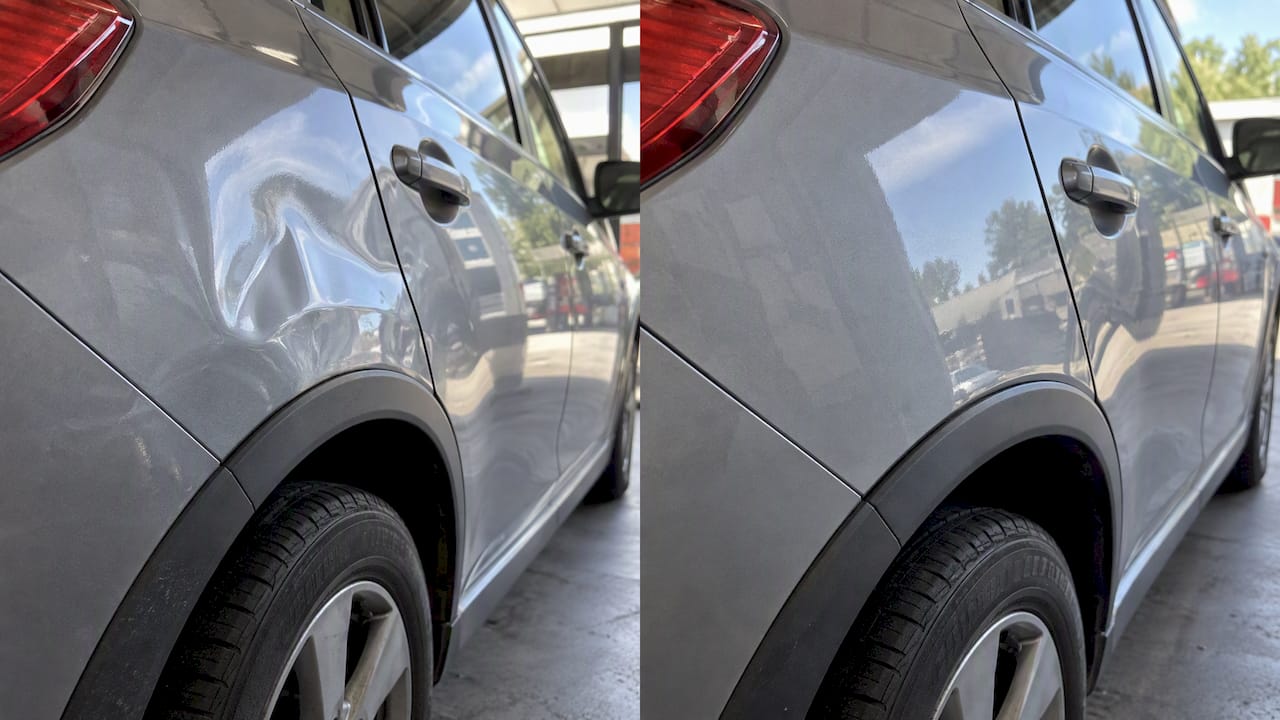
What is Paintless Dent Repair? It is a craft that restores your car to 100% original condition. Unlike body shops, we don’t use Bondo, fillers, or aftermarket paint. This means your factory corrosion protection remains intact, and there’s no risk of “mismatched” paint colors under the California sun.
Frequently Asked Questions about Small Dent Removal
How much does professional PDR cost for a single micro-dent?
For a single “quarter-sized” dent, professional PDR typically ranges from $50 to $200. The price depends on the dent’s location (is it behind a brace?) and the material (aluminum costs more than steel). Most technicians, including us at Dent Erasers LLC, offer volume discounts. If you have three or four “parking lot dings,” the price per dent drops significantly. This is often much cheaper than a traditional Large Dent Repair at a body shop, which can easily exceed $500.
Does dry ice really work to remove tiny dents from car surfaces?
Dry ice works on the same principle as the compressed air method—thermal shock. While it can work on very shallow, large-surface-area dents (like hail damage on a roof), it is rarely effective on smaller, sharper dings. Furthermore, handling dry ice requires heavy gloves and safety gear. If left on the paint too long, it can actually cause the paint to become brittle and crack. Before trying this, consult the complete paintless dent removal checklist.
Can a household plunger fix a creased dent?
In short: No. A plunger relies on vacuum pressure to pull a “popped-in” panel back out. A crease represents a structural change in the metal—it’s like a fold in a piece of paper. You can flatten the paper, but the line remains. A creased dent requires a technician to “read” the metal and use specialized tools to move the metal back into place millimetre by millimetre.
Conclusion
To remove tiny dents from car panels is a great way to take pride in your vehicle and maintain its value. Whether you’re using the hairdryer method on a fender or boiling water on a bumper, the key is to stay within your comfort zone. If the dent is sharp, located on a body line, or if you’re working on a high-value luxury vehicle, the DIY risk often outweighs the reward.
At Dent Erasers LLC, we’ve spent nearly three decades perfecting the art of PDR. We provide expert, mobile service throughout Contra Costa County—from Concord and Antioch to San Ramon and Walnut Creek. We come to your home or office, preserving your factory paint and saving you time. Our repairs are typically completed in under an hour and are far more affordable than traditional body shop work.
If that “tiny” dent is giving you a big headache, don’t risk your paint. Give us a call for a fast, affordable, and perfect Paintless Dent Repair. We’ll make that ding disappear like it never happened.