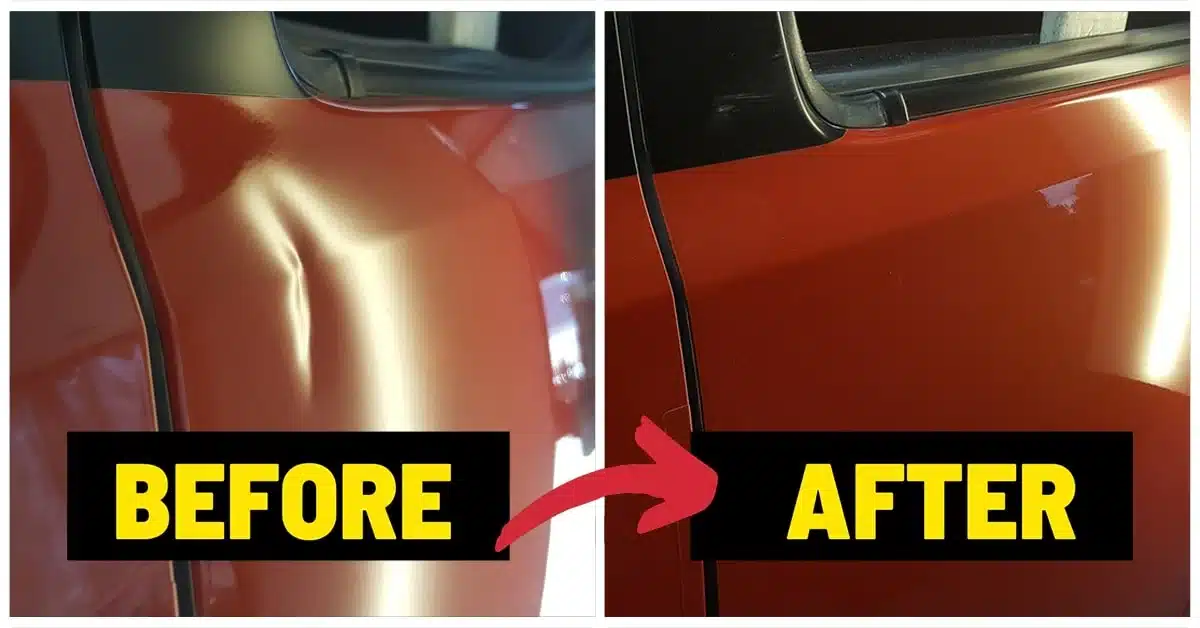
Fender Dents Are More Common Than You Think — Here’s What to Do
Removing a dent from a fender is something most car owners will need to deal with at least once. Whether it’s a shopping cart in a parking lot or a minor bump during a tight parallel park, fender and wheel arch dents are frustratingly common.
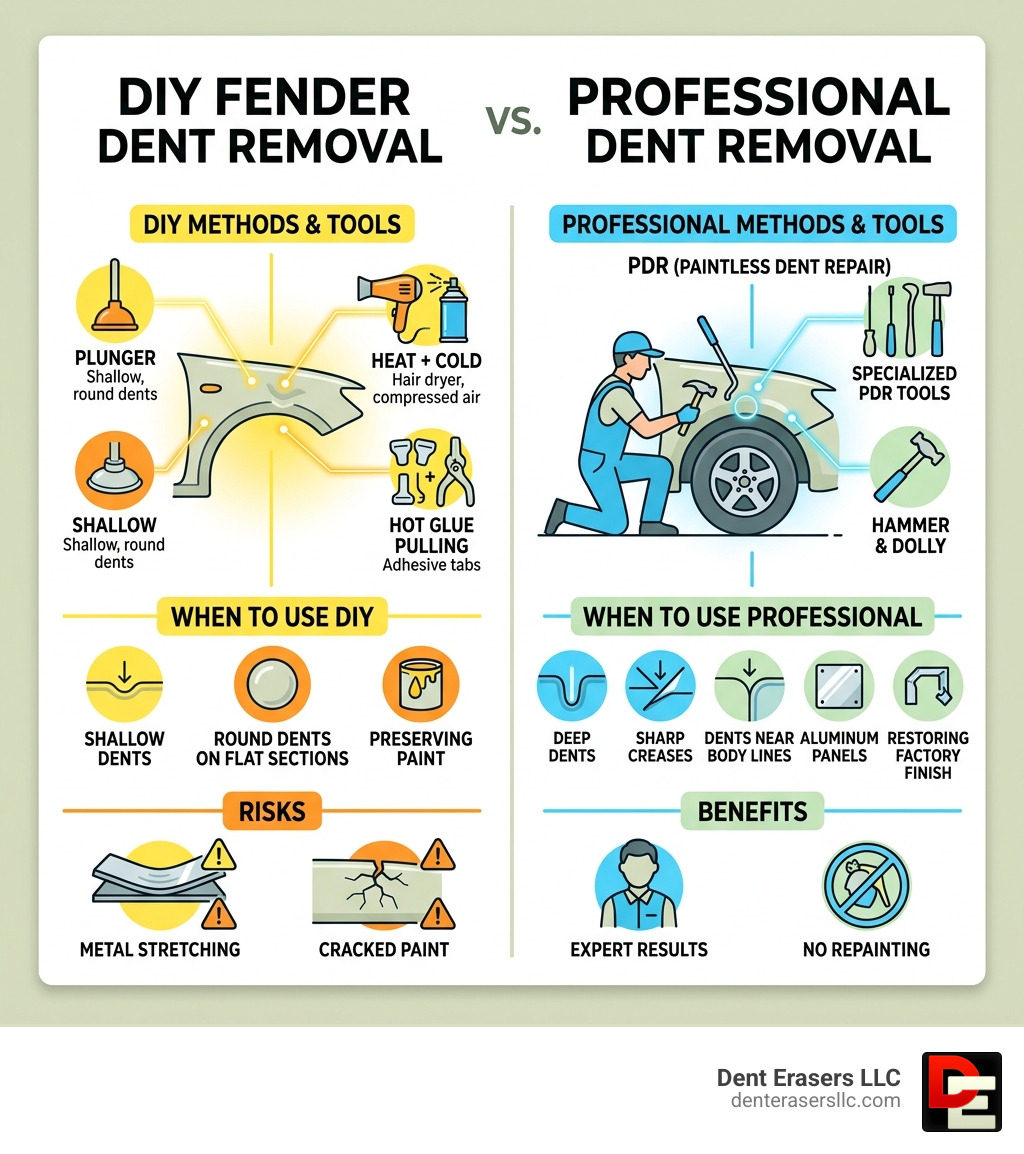
Here are the most effective ways to remove a dent from a fender:
- Plunger method — Best for shallow, round dents on flat sections
- Thermal expansion (heat + cold) — Use a hair dryer then compressed air to pop out minor dents
- Hot glue pulling — Attach an adhesive tab and pull; preserves paint
- Hammer and dolly — For traditional metalwork on deeper dents; works best off-dolly
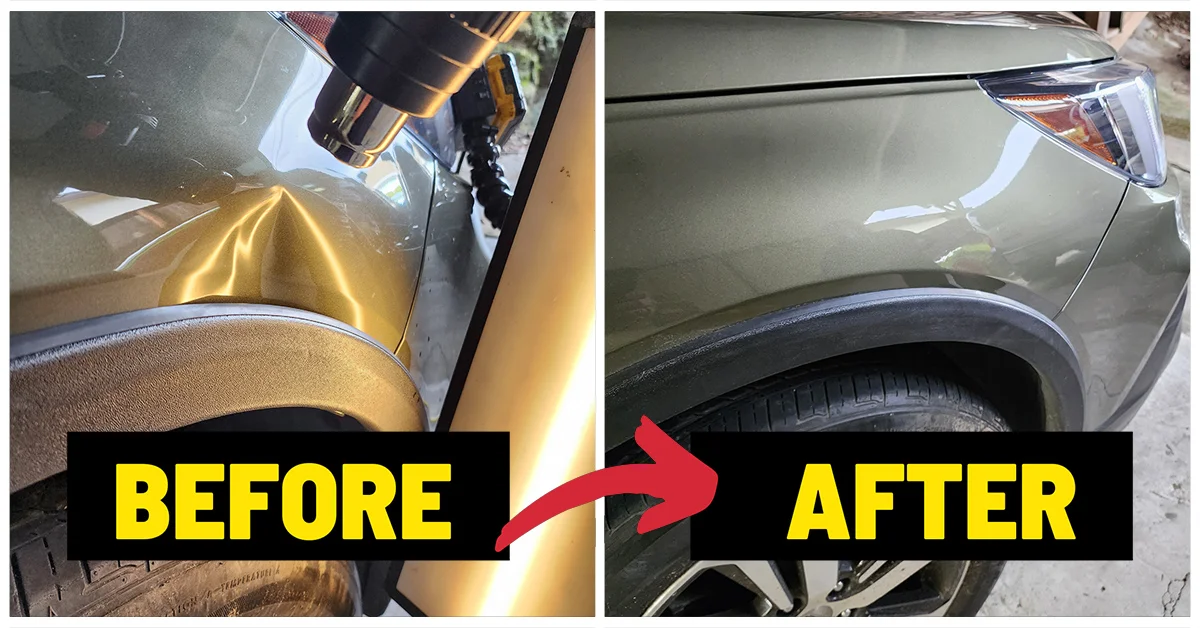
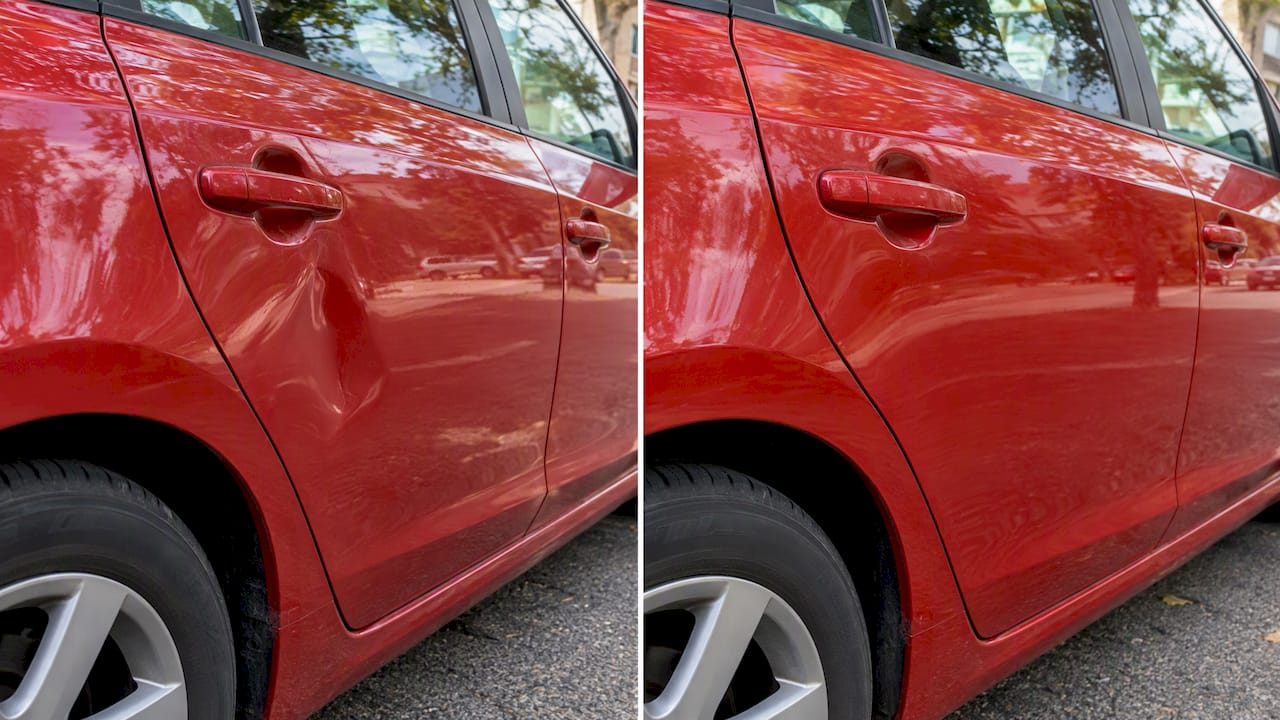
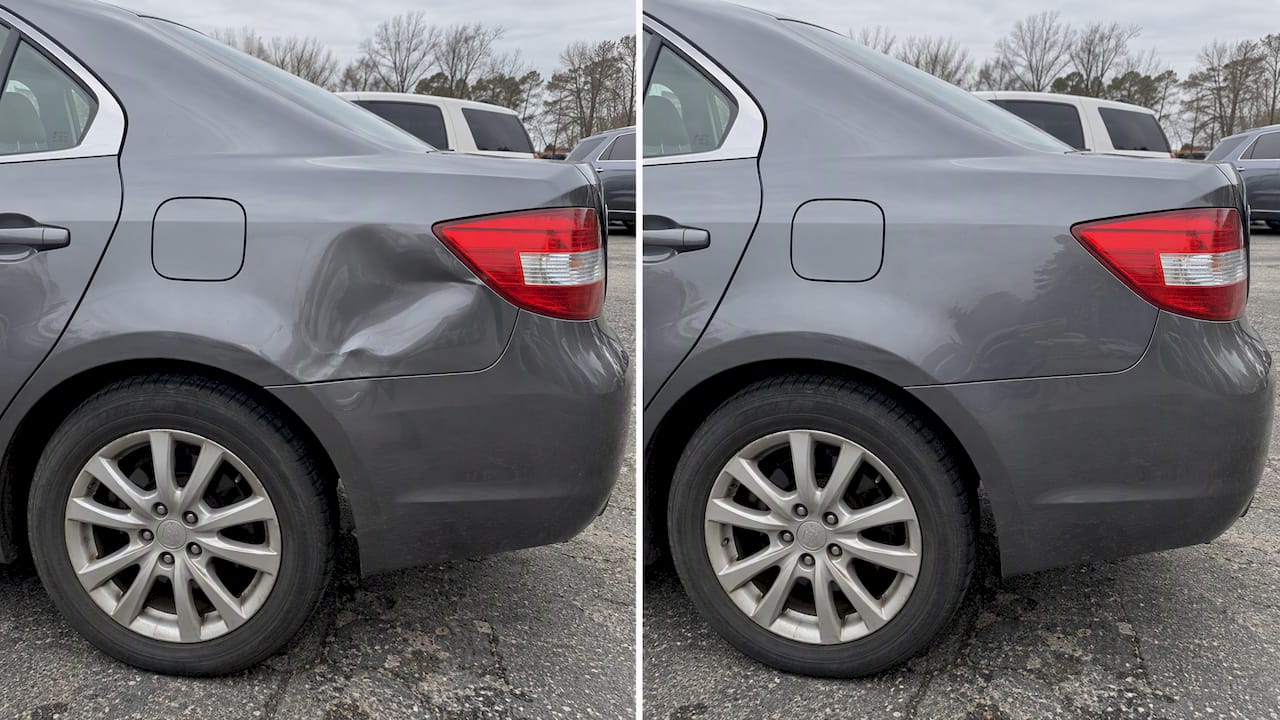
- Professional PDR (Paintless Dent Repair) — Best for any dent you want restored to factory finish without repainting
The right method depends on three things: how deep the dent is, whether the paint is cracked, and where on the fender or arch the damage sits.
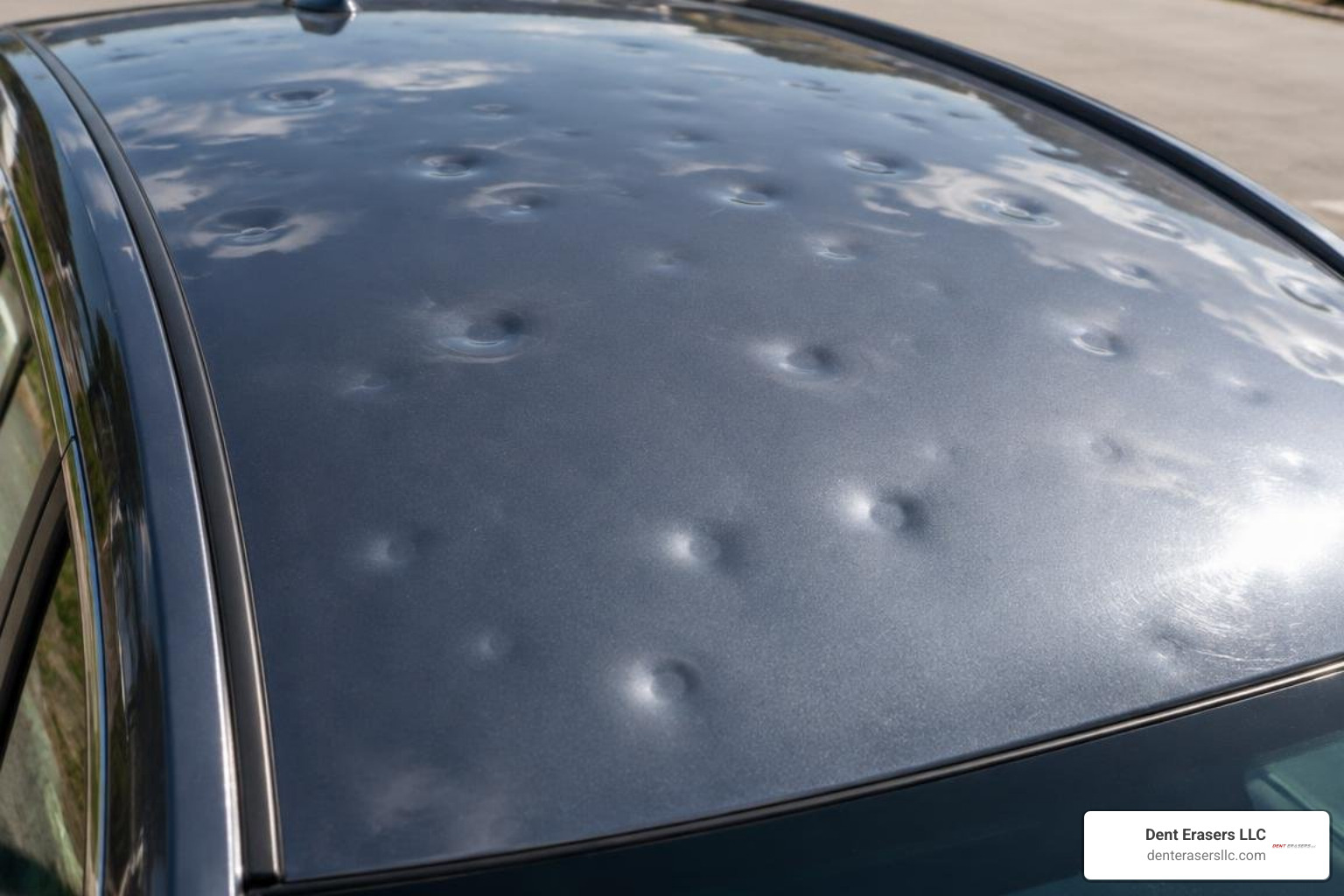
Nearly 77% of car owners deal with minor dents or scratches every year, and professional repairs often cost over $150 per dent — so it’s no wonder so many people look for DIY options first.
But not every dent is a good DIY candidate. Sharp creases, dents near body lines, and damage on aluminum panels all need a more careful approach. Rushing in with the wrong tool can stretch the metal or crack the paint, making the repair more expensive in the end.
I’m Brian Blanc, owner of Dent Erasers LLC and a master PDR technician with 28 years of experience removing dents from fenders and all types of vehicle panels across the East Bay Area. In this guide, I’ll walk you through every method — from simple household tricks to professional techniques — so you can make the smartest call for your car.
How to Remove Dent from Fender: Assessing the Damage
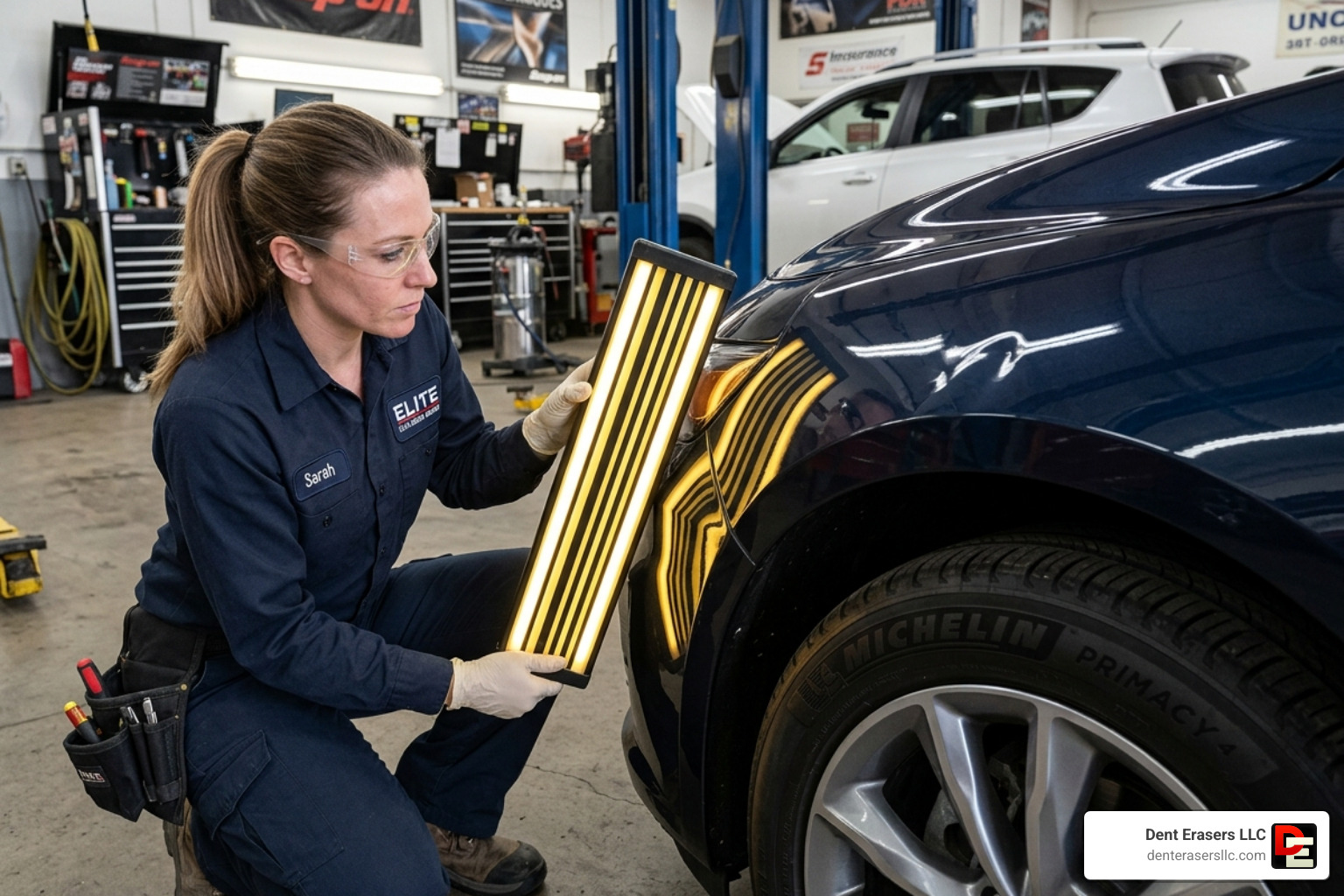
Before you grab a tool or heat up the kettle, you need to be a bit of a detective. Not all damage is created equal. When we arrive at a job in Concord or San Ramon, the first thing we do is perform a thorough visual inspection. We often use specialized LED light boards to see how the light reflects off the metal. If the lines of light are straight, the panel is flat; if they wavy or “pinched,” we know exactly where the tension is held.
You should look for three main things:
- Paint Integrity: Is the paint cracked, flaked, or scuffed? If the paint is broken, a DIY puller might rip more paint off.
- Location: Is the dent on a flat part of the fender, or is it right on the “body line” (that sharp crease designed into the car’s shape)? Body lines are much stronger and harder to move.
- Depth and Shape: A shallow “soft” dent is like a pushed-in plastic bottle—it wants to pop back. A sharp “creased” dent has actually stretched the metal.
According to traditional metalworking guides like Removing Dents From Your Fender, dents actually spread wider and deeper from the initial point of contact. This means the damage you see on the surface often involves tension in the surrounding metal that you can’t see at first glance.
Identifying Sharp Creases vs. Shallow Dings
Think of your fender like a piece of paper. If you gently curve it, it bounces back. If you fold it sharply, you’ve created a permanent crease. In auto body repair, a shallow ding is a “low spot” without a sharp fold. These are the primary candidates for DIY methods.
However, if the impact was sharp—like the corner of a car door or a bicycle handlebar—it creates a crease. This involves “metal stretching,” where the surface area of the metal has actually increased. If you simply try to pop a crease out, you’ll often end up with an “oil can” effect where the metal won’t stay flat because there is now “too much” metal for the space. As noted in this guide to fender repair tools, these require precision tapping to “shrink” the metal back into place.
Material Matters: Steel vs. Aluminum Fenders
In April 2026, we see a lot of modern vehicles on the roads of Walnut Creek and Danville. Many of these newer trucks and luxury SUVs use aluminum fenders to save weight.
- Steel: This is the “old school” material. It has a great “memory” and is generally easier to pull back into shape.
- Aluminum: This is much more stubborn. Aluminum doesn’t have the same “memory” as steel and is prone to “work hardening”—meaning the more you mess with it, the more brittle and stiff it becomes. Aluminum also dissipates heat very quickly, which makes thermal methods less effective.
If you aren’t sure what your fender is made of, try a refrigerator magnet. If it sticks, it’s steel. If it falls off, you’re likely dealing with aluminum or plastic.
DIY Methods for Shallow Fender Dents
If you’ve assessed the damage and decided it’s a simple, shallow “pop-in” dent, you might want to try a home remedy. These methods are low-cost and rely on basic physics to remove dent from fender surfaces.

Step-by-Step: Using a Plunger to Remove Dent from Fender
The plunger method is the oldest trick in the book, but it only works on large, shallow dents on relatively flat panels. It won’t work on the tight curves of a wheel arch.
- Clean the Area: Use detailing spray and a microfiber cloth to remove any wax or dirt. You need a perfect seal.
- Moisten the Rim: Use a little water or even a bit of petroleum jelly on the rim of a cup-style plunger (not the flange type used for toilets).
- The Pull: Push the plunger in slowly to burp the air out, then pull straight back with a firm, steady motion.
- Repeat: It may take 5 or 6 tries to get the metal to “snap” back into its original memory.
We’ve seen cases where this works brilliantly, like in this precision fender restoration, though professional tools usually provide a much cleaner finish.
The Thermal Expansion Technique
This method uses the power of molecular contraction. By heating the metal and then rapidly cooling it, you can sometimes trick the metal into snapping back to its original shape.
- The Heat: Use a hair dryer (not a high-powered heat gun, which can scorch your clear coat!) to heat the dent for about 2 minutes. The metal should be hot to the touch but not burning.
- The Cold: Immediately spray the area with a can of compressed air held upside down (this releases freezing liquid CO2) or apply a block of dry ice.
- The Pop: The rapid change from hot to cold causes the metal to contract quickly. If you’re lucky, you’ll hear a “pop” as the dent disappears.
For more details on this, check out this blog on pulling out dents without professional help.
Advanced Techniques: Hammer, Dolly, and Glue Pulling
When the plunger fails, you’re moving into the realm of actual bodywork. This requires more specialized tools and a lot more patience.
The ‘Last In, First Out’ Principle
This is the golden rule of dent repair. A dent is a sequence of events: the impact hits one spot, and the energy ripples outward. To fix it, you have to reverse that sequence. You don’t start by hitting the center of the dent (the “last” part of the impact). Instead, you start at the outer edges—the “first” part of the damage—and work your way inward in a spiral. This releases the tension held at the perimeter, allowing the center to eventually return to its home.
Using a Hammer and Dolly to Remove Dent from Fender
If you can reach the back of the fender (often by removing the plastic wheel well liner), you can use a hammer and dolly.
- The Dolly: This is a heavy piece of shaped steel that you hold against the metal.
- Off-Dolly Method: This is what we recommend for fenders. You hold the dolly against a “low” spot on one side of the metal and strike a “high” spot (a ridge) nearby with the hammer. This uses the vibration and the dolly’s mass to lift the low spot without overstretching the metal.
- On-Dolly Method: This is where you hit the metal directly against the dolly. Be careful—this thins and stretches the metal, which can make a fender look “lumpy.”
We often use these techniques for quarter panel repairs as well, where access is tighter. You can see an example of a successful repair for a new driver’s mishap here.
Hot Glue Pulling for Paint Preservation
This is a favorite in the PDR industry. It allows us to remove dent from fender panels without ever touching the back of the metal.
- Select a Tab: We use plastic tabs of various shapes and sizes.
- Apply Glue: Special high-strength PDR glue is applied to the tab and pressed onto the center of the dent.
- The Pull: Once the glue sets (about 2-3 minutes), we use a “slide hammer” or a “mini-lifter” to pull the tab.
- Release: We use 99% isopropyl alcohol to instantly break the bond of the glue, leaving the paint perfectly intact.
Professional PDR vs. Home Repair
While DIY is tempting, there is a reason why professional Paintless Dent Repair (PDR) has become the gold standard. In the 2020s and now in 2026, car paint has become thinner and more environmentally friendly, but also more brittle.
| Feature | DIY Home Repair | Professional PDR (Dent Erasers) |
|---|---|---|
| Cost | $20 – $100 (Tools) | $150 – $500 |
| Time | 2 – 5 Hours | 1 – 2 Hours |
| Paint Risk | High (Cracking/Scorching) | Zero (Preserves Factory Finish) |
| Result | 70-80% Improvement | 99-100% (Factory Finish) |
| Resale Value | Can decrease if messy | Maintains original value |
Professional PDR technicians use “rods” and “whale tails”—long, specialized steel tools—to reach inside the fender and massage the metal back to its original position millimeter by millimeter. This level of precision is hard to replicate with a plunger and a hair dryer. You can see the difference in this windstorm damage repair.
When to Call a Pro to Remove Dent from Fender
We always tell our neighbors in Antioch and Pittsburg: “If you’re nervous, stop.” You should definitely call a professional if:
- The dent is on a body line: These require “knockdown” techniques to release pressure.
- The metal is “double-walled”: Many fenders have structural reinforcements behind them that prevent you from reaching the dent.
- The vehicle is luxury or classic: A 1960s classic has thick, heavy steel that requires significant force, while a new Mercedes has sensitive sensors behind the panels.
- The paint is already cracked: Attempting to pull a dent with cracked paint will almost certainly result in a large paint chip.
Safety and Common DIY Mistakes
We’ve seen it all—and usually, we’re called in to fix the “fix.”
- Overstretching: If you pull too hard, the metal “crowns” outward. This creates a “high spot” that is much harder to fix than a dent.
- Paint Scorching: Using a heat gun instead of a hair dryer can literally melt your clear coat in seconds.
- Lack of Bracing: If you are hammering on a fender that isn’t stable, you’re just bouncing the metal around, which can cause secondary dings elsewhere. Always work on a stable vehicle or use padding if the fender is off the car.
- Safety First: Always wear eye protection. When using glue pullers, tabs can occasionally fly off with significant force.
Frequently Asked Questions about Fender Repair
How much does professional fender dent repair cost in 2026?
In the East Bay Area, a standard mobile PDR repair for a fender typically ranges from $150 to $500. The price depends on the size of the dent and the material (aluminum usually costs about 25% more due to the difficulty). This is significantly cheaper than a traditional body shop, which might charge $1,500+ because they insist on sanding, filling, and repainting the entire panel.
Can I use a plunger on a creased wheel arch?
Short answer: No. A plunger requires a flat, airtight seal. The curve of a wheel arch prevents that seal from forming. Furthermore, a crease means the metal is “locked” in place; suction alone is almost never strong enough to “unlock” a crease. These usually require PDR rods to push from the inside.
Is boiling water safe for my car’s clear coat?
Boiling water is generally safe for the plastic bumpers of modern cars (it helps them regain their shape), but we don’t recommend it for metal fenders. The heat isn’t concentrated enough to move metal, and the mess isn’t worth the risk. A hair dryer is a much more controlled heat source for metal panels.
Conclusion
Removing a dent from a fender doesn’t have to be a nightmare. If you have a shallow ding and a bit of “DIY spirit,” the plunger or thermal methods are worth a shot. But if you’re looking at a sharp crease, a dent on a body line, or you simply want your car to look like the accident never happened, professional PDR is the way to go.
At Dent Erasers LLC, we specialize in making those unsightly dings disappear while you’re at work or home. We provide mobile service throughout Contra Costa County, from Concord and Walnut Creek to Brentwood and San Ramon. Our goal is to preserve your car’s original factory paint, which keeps your resale value high and your repair costs low.
If you’re tired of looking at that dent, don’t wait for it to rust or for the paint to fail. Give us a call or visit our Paintless Dent Repair page to see how we can help you get your “arch support” back today!