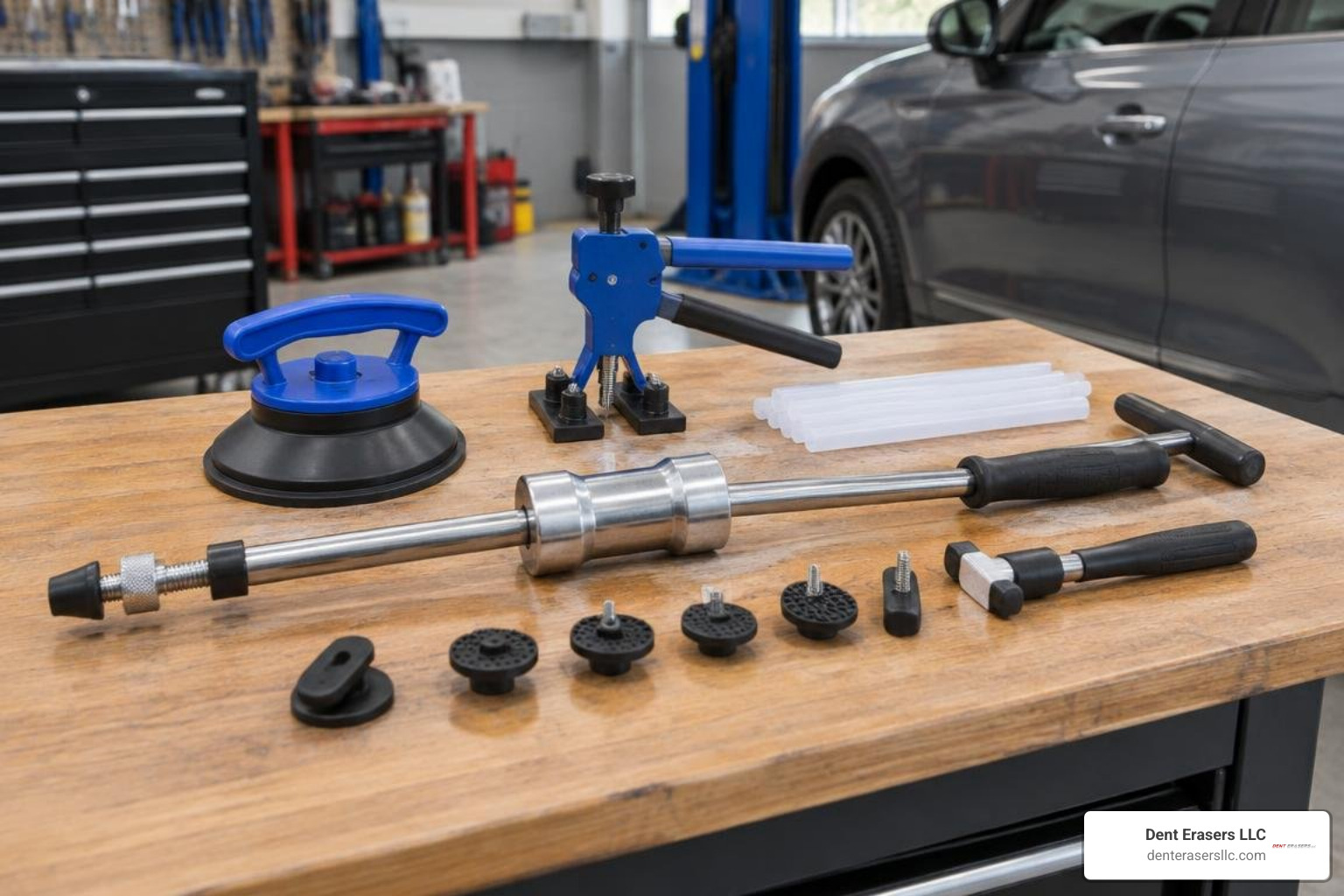
Which O’Reilly Dent Puller Is Right for Your Dent?
O’Reilly Auto Parts lists the OTC Body and Fender Dent Puller 898A and OTC Dent Puller Adapter 205377. Its Loaner Tool Program also offers puller tools with a refundable deposit. Check your local store before you go: a listed product is not always available to borrow.
For a shallow dent with intact paint, a suction cup or glue puller may be worth considering. A slide hammer is better suited to bodywork that may need paint repair. The right choice depends on the dent, not just the tool’s pulling power. If you are comparing a dent puller O’Reilly’s stocks with other options, the key is matching the tool to the panel damage.
I’m Brian Blanc, owner of Dent Erasers LLC, and I’ve spent 28 years repairing dents while protecting factory finishes. Choosing the right dent puller at O’Reilly’s comes down to panel accessibility and finish protection, and I’ll help you sort out which tools fit a DIY job and when to leave the panel to a pro.
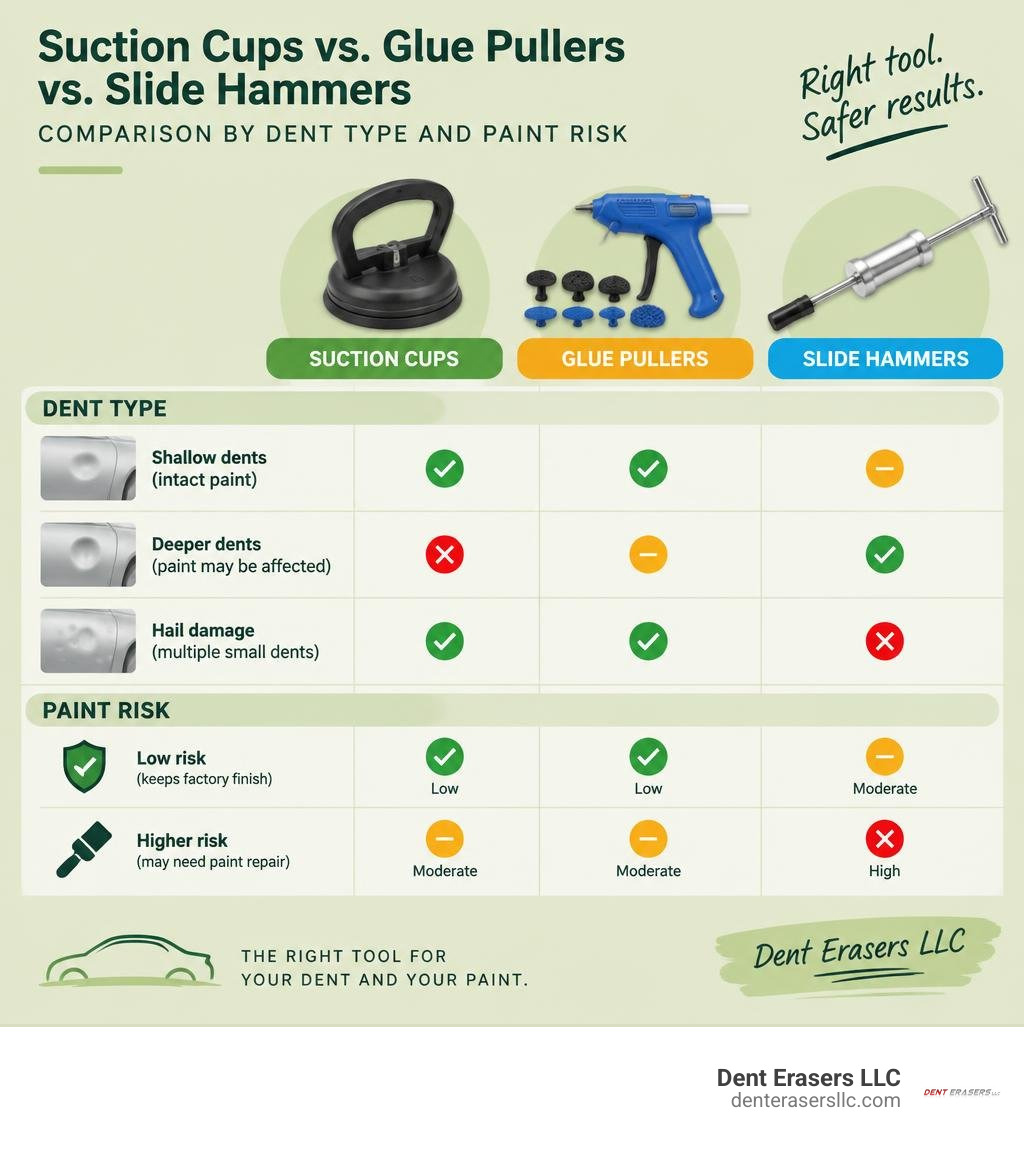
Helpful dent repair resources:
Dent Puller O’Reillys Tool Catalog: What’s Available to Buy or Rent?
When shopping for dent repair equipment at O’Reilly Auto Parts, you will encounter several distinct categories of bodywork tools. Whether you are browsing their retail shelves for permanent purchase or browsing their specialty tool inventory, choosing the correct category determines whether your vehicle’s paint survives the process intact.
| Tool Type | Primary Mechanism | Paint Finish Impact | Best For | Typical Availability |
|---|---|---|---|---|
| Mechanical Lever Puller | Threaded mechanical screw / leverage feet | Requires bodywork prep or repainting | Deep creases, thick gauge metal | In-Store / Online Retail |
| Slide Hammer & Adapter | Impact weight on a threaded shaft | Pierces sheet metal or grabs welded studs | Severe structural dents, collision repair | Retail & Loaner Program |
| Suction Cup Pullers | Vacuum seal leverage | Preserves factory paint | Shallow, broad dings with flat surfaces | Retail Floor Purchase |
| Glue Puller Systems | Hot melt adhesive and bridge tension | Non-invasive, preserves paint | Hail damage, minor door dings | Specialty / Retail |
When selecting tools for smaller dings, reading a guide to dent pullers for small dents helps establish realistic expectations before applying mechanical force to sheet metal.
OTC Body and Fender Dent Puller 898A
The OTC Body And Fender Dent Puller – 898A is a heavy-duty mechanical tool tailored for auto body specialists and serious DIYers tackling rigid metal. Retailing around $199, this tool relies on controlled mechanical leverage via sturdy support feet and a central pulling screw to draw out low spots in fenders and quarter panels.
Unlike lightweight suction cups that release under heavy load, the OTC 898A delivers substantial pulling force. It is engineered for traditional bodywork where panels require reshaping prior to filler work or priming. For broader depressions across flexible door skins, consulting our buyers guide to heavy duty suction and glue pullers will help you assess whether a non-invasive glue setup is a safer alternative for preserving your clear coat.
OTC Dent Puller Adapter 205377 & Slide Hammers
The OTC Dent Puller Adapter – 205377 serves as a bridge between specialty bodywork attachments and standard slide hammers. Threaded directly onto the end of a slide hammer shaft, this adapter allows technicians to connect various pulling tips, screws, or stud grippers.
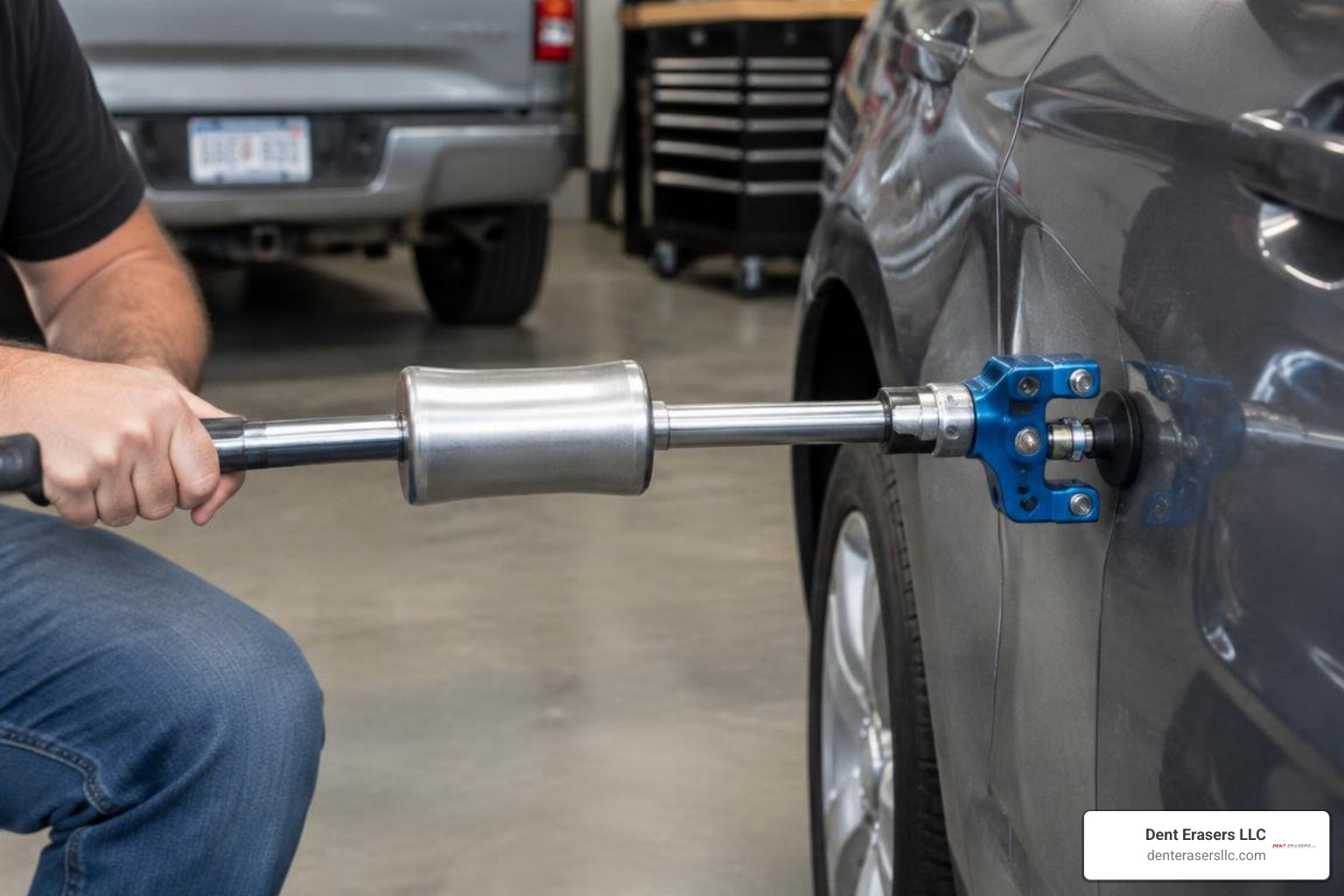
Slide hammers utilize a weighted sleeve sliding along a steel rod to deliver sharp outward kinetic strikes. When paired with part 205377, the tool delivers concentrated, repeatable impacts directly to stubborn metal creases. That traditional slide hammer attachments often require drilling a pilot hole or welding temporary pull pins to the metal—methods that permanently compromise the factory paint coat.
Dent Puller vs. Pulley Puller: Key Differences
It is common for DIYers new to auto repair to confuse body dent pullers with engine pulley pullers when browsing O’Reilly’s extensive catalog. While both rely on mechanical leverage and forcing screws, their applications are completely different:
- Dent Pullers: Built with wide support pads or vacuum seals designed to distribute weight across automotive sheet metal while gently lifting sunken panels.
- Pulley Pullers: Engineered with narrow, ultra-strong forged steel jaws to grip press-fit engine parts like power steering pumps, alternators, and harmonic balancers.
Attempting to use a mechanical gear puller on body sheet metal will punch holes straight through the panel, while a dent puller lacks the tensile strength to remove press-fit engine components. For mechanical engine work, review How To Use A Pulley Puller and Installer Rental Tool to follow proper service procedures safely.
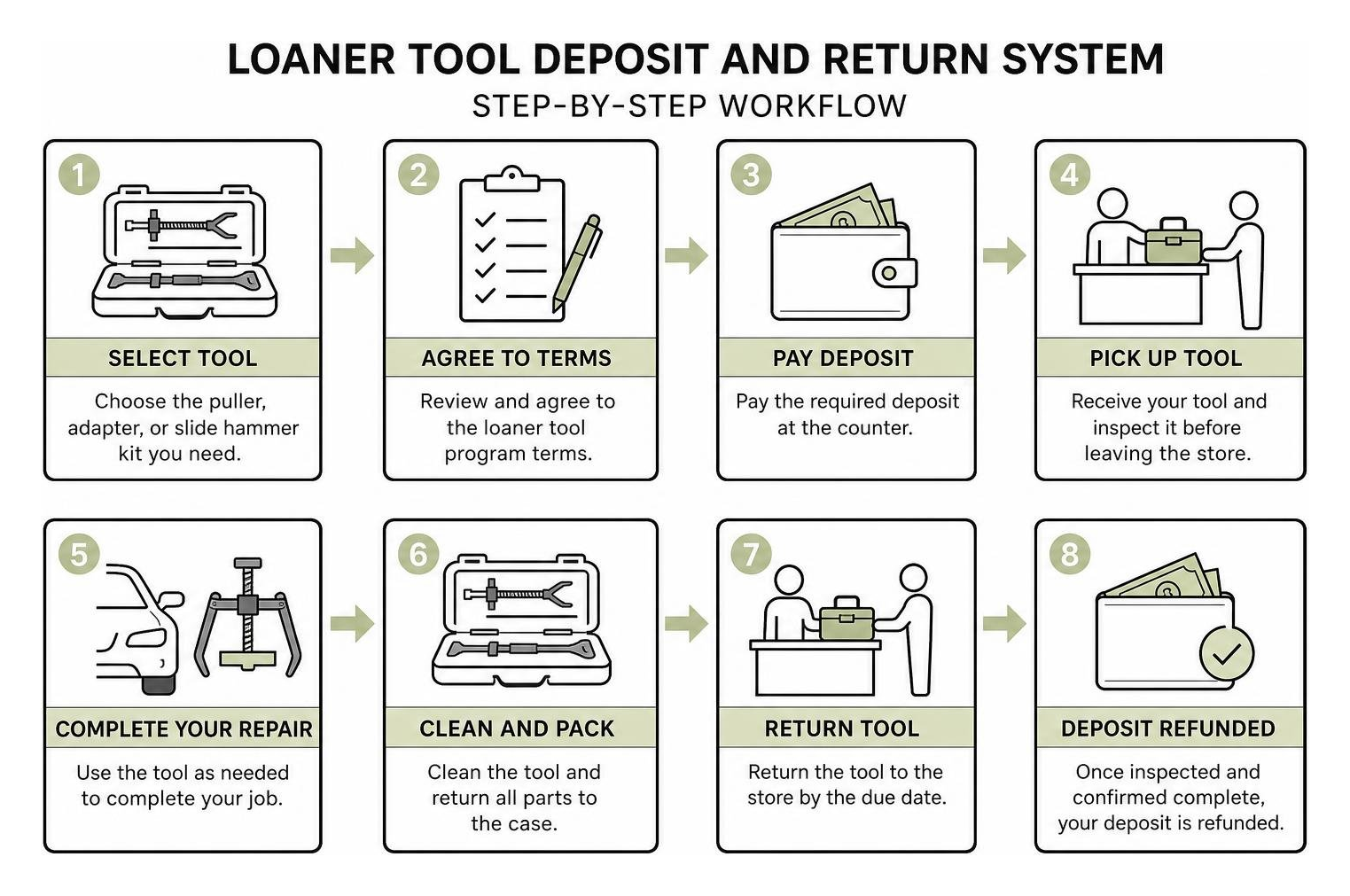
How O’Reilly’s Loaner Tool Program Works for Body Repair
Purchasing professional-grade auto body tools for a one-time project can quickly become expensive. O’Reilly solves this dilemma through their Loaner Tool Program, which allows DIYers and mechanics to borrow professional specialty gear without long-term investment.
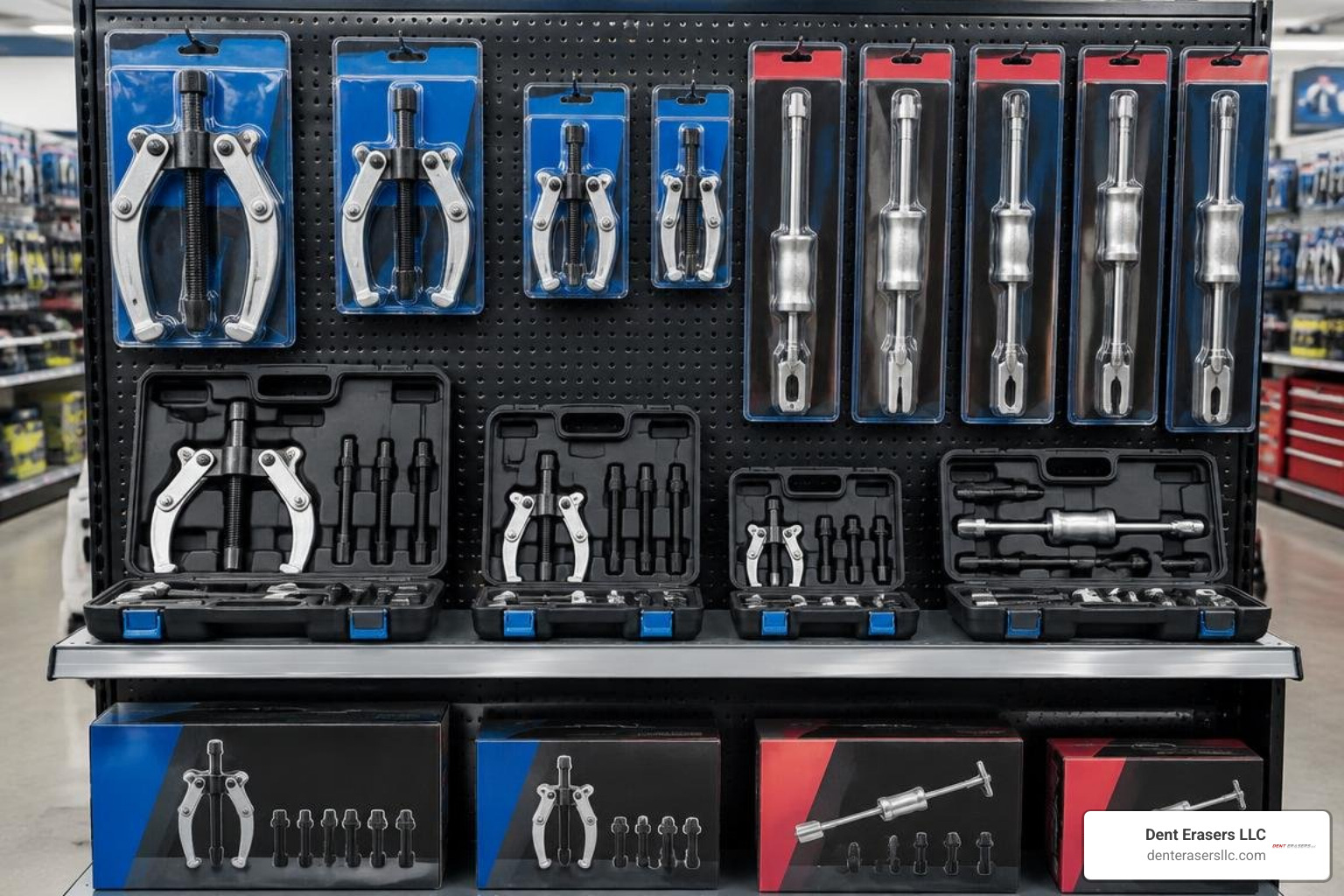
Understanding the rental process ensures you get the exact tools needed for the job:
Before undertaking a repair, exploring professional car dent repair kits can help you decide whether loaner equipment or a dedicated DIY kit best suits your vehicle.
Exploring the Dent Puller O’Reillys Loaner Tool Program
The Puller Rental Tools with O’Reilly Loaner Tool Program provides access to over 80 professional-grade specialty tools. The program operates on a straightforward deposit structure:
- Deposit Payment: You pay a deposit at checkout equal to the retail purchase price of the tool.
- Project Completion: You take the tool home and complete your body or mechanical repair.
- Full Refund or Purchase: Return the tool clean and undamaged with its case for a 100% refund of your deposit. If you decide you want to keep the tool permanently, simply keep it—your initial deposit covers the purchase price.
Complementary Rental Tools for Auto Body and Fender Projects
When repairing damaged sheet metal, auxiliary tools from the loaner program make the job significantly smoother:
- 3-lb Slide Hammer Kits: Ideal for pairing with adapters for controlled, incremental pulling.
- 2-Ton and 5-Ton Mechanical Pullers: Useful for aligning heavy inner brackets and structural supports behind damaged panels.
- Pitman Arm and Tie-Rod Tools: Essential when inner fender damage requires disconnecting steering linkage to gain clear tool access to the panel’s reverse side.
How to Use Auto Body Pullers for Fender and Panel Repair
Using a mechanical puller requires patience, proper alignment, and gradual pressure. Rushing the process can easily stretch the metal beyond its elastic limit, causing high spots that are far harder to fix than the original dent. Knowing how to pop out large dents safely begins with disciplined prep and careful setup.
Safety Precautions and Essential Prep Materials
Before mounting any pulling hardware to your vehicle, gather the following essential materials:
- Personal Protective Equipment: Safety glasses and durable nitrile gloves to protect against metal shavings and sudden tool release.
- Surface Cleaners: Isopropyl alcohol and micro-abrasive cleaners to remove road film, wax, and grease from the repair area.
- Panel Marking Pencils: Water-soluble grease pencils to mark the center of the dent and the outer perimeter of the crown.
- Tension Gauges / Wrenches: Correctly sized open-end and socket wrenches (such as 5/8″, 13/16″, or 9/16″) to turn forcing screws smoothly without rounding the hex heads.
Step-by-Step Guide to Using a Dent Puller from O’Reillys
Follow these steps to safely reshape auto body metal using a mechanical leverage puller:
- Clean and Map the Damage: Wash the panel thoroughly. Use cross-lighting or a reflection board to identify the deepest point (the low) and the outer tension ridges (the crowns).
- Position the Support Feet: Place the broad bridge feet of the puller onto solid, undamaged sheet metal outside the dent zone. Ensure the rubber or plastic protective pads rest squarely against the panel to avoid causing secondary gouges.
- Attach the Center Puller: Secure your pulling attachment—whether a glued tab, threaded stud, or bridge adapter—directly to the lowest center point of the dent.
- Engage the Forcing Mechanism: Thread the central puller shaft into the adapter. Slowly turn the forcing screw clockwise with an appropriate hand wrench, applying steady, incremental tension.
- Monitor Metal Flow: Watch the panel rise gradually. Do not attempt to pop the dent out with a single aggressive pull; instead, apply light tension, release, and check your panel profile.
- Knock Down High Tension Ridges: If the dent crowns stiffen, use a soft plastic tap-down tool and light hammer strikes to release tension along the outer perimeter while the center is under moderate load.
- Release and Inspect: Back off the forcing screw, remove the tool, and clean the panel to verify alignment against adjacent body lines.
Frequently Asked Questions About O’Reilly Dent Pullers
Can you rent a dent puller for free with O’Reilly’s loaner program?
Yes. The O’Reilly Loaner Tool Program is effectively free provided the tool is returned in clean, working condition with all its original components. You pay a refundable deposit up front, and upon return, the entire deposit is credited back to your original payment method.
What is the difference between a mechanical slide hammer and a suction dent puller?
Mechanical slide hammers utilize kinetic energy from a moving weight to jerk stubborn metal outwards, typically requiring threaded screws, spot-welded studs, or specialized adapters. Suction dent pullers use atmospheric pressure to grip smooth panels non-invasively, preserving the vehicle’s original paint.
Where can I find local O’Reilly store services and tool availability?
You can verify loaner tool inventory online through the O’Reilly Auto Parts website by selecting your local retail branch. For customers in Northern California communities such as Concord, Antioch, Walnut Creek, Brentwood, Danville, San Ramon, and Richmond, local branches maintain loaner inventory for immediate pickup.
Conclusion
O’Reilly’s Loaner Tool Program and retail inventory offer DIYers accessible, professional-grade equipment for tackling challenging auto body repairs. From mechanical leverage tools like the OTC 898A to slide hammer adapters, these tools deliver the mechanical force required to reshape stubborn steel.
However, mechanical dent pulling carries inherent risks of over-pulling, paint cracking, and metal stretching. When you want to restore door dings, crease damage, or hail impacts while preserving your vehicle’s pristine factory finish, DIY tools often reach their limit.
At Dent Erasers LLC, our mobile technicians bring 28 years of master-level craftsmanship directly to your driveway across Concord, Walnut Creek, Pittsburg, Martinez, Pleasant Hill, San Ramon, Danville, and surrounding Contra Costa County areas. We specialize in non-invasive, paintless dent repair for everyday drivers, classic restorations, and luxury vehicles at competitive rates ($150–$500). Explore our professional paintless dent repair services today to restore your car’s panels without body filler or repainting.