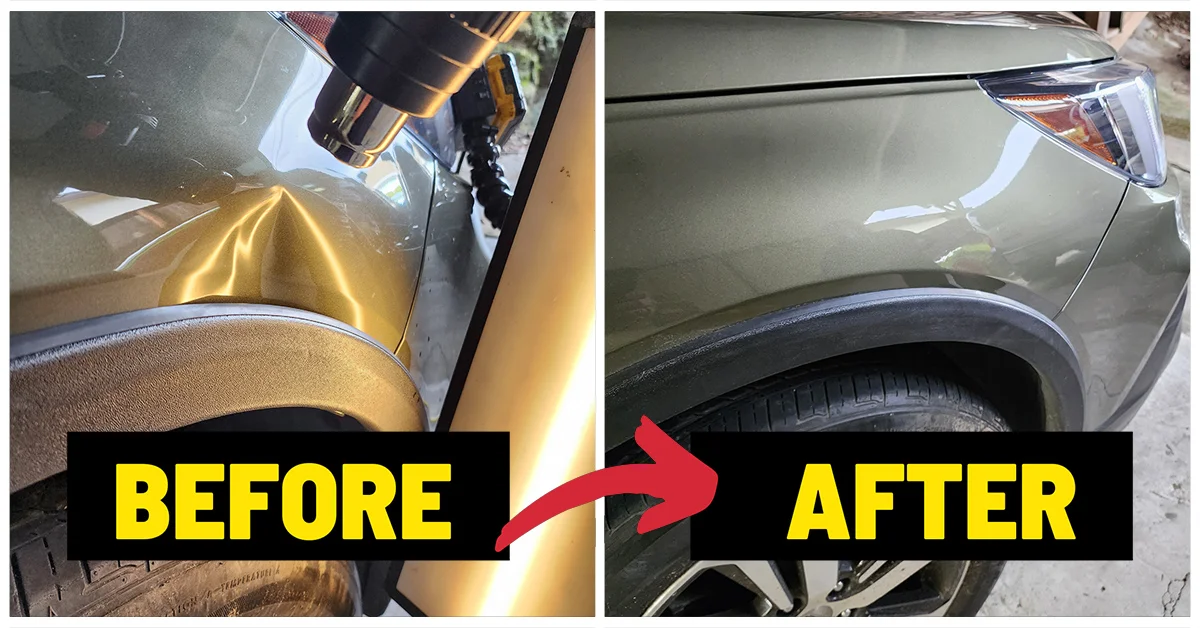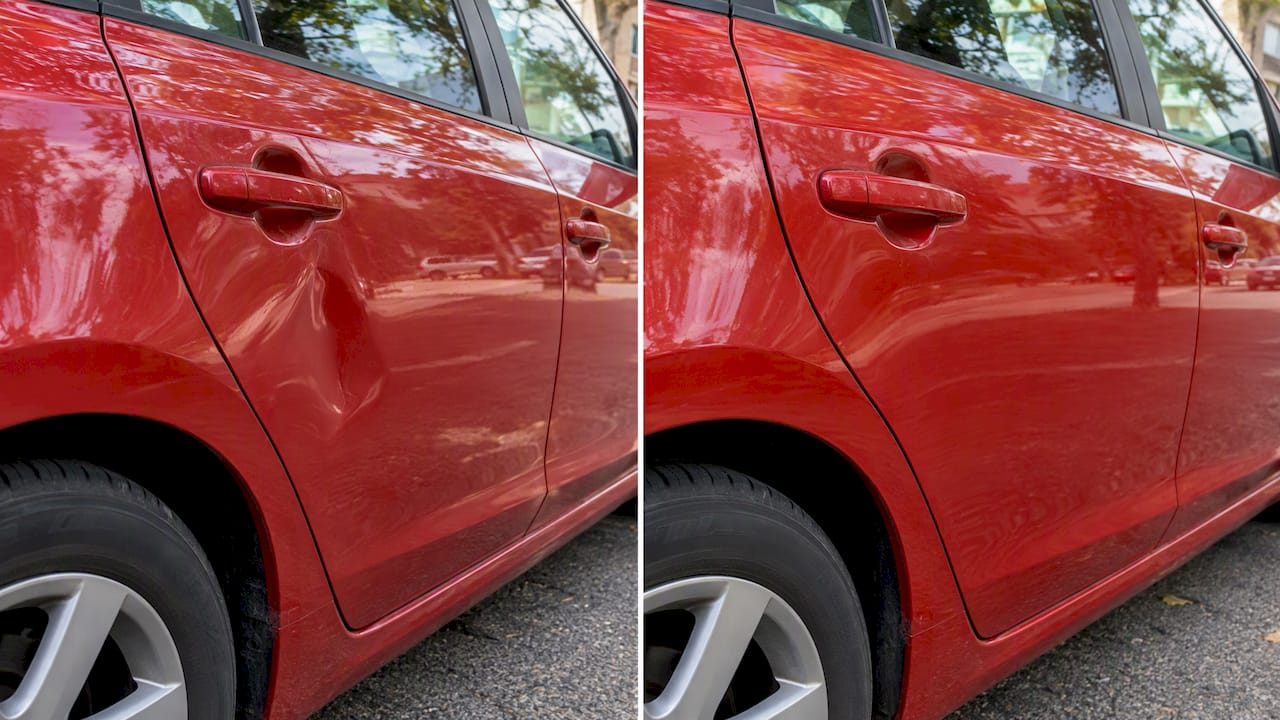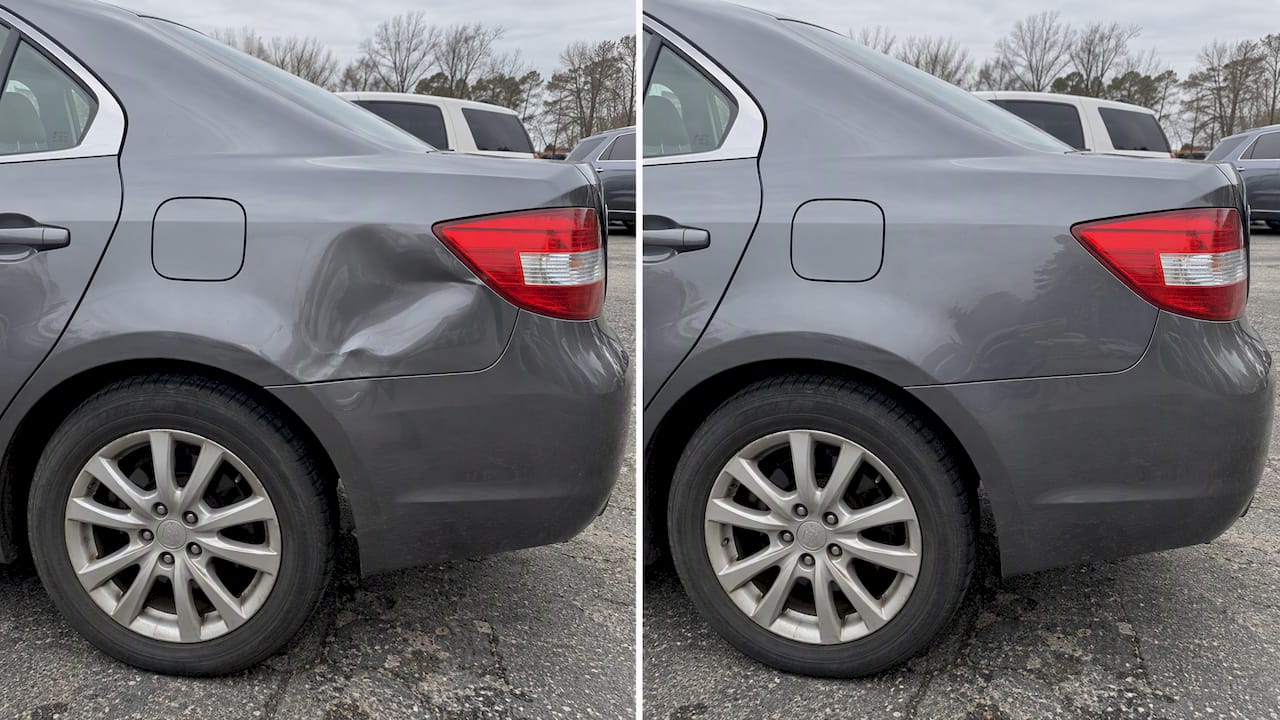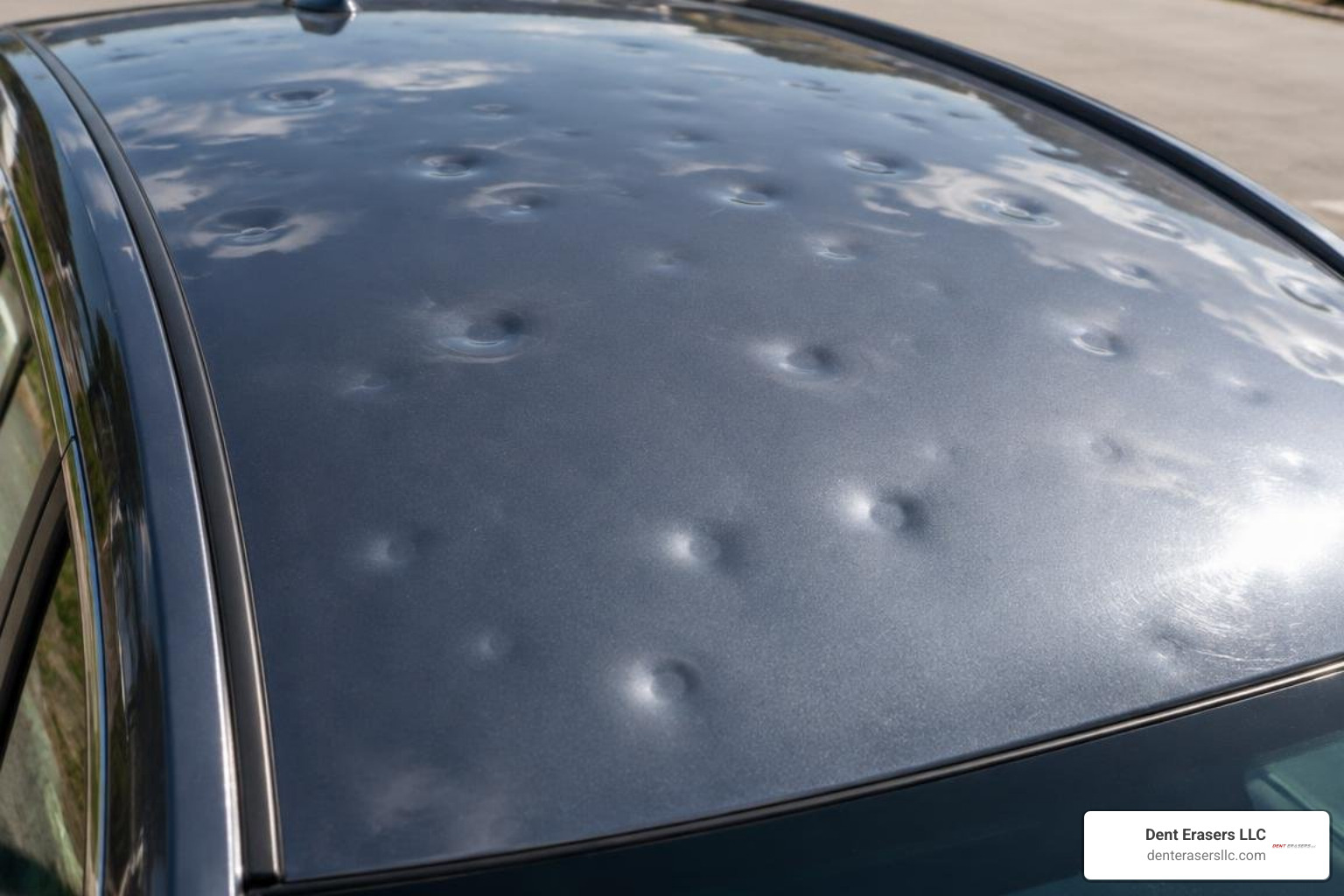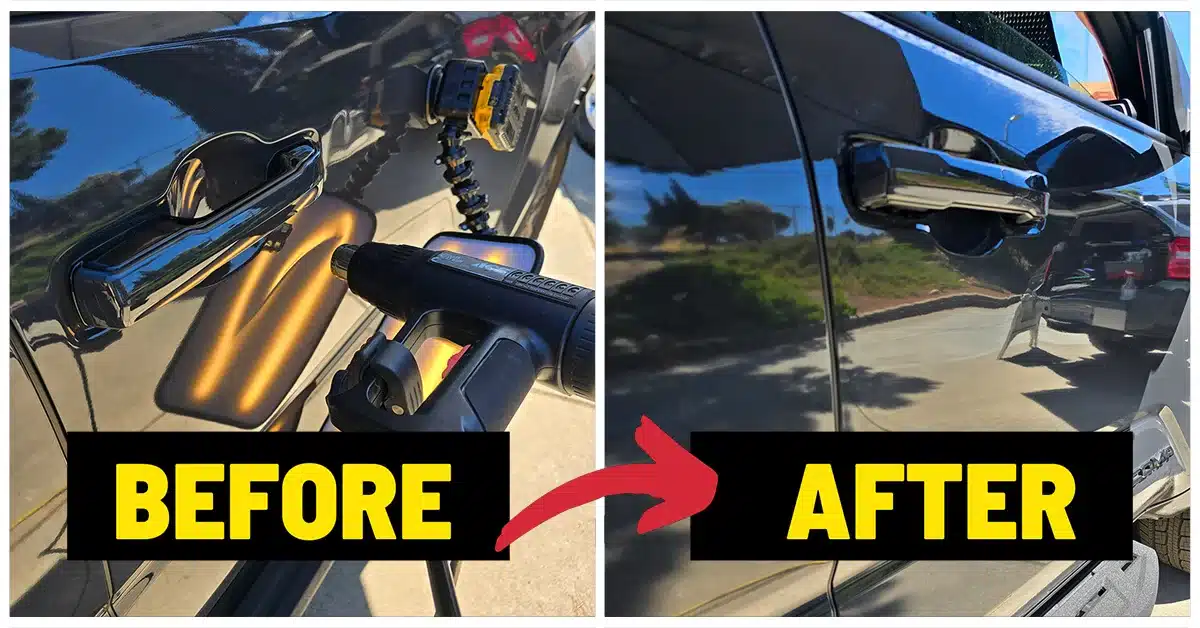
When a Big Dent Shows Up, Here’s What You Need to Know
Removing big dents from a car doesn’t always mean an expensive trip to the body shop. Here’s a quick breakdown of your best options:
Your main options for large dent repair:
- Paintless Dent Repair (PDR) — Best option when paint is intact. A technician massages the metal back into shape from behind the panel. Costs $300–$500 for large dents. No filler, no repainting.
- Traditional body shop repair — Required when paint is cracked or metal is heavily stretched. Involves body filler, sanding, and repainting. Can cost $2,000 or more.
- Panel replacement — Used when damage is too severe to repair. Most expensive option, but sometimes the most practical.
A large dent is more than an eyesore. It can chip away at your car’s resale value, expose bare metal to rust, and — in serious cases — signal structural damage beneath the surface. Yet most drivers assume any dent bigger than a fist automatically means a week in the shop and a four-figure bill.
That’s often not true.
Modern paintless dent repair technology has expanded dramatically. In many cases, even dents 10 inches or larger can be restored without touching the factory paint — if the paint is still intact and the metal hasn’t been overstretched.
I’m Brian Blanc, founder of Dent Erasers LLC, and I’ve spent nearly three decades removing big dents from cars of all types — from daily drivers to luxury vehicles — using mobile PDR techniques that protect your factory finish and skip the body shop entirely. In this guide, I’ll walk you through exactly when PDR works for large dents, when it doesn’t, and what to do in each case.
Simple removing big dents from car glossary:
Understanding the Challenge of Removing Big Dents from Car Panels
When you are looking at a massive crater on your car door, it is easy to think of it as just a “scaled-up” version of a tiny door ding. However, removing big dents from car panels requires a completely different understanding of metal physics, depth, and structural integrity.
Unlike minor dings, which are often shallow and localized, large dents involve a massive displacement of metal. When an object strikes a vehicle panel with enough force to create a 10-inch dent, the metal actually stretches. Every piece of automotive sheet metal has an elastic limit. Once the impact pushes the metal past this limit, it undergoes plastic deformation—meaning the metal’s molecular structure has physically changed and expanded.
Furthermore, modern vehicles are no longer made of the thick, heavy steel of the 1970s. Today, in 2026, manufacturers use ultra-thin steel, aluminum, and high-strength steel (HSS) to reduce vehicle weight and improve fuel economy. While these materials are incredibly strong structurally, they react very differently during a repair:
- Thin Steel: Highly flexible but prone to overstretching and micro-pinholes if worked too aggressively.
- Aluminum Panels: Aluminum has virtually no “metal memory.” It is much stiffer than steel, work-hardens rapidly, and requires specialized thermal control to massage back into place without cracking.
- High-Strength Steel: Extremely resilient, meaning it takes immense force to move, but can lose its heat-treated hardening properties if exposed to excessive heat during traditional grinding or welding.
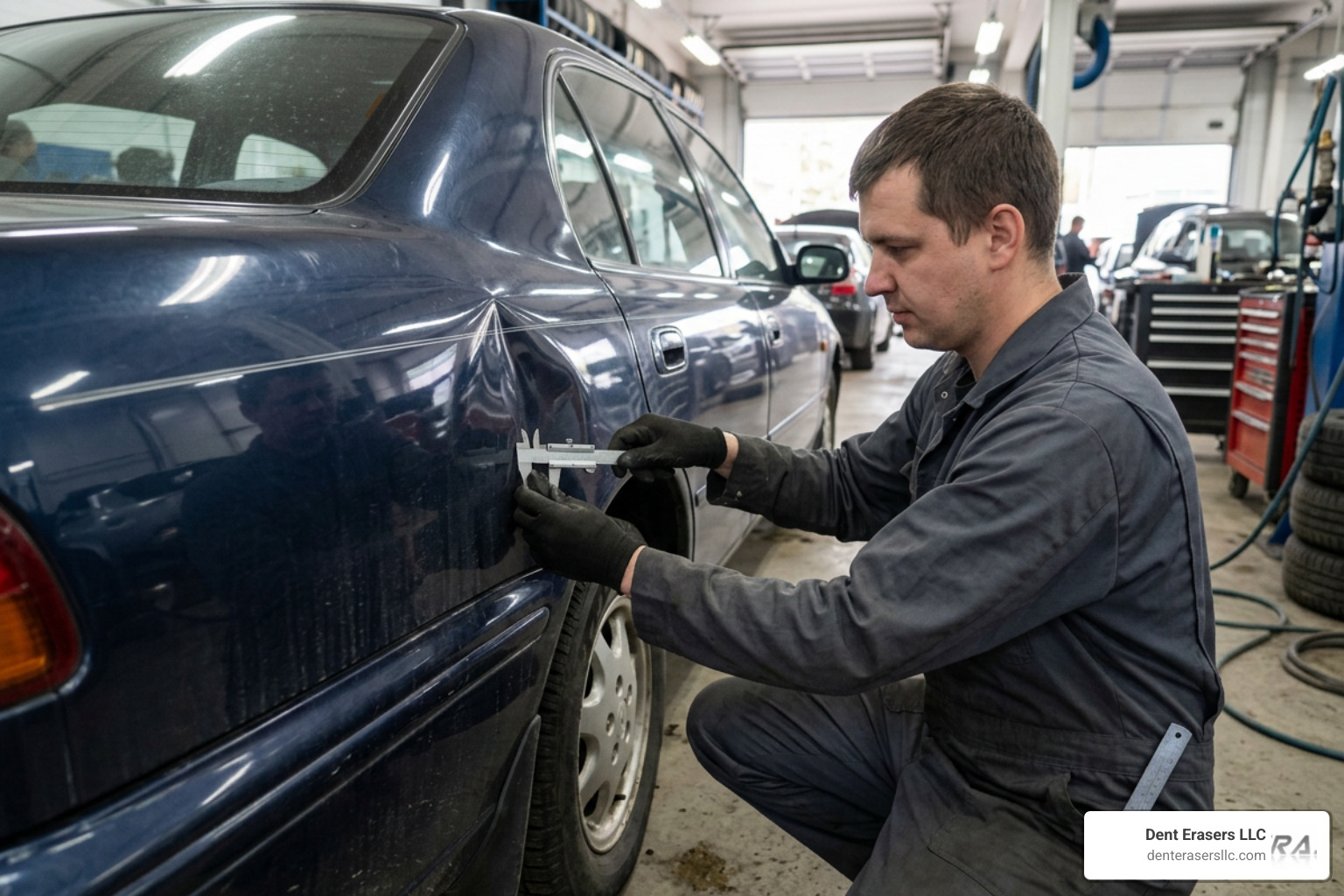
Understanding these material differences is crucial. If a DIYer or an untrained technician tries to pop out a large dent on an aluminum hood without applying the correct heat, the panel will likely crack or tear. This is why we must carefully evaluate the dent depth, location, and paint condition before touching the vehicle.
If you want to understand the difference between minor surface issues and deep structural damage, you can learn more about small vs large dents to see why deep dents require specialized care.
Paintless Dent Repair (PDR) for Large Damage
For a long time, the industry myth was that Paintless Dent Repair (PDR) was only good for hail damage or minor parking lot dings. But in 2026, PDR is the primary professional solution for massive, complex dents. In fact, statistics show that 98% of all dents—including those ranging from 3 to 10 inches or larger—can be completely removed using paintless methods, provided the paint remains flexible and intact.
The core philosophy of PDR is preserving your vehicle’s factory paint finish. When we perform PDR, we are not hiding the damage under plastic body filler or spraying non-OEM paint over your clear coat. Instead, we use specialized tools to restore the metal’s original “molecular memory,” returning it to its exact factory shape.
To achieve this, we use two primary methods:
- The Push Method: Gaining access behind the damaged panel using custom-designed steel rods to gently massage the dent outward.
- The Glue Pulling Method: When rear access is completely blocked (such as on double-walled box sections, roof rails, or certain luxury car doors), we apply specialized hot glue tabs to the exterior paint, allowing us to pull the metal back into shape from the outside.
By keeping the factory paint intact, you protect your vehicle’s resale value. Traditional body shop repairs are reported to CARFAX as refinish work, which can instantly slash 10% to 15% off your car’s market value. PDR keeps your car’s history clean.
If you are tired of staring at that ugly crease every time you walk out to your driveway, you can stop dents from driving you crazy by exploring how PDR preserves your peace of mind and your car’s value. With the right techniques, we can easily get your car looking new again without a single drop of body paint.
For those curious about the absolute basics of DIY dent removal, check out this guide on how to remove dents from your car for some context on how basic home methods compare to professional standards.
The Science of Removing Big Dents from Car Panels Using PDR
So, how do we actually make a 12-inch dent disappear without leaving a trace? It isn’t magic—it is a blend of precise physics, thermal control, and tactile skill.
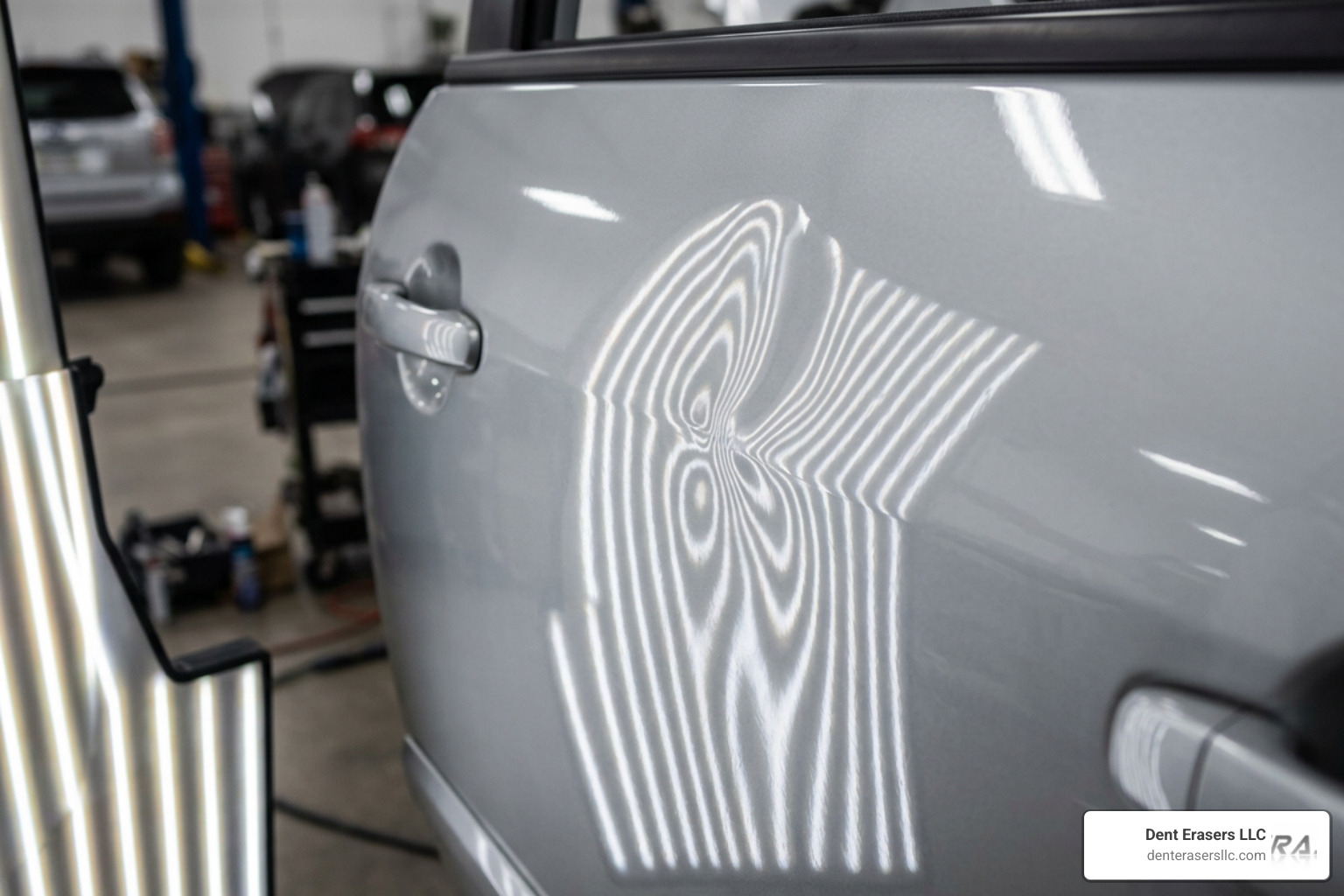
First, we set up high-intensity LED line boards at an oblique angle to the panel. These boards project parallel lines onto the car’s paint. When a dent is present, the lines bend and distort. By reading these reflections, we can map out the exact topography of the damage, identifying high spots, low spots, and trapped pressure lines that are invisible to the naked eye.
Next, we address the metal’s temperature. This is especially critical for aluminum panels or older, brittle paint. We use thermal heat guns to warm the area to a precise window (typically 140°F to 170°F). This softens the clear coat, making the paint highly elastic so it can bend with the metal without cracking.
Once the panel is prepped, we use a series of highly calculated movements. A massive dent cannot simply be “popped” from the middle. If you force the center of a large dent outward, you will create a sharp, locked high spot and permanently stretch the metal. Instead, we must release the tension around the outer crown of the dent first.
Using custom-tipped blending hammers and knock-down punches made of soft Delrin or polished steel, we tap down the raised edges (crowns) surrounding the crater. This releases the trapped energy. Only then do we use our rods or glue-pulling slide hammers to incrementally massage the low areas back to level. It is a process of a thousand tiny, deliberate movements rather than one aggressive push.
For a deeper dive into the physics of how we reshape metal, take a look at our guide to small dent removal to understand the concept of “metal morphing.”
When is PDR Not Suitable for Large Dents?
While PDR is incredibly versatile, it does have physical limitations. We will always give you an honest assessment of your damage, but there are certain red flags that make PDR unsuitable:
- Cracked or Broken Paint: If the impact was sharp enough to scrape, chip, or crack the paint down to the primer or bare metal, PDR cannot restore the finish. In these cases, the panel must be repaired traditionally and repainted to prevent rust.
- Severely Stretched Metal: If the metal has been pushed so far past its elastic limit that it has become thin, floppy, or “oil-canned” (meaning it pops back and forth with no structural tension), PDR cannot restore its structural integrity.
- Compromised Interior Bracing: If the dent is located directly over an inner reinforcement beam or side-impact safety bar, and the metal is crimped tightly against it, we may not be able to safely gain access or pull the metal free.
When PDR is ruled out due to paint damage, you must look into traditional refinishing. To understand what professional body shops do in these scenarios, you can read about 3M’s technical guidelines on deep dent repair techniques to see the industrial products required to seal and repair damaged metal substrates.
Traditional Body Repair for Severe Dents
Note: This section explains traditional body shop methods (such as body filler, sanding, and repainting) solely as an educational comparison to highlight why mobile Paintless Dent Repair (PDR) is a superior, non-invasive alternative that preserves original paint.
When a dent is too deep, creased, or has completely stripped the paint off your vehicle, traditional collision repair is the only viable path forward. Unlike PDR, which works with the existing metal and paint, traditional repair is an invasive, multi-step reconstruction process.
Traditional repair relies heavily on sanding the panel down to bare metal, pulling the deepest parts of the dent using welded pull pins, filling the remaining low areas with polyester or epoxy body filler (often referred to as Bondo), sanding the filler flush, applying primer, spraying multiple layers of base color paint, and finishing with a clear coat.
While this process can make a heavily damaged car look brand new, it comes with several major drawbacks:
- Loss of Factory Finish: Once your factory paint is sanded away, your vehicle no longer has its original corrosion-resistant e-coat.
- Repair Mapping and Shrinkage: Over time, body fillers and primers can shrink, leaving visible outlines (known as mapping) under the clear coat.
- High Costs and Downtime: Because of the extensive labor, cure times, and paint booth requirements, traditional repairs often take days or weeks and cost thousands of dollars.
To see the exact step-by-step industrial standards that collision shops must follow for these complex tasks, you can review the official large damage collision repair SOP to understand the meticulous level of cleaning, priming, and block sanding required.
Traditional Body Shop Methods for Removing Big Dents from Car Panels
In a traditional body shop, the technician begins by grinding away all the paint in and around the dented area. Once the bare metal is exposed, they use a stud welder to temporarily fuse metal pins or pull-tabs directly into the low spots of the dent. A heavy slide hammer is then attached to these studs to yank the metal outward.
After the metal is pulled as close to its original plane as possible, the welded studs are cut off, and the grinder is used again to smooth down the weld spots. Because this process naturally leaves minor imperfections and high/low waves in the metal, the technician must apply a polyester body filler.
This filler must be mixed with a hardener, applied smoothly, and allowed to cure. Once cured, the technician performs progressive block sanding—starting with a coarse 80-grit sandpaper to shape the filler, moving to 180-grit, and finishing with 320-grit to blend the edges seamlessly into the surrounding metal.
Finally, the vehicle goes into a pressurized paint booth. The panel is sprayed with primer, wet-sanded, sprayed with color-matched OEM paint, and sealed with clear coat. The paint must then be cured under infrared heat lamps before being wet-sanded and polished to match the texture of the rest of the car.
As you can imagine, the sheer volume of materials and highly skilled labor involved drives up the price dramatically. To help plan your budget, you can read about car dent and scratch repair costs to see how paintwork and material fees accumulate on your final invoice.
Evaluating Costs, Timeframes, and Quality of Large Dent Repairs
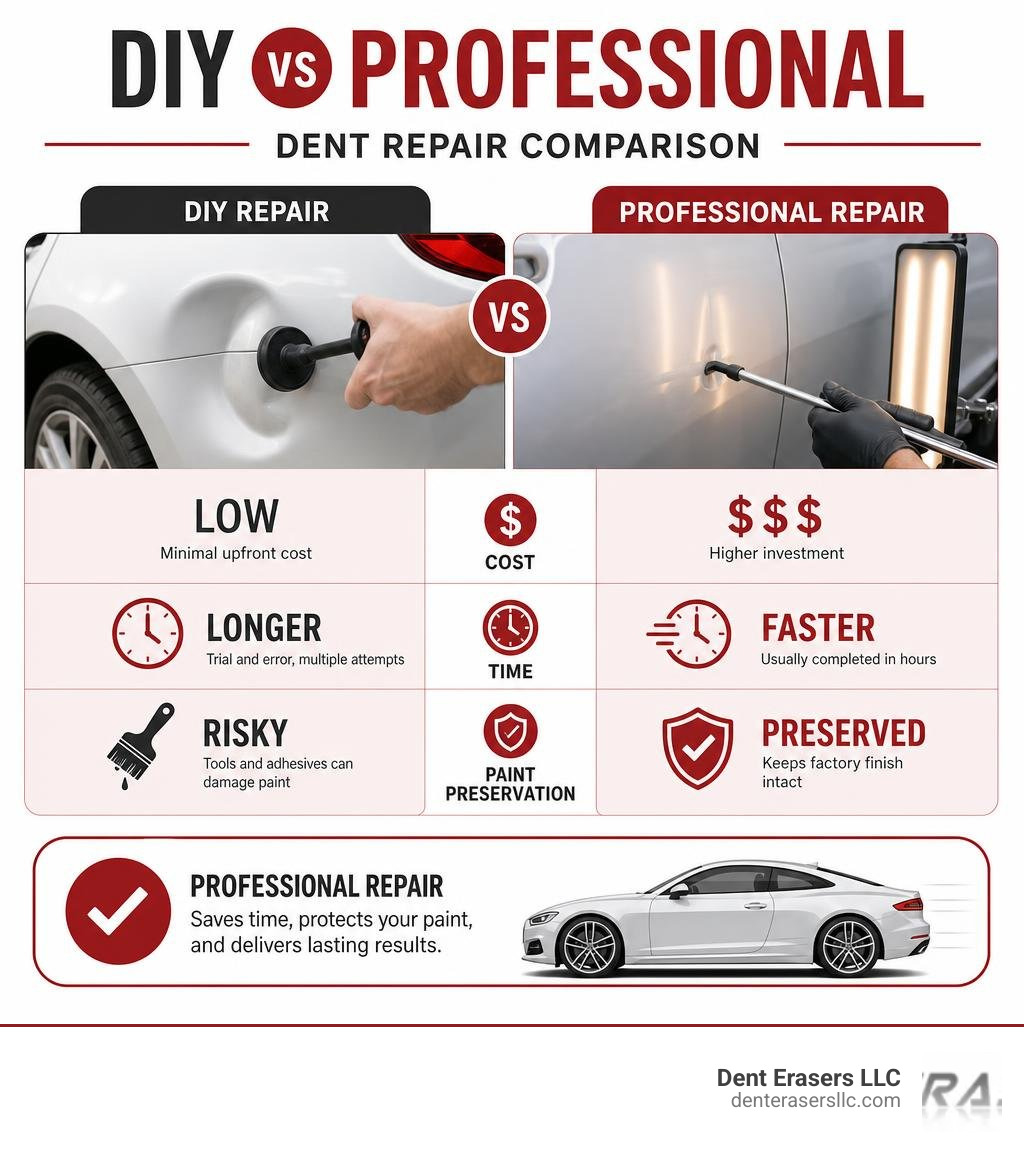
When deciding how to handle a large dent, three factors will dominate your decision: cost, time, and quality. Let’s look at how DIY attempts, traditional body shops, and professional mobile PDR compare:
| Repair Method | Average Cost | Typical Turnaround Time | Paint Preservation | Resale Value Impact |
|---|---|---|---|---|
| DIY Dent Kit / Home Methods | Under $100 | 1–3 Hours | High Risk of Damage | High Risk of Devaluation |
| Traditional Body Shop | $2,000+ | 3–10 Days | None (Repainted) | Negative (CARFAX Record) |
| Professional Mobile PDR | $300–$500 | 2–5 Hours | 100% Preserved | None (Restores Value) |
As the table shows, trying to fix a large dent yourself with cheap suction cups or hot glue kits often ends in disaster. Cheap glue can pull the paint clean off your car, and home-made slide hammers can easily overstretch the metal, turning a repairable PDR job into an expensive body shop nightmare.
On the other hand, traditional body shops charge a premium because they have massive overhead, paint booth operating costs, and paint material fees.
Professional PDR strikes the perfect balance. It is incredibly fast—usually completed in a single afternoon right in your driveway—and highly affordable. If you want to dive deeper into how repair shops calculate these numbers, check out our guide to professional estimates to avoid being overcharged. We also have a dedicated resource on how to find affordable dent removal without sacrificing quality.
Red Flags to Watch For in Large Dent Repairs
If you do hire a technician, make sure you are getting quality work. Watch out for these red flags:
- “Orange Peel” or Texture Mismatch: If a shop repainted your car, the texture of the new clear coat should perfectly match the factory paint on the adjacent panels. If it looks wavy or rough, it is a poor paint job.
- Drilled Holes: Some low-quality PDR technicians will drill unauthorized holes in your door jambs or inner panels to gain access to a dent. A true professional will always prioritize factory access points or use glue pulling.
- Rust and Corrosion: If a traditional repair was rushed and the bare metal wasn’t properly sealed with epoxy primer, moisture will creep under the body filler, leading to hidden rust and paint bubbling within a year.
Frequently Asked Questions About Large Dent Repair
We hear many of the same questions from concerned car owners throughout Contra Costa County. Here are the facts.
Can a basketball-sized dent be repaired with PDR?
Yes, absolutely! It sounds shocking, but a shallow, basketball-sized dent is often much easier to repair than a sharp, 2-inch puncture. Because the energy of a large, shallow impact is distributed widely across the panel, the metal elasticity is preserved, and the paint flexibility remains intact. As long as there are no sharp creases, folded body lines, or cracked paint, we can successfully restore large, sweeping dents using advanced PDR and glue-pulling techniques.
Will a large dent pop back in after being repaired?
No. This is one of the most common myths in the automotive world. When we perform professional PDR, we are not simply “popping” the center of the dent so it sits in a temporary state of tension. We use hundreds of precise micro-pushes to release the stress in the metal and restore its original molecular structure. Once the metal’s memory is fully restored to its factory shape, it is physically impossible for the dent to “pop back in” on its own.
Is it better to repair a large dent or replace the panel?
It depends on the cost-effectiveness and structural integrity of the panel. If a steel door panel is heavily creased, has severe paint damage, and requires 15 hours of intense metal-shaping and body filler, it is often cheaper and safer to purchase a brand-new OEM factory panel and paint it to match. However, if the paint is undamaged, repairing the dent with PDR is always the superior choice because it keeps your original factory-bonded parts intact and avoids color-matching issues.
Conclusion
Removing big dents from a car doesn’t have to be a stressful, bank-breaking ordeal. By choosing mobile Paintless Dent Repair, you can save thousands of dollars, complete the repair in just a few hours, and completely preserve your car’s original factory paint and resale value.
At Dent Erasers LLC, we specialize in providing elite, on-site mobile paintless dent repair for cars, motorcycles, luxury, and classic vehicles. Whether you are located in Concord, Walnut Creek, Richmond, Antioch, or anywhere else in Contra Costa County, CA, we bring the shop directly to your home or office. With pricing ranging from just $150 to $500 for most dent repairs, we make it easy to skip the body shop entirely.
Don’t let an unsightly dent ruin your vehicle’s look or tank its value. If you want to see what our local clients are saying about our mobile service, you can check out Yelp reviews for mobile dent repair in Concord CA to see our track record of excellence.
Ready to get your car looking brand new again? Schedule expert paintless dent repair with Dent Erasers LLC today and get a free, no-obligation estimate!