What Does It Actually Cost to Repair a Small Dent in a Car Door?
The cost of repairing a small dent in a car door depends mainly on one thing: whether the paint is still intact.
Here’s a quick answer:
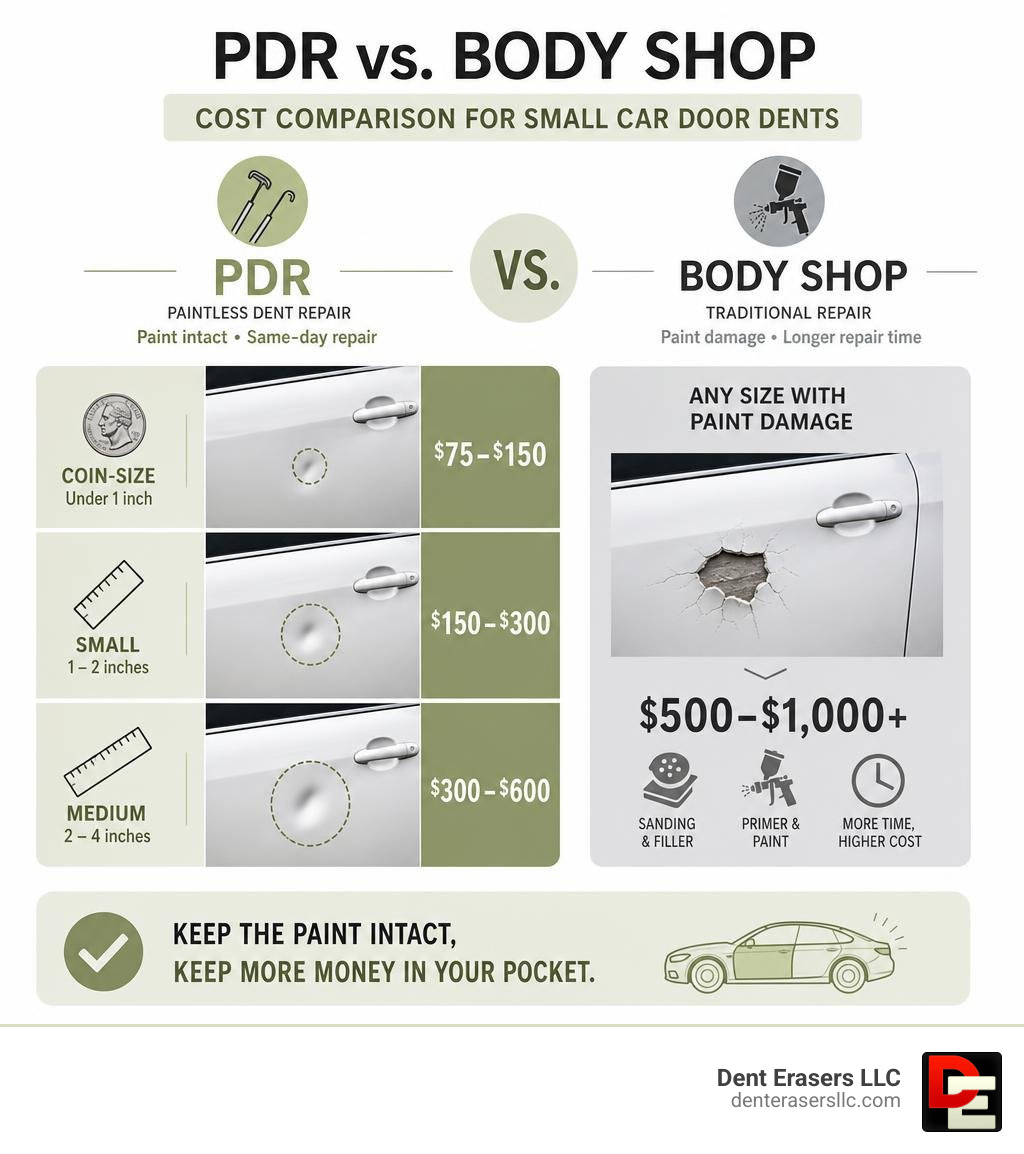
| Repair Type | Dent Size | Typical Cost |
|---|---|---|
| Paintless Dent Repair (PDR) | Coin-size (under 1 inch) | $75 – $150 |
| Paintless Dent Repair (PDR) | Small (1 – 2 inches) | $150 – $300 |
| Paintless Dent Repair (PDR) | Medium (2 – 4 inches) | $300 – $600 |
| Traditional Body Shop | Any size with paint damage | $500 – $1,000+ |
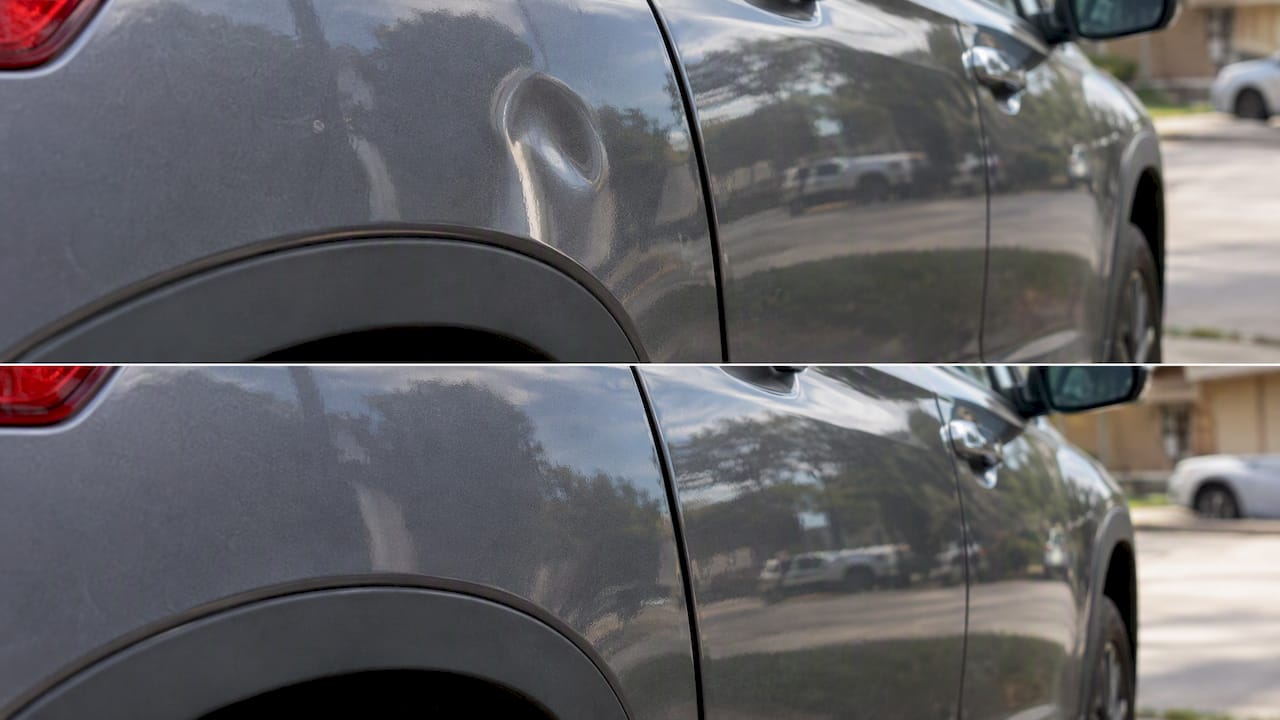
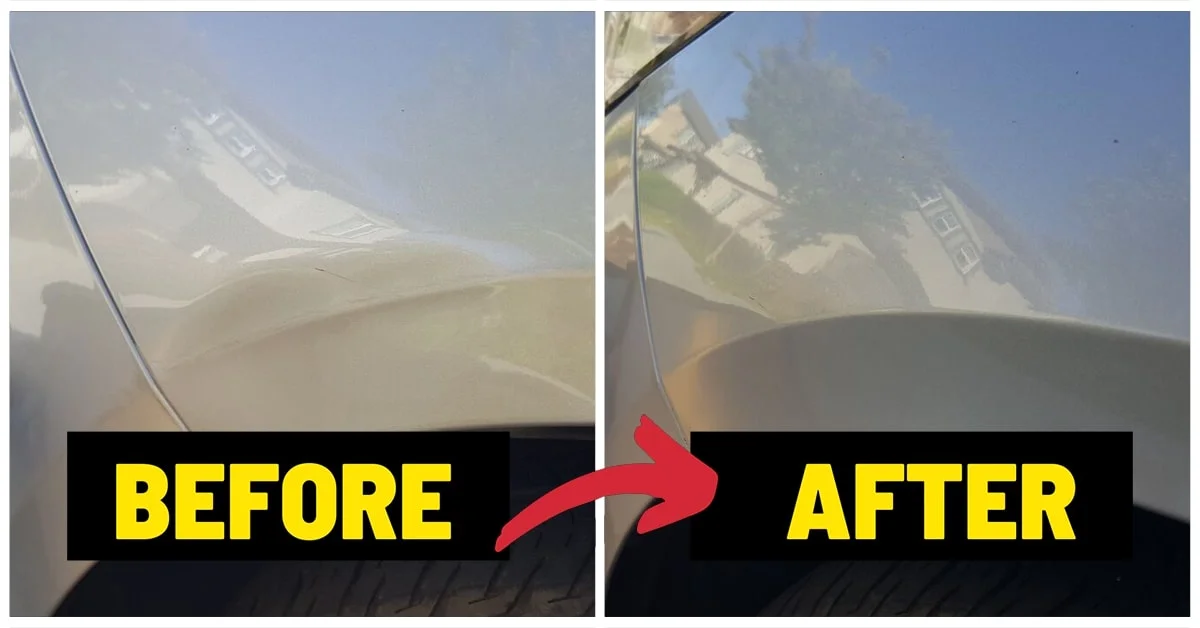
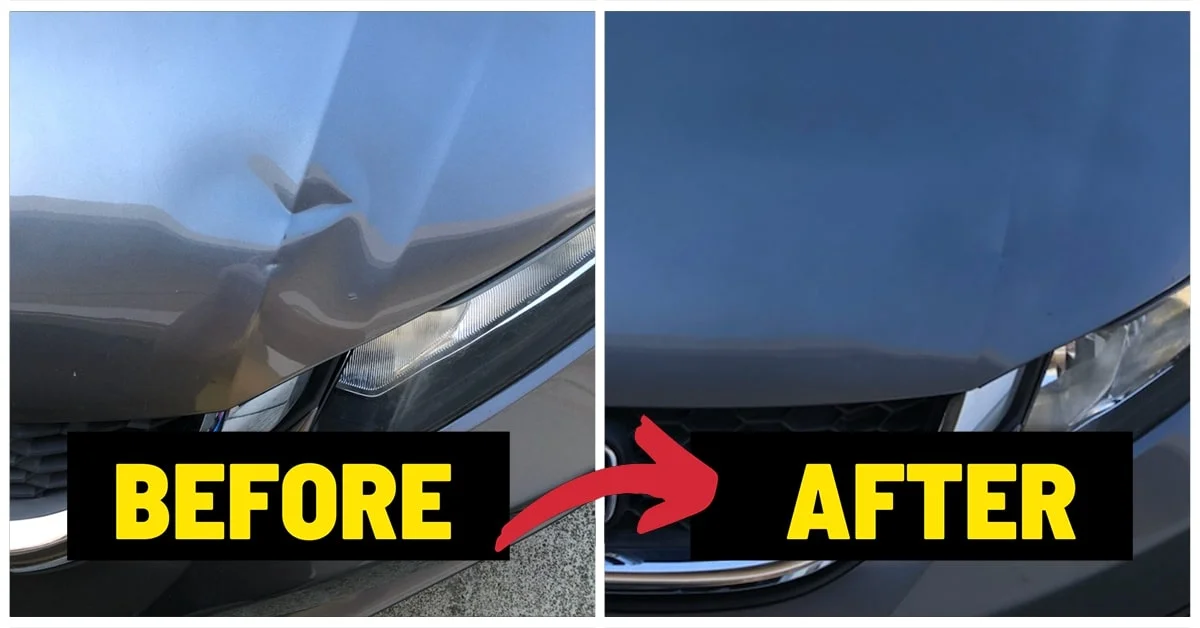
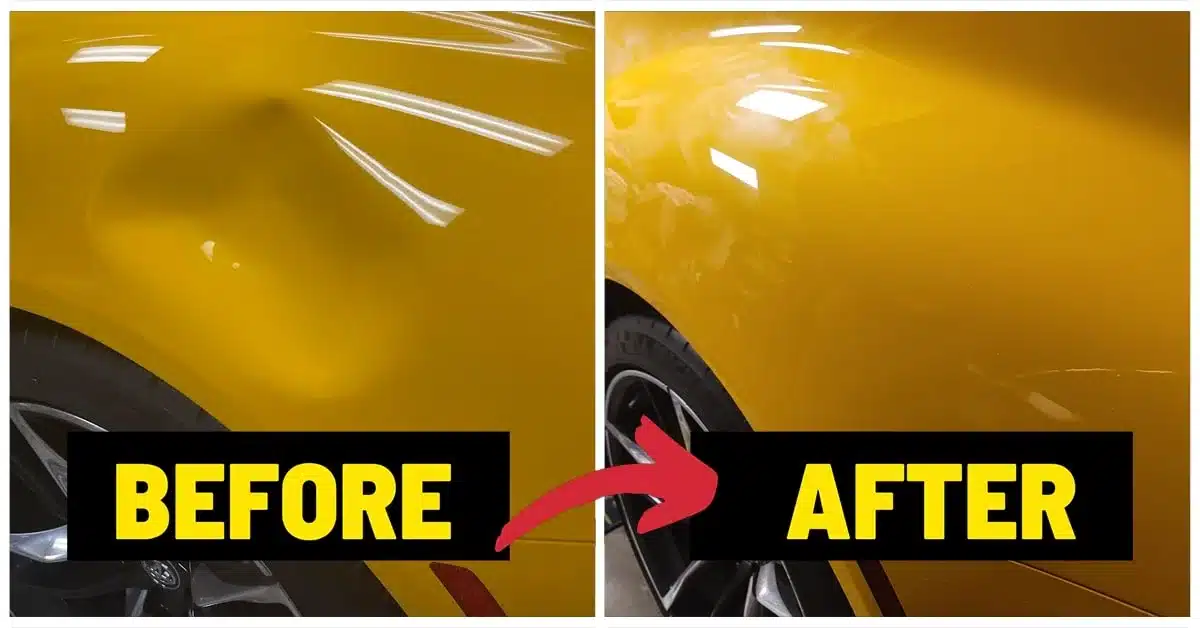
If the paint is intact, a PDR technician can fix most small door dents the same day — often in under two hours — for $75 to $300.
If the paint is cracked or chipped, expect a body shop bill of $500 or more once sanding, filler, primer, and repainting are factored in.
The gap between those two numbers is why acting fast on a fresh dent almost always saves you money.
I’m Brian Blanc, founder of Dent Erasers LLC and a mobile PDR specialist with nearly three decades of hands-on experience restoring vehicles across the East Bay — from everyday commuter cars to high-end luxury vehicles. Over the years I’ve helped thousands of vehicle owners understand the real cost of repairing a small dent in a car door and find the most affordable, paint-safe path forward. In this guide, I’ll walk you through everything that drives the final price — so you can make a confident decision before you book a single appointment.
Cost of repairing small dent in car door terms you need:
The Real Cost of Repairing a Small Dent in a Car Door: Why PDR Wins
When you find a fresh ding on your car door, your first instinct might be to sigh, roll your eyes, and brace your wallet for a massive hit. Historically, fixing any cosmetic blemish meant losing your car to a traditional auto body shop for a week and paying a premium. However, as we navigate June 2026, the automotive repair landscape has shifted dramatically toward Paintless Dent Repair (PDR) as the primary, most cost-efficient solution for minor cosmetic damage.
To understand why PDR is almost always the superior financial choice, let’s look at a direct comparison of repair pathways:
| Feature | Paintless Dent Repair (PDR) | Traditional Body Shop |
|---|---|---|
| Typical Cost Range | $150 – $500 (standard door dings: $75 – $300) | $500 – $1,000+ (even for small dings) |
| Turnaround Time | 1 – 3 hours (same-day mobile service) | 3 – 7 days (requires paint curing time) |
| Materials Used | None (specialized metal-shaping tools only) | Body filler, primer, base coat, clear coat |
| Carfax Impact | None (retains original factory finish) | Permanent “damage reported” history record |
| Factory Warranty | Fully preserved | Often voided on the repainted panel |
As highlighted in the Lemonade Insurance guide on car dent repair costs, traditional repair methods quickly escalate in price because of the sheer volume of labor and materials involved. When you choose PDR, you are paying almost exclusively for the technician’s highly specialized skill and precision, rather than expensive consumable paints and chemical fillers. For a deeper dive into the most budget-friendly approaches to handling vehicle dings, you can check out our article on The Cheapest Ways to Fix a Car Dent.
How Paintless Dent Repair Lowers the Cost of Repairing Small Dent in Car Door
The fundamental magic of PDR lies in its non-invasive methodology. Instead of covering up a dent, we access the back of the door panel using custom-designed steel rods, whale tails, and hand picks. By applying incredibly precise, micro-level pressure to the underside of the metal, we massage the steel or aluminum back to its original factory shape.
This process completely eliminates the need for:
- Grinding down your car’s original paint
- Slathering the door in heavy body filler (Bondo)
- Spraying toxic primers and color coats
- Attempting to blend new paint across adjacent door panels
Because we bypass these labor-intensive steps, PDR pricing remains highly accessible. A simple coin-size ding (under 1 inch) can often be massaged out for as little as $75 to $150. If you have multiple dings on the same door panel, we can bundle them together, with each additional minor dent costing only $40 to $75. This volume discount makes PDR incredibly cost-effective for vehicles that have accumulated a few parking lot battle scars. For a transparent, step-by-step breakdown of how these prices are structured, see The Complete Guide to PDR Pricing and Estimates.
Why Conventional Body Shop Methods (Filler & Paint) Drive Up Costs
To appreciate why a traditional body shop charges $500 to $1,000 for a minor door dent, you have to look at their multi-step production line. If a dent has even minor paint damage — such as a deep scratch that cuts through the clear coat to the bare metal — PDR alone may not be enough.
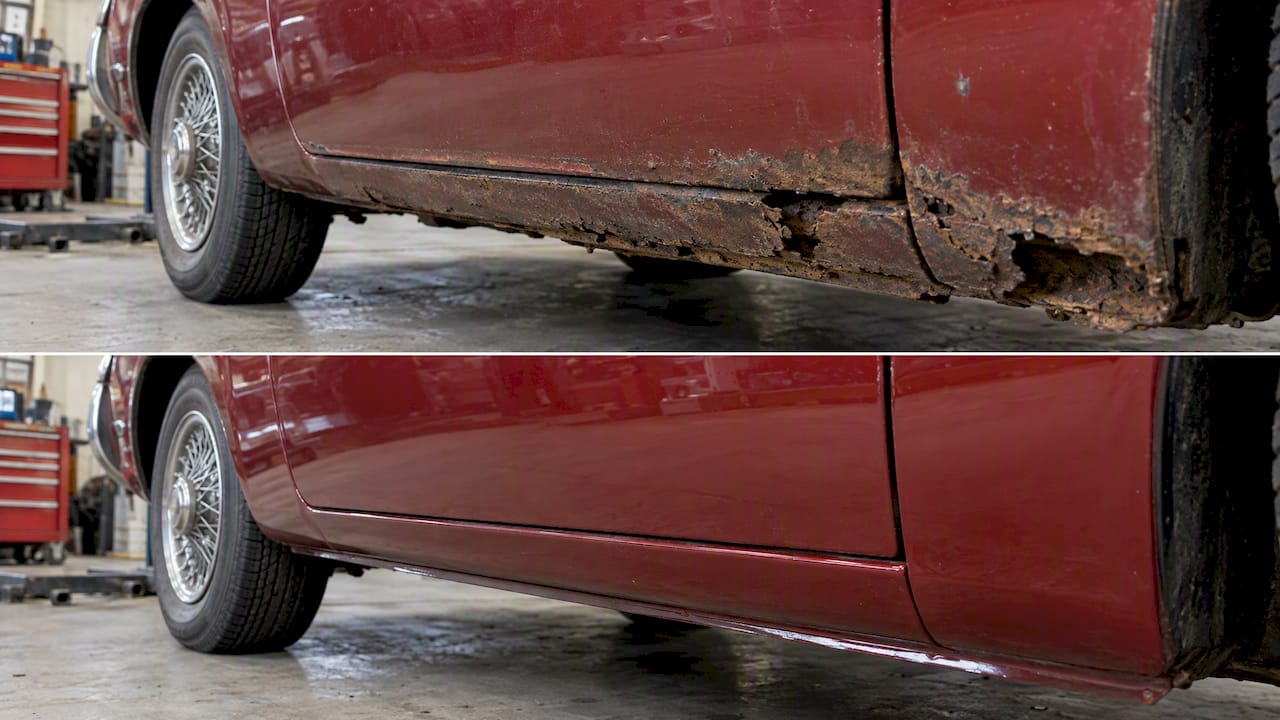
Once the paint is broken, a body shop must grind the area down, apply plastic filler, sand it flat, apply primer, and then spray a base color coat followed by a protective clear coat. To make the repair invisible, the painter cannot simply paint the spot of the dent; they must “blend” the paint across the entire door panel, and sometimes even onto the front fender or rear passenger door.
This process requires hours of meticulous prep work, masking, and paint booth curing time. The cost of paint materials, hazardous waste disposal fees, and specialized labor quickly adds up. Furthermore, as discussed in our guide on Small Dents, Big Problems and How to Fix Them, using body filler on a door panel creates a thick, rigid spot that can crack or shrink over time, especially under the hot California sun in areas like Concord, Antioch, and San Ramon.
Key Factors That Determine Your Final Repair Bill
Every door dent is unique. When we evaluate a vehicle in Contra Costa County, we don’t just guess a number; we look at several physical and structural elements of the damage.
To understand how these variables shift your estimate, let’s explore the primary cost drivers. If you want to study the science behind these calculations, read The Complete Guide to PDR Pricing and Estimates.
Dent Size and Depth
Size is the most obvious starting point, but depth is actually the more critical factor. A wide, shallow, quarter-size dent is relatively easy to massage back into place because the metal has not been severely stretched.
Conversely, a tiny, sharp, BB-gun-sized ding can stretch the metal to its limit. If a dent is deep enough to create a sharp “point” or crease at its center, the metal has undergone “work hardening.” This means the molecular structure of the steel or aluminum has become rigid in its deformed state. Restoring this stretched metal requires advanced techniques, more time, and a higher level of skill, which naturally increases the repair cost.
Panel Material: Steel vs. Aluminum
What is your car door made of? If you drive an older vehicle or a standard compact car, it likely features steel door panels. Steel has excellent “elastic memory,” meaning it wants to return to its original shape when massaged correctly.
However, many modern vehicles — including newer Ford F-150s, Teslas, and luxury sedans from BMW, Audi, and Mercedes-Benz — utilize aluminum door panels to save weight. Aluminum is a fantastic, corrosion-resistant material, but it behaves very differently than steel:
- It is much stiffer and does not have the same natural elasticity.
- It requires specialized, high-heat PDR tools to make the metal pliable.
- It work-hardens very quickly, meaning the technician must work slower and with greater precision.
Because aluminum requires specialized training and physical effort, PDR repairs on aluminum panels typically carry a 30% to 50% price surcharge compared to steel.
Location and Accessibility on the Door
A dent’s location on your car door dictates how easily we can get our tools behind it. If a dent is located in the middle of a wide, flat open space on the panel, we can easily slide a thin steel rod through the window glass channel to access the back of the metal.
However, doors are full of structural obstacles:
- Body Lines: Dents directly on a sharp, stylized body line are incredibly difficult to repair because the metal is highly reinforced at that bend.
- Intrusive Bracing and Crash Beams: Modern doors contain heavy steel side-impact crash bars. If your dent sits directly over one of these braces, direct tool access may be blocked.
- Double-Metal Areas and Edges: The very bottom and outer edges of a door are hemmed together, creating double-layered metal with zero internal clearance.
When direct rod access is blocked, we must use a specialized technique called Glue Pull Dent Repair (GPDR). This involves gluing plastic tabs to the outside of your door and using a slide hammer or lifting mini-lifter to gently pull the dent outward. This technique is highly effective but requires multiple pulling and tapping cycles, adding time and complexity to the job. For a technical breakdown of how we navigate these tight spaces, see our article on Small Dent Removal from Car: A Step-by-Step Guide to Metal Morphing.
Insurance vs. Out-of-Pocket: Making the Smart Financial Choice
One of the most common questions we receive from drivers in Concord, Walnut Creek, and Danville is: “Should I file an insurance claim for this door dent, or pay for it myself?”
To make the smartest financial decision, you need to do some quick “insurance math.” You can find more helpful tips on budgeting for car repairs in our resource on How to Find Affordable Dent Removal for Your Car.
The Deductible Decision Rule
The rule of thumb for cosmetic auto repairs is simple: If the cost of the repair is less than or close to your insurance deductible, pay out of pocket.
Most drivers carry a comprehensive or collision deductible of $500 or $1,000. Because a high-quality PDR repair for a small door dent typically ranges from $150 to $500, filing a claim rarely makes sense.
Consider this scenario:
- You have a 2-inch door dent that costs $250 to fix via PDR.
- Your insurance deductible is $500.
- If you file a claim, your insurance company will pay $0 (since the cost is below your deductible), but the claim will still be permanently recorded on your insurance history.
- Even if your deductible is low (e.g., $100 or $250), filing an at-fault collision claim can cause your monthly premiums to spike by 20% to 40% for the next three years. Paying out of pocket keeps your insurance record clean and saves you hundreds of dollars in long-term premium hikes.
Impact on Vehicle Resale Value and Carfax
Beyond the immediate repair bill, there is a hidden cost to consider: diminished value.
When a traditional body shop repairs a door dent, they typically file a report that ends up on your vehicle’s Carfax or AutoCheck history report. Even if the repair was flawless, a permanent “damage reported” flag on a history report can lower your vehicle’s trade-in or private-party resale value by 10% to 20% when you eventually sell it.
Furthermore, a repainted door panel rarely matches the rest of the car perfectly under direct sunlight. Professional appraisers can easily spot non-factory paint finishes using digital paint depth gauges. Because PDR preserves your vehicle’s original factory paint, it does not require a Carfax report and leaves no trace of repair. Your car retains its maximum value, making PDR an investment that pays for itself when it’s time to trade up.
How to Get an Accurate Estimate and Choose the Right Service
Getting a precise quote for your door dent doesn’t require driving around the East Bay to get multiple physical inspections. In 2026, we can provide highly accurate remote estimates using digital photos.

To get the most accurate quote possible, you can read our guide on How to Find Affordable Dent Removal for Your Car.
Taking the Perfect Photos for a Remote Quote
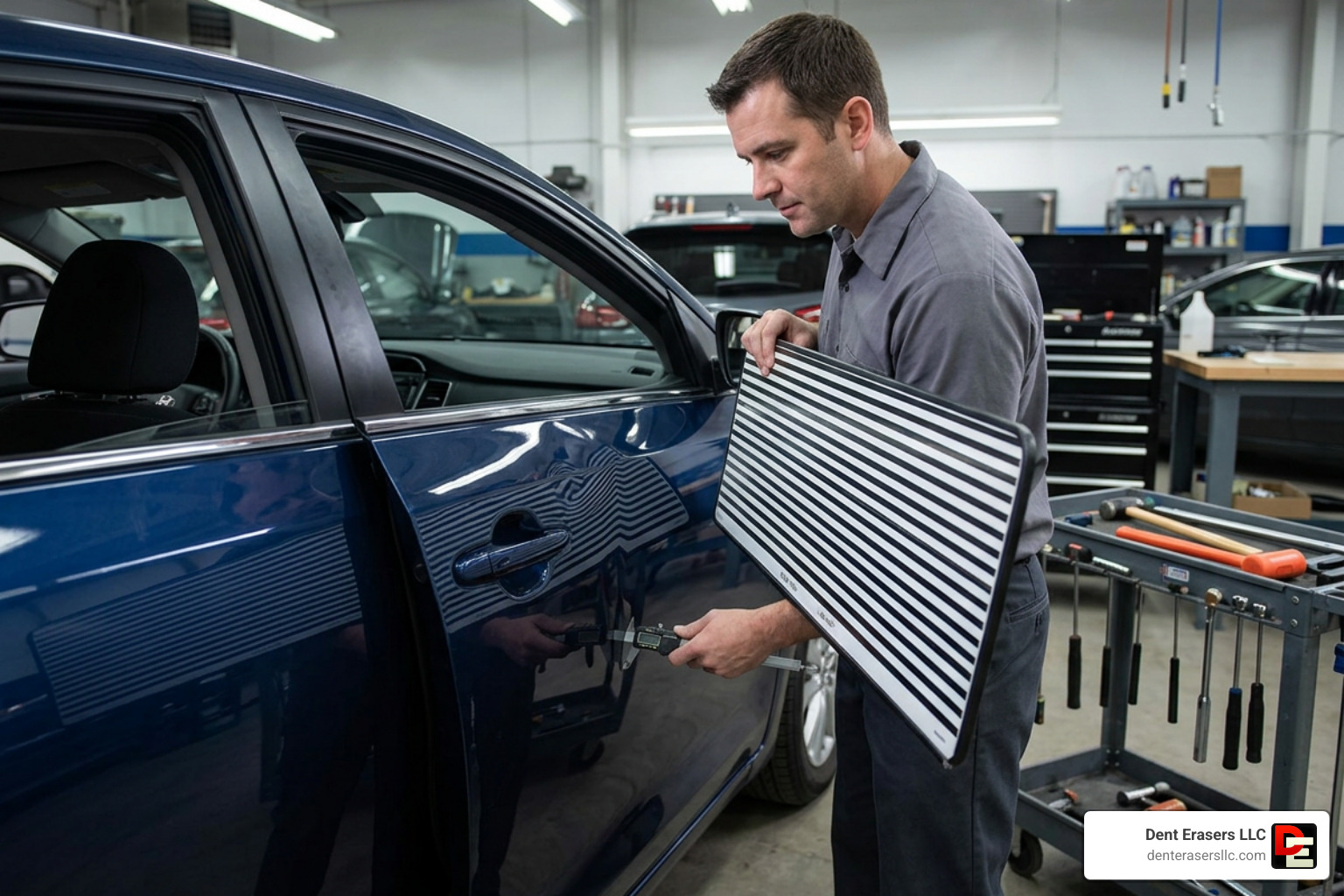
Because PDR is all about reading the reflection of light off the metal, a single flat, direct photo of a dent can be hard to evaluate. To help us see the exact depth and contour of the damage, follow these quick photography tips:
- The Three-Angle Rule: Take one photo looking straight at the dent, one from a 45-degree angle to the left, and one from a 45-degree angle to the right.
- Use a Scale Reference: Hold a common object, like a quarter or a credit card, next to the dent so we can gauge its exact size.
- Capture the Reflection: Take the photos in a shaded area or garage, but look for a straight line (like a garage door panel line, a parking space line, or a building edge) reflecting across the dent. The way that straight line bends tells us everything we need to know about the metal’s distortion.
The Convenience of Mobile PDR: Saving You Time and Money
In the busy San Francisco Bay Area, your time is incredibly valuable. Leaving your car at a physical shop in Concord or Walnut Creek means coordinating rides, renting a car, or taking time off work.
Mobile PDR eliminates all of that friction. At Dent Erasers LLC, we bring our fully equipped mobile repair vehicles directly to your home, office, or garage anywhere in Contra Costa County, including Antioch, Brentwood, Pittsburg, and San Ramon.
While you are working, relaxing, or spending time with family, we can complete the repair right in your driveway. Most small door dents are fully restored within 1 to 3 hours, allowing you to get back on the road immediately with zero paint curing downtime. To experience this seamless process firsthand, you can Schedule professional paintless dent repair today.
Frequently Asked Questions About Door Dent Repairs
How long does it take to repair a small door dent?
With Paintless Dent Repair, a standard small door dent (under 2 inches) typically takes 1 to 2 hours to fully restore. Because we do not use fillers, primers, or paints, there is absolutely no curing or drying time required. Once we pack up our tools, your car is immediately ready to drive, wash, and wax. In comparison, a traditional body shop will usually require your vehicle for 3 to 5 days for the exact same size dent to allow for paint prepping, spraying, and baking.
Can I use a DIY dent puller kit to save money?
While cheap suction cup or hot-glue DIY kits are widely available online for $15 to $50, we strongly advise against using them on door panels. Door metal is thin and highly sensitive. Without professional training, it is incredibly easy to over-pull a dent, creating an unsightly “high spot” that stretches the metal beyond repair. Additionally, cheap retail glue guns can easily burn or pull the clear coat clean off your door, turning a simple $150 PDR job into a $1,000 professional repainting nightmare.
Will fixing a minor door ding raise my auto insurance rates?
If you pay for the repair out of pocket, your insurance company will never know about it, and your rates will remain completely unaffected. If you do choose to file a claim, comprehensive claims (such as damage from a sudden hail storm or a runaway shopping cart) generally do not raise your rates. However, collision claims (such as accidentally opening your door into a concrete pillar) are considered “at-fault” incidents and will almost certainly trigger a premium increase.
Conclusion
A small door dent doesn’t have to be a major headache or an expensive financial burden. By choosing Paintless Dent Repair, you can restore your vehicle’s pristine appearance, protect its long-term resale value, and preserve its original factory paint finish — all at a fraction of the cost of a traditional auto body shop.
At Dent Erasers LLC, we are proud to provide premium, highly convenient mobile PDR services throughout Concord, CA, and the surrounding East Bay communities. Whether you are in Walnut Creek, Antioch, Brentwood, or San Ramon, our expert technicians will come directly to your home or office to erase your door dings on-site. Don’t let a minor dent impact your ride’s value. Contact us today to get your free photo estimate and Schedule professional paintless dent repair today.