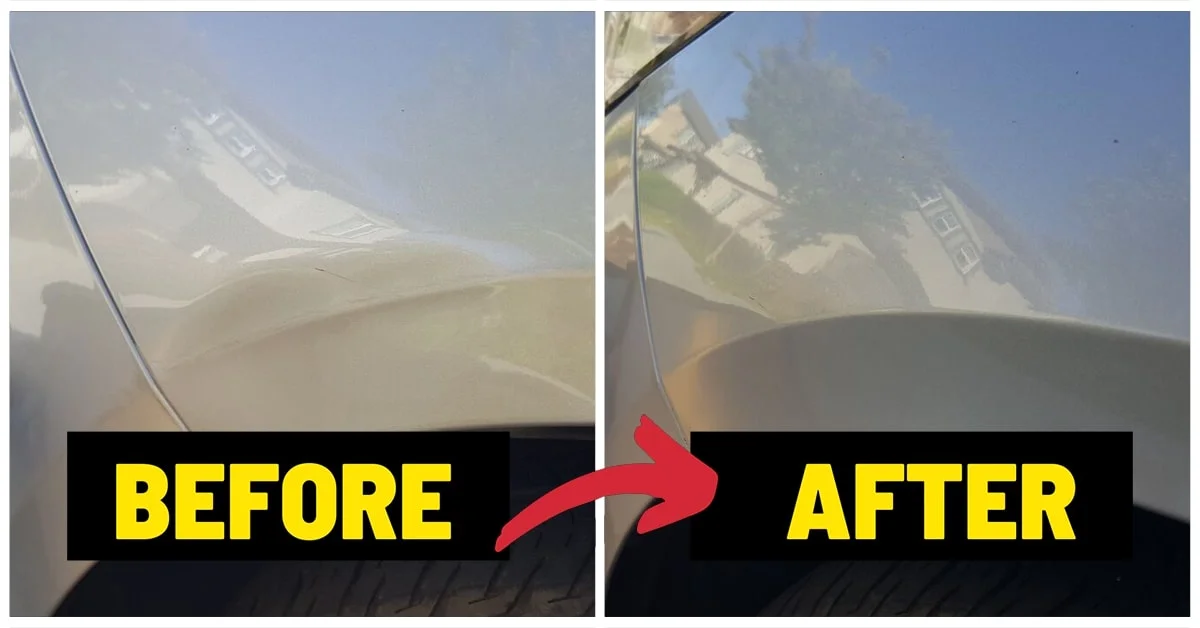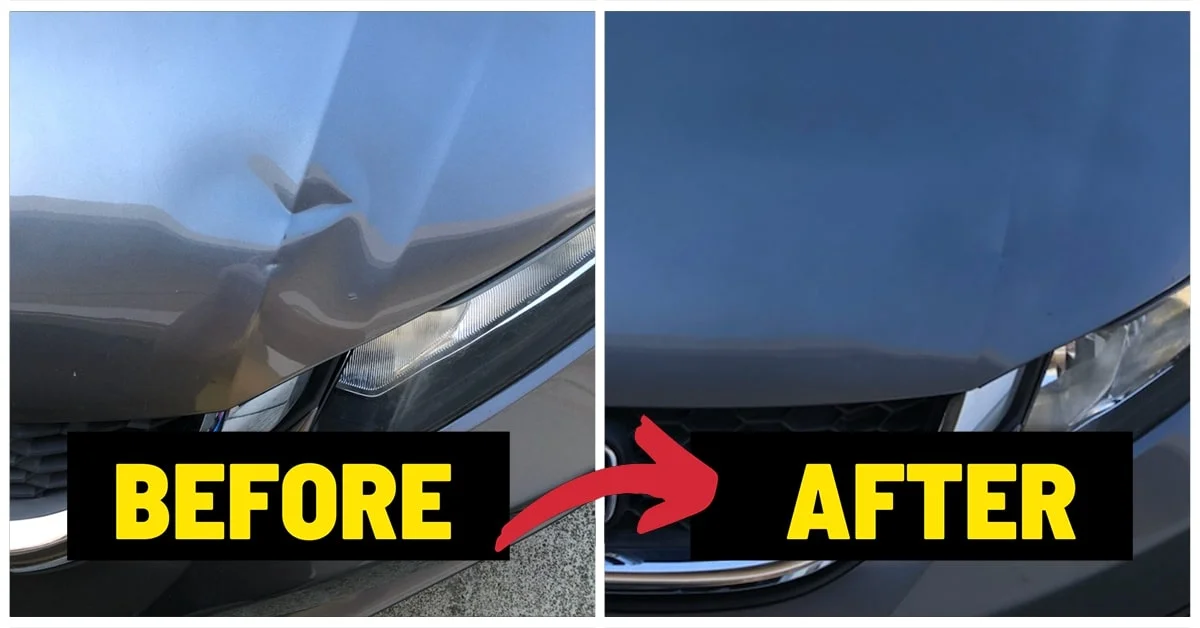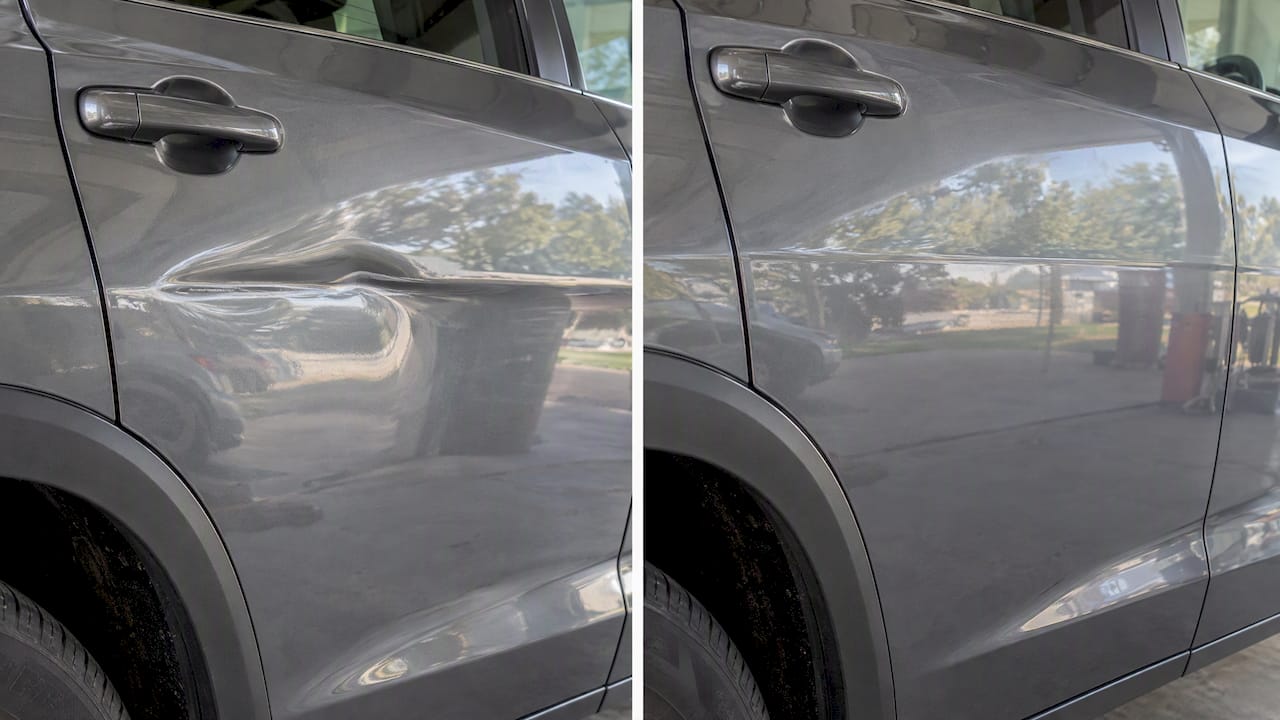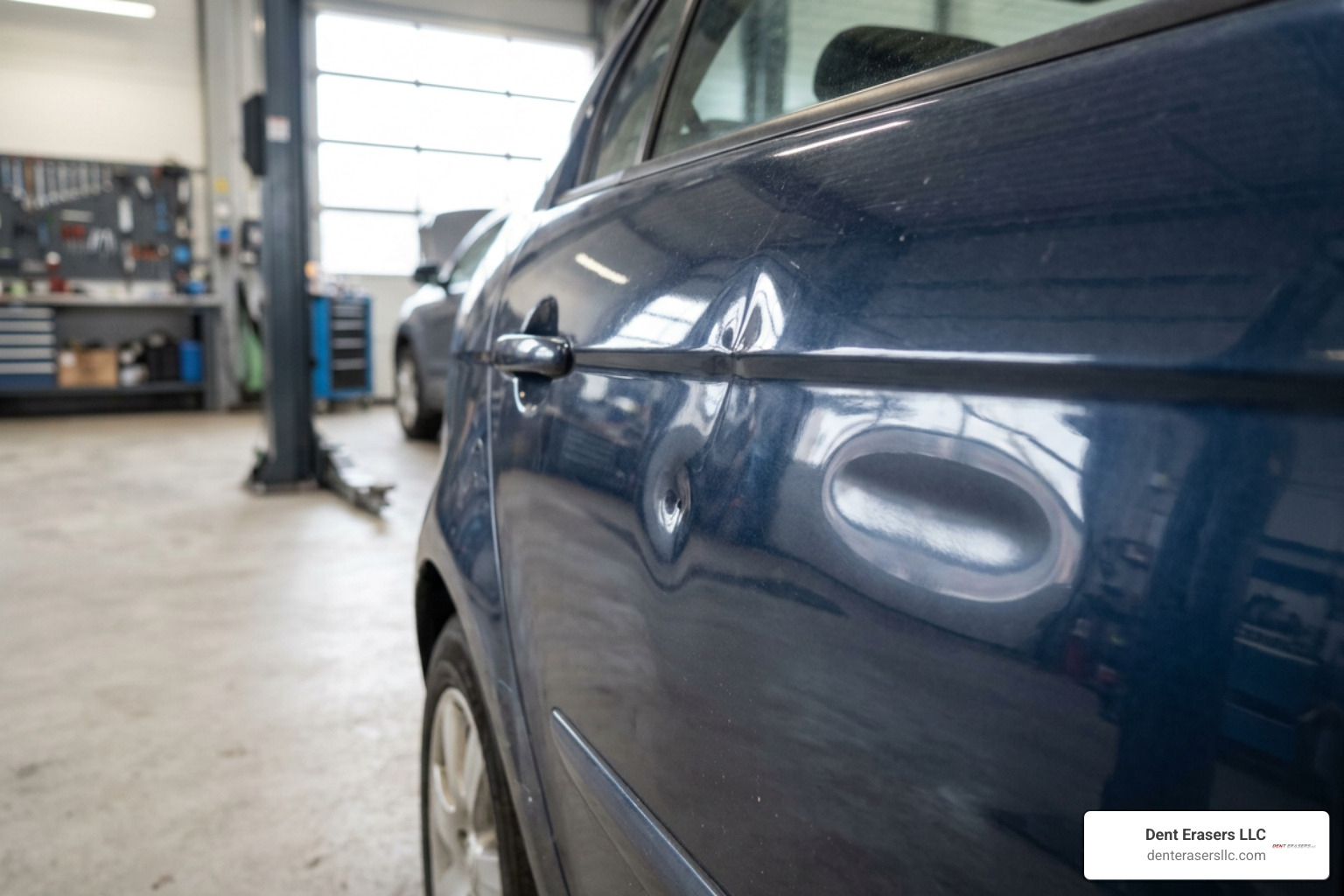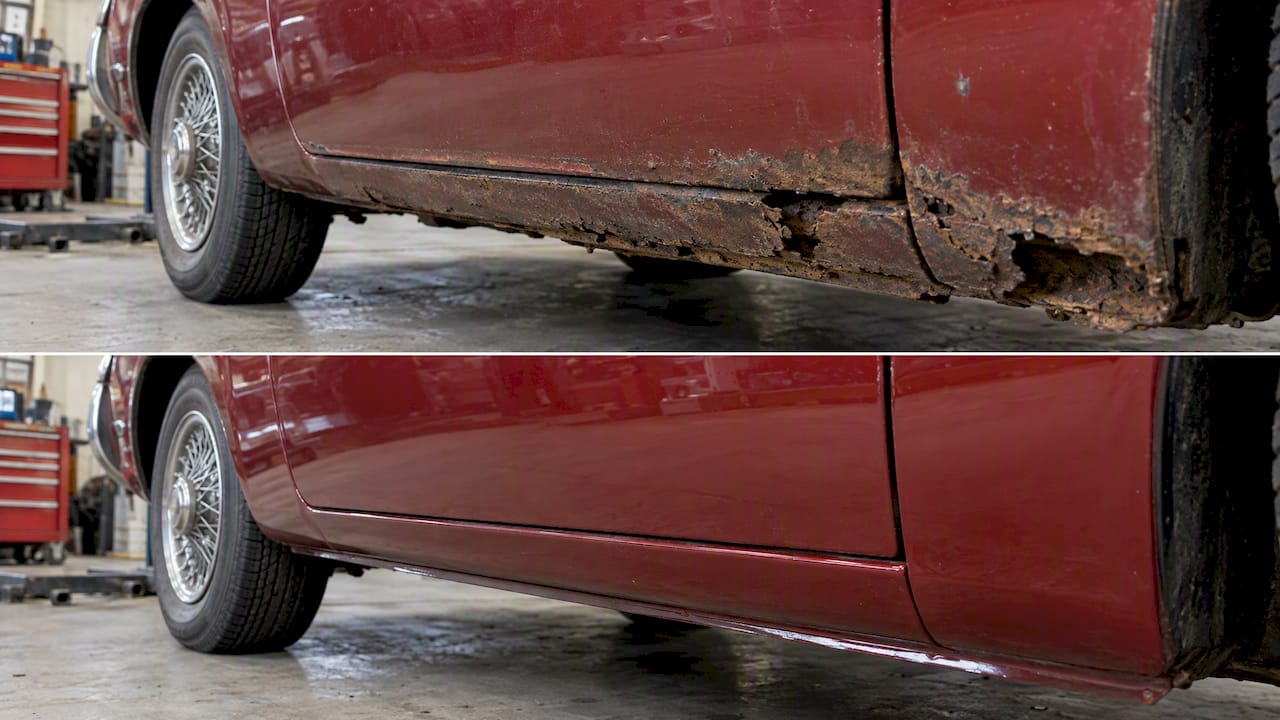
Bodywork on classic cars is primarily metal and rust repair followed by skilled finishing: rust diagnosis, panel fabrication and welding where needed, careful filler or lead work, multi-stage primer and paint, then cavity wax inside the panels. Welding and fabrication belong in a shop that follows OSHA safety rules. For dents that left the paint intact, we repair them onsite and keep the factory finish.
TL;DR:
- Rust reaching seams, folds, spot welds, or thin, perforated steel requires cutting and replacing metal; cosmetic patches over active corrosion usually fail.
- For lead coated metal, OSHA requires stripping paint at least 4 inches from heat or using airline respirators; welding also needs ventilation and protective equipment.
- Keep filler at or below 1/8 inch after sanding; thicker areas, compound curves, and high vibration favor lead solder, which requires ventilation and protective equipment.
- Paintless dent repair suits intact paint, sound metal, and access behind the panel; published rates are $150–500 generally and $150–1,500 for large dents.
- Confirm treated cavities, access points, and wax type; manufacturer guidance calls for one or two coats applied with a 360 degree applicator.
Table of Contents
- What services does a classic car body actually need?
- How do you tell surface rust from rot that needs a new panel?
- How do pros fit and weld panels without warping them?
- When should you use plastic filler and when does lead make sense?
- What does it take to get a show-quality finish?
- Why do inner panels need protection after the paint is done?
- How long will classic car bodywork take, and what drives the cost?
- How do you choose the right shop for classic car bodywork?
- How does insurance handle classic car body repairs?
- How do you protect a classic car after the bodywork is finished?
- Should you preserve originality or restore a classic car completely?
- When is paintless dent repair the right call for a classic car?
- Structure first, finish second
- Get a dent quote for your classic
- FAQ
- Sources
What services does a classic car body actually need?
Most estimates come down to a handful of services, and knowing which one matches your damage makes a quote far easier to read.
- Rust removal and prevention: stops active corrosion and treats the metal so it does not return.
- Panel fabrication or replacement: cuts out rotted steel and builds or fits new metal where the old panel cannot be saved.
- Welding: joins new metal to the car, usually in staged steps to control heat.
- Dent repair: pulls or massages metal back to shape, sometimes with the paint left untouched.
- Plastic bumper repair: fixes cracks and gouges in later-model or replacement bumpers.
- Seam sealing: closes joints so moisture stays out.
- Refinishing: primer, color and clear coat over the finished metal.
Cosmetic dents and structural rot are very different problems. Paintless dent repair and careful paint-preserving work keep your original finish, while welding, fabrication and filler work always end in a repaint of that area.
How do you tell surface rust from rot that needs a new panel?
Rust behaves badly in seams, folds and places where two layers of steel meet. Moisture hides there, so the corrosion keeps working under a finish that looks fine. That is why panel fabrication is required when rust reaches seams, folds or structural spot welds, or when the metal has thinned. Sanding or patching over active rust usually fails.
Run through this checklist before you accept a “quick fix”:
- Look for bubbling paint, brown weeping at seams and stains along lower edges.
- Press a screwdriver handle or probe against suspect metal. Soft, flaking or crunchy steel is past saving.
- Check edges and low corners for pinholes or perforation.
- Inspect the inside of the cavity from the interior, trunk or door jamb for scale and flaking.
Pro Tip: Tap the area with a light hammer handle. A dull, crumbly sound often means rot is hiding under good-looking paint.
If you cover structural rot cosmetically, it returns and often takes your new paint with it. The professional path is simple: cut out the bad metal, fit new steel, weld it, then finish.
How do pros fit and weld panels without warping them?
Good metalwork starts with patience. Shops test-fit panels before any final weld, checking alignment with clekos, straightedges and door gaps, then tack the panel in place. Final welding happens in stages so heat never builds up in one spot and distorts the steel.
Restorers commonly work with:
- MIG welding for general panel work.
- TIG welding for thin metal and precise seams.
- Spot welding to match factory construction.
Safety is not optional on a car that may carry old paint. OSHA requires stripping lead-bearing paint at least 4 inches back from the area where heat is applied, or providing airline respirators when that distance cannot be stripped. Welding also puts hazardous fume and gas in the air, and OSHA’s welding fact sheet points to local exhaust ventilation, good positioning and respirators when ventilation falls short.
A 4-inch stripped buffer around the heat is the OSHA baseline for welding lead-coated metal.
After welding, the metal is ground, planished and primed before any filler goes on. Our write-up on custom car body repair types explains how these repair types differ.
When should you use plastic filler and when does lead make sense?
Plastic filler is for smoothing, not for building. Restorers agree that it should never exceed 1/8 inch after sanding. For thicker fills, compound curves or high-vibration areas, lead body solder lasts longer and flexes better.
Leading is a craft, and the sequence matters:
- Tin the clean metal so the lead bonds.
- Apply the molten lead and work it into shape.
- File it with a vixen file, then sand progressively.
- Clean the area thoroughly before primer.
Because of the toxic materials involved, the process demands strict safety precautions, including proper PPE and ventilation. Our guide to body panel repair options compares these approaches side by side.
Pro Tip: Block-sand over primer between layers. Primer shows high and low spots that bare filler hides, and that is how body lines stay crisp.
What does it take to get a show-quality finish?
A quality finish is mostly preparation. High-end work typically involves multiple coats of high-build primer, wet-sanding and blocking between stages, then several basecoat and clearcoat passes followed by sanding and buffing that can consume dozens of labor hours on its own.
A typical sequence looks like this:
- Epoxy or high-build primer over bare, treated metal.
- Guidecoat to reveal low spots during sanding.
- Block sanding through progressively finer grits, roughly 100, then 400, then 600 as the job demands.
- Basecoat and clearcoat in multiple coats.
- Wet sanding, compounding and buffing to remove texture and bring up depth.
Sanding and buffing alone can run to dozens of labor hours on a high-end restoration.
Full restorations often strip to bare metal and layer epoxy primers and primer/filler systems before paint. Fiberglass bodies need a different approach: avoid liquid chemical stripping and use reinforced fillers and high-build primers suited to composites. Once the paint cures, post-paint care matters too. This spray-and-rinse coating guide covers streak-free finishing methods.
Why do inner panels need protection after the paint is done?
Beautiful outer paint means little if the inside of the panel is bare. Professionals treat inner panels as seriously as the finish, because untreated cavities let corrosion start inside and undo the exterior work.
Cavity wax products spray in a 360° pattern and wick into seams. Manufacturer guidance calls for a rigid 360° applicator and one to two coats in accessible cavities. Seam sealing and inner-panel corrosion protection are standard steps in professional body repair procedures.
Ask your shop to put these on the estimate:
- Which cavities will be treated, such as rockers, door bottoms and rear quarters.
- Where the access points will be.
- What type of wax or sealer they use.
How long will classic car bodywork take, and what drives the cost?
Every project moves through the same phases, and the order tells you where time and money go:
- Assessment and strip-down.
- Metalwork and fabrication.
- Primer and blocking.
- Paint and finishing.
- Reassembly.
Structural rust, hand-fabricated panels and custom colors stretch the timeline the most. In terms of cost, paint prep and fabrication sit at the high end, while paint-preserving dent work sits at the low end. Fix structure and corrosion protection first, then the finish. If the full budget is not there, a phased restoration spreads the cost without sacrificing the order of work.
Before you authorize anything, get a written, itemized estimate, photo documentation of the current condition and a timeline. For smaller dent work, our published ranges start at $100–500 for minor dent repair.
How do you choose the right shop for classic car bodywork?
Experience with classics shows up in the details. Use this checklist:
- A portfolio of classic restorations, not just collision work.
- Demonstrated metal fabrication and paint results you can see.
- Documented safety controls for welding and paint stripping.
- A clear warranty or repair policy.
- A written scope with photographs at each phase.
Good shops also work to documented standards. This overview of quality assurance in repairs explains why written procedures matter.
Mobile paint-preserving service suits minor dents and repairs where the paint is intact. A full shop is required for panel fabrication and structural welding. Questions worth asking any shop: Have you worked on my exact make and model? Can you show panel fabrication examples? How do you prevent heat warpage? What cavity protection do you use?
How does insurance handle classic car body repairs?
Classic cars are usually insured differently than daily drivers, often under an agreed-value or specialty collector policy. That changes the claim process, so start by reading your policy for how value is set, whether you must use an approved shop and what documentation is required.
Document everything before repairs begin. Take clear photos of the damage, your car’s pre-loss condition and any original parts, and keep restoration receipts. Adjusters can undervalue a classic if they treat it like a late-model car, so detailed records make your case.
Then request an itemized estimate from a shop that understands classics, because quotes for fabrication, refinishing and correct materials differ from standard collision pricing. Ask the insurer in writing whether it covers period-correct parts and finishes, and what happens if the repair cost approaches the agreed value.
We help with this part. We offer insurance claim assistance alongside our dent and collision services, working from photographs and written estimates so your adjuster sees what the repair actually involves. If your car needs welding or fabrication, we will say so plainly and tell you what the claim should reflect. Keep every estimate, invoice and photo in one file, because the claim is only as strong as its paperwork.
How do you protect a classic car after the bodywork is finished?
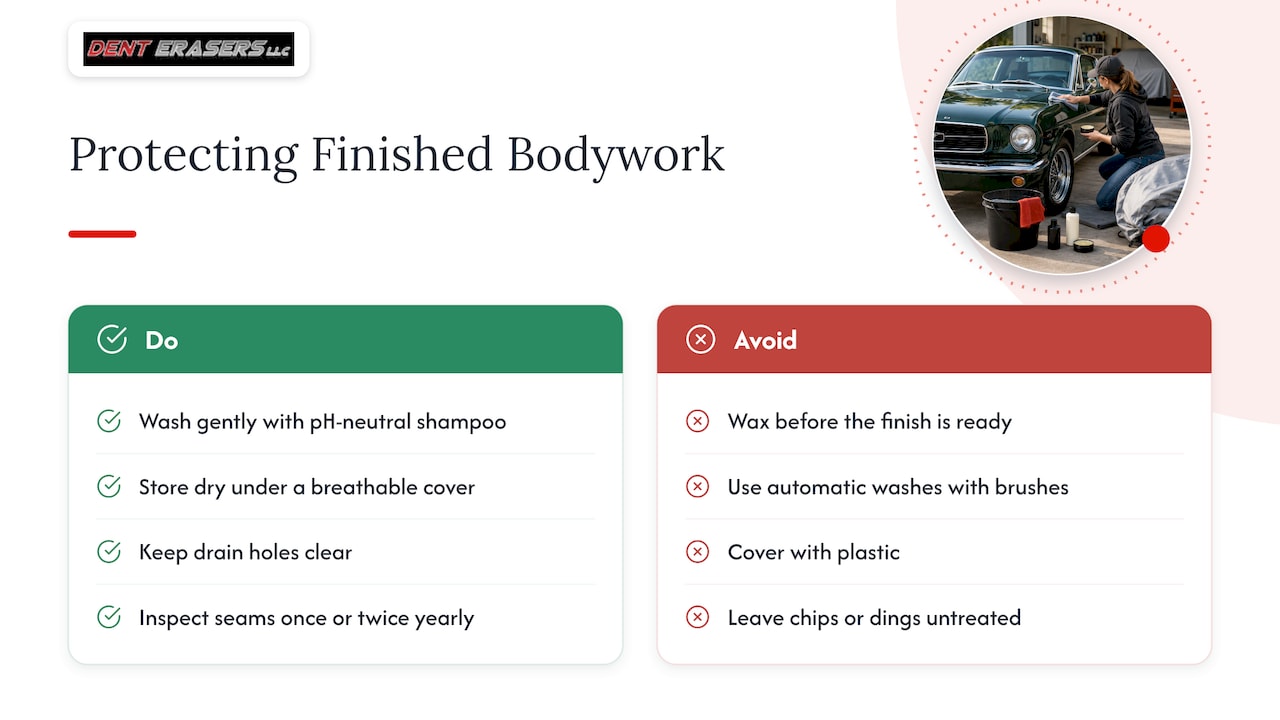
The first weeks matter. Fresh paint continues to cure, so avoid waxing or sealing until your shop says the finish is ready, and wash gently with a pH-neutral shampoo and clean microfiber, never an automatic wash with brushes. Park out of direct sun and away from sap, bird droppings and sprinklers, which can etch soft paint.
Long term, moisture is the enemy. Store the car dry and covered with a breathable cover, never plastic, which traps humidity against the finish. Keep drain holes in doors and rockers clear so water cannot sit inside. Once or twice a year, inspect seams, door bottoms and lower edges for early bubbling, and have cavity wax touched up wherever it was disturbed.
Check for small damage quickly. A door ding from a parking lot or a stone chip left alone becomes a rust starter, and a quick, paint-preserving fix costs far less than a repaint. If you see one, send us photos through our free quote page and we will tell you whether it is a mobile job.
Keep your records, too. Photos of the finished work, receipts for materials and the shop’s warranty all support the car’s value when you insure it, sell it or show it. A well-documented, well-protected classic holds its worth.
Should you preserve originality or restore a classic car completely?
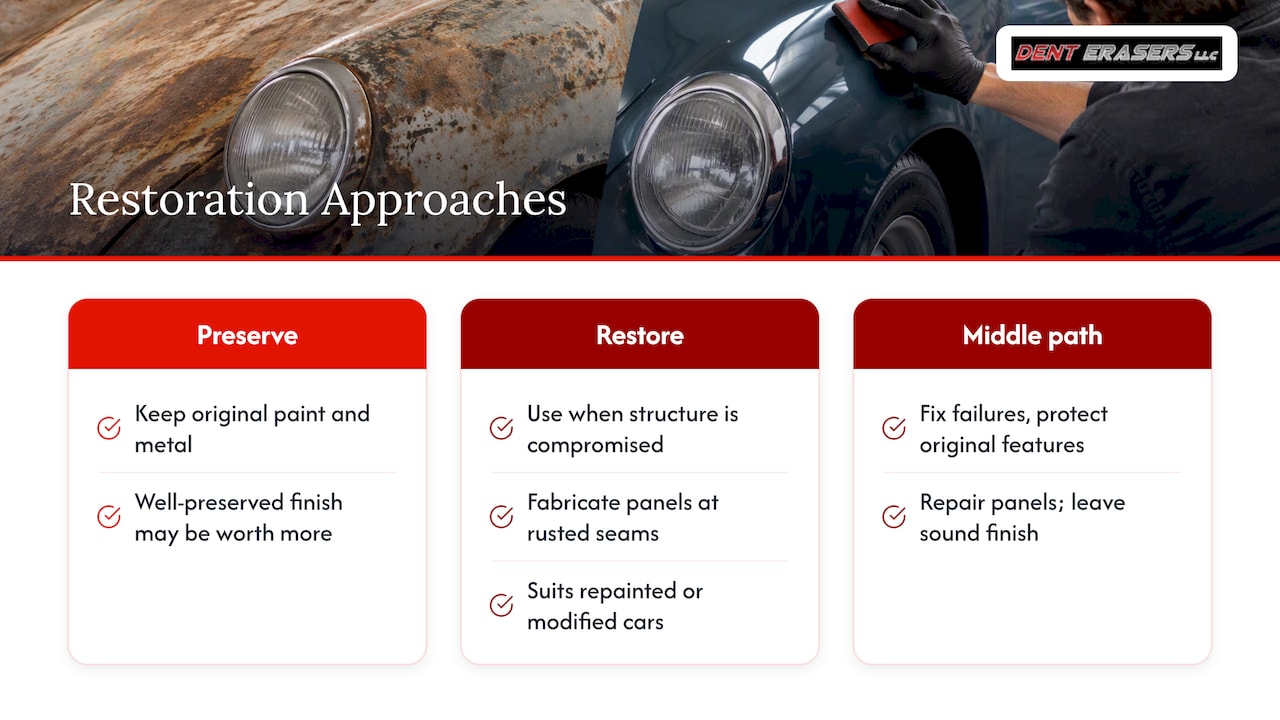
This is the question every owner eventually faces, and the answer depends on the car and your goals. Original paint and metal carry a history that cannot be recreated. On many collector cars, a well-preserved original finish is worth more than a flawless repaint, so repairing a flaw is not the same as replacing the whole surface.
A full restoration makes sense when structure is compromised. If rust has reached seams and folds, panel fabrication is not optional, and preserving rotten metal protects nothing. Restorations also suit cars that were already repainted or modified, where originality is already gone.
A middle path often works best: fix what is failing, protect what is original. Treat rust and cavities, repair damaged panels and leave sound factory finish alone. Repairs that keep original paint, such as paintless work on a dented fender, follow this approach, and our guide to protecting your investment with the right vintage dent repair method walks through it.
Before you commit, ask three questions. What does the car’s market value depend on, original condition or finish quality? Is the structure sound? And will you drive it, show it or hold it? Answer those honestly, and the right amount of restoration becomes clear. Whatever you choose, document the car before and after, so the next owner knows what is original and what was replaced.
When is paintless dent repair the right call for a classic car?
Paintless dent repair works when the paint is intact and the metal has stretched or creased without cracking the finish. We massage the metal back from behind the panel, so your factory paint stays where it is. On a classic, that can protect value that a repaint would erase.
Choose paintless dent repair when:
- The paint is unbroken, with no chips, cracks or flaking at the dent.
- The dent is a ding, door-edge crease or hail-style depression, with access behind the panel.
- The metal is sound underneath, with no rust at the dent.
Choose traditional bodywork when:
- The paint is cracked, or the metal is torn or stretched past recovery.
- Rust is present at or behind the damage.
- The panel needs welding, fabrication or replacement.
- Repainting is already planned.
For sill and lower-panel damage, where corrosion and welding often come into play, our guide to dented sill repair costs and safety explains what to expect.
Our published ranges for paintless work run $150–500 for general paintless dent repair and $150–1,500 for large dents. Not sure which side of the line your dent falls on? Send us photos. We will tell you honestly whether it is a mobile job or one for a body shop.
Structure first, finish second
I have learned that owners often start with the paint color when the real conversation should begin with what is underneath. Fix structural rust and protect the cavities, and every coat of paint that follows lasts. Skip that, and the best finish in the world fails from the inside. A good repair, to me, is the one the next owner never has to redo. We bring that thinking to vintage cars, and where paint can be preserved with mobile dent work, we say so before anyone grinds anything.
Get a dent quote for your classic
If your classic has a dent and the paint is intact, we can often repair it onsite with mobile paintless dent repair, keeping your factory finish. We also handle plastic bumper repair, large and small dent repair, auto body and collision repair, and specialty work on luxury and vintage vehicles. Welding and panel fabrication need a shop, and we will tell you when that is the case. Send photos through our free dent quote page or schedule an inspection today.

FAQ
What is the average cost to restore a classic car?
Cost depends mostly on how much rust, fabrication and paint work the car needs. Structural repair and multi-stage paint are the largest line items, while paint-preserving dent work sits at the low end. Get a written, itemized estimate before authorizing any work.
How much does it cost to have a classic car painted?
A quality classic paint job costs more than a standard repaint because the prep is the bulk of the work. Primer, block sanding, multiple color and clear coats, and sanding and buffing can consume dozens of labor hours. Ask for an estimate that breaks down prep and paint separately.
What is the going rate for body work on a car?
Rates vary by shop, region and the type of work, and classic-car metalwork is priced higher than routine collision repair. Fabrication, welding and refinishing are billed by labor hours, so compare itemized estimates rather than totals. For dent repair, our published range for minor dents is $100–500.
What is the $3000 rule for car repairs?
It is a rough rule of thumb, not a standard, suggesting you reconsider repairs when costs become substantial relative to an older car. For a classic, value is not just market price, so weigh originality, rarity and sentimental value before deciding. Insurance valuation and your goals for the car matter more than any single number.
Sources
- Welding, Cutting or Heating of Metals Coated with Lead-Bearing Paint | Occupational Safety and Health Administration
- Garagejournal